What Agencies Should Look for in a Food CPG Influencer Platform
Agencies buy influencer software on different criteria than brands do. This guide covers the six capabilities that determine whether a platform makes your team more billable or just adds another login.
Trusted by leading CPG brands
















On this page
▼
- Agencies buy influencer software on different criteria than brands do
- Multi-client account structure is the first thing to test
- Creator discovery has to be category-specific, not category-agnostic
- Client approval workflows determine how much of your margin survives
- Attribution is the difference between a renewal and a rebid
- Reporting should be something you can hand a client without rebuilding it
- Competitive intelligence is a service line agencies can bill for
- The platform questions that actually separate vendors
- How Jupiter handles influencer marketing for CPG agencies
An influencer marketing platform for agencies is software that lets a single team run creator campaigns for multiple client brands from one account, with separate assets, budgets, reporting, and attribution for each. That last part is what separates it from a platform built for a brand. A brand needs one campaign to work. An agency needs ten campaigns to work, across ten clients, without ten times the headcount.
Most influencer platforms are sold to brands and then stretched to fit agencies. The stretch shows up in predictable places. Client data bleeds across accounts. Reports need rebuilding in a slide deck before anyone will look at them. Creator discovery returns fashion and fitness creators when your client sells frozen dumplings. None of these are dealbreakers on a demo call. All of them are dealbreakers by month four, when the platform has quietly become a data entry job.
This guide covers what to evaluate, in the order it will matter to your margin.
Agencies buy influencer software on different criteria than brands do
A brand evaluating influencer software is asking whether it will drive sales. An agency is asking a different question: will this make my team faster per client, and will it produce something my client will accept as proof?
Those two questions point at capabilities most platform comparison content ignores. Speed per client comes from reusable assets, account structure, and how much of the campaign setup is automated. Client-acceptable proof comes from attribution and reporting that survives contact with a skeptical brand manager. A platform can be excellent at running a single campaign and still be a poor fit for an agency, because neither of those things is what it was designed for.
There is a second-order issue. Agencies working in food and beverage are competing against brands' in-house teams, who have started buying software directly. The pitch that used to work, which was access to creators the brand could not reach alone, no longer works on its own. The brand can now see the same creators. What an agency sells today is judgment, throughput, and accountability. The platform either supports that case or undermines it.
For a fuller comparison of the buy-versus-hire decision from the brand's side of the table, our breakdown of influencer marketing software versus agency for CPG covers what brands are weighing when they consider bringing this in-house.
Multi-client account structure is the first thing to test
Ask any vendor to show you two client brands side by side in one login. Watch what happens.
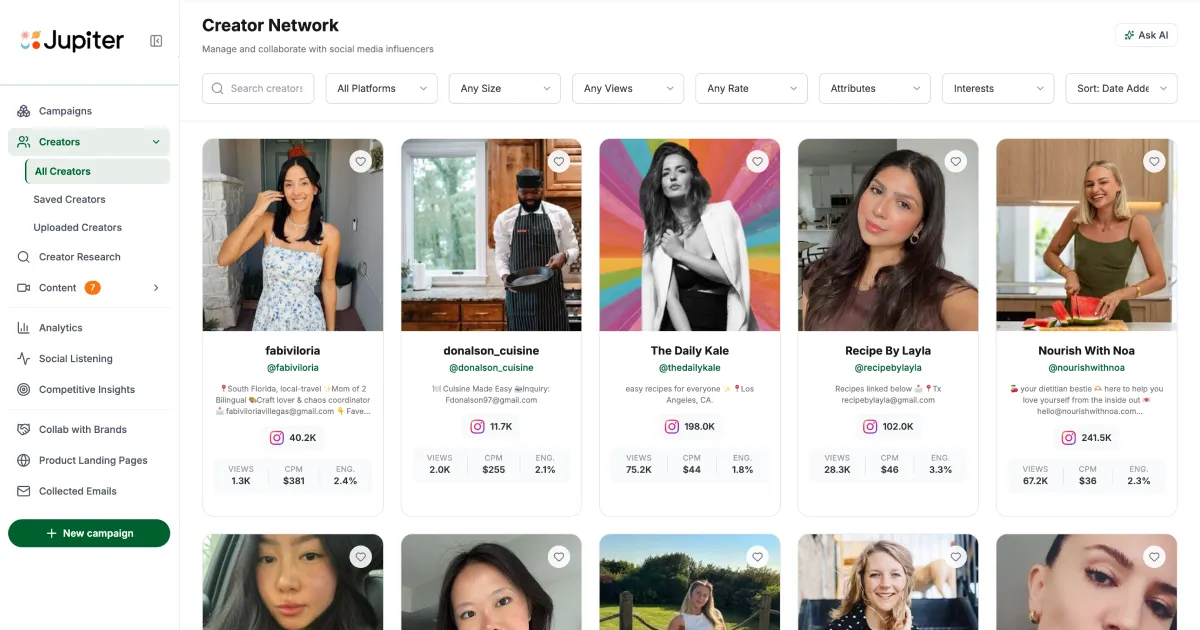
The failure modes are specific. Some platforms give you one account per client, which means separate logins, separate billing, and no cross-client view of your own creator relationships. Some give you a single shared workspace where every client's briefs, products, and creator lists sit in one undifferentiated pile. Neither works. What you need is one account with genuine brand-level separation underneath it, so that a campaign, a product catalogue, a brief library, and an analytics view all belong to a specific client, while your team moves between them without logging out.
Test the filtering, not just the structure. When you open the analytics dashboard, can you scope it to one brand and one product, or does it show you everything at once? When you build a campaign, does the product dropdown show only that client's SKUs? When you look at competitive tracking, is it tracking that client's category and that client's competitors, or a generic industry view?
This sounds like plumbing. It is the difference between onboarding a new client in an afternoon and onboarding one over two weeks.
Creator discovery has to be category-specific, not category-agnostic
Generalist creator databases are large and shallow. They will return a hundred thousand creators for a food query, most of whom have posted about food once, and give you follower count and engagement rate to sort by. For a fashion client that is often enough. For a food and beverage client it is not, because the thing that predicts whether a creator will drive product movement is not audience size. It is whether they actually cook, whether their audience shops the categories your client sells into, and whether they are near the retail footprint that matters.
The signals worth asking about are specific. Does the platform know a creator's content interests beyond a self-declared category tag? Does it estimate what proportion of followers are real? Does it know which brands the creator has worked with before, so you can screen for direct competitors before you send an offer? Does it know where the creator is, relative to the retailers your client is trying to move volume in?
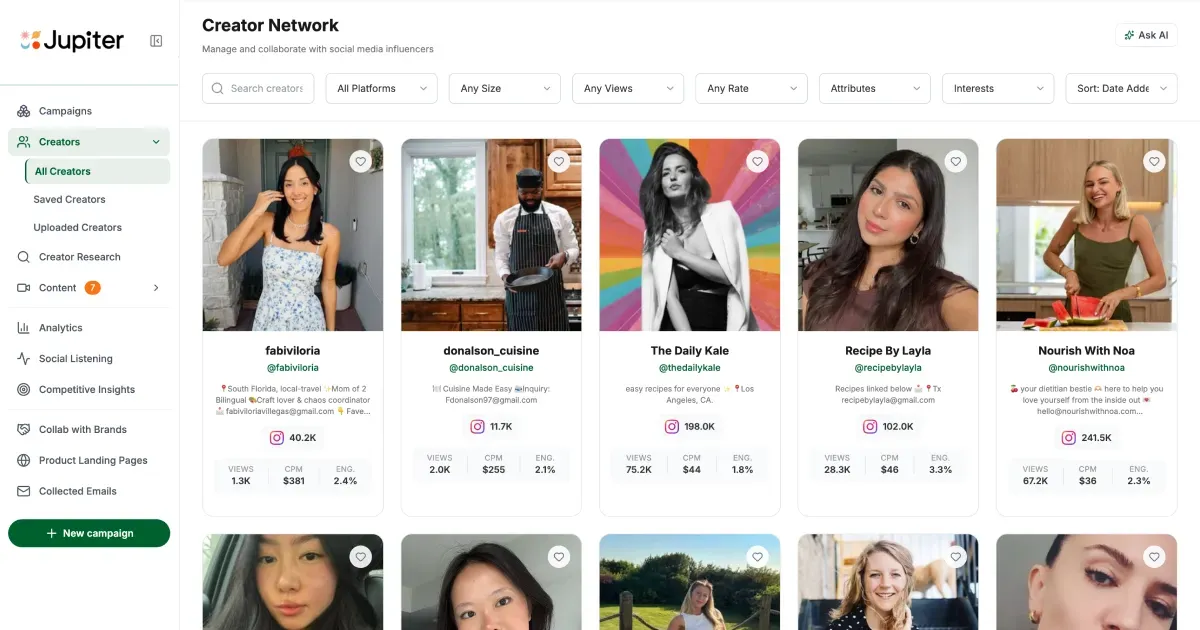
The practical test on a demo is to bring a real brief from a live client and ask the vendor to build the shortlist in front of you. A category-specific network will produce something you would actually send. A generalist one will produce a list you then need to spend two days filtering by hand, which is exactly the labour cost the platform was supposed to remove.

See what a food-specific creator network returns for your client's brief
Bring a live brief to the demo and we will build the shortlist with you, using the same signals your campaign would run on.
Client approval workflows determine how much of your margin survives
The least visible cost in agency creator work is the approval loop. A client wants to see what the creator will make before it gets made. The creator wants to be paid before they invest production time. Historically the agency absorbs the gap, running concepts back and forth over email, holding the risk, and eating the hours.
This is worth evaluating as a first-class platform capability rather than a nice-to-have. What you want is a structure where invited creators submit content concepts up front, priced individually, before anyone commits to production. That gives you something concrete to put in front of a client at the point where the client is still deciding whether to spend, which changes the conversation from a projection to a set of real proposals from real creators.
Jupiter supports this through a campaign type built for exactly that sequence. The team curates an invite list, either from the optimizer's suggestions or by adding creators manually, with an individual offer attached to each creator based on their own rate rather than one flat campaign fee. When the list is ready, invitations go out to those creators and only those creators. Invited creators apply by submitting two to five content or recipe concepts. The team reviews the applications, shortlists creators, and selects one concept per creator, which is the point at which content production actually begins. Concept and content review are required by default. Invitations can continue going out while the campaign runs, so a shortlist that comes back thin can be topped up without restarting anything.
For an agency the value is in the ordering. You walk into a client review holding named creators, their actual costs, and their actual proposed concepts, before the client has released budget. That is a materially different meeting from presenting an estimated reach figure and asking for trust.
Attribution is the difference between a renewal and a rebid
Every agency has had the conversation where a client asks what the creator campaign did, and the honest answer is impressions and engagement. Those are real numbers. They are also the numbers a client's finance team discounts to zero when the contract comes up.
Food and beverage has a specific version of this problem. The purchase does not happen on the brand's website. It happens at a grocery store or in a delivery app, days later, in a transaction the brand does not connect back to the post. Platforms built for direct-to-consumer e-commerce solve attribution with a link and a pixel, which works when the checkout is on a site you control. It does not work when the checkout is a Kroger self-scan lane.
The two paths that do work in this category are worth understanding before you evaluate anything. The first is a comment-triggered mechanic: a viewer comments a keyword on the creator's post, receives an automated direct message with a shoppable link tied to that specific creator and that specific post, and the resulting cart adds attribute back to the individual creator. The second is receipt-verified purchase capture, which picks up the in-store side that the link-based path structurally cannot see. Both are live on Jupiter, which means an agency can report on both the delivery-app and the physical-shelf portion of a campaign rather than reporting on the half that happens to be measurable.
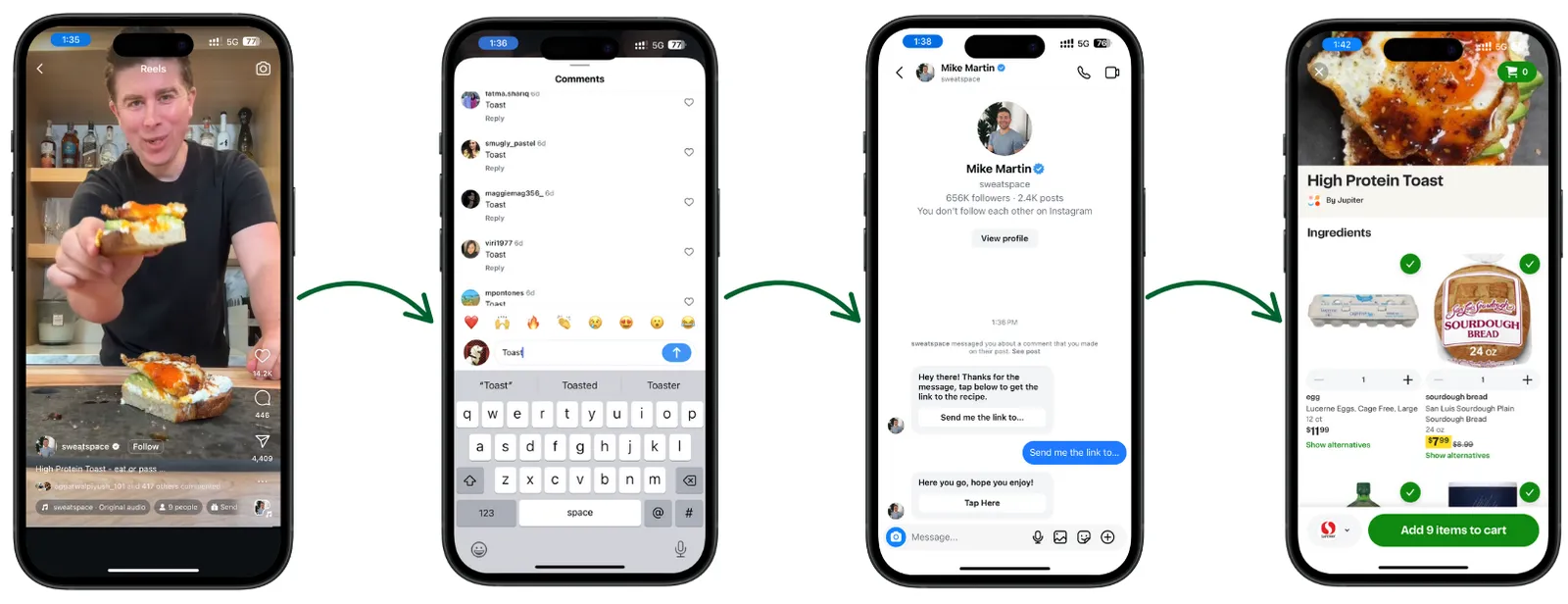
One production example gives a sense of the ceiling. A single Instagram Reel in a food campaign reached 6.5 million views and drove over 1,000 cart adds traceable back to that creator and that post. That is a number an agency can put in a renewal deck without qualification.
Jupiter is one of Instacart's fastest-growing affiliate partners, which is the structural reason this works. For the mechanics of measurement in more depth, our guide to measuring influencer marketing ROI with Instacart attribution goes through it from the brand's perspective.
Still reporting creator campaigns in impressions?
If your clients are asking what the spend actually moved, the answer should not depend on which half of the purchase journey you can see.
Reporting should be something you can hand a client without rebuilding it
Most agency reporting time is spent moving numbers out of a platform and into a deck. The platform's own dashboard is built for the person operating the campaign, not for the person paying for it, so it gets exported, reformatted, annotated, and rebuilt every month.
The evaluation question is whether the platform's reporting view is client-presentable as it stands. That means a few things in practice. Estimated performance and actual performance should sit next to each other, because a client's first question is always whether the campaign did what it was projected to do. Campaign health should be legible at a glance rather than requiring interpretation. Per-creator performance should be visible, because clients ask which creators worked. Cost efficiency should be expressed in terms the client already uses, which in this category means CPM.
Real numbers help calibrate what good looks like. Across Jupiter campaigns, delivered CPM varies widely by category and campaign type. An ambassadorship for a plant-based pasta brand delivered at $1.25. A general awareness campaign for a bone broth brand came in at $1.57. A $950 campaign for a frozen plant-based brand delivered 1.1 million impressions. Those are production figures, and the spread between them is the useful part: it tells you that CPM is a function of campaign structure and category, not a fixed benchmark to be held against.
There is also a distribution question that shapes what you should promise a client. Across 635 posted pieces tracked on the platform, 73.7 percent of delivered impressions came from Instagram and 26.3 percent from TikTok. Agencies pitching TikTok-heavy plans into food and beverage should know that going in.
Jupiter's influencer marketing analytics view is built around estimated versus actual performance, a creator leaderboard ranked on impressions and cost efficiency, and per-campaign health indicators, all filterable to a single client brand.
Competitive intelligence is a service line agencies can bill for
Share of voice tracking is usually sold as a monitoring feature. For an agency it functions as something more useful, which is a reason to be in the client's inbox with an insight the client did not ask for.
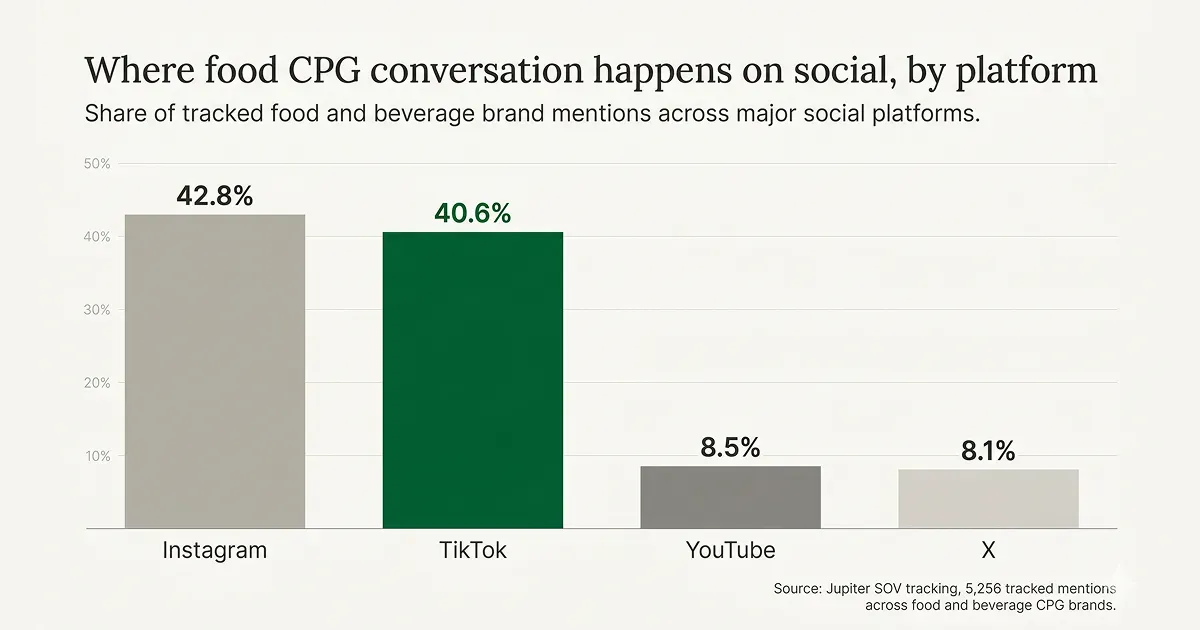
A platform that tracks a client's share of category conversation across Instagram, TikTok, YouTube, and X, alongside their named competitors, gives an agency a recurring deliverable that costs almost nothing to produce and reads as strategic rather than operational. It also gives you the pre-campaign baseline that makes post-campaign results defensible, which is the thing most creator programs never establish and then wish they had.
The practical use is in the pitch as much as the retainer. Walking into a new business meeting already knowing that a prospect is losing share to two specific competitors on TikTok is a different conversation from asking them what their goals are. Jupiter's share of voice tracking sets up per brand and begins populating within a day.
The platform questions that actually separate vendors
By the third demo, every platform sounds similar. These are the questions that produce different answers.
Ask to see two client brands in one login, with analytics scoped to one of them. Ask what happens to the creator relationships you bring with you, whether existing rosters can be imported and enriched, or whether the platform only works with its own network. Ask how a creator gets paid and who carries that administrative load. Ask what the attribution looks like when the purchase happens in a physical store rather than online. Ask whether concepts can be reviewed before production begins, and whether the client can be shown those concepts. Ask what the reporting view looks like when a client is sitting next to you, not when your campaign manager is using it.
Then ask the question most agencies forget: what does month six look like? Almost every platform is pleasant in month one. The ones worth buying are the ones where reusable briefs, copied campaigns, and long-running creator relationships mean the eighth client costs less to run than the third.
How Jupiter handles influencer marketing for CPG agencies
Jupiter is built exclusively for food and beverage CPG, and the agency use case follows from that rather than being retrofitted onto it.
The account structure supports multiple client brands under a single login, with brands, products, brief libraries, campaigns, analytics, and competitive tracking all scoped per client. Your team moves between clients without switching logins, and each client's data stays separated in the places where separation matters.
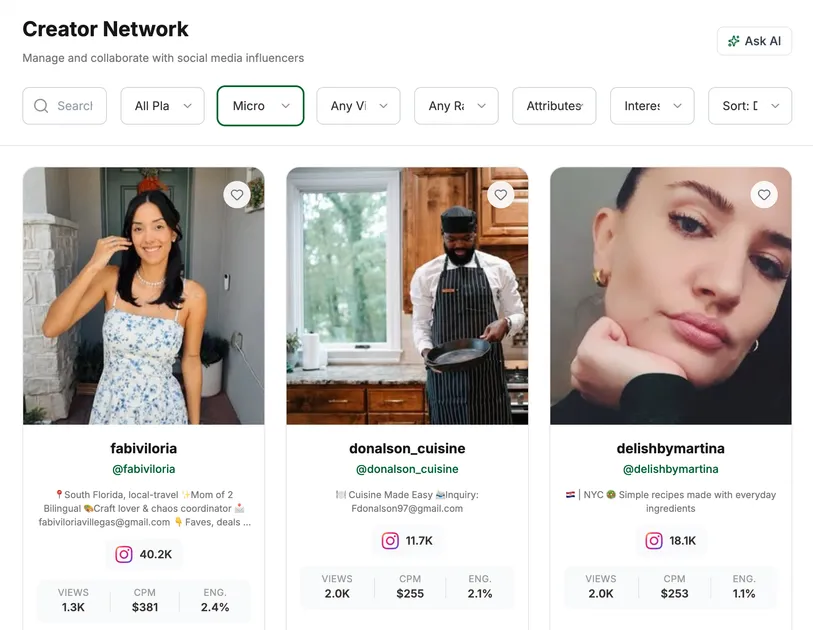
The creator network is over 1,000 vetted food and recipe creators on Instagram and TikTok, chosen for this category rather than filtered down to it. Campaign creator selection runs through a 12-signal optimizer that weighs content interest alignment, posting recency, retailer proximity, brand affinity from past collaborations, audience credibility, and creator and audience attribute matching, then allocates budget across the selected creators to maximize projected impressions. You get a projected impressions and CPM figure before spend, which is the number you can take into a client budget conversation.
If you already have creator relationships, you can bring them in. Uploaded rosters are enriched automatically with follower counts, average views, engagement rate, and an estimated market rate, so your owned relationships sit alongside the network rather than being managed separately.
Special Invitation Campaigns give you the concept-first sequence described above, with per-creator pricing and rolling invitations. Content review is a built-in approval workflow rather than an email thread. Attribution covers both the comment-to-cart delivery path and receipt-verified in-store purchases. Reporting is client-facing by default, with estimated versus actual performance, creator-level results, campaign health, and cost efficiency in one filtered view. For longer client engagements, brand ambassador programs run on a six-month minimum with a two-post monthly cadence and meaningfully reduced per-post rates, graduating high performers out of past campaigns.
There is also a part of this that is not software. Agencies working with Jupiter regularly bring us into the pre-sale stage, where we build campaign proposals that the agency incorporates into its own pitch to a prospective brand partner. That means an agency can go into a new business meeting presenting creator strategy, projected performance, and retail attribution as part of its offer, without having built any of it in-house first. For a growing agency this is often more immediately valuable than any single platform feature, because it affects whether the account is won at all.
The platform has delivered over 800 million impressions across campaigns and is used by 58 or more CPG brands, including through agencies running food and beverage clients on Jupiter. If you want to see how it handles your specific client mix, the fastest path is a demo with a live brief in hand.
Run your food and beverage clients on a platform built for their category
Multi-client accounts, a 1,000+ food creator network, retail and Instacart attribution, and reporting your clients will accept without a rebuild. Used by 58+ CPG brands.
FAQs
Quick answers to common questions.
What is an influencer marketing platform for agencies?▼
It is software that lets one agency team run creator campaigns for multiple client brands from a single account, with separate brand assets, budgets, campaigns, reporting, and attribution for each client. The distinction from a brand-facing platform is account structure and client-ready reporting. An agency needs to move between clients quickly without data bleeding across them, and needs output a client will accept as proof of performance.
How much does an influencer marketing platform cost for an agency?▼
Pricing varies widely by vendor and is usually tied to the number of brands, campaigns, or users on the account. Some platforms charge per client seat, which gets expensive as an agency grows. Jupiter is demo-based rather than self-serve, and pricing is discussed against your actual client count and campaign volume. The more useful comparison is cost per client managed rather than headline subscription price.
Can an agency manage multiple client brands in one Jupiter account?▼
Yes. Multiple client brands sit under one login, with brands, products, brief libraries, campaigns, analytics, and share of voice tracking all scoped per client. Your team switches between clients without separate logins, and analytics can be filtered to a single brand and product.
Can agencies bring their own creators into the platform?▼
Yes. Existing creator rosters can be imported by CSV or added manually, and are then enriched automatically with follower counts, average views, engagement rate, and an estimated market rate. Those creators sit alongside the platform's own network rather than being managed in a separate system, so an agency's owned relationships stay usable.
How do agencies prove influencer campaign results to CPG clients?▼
Impressions and engagement are not sufficient for a client's finance team at renewal. In food and beverage the credible proof is retail attribution: comment-triggered shoppable links that attribute cart adds back to a specific creator and post, and receipt-verified capture for in-store purchases. One production campaign drove over 1,000 attributable cart adds from a single Instagram Reel that reached 6.5 million views.
Can agencies use Jupiter's capabilities in their own new business pitches?▼
Yes. Agencies working with Jupiter often bring us in before a client is signed, and we build campaign proposals the agency then incorporates into its own pitch. That lets an agency present creator strategy, projected performance, and retail attribution as part of its offer without building that capability in-house first. The platform itself is Jupiter-branded rather than white labeled, so this operates as pitch support rather than a rebranded product tier.
More in Platforms & Comparisons
More from Platforms & Comparisons.