Jupiter vs Hummingbirds: Which Creator Platform Fits Your Food CPG Brand
Jupiter and Hummingbirds both connect CPG brands with creators, but they solve different problems. Here's how a food-and-beverage-exclusive Instacart attribution platform compares to a hyperlocal, receipt-verification network.
Trusted by leading CPG brands









On this page
▼
- Quick Verdict
- Platform Overview: Hummingbirds
- Platform Overview: Jupiter
- Feature-by-Feature Comparison
- Creator network composition
- Attribution model
- Campaign management depth
- In-store and local launch support
- AI assistance
- Competitive intelligence
- Category focus
- Two Purchase Journeys, Two Different Attribution Needs
- Who Should Use Hummingbirds
- Who Should Use Jupiter
- Summary
Food and beverage CPG brands evaluating creator marketing platforms increasingly run into two names built around retail: Jupiter and Hummingbirds. Both connect brands with creators. Both drive real purchases, not just impressions. But only one is built exclusively for food and beverage CPG, and for brands in that category, that focus changes the answer on nearly every dimension that matters.
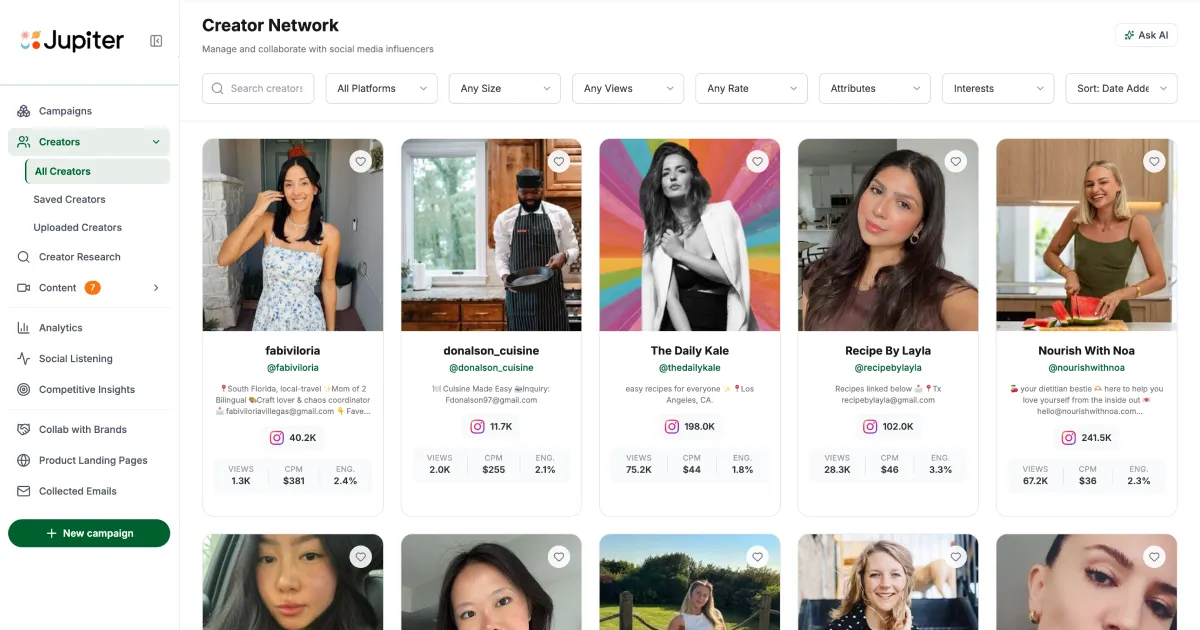
Jupiter is an AI-powered influencer marketing platform built exclusively for food and beverage CPG brands. It runs a 12-signal campaign optimizer, a network of 1,000+ vetted Instagram and TikTok recipe creators, a Creator Deep Research agent that scores creators against a custom brief, comment-triggered Instacart attribution that turns a single post into a shoppable cart, receipt-verified in-store attribution, retailer-proximity targeting for local launches, share of voice tracking, and a dedicated account and operations team behind every brand. Hummingbirds is a community-powered retail platform connecting consumer brands, food included but not exclusively, with a large pool of everyday local creators who drive verified in-store purchases through a receipt-upload Offers system.
Put simply: Jupiter is the food-and-beverage-specialist platform that covers both the digital-to-cart and in-store purchase paths in one place. Hummingbirds is a broad, cross-category local platform focused on the in-store-to-receipt moment. For a food or beverage brand, the specialist wins on fit, depth, and measurement range. Here is the full comparison.
Quick Verdict
Jupiter | Hummingbirds | |
|---|---|---|
Built for | Food and beverage CPG exclusively | Consumer brands broadly (food, beauty, wellness) |
Creator network | 1,000+ vetted recipe creators, Instagram and TikTok | 50,000+ everyday local creators, cross-category |
Core attribution | Instacart cart tracking plus receipt-verified in-store | Receipt-verified in-store purchase only (Offers) |
Optimization engine | 12-signal AI campaign optimizer | Creator-to-offer matching by geography and interest |
Retailer footprint | Instacart-integrated, works across grocery retailers | Costco, Target, Walmart, Whole Foods Market, Sprouts |
Geographic model | National creator targeting by retailer proximity | Hyperlocal, market-by-market (78 U.S. cities) |
Pricing model | Demo-based, campaign and ambassador structures | Annual SaaS subscription, credit-based campaign spend |
AI agent | Creator Deep Research: scored, evidence-backed creator shortlists | 🔻 Not a core product feature |
Dedicated brand support | Dedicated account manager plus ops team | Dedicated customer success and campaign team |
In-store launch support | Retailer-proximity creator targeting in the optimizer | Hyperlocal, market-by-market activations |
Receipt-verified attribution | Live | Live (Offers) |
Analytics | Estimated vs. actual impressions, CPC, CPM, share of voice | Redemption data, velocity signals, UGC performance |
Platform Overview: Hummingbirds
Hummingbirds built its model around a specific insight: national influencers create awareness, but they rarely move product in a specific store. A creator in Chicago with followers scattered nationwide doesn't help a brand that just landed at a Midwest Costco. So Hummingbirds recruits large volumes of local, everyday creators, most with followings between 500 and 3,500, and pays them in perks and gift cards rather than cash fees. Brands pair this creator layer with a product called Offers: a shopper discovers a product through a creator or the Hummingbirds community, buys it at a named retailer such as Target or Whole Foods Market, and uploads a receipt for verification.
Its receipt-verification layer closes the loop between content and a confirmed, individual in-store purchase, something few creator platforms attempt. The company has scaled this across 78 U.S. cities and reports working with more than 280 brands, including Olipop and Goodles. Hummingbirds runs on an annual SaaS subscription with a dedicated campaign team that handles sourcing and logistics.
Where Hummingbirds is not built specifically for food and beverage: its creator network spans food, beauty, and wellness categories, and its content model centers on everyday local advocacy and receipt-based proof rather than recipe content, cooking demonstrations, or grocery e-commerce attribution.
Platform Overview: Jupiter
Jupiter takes the opposite starting point: build everything around one category, food and beverage CPG, and one purchase path, the shift from social discovery to grocery cart. Every part of the platform reflects that focus. The creator network is exclusively food and recipe creators on Instagram and TikTok. The campaign optimizer scores creators on 12 signals including retailer proximity, brand affinity, and content interest overlap, all tuned for grocery and recipe content rather than generic lifestyle posts.
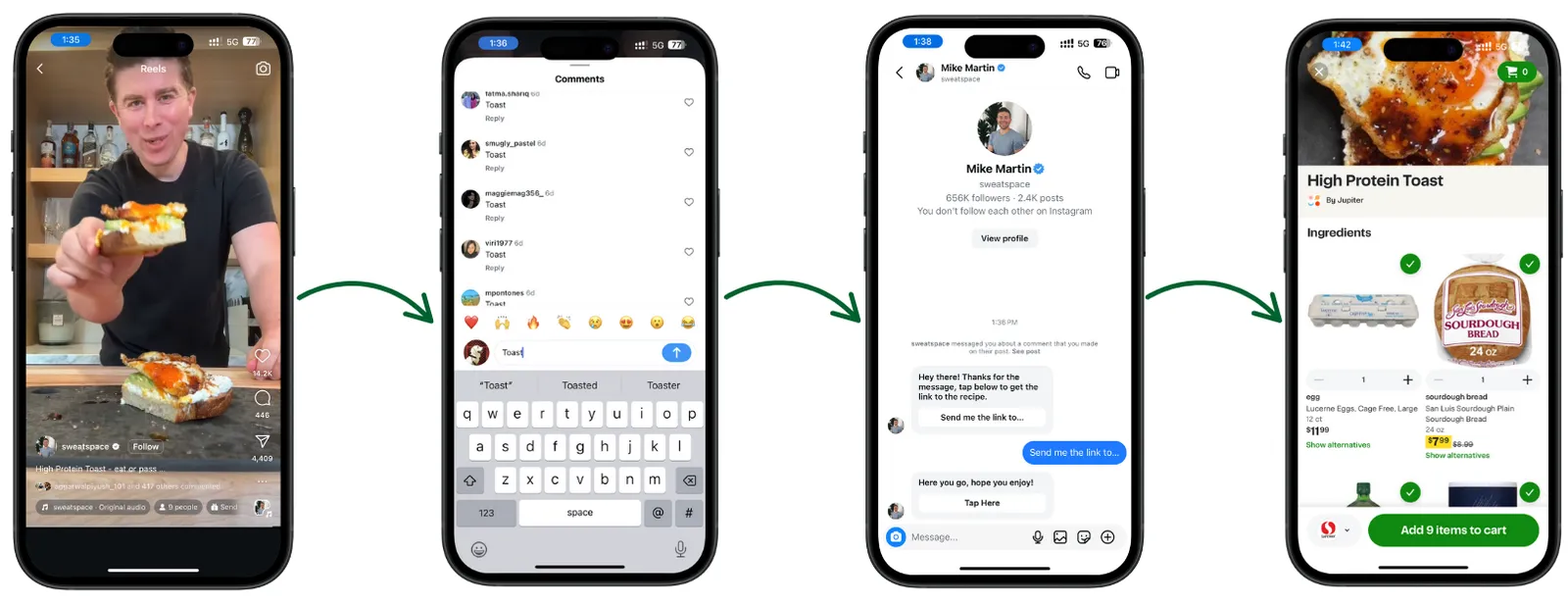
The signature mechanic is Instacart attribution: a viewer comments a keyword on a creator's recipe video, receives an automated DM with a shoppable Instacart link pre-loaded with that recipe's ingredients, and the resulting cart add attributes directly back to the creator and post.
Jupiter also runs a Creator Deep Research agent: a marketer describes their ideal creator in plain language, and the AI turns that into a weighted scoring rubric, evaluates up to 150 creators from Jupiter's vetted food network, and returns a ranked shortlist with a percentage match score and cited evidence behind every creator, from cuisine and content style to audience geography and credibility. It replaces hours of manual profile-by-profile sourcing with systematic, criteria-driven evaluation the marketer stays in control of. Jupiter pairs this with a share of voice tracker that monitors brand mentions against named competitors across Instagram, TikTok, YouTube, and X. Behind the platform, every brand gets a dedicated account manager and operations team supporting campaign strategy and execution, so the self-serve engine is backed by hands-on support rather than left to run alone.
Jupiter's optimizer also directly supports in-store and local go-to-market launches. Its retailer-proximity signal targets creators geographically near the specific stores a brand is launching in, which makes it a strong fit for emerging CPG brands driving trial around new retail placements, not only national Instacart campaigns. Jupiter also verifies purchase behavior on both sides of the aisle: alongside its Instacart cart tracking, receipt-verified attribution measures confirmed in-store purchases, so food brands can attribute both the online cart path and physical retail purchases from one platform. Used by 58+ leading CPG brands including Banza, Pete & Gerry's, and Kettle & Fire, Jupiter has become one of Instacart's fastest-growing affiliate partners.

See the 12-signal optimizer in action
Jupiter scores every creator on retailer proximity, brand affinity, and content fit before a dollar is spent.
Feature-by-Feature Comparison
Creator network composition
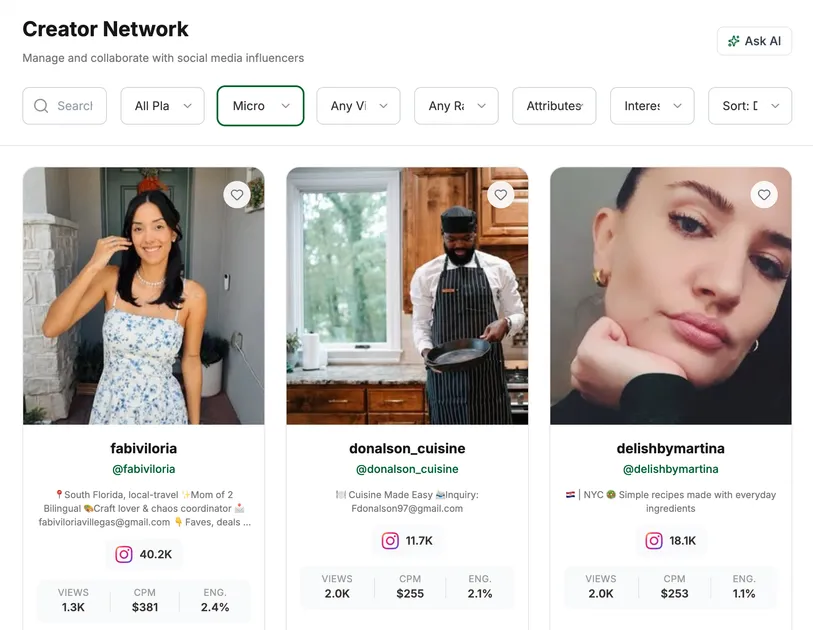
Hummingbirds optimizes for raw volume: 50,000+ everyday creators matched to campaigns mostly by geography. Jupiter optimizes for fit. Its 1,000+ creators are vetted specifically for food and recipe content and scored against a campaign's exact product, cuisine, audience, and retailer targets, not just where they live. For a food brand, 1,000 creators who can actually cook your product on camera and reach the right grocery shopper beat tens of thousands of general local creators who were never screened for recipe fit. Specialization is the point, and it is the harder network to build.
Attribution model
This is where Jupiter's range shows. Hummingbirds measures one moment: a shopper-submitted receipt after an in-store trip, verified through a manual upload step. Jupiter measures both moments. Its automated comment-to-DM-to-cart flow on Instacart captures the digital purchase path with no manual step from the shopper, proven by 6.5 million views from a single Reel generating over 1,000 Instacart cart adds, and its receipt-verified attribution captures confirmed in-store purchases too. A food brand on Jupiter sees the full picture, online cart adds and physical retail purchases, in one platform. On Hummingbirds it sees only the in-store half.
Campaign management depth
Both platforms pair software with hands-on support. Jupiter's campaign optimizer runs a budget-constrained selection and scheduling pipeline automatically, projecting impressions and CPM before spend, and every brand is backed by a dedicated account manager and operations team for strategy and execution. Hummingbirds' campaign build is more fully service-led, with its campaign team handling brief creation, creator sourcing, and Offer setup as part of the annual agreement.
In-store and local launch support
Both platforms support brands launching at specific retailers. Jupiter's optimizer uses a retailer-proximity signal to target creators geographically near a brand's launch stores, making it a strong fit for emerging CPG brands driving local trial around new placements. Hummingbirds approaches the same goal through its hyperlocal, city-by-city creator network. The difference is method, not capability: Jupiter targets proximity within a food-specific recipe creator network, Hummingbirds through volume of everyday local creators.
AI assistance
Jupiter's Creator Deep Research agent is a core part of the platform: a marketer writes a plain-language brief, and the AI scores up to 150 vetted food creators against a custom rubric, returning a ranked shortlist with cited evidence per creator and instant re-weighting without re-running the model. AI-driven creator evaluation at this depth is not a comparable focus of the Hummingbirds product.
Competitive intelligence
Jupiter's share of voice tracking gives food and beverage brands a direct read on category conversation share against named competitors. Hummingbirds does not offer a comparable social listening or share-of-voice product.
Category focus
Hummingbirds spreads across food, beauty, and wellness. That breadth is exactly why it cannot match a food specialist on food. Its creator vetting, content templates, and matching were built to serve three categories at once, so nothing in the platform is tuned specifically to recipe content quality, cuisine authenticity, or grocery retailer fit. Jupiter does one category and does it completely. For a food and beverage brand, a platform built only for you beats a platform where you are one vertical of three.
Running local creator campaigns without recipe-specific targeting?
If your creators aren't scored on food content fit and retailer proximity, you're likely leaving impressions on the table.
Two Purchase Journeys, Two Different Attribution Needs
Hummingbirds was built for the local, in-store discovery journey: a shopper encounters a product through community and place, buys it at a specific nearby retailer, and proves that purchase with a receipt. Jupiter was built for the national, digital-to-Instacart purchase journey: a shopper encounters a recipe on Instagram or TikTok, comments to get a shoppable link, and adds ingredients to an Instacart cart in the same session.
The question is which platform covers the journey your customers actually use. Hummingbirds covers one lane: local, in-store, receipt-verified. Jupiter covers both lanes, the national digital-to-Instacart path and confirmed in-store purchases, inside a platform built only for food and beverage. A brand whose entire strategy is a handful of regional store launches could get by on the single lane. A food or beverage brand that sells through grocery and Instacart, or expects to, needs the platform that measures the whole path. That is Jupiter.
Who Should Use Hummingbirds
Hummingbirds fits brands whose primary need is hyperlocal, market-by-market retail launches across a very high volume of everyday creators, and brands outside the food-and-beverage lane that want one platform spanning food, beauty, and wellness. If you want to hand off campaigns entirely to a managed team and your measurement need stops at in-store receipts, it does that job.
Who Should Use Jupiter
Jupiter fits essentially every food and beverage CPG brand serious about creator marketing. If you sell through grocery retail and Instacart, its recipe creator network, 12-signal optimizer, Creator Deep Research agent, and dual Instacart-plus-receipt attribution map onto exactly how your customers discover and buy. If you are launching locally around new retail placements, its retailer-proximity targeting drives trial store by store. If you want AI-scored shortlists, share of voice tracking against named competitors, ambassador programs like the ones Jupiter runs for La Tourangelle and Banza, and a dedicated account and operations team behind all of it, that is the platform. For a food brand, the only reason to look elsewhere is if food is not actually your category.
Summary
Hummingbirds and Jupiter both measure creator content against real purchase behavior, but they are not in the same class for a food brand. Hummingbirds proves in-store purchases across a broad, cross-category creator network. Jupiter proves purchases on both the Instacart and in-store paths, runs a food-specific creator network and 12-signal optimizer, adds AI-scored creator research and share of voice tracking, supports local store launches through retailer-proximity targeting, and puts a dedicated account and operations team behind every brand, all built exclusively for food and beverage CPG.
For a food or beverage CPG brand, this is not a close call. Jupiter covers more of the purchase journey, is purpose-built for your category rather than serving it as one vertical of three, and gives you the deepest measurement and creator fit available. Whether you are scaling nationally through Instacart or launching store by store, Jupiter is the platform built to win it. Book a demo and see it against your own campaign goals.
See why 58+ CPG brands chose a platform built only for food
Jupiter combines a vetted recipe creator network, a 12-signal optimizer, and direct Instacart attribution in one platform.
FAQs
Quick answers to common questions.
What is the main difference between Jupiter and Hummingbirds?▼
Jupiter is built exclusively for food and beverage CPG brands and attributes creator content directly to Instacart cart adds through a comment-to-DM mechanic. Hummingbirds is a broader consumer platform that verifies in-store purchases through shopper-submitted receipts, using a large network of hyperlocal, everyday creators.
Which platform is more affordable for a CPG brand?▼
Hummingbirds uses an annual SaaS subscription with credit-based campaign spend, structured around managed service. Jupiter is demo-based, with campaign structures including standard paid partnerships, ambassador programs, and product seeding. Exact costs depend on campaign scope for both platforms, so a direct demo comparison is the most reliable way to evaluate spend against expected impressions.
Does Hummingbirds work specifically with food and beverage brands?▼
Hummingbirds works with food CPG brands but is not exclusive to the category. Its creator network and Offers system also serve beauty and wellness brands, which means its creator vetting and content templates are not built specifically around recipe content or grocery retail behavior.
Does Jupiter support in-store retail launches and purchase verification?▼
Yes to both. Jupiter's optimizer targets creators by retailer proximity, so brands can drive local trial around specific launch stores, and Jupiter offers receipt-verified attribution for confirmed in-store purchases alongside its Instacart comment-to-cart tracking. That lets food brands measure both online cart adds and physical retail purchases in one platform. Hummingbirds also offers receipt verification through its Offers product at retailers like Target, Walmart, and Whole Foods Market.
Can a food CPG brand use both platforms at the same time?▼
They can, but most food brands do not need to. Because Jupiter now covers both the Instacart cart path and receipt-verified in-store purchases, plus local launch targeting, it handles the full purchase journey on its own, which is the main reason a brand might otherwise run two tools. For most food and beverage brands, Jupiter as the single food-specific platform is the simpler and more complete choice.
Which platform has a larger creator network?▼
Hummingbirds reports a network of more than 50,000 everyday creators across 78 U.S. cities. Jupiter's network is smaller by design, at 1,000+ creators, but is vetted exclusively for food and recipe content on Instagram and TikTok, prioritizing content fit and retailer proximity over raw creator count.
More in Platforms & Comparisons
More from Platforms & Comparisons.