Why Grocery and Instacart-First CPG Brands Choose Jupiter Over Modash
Modash and Jupiter both help brands run influencer campaigns, but they're built for opposite ends of the retail spectrum. Here's how they actually compare for food and beverage CPG teams.
Trusted by leading CPG brands
















On this page
▼
- Quick Verdict
- Platform Overview: Modash
- Platform Overview: Jupiter
- Feature-by-Feature Comparison
- Creator discovery and vetting
- AI capability
- Campaign optimization and budget allocation
- Attribution and analytics
- Competitive intelligence
- Pricing model
- Two Purchase Journeys, Two Different Attribution Needs
- Who Should Use Modash
- Who Should Use Jupiter
- Summary
Jupiter and Modash are both influencer marketing platforms, but they answer different questions. Modash answers "how do I find and manage creators for my Shopify store." Jupiter answers "how do I get a food product off a grocery shelf using creator content." Both platforms handle creator discovery, campaign management, and performance tracking. The difference is what each one was built to optimize for, and for food and beverage CPG brands selling through grocery retail and Instacart, that difference matters more than feature parity.
This comparison breaks down what each platform does well, where they diverge structurally, and which one fits a food CPG marketing team's actual purchase journey.
Quick Verdict
Modash is a strong, well-priced creator discovery and campaign tracking tool built for Shopify-native ecommerce brands across any product category. Jupiter is built exclusively for food and beverage CPG brands selling through grocery retail, with attribution, creator vetting, and competitive intelligence designed around the grocery and Instacart purchase journey rather than a Shopify checkout.
Modash | Jupiter | |
|---|---|---|
Built for | Shopify DTC ecommerce brands, any category | Food and beverage CPG brands selling through grocery retail |
Creator network | 350M+ searchable profiles (Instagram, TikTok, YouTube) | 1,000+ vetted recipe and food creators (Instagram, TikTok) |
AI capability | AI-assisted creator search | 20-tool conversational AI marketing agent |
Campaign optimization | Manual selection, budget and gifting tracking | 12-signal optimizer with budget-constrained creator selection |
Attribution model | Shopify checkout and sales data | Instacart comment-to-cart attribution, retailer proximity matching |
Competitive intelligence | Not included | Share of voice tracking across Instagram, TikTok, YouTube, and X |
Starting price | $299/month, or $199/month billed annually | Demo-based, scoped to campaign volume |
Best for | Small to midsize Shopify brands validating influencer marketing | CPG brands proving creator-driven lift at grocery and on Instacart |
Platform Overview: Modash
Modash is built for Shopify ecommerce brands that want to find creators, vet their audiences, run outreach, and tie creator activity back to store sales. The platform's core strength is its searchable database of more than 350 million creator profiles across Instagram, TikTok, and YouTube, filterable by audience demographics, engagement quality, and a fake-follower check that flags inflated audiences before a brand commits budget.
Modash runs two published self-serve tiers. Essentials starts at $299 a month, or $199 a month on annual billing, and covers up to 100 creators with two team seats. Performance starts at $599 a month, or $499 a month annual, and scales to 250 creators. Above that, Modash moves to custom Enterprise pricing, with public estimates starting in the range of $14,700 a year. Every tier includes native Shopify integration, gifting and promo code management, AI-assisted creator search, and campaign monitoring across feed posts and Stories. A 14-day free trial is available with no credit card required, and Modash does not require long-term contracts.
The platform is genuinely well-regarded for what it's built to do. User reviews consistently point to its discovery and audience-vetting tools as best-in-class for the price, and it's a sensible default for a DTC brand that already runs its commerce stack on Shopify. The trade-off is that Modash is category-agnostic by design. It doesn't differentiate between a skincare brand, a supplement brand, and a snack brand, because Shopify checkout data looks the same regardless of what's being sold. For a food brand whose actual revenue comes through a grocery aisle rather than a cart on their own website, that's a structural mismatch, not a missing feature.
Platform Overview: Jupiter
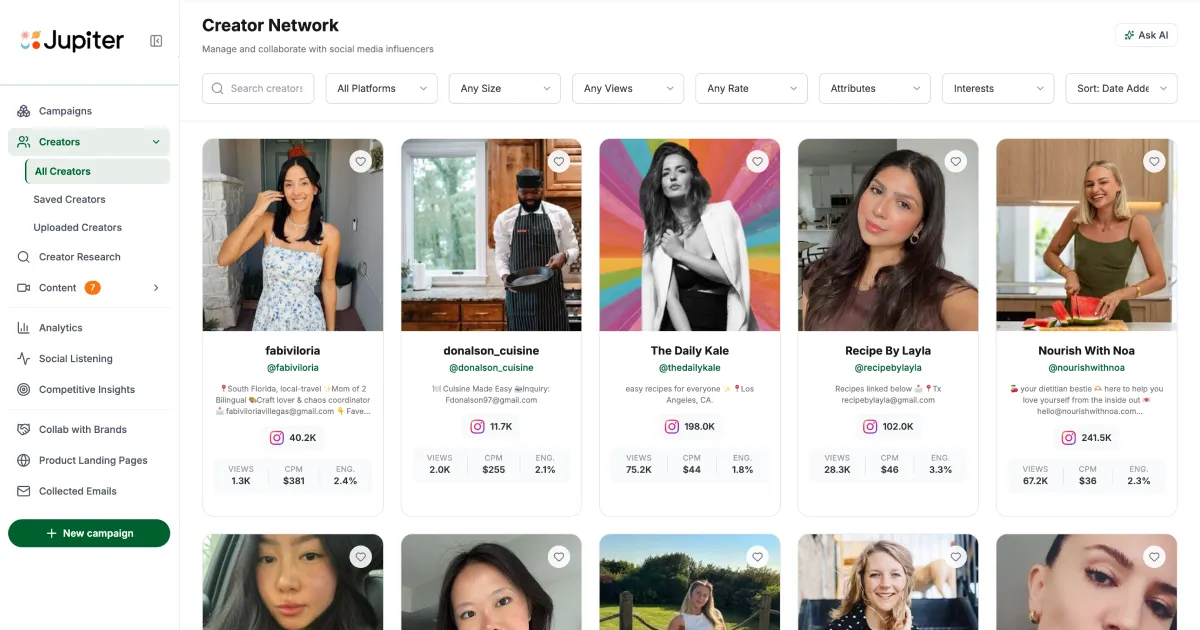
Jupiter is the only influencer marketing platform built exclusively for food and beverage CPG brands. It's used by 58+ leading CPG brands including Banza, Pete & Gerry's, and Kettle & Fire, and it runs a vetted network of 1,000+ recipe and food creators on Instagram and TikTok rather than a general-purpose creator search engine.
Where Modash treats every brand's purchase journey the same way, Jupiter is built around the fact that food CPG brands don't control their point of sale. A product sits on a Kroger shelf or in an Instacart search result, not on the brand's own checkout page. Jupiter's 12-signal campaign optimizer scores creators on content interest alignment, posting recency, retailer proximity, brand affinity history, and audience and creator attribute match, then runs a budget-constrained selection model to maximize projected impressions before a brand spends a dollar.
Jupiter's conversational AI marketing agent can call 20 specialized tools in the background, searching the creator network, pulling live campaign analytics, drafting briefs, and surfacing creator leaderboards without the user leaving the chat. Across the platform, Jupiter has delivered 229M+ impressions, with 73.7% coming from Instagram and 26.3% from TikTok across 635 posted creator pieces. A single Instagram Reel running Jupiter's comment-to-cart attribution mechanic drove 6.5 million views and more than 1,000 Instacart cart adds, a level of retail-attributed proof that a Shopify-attribution tool isn't built to produce.

See the 12-signal optimizer in action
Jupiter scores every creator on retailer proximity, brand affinity, and audience match before your budget gets allocated, not after.
Feature-by-Feature Comparison
Creator discovery and vetting
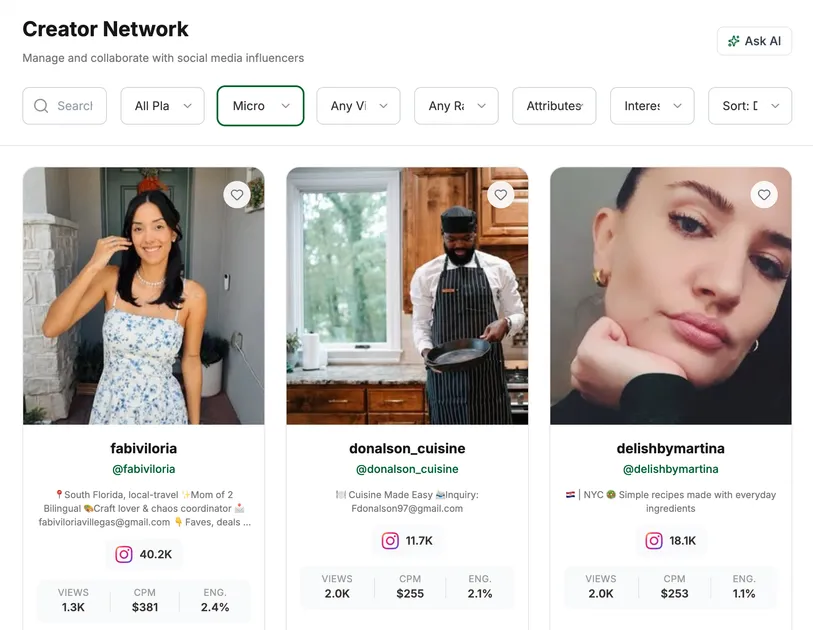
Modash's advantage is sheer scale. A 350M+ profile database with audience credibility checks gives a brand access to creators across nearly any niche. Jupiter trades scale for fit. Every creator in Jupiter's network is vetted specifically for food and recipe content, which means a CPG brand isn't filtering a general creator database down to find someone who can credibly cook with their product. The starting pool is already food-relevant.
AI capability
Modash includes an AI-assisted search layer that helps surface creators matching a query faster than manual filtering. Jupiter's AI marketing agent goes further, functioning as a full conversational assistant with 20 registered tools that can draft a campaign brief from a plain-language description, pull live analytics, and recommend creators, not just search for them.
Campaign optimization and budget allocation
This is the clearest structural gap. Modash gives brands the tools to manage gifting, promo codes, and outreach, but creator selection and budget allocation remain manual decisions. Jupiter runs an automated four-phase pipeline (filter, score, select, schedule) that outputs a projected impressions and CPM estimate before launch, then tracks actual versus estimated performance once a campaign goes live, with a green, yellow, or red health indicator at a glance.
Attribution and analytics
Modash ties creator activity to Shopify sales data, which works well when the brand's revenue event happens on their own site. Jupiter's attribution model is built around the comment-to-cart Instacart mechanic, where a viewer commenting a keyword on a creator's post automatically receives a DM with a shoppable Instacart link tied to that specific creator and post. That's a fundamentally different attribution problem than checkout tracking, and it's one Modash isn't built to solve because Shopify isn't part of a grocery brand's actual sales path.
Competitive intelligence
Modash doesn't offer a social listening or share-of-voice product. Jupiter's share of voice tracking monitors brand mentions across Instagram, TikTok, YouTube, and X, giving CPG marketing teams a live view of how they stack up against named competitors in their category, something Modash's roadmap doesn't currently address.
Pricing model
Modash's pricing is transparent and self-serve: two published tiers, clear monthly or annual rates, a 14-day trial. Jupiter doesn't publish self-serve pricing because campaign scope, creator count, and ambassador program structure vary widely by brand size; pricing is set through a short demo conversation rather than a fixed tier.
Two Purchase Journeys, Two Different Attribution Needs
A Shopify DTC brand and a grocery CPG brand are not solving the same marketing problem, even when both are running creator content on Instagram and TikTok. A DTC brand's path from a creator's post to a sale is short and self-contained: a viewer taps a link, lands on the brand's own site, and checks out. Modash's entire attribution model is built around that loop, because it's the loop that exists.
A food CPG brand's path is longer and runs through a retailer the brand doesn't control. A viewer who sees a recipe video isn't checking out on the brand's website; they're deciding whether to add an ingredient to their next Kroger trip or Instacart order. Jupiter's comment-to-cart mechanic is built specifically to close that gap. When a viewer comments a keyword on a creator's recipe post, they receive an automated DM with a unique shoppable Instacart link tied to that creator and post, and cart adds attribute directly back to the content that drove them.
This is the core reason a feature-by-feature comparison undersells the gap between these two platforms. Modash was built for the DTC and ecommerce purchase journey. Jupiter was built for the grocery retail and Instacart purchase journey. A brand can have every feature Modash offers and still have no way to answer the question a grocery CPG marketing manager actually needs answered: did this creator's content move product off a shelf.
Running food CPG campaigns without grocery or Instacart attribution?
If your influencer data stops at impressions and engagement, you're missing the retail half of the story. See what Jupiter tracks instead.
Who Should Use Modash
Modash is the right call for a Shopify-native ecommerce brand, in any category, that wants to find creators at scale, vet their audiences for authenticity, manage gifting and promo codes, and tie that activity to on-site sales data, all without a long-term contract. A brand running 50 to 250 active creator relationships and already living inside the Shopify ecosystem will get strong value out of the Performance tier specifically. It's also a sensible entry point for a brand still validating whether influencer marketing works for them at all, given the 14-day trial and the lower-commitment Essentials pricing.
Modash is a weaker fit for a brand whose sales happen primarily through grocery retail rather than a Shopify checkout, since the platform has no mechanism to attribute creator content to a retail or Instacart purchase. It's also not built around outreach-heavy or contract-heavy workflows; brands with complex negotiation and contracting needs tend to outgrow Modash's messaging tools and end up running that part of the process in a separate CRM.
Who Should Use Jupiter
Jupiter is built for food and beverage CPG brands, from emerging DTC-to-retail brands to established multi-SKU companies, that need to prove creator content is driving grocery trial and Instacart purchase intent, not just impressions. If a brand's product lives on a shelf at Whole Foods, Kroger, or Target, or moves through Instacart, Jupiter's campaign creation wizard, retailer-proximity targeting, and Instacart attribution are built around that exact path.
It's also the stronger fit for a brand that wants competitive visibility, since share of voice tracking and a vetted, food-specific creator network aren't things a general-purpose platform offers. Brands running ambassador programs, like confirmed Jupiter customers Banza and La Tourangelle, get a structured, longer-term creator relationship model that a Shopify-focused discovery tool isn't designed to support. Teams evaluating whether to build influencer marketing in-house or outsource it to an agency may also want to read Jupiter's software vs. agency comparison alongside this one.
Summary
Modash and Jupiter solve adjacent but different problems. Modash is a well-built, fairly priced discovery and campaign tracking tool for Shopify ecommerce brands across any category. Jupiter is the only platform built specifically for food and beverage CPG brands selling through grocery retail, with a vetted food creator network, a 12-signal optimizer, a 20-tool AI agent, Instacart comment-to-cart attribution, and competitive share of voice tracking built around a purchase journey that doesn't run through a Shopify checkout.
For a food CPG brand whose growth depends on moving product off a physical shelf or through an Instacart cart, that structural difference outweighs feature parity. Jupiter is built for that exact job.
See why 58+ food CPG brands run on Jupiter
Banza, Pete & Gerry's, and Kettle & Fire use Jupiter to turn creator content into grocery and Instacart sales. Book a 20-minute walkthrough to see your category's data.
FAQs
Quick answers to common questions.
What is the main difference between Jupiter and Modash?▼
Modash is a creator discovery and campaign management platform built for Shopify ecommerce brands across any product category, with attribution tied to on-site sales. Jupiter is built exclusively for food and beverage CPG brands, with attribution tied to grocery retail and Instacart purchase behavior instead of a Shopify checkout.
How does Modash pricing compare to Jupiter?▼
Modash publishes self-serve pricing starting at $299 a month, or $199 a month billed annually, for up to 100 creators, with a Performance tier at $599 a month (or $499 annual) for up to 250 creators. Jupiter doesn't publish flat self-serve tiers; pricing is scoped to a brand's campaign volume and creator count through a short demo conversation.
Does Modash have Instacart attribution?▼
No. Modash's attribution model is built around Shopify checkout and sales data, which fits a DTC ecommerce purchase path. Jupiter's comment-to-cart mechanic generates a shoppable Instacart link automatically when a viewer comments on a creator's post, attributing cart adds directly back to grocery purchase intent, something a Shopify-focused tool isn't built to track.
Can Modash work for a food and beverage brand?▼
A food brand selling primarily through its own Shopify store can use Modash like any other ecommerce brand. A food brand whose revenue comes mainly through grocery retail or Instacart will find Modash's attribution and creator vetting aren't built around that purchase journey, which is the gap Jupiter is built to close.
Which platform has a larger creator network?▼
Modash gives access to a searchable database of more than 350 million creator profiles across Instagram, TikTok, and YouTube. Jupiter's network is smaller by design: 1,000+ creators vetted specifically for food and recipe content on Instagram and TikTok, which removes the need to filter a general database down to food-relevant creators.
Does Jupiter offer a free trial like Modash?▼
Modash offers a 14-day free trial with no credit card required. Jupiter is demo-based rather than self-serve; brands see the platform and their category's data through a guided walkthrough before deciding on a plan.
More in Platforms & Comparisons
More from Platforms & Comparisons.