The New Kitchen Aisle: How Retail Media Is Reinventing CPG Commerce
Forget banner ads and keyword bids. The next frontier of CPG retail media lives inside a recipe, right next to the ingredient list — and it routes directly to a retailer checkout.
There's a moment in every cooking journey — the moment a person finds a recipe they love and decides: I'm going to make this tonight. They scan the ingredient list. They tap "Shop Recipe." And then they buy.
That moment is one of the most high-intent purchase signals in CPG. And for years, brands had no reliable way to own it.
Until now.
Retail media for CPG brands is paid placement inside the shopping journey — not on a search results page, but inside the content that drives purchase decisions. The most effective form right now is sponsored ingredient placement: your product appears as the recommended ingredient inside a food creator's recipe, at the moment a consumer decides to cook it and clicks "Shop Recipe." The purchase routes directly to Instacart or a retail partner. Every add-to-cart is tracked back to the specific recipe and creator.
What Retail Media Actually Means on Jupiter
Jupiter's Retail Media is not a banner ad. It's not a keyword bid on a search results page. It's a Sponsored Ingredient placement — your brand's product appearing as the ingredient recommendation inside a food creator's recipe, at the exact moment a consumer is ready to shop.
When a creator's audience clicks "Shop Recipe," they're routed to a retailer checkout — through Instacart, Kroger, and other retail partners — with your product already in the cart.
The tagline says it best: Put your brand in the kitchen.
Why the Placement Moment Matters
Traditional retail media networks — Kroger Precision Marketing, Instacart Ads — intercept shoppers at the search and browse stage. The consumer is already in the store or on the app, actively comparing options. That's valuable, but it's late.
Jupiter starts earlier. It starts at the content creation stage — inside the recipe, before the shopper even opens a retailer app.
The chain looks like this:
Creator publishes recipe → Consumer discovers it → Consumer clicks "Shop Recipe" → Your product is in their cart
It's a direct line from cooking inspiration to purchase. No search query required. No category browse. Just a moment of intent, with your brand already inside it.
The Commerce Signal Layer: How Jupiter Measures What's Working
Jupiter tracks three signals per recipe, per ingredient category, per retailer — rolling 30 days:
Page Views — How many people saw the recipe
Shop Clicks — How many clicked "Shop Recipe" (confirmed purchase intent)
Add-to-Carts — Actual cart additions, synced directly from the retailer via BigQuery
This is not estimated engagement. Add-to-Carts is retailer-verified purchase behavior. The platform uses these signals to calculate an Estimated Monthly GMV for your brand's placement:
That number is surfaced in real time in your Retail Media dashboard — so before you spend a dollar, you can see the projected revenue a placement is expected to drive.
The Ingredient Category Play: Own a Category Across a Creator Network
When a brand uploads their products to Jupiter, the platform's classification engine maps those products to a canonical ingredient taxonomy — olive oil, pasta, canned tomatoes, Greek yogurt, and so on. Every recipe across Jupiter's network of 1,000+ food creators is mapped to the same taxonomy.
The result: a brand can own olive oil as a sponsored ingredient category across every creator who uses olive oil in their recipes. Every recipe. Every creator. One placement.
This is the CPG equivalent of owning a shelf category — except it lives in content, not a store aisle, and it scales across an entire creator network simultaneously.
For brands, the dashboard surfaces exactly:
Which of your products have been matched (and the confidence score of each match)
How many creators are cooking with that ingredient category
The top 5 creators driving the most page views in your category
Monthly add-to-carts and estimated GMV — broken out by ingredient, by retailer
The Personalization Layer: Your Inventory, Your Category, Your Numbers
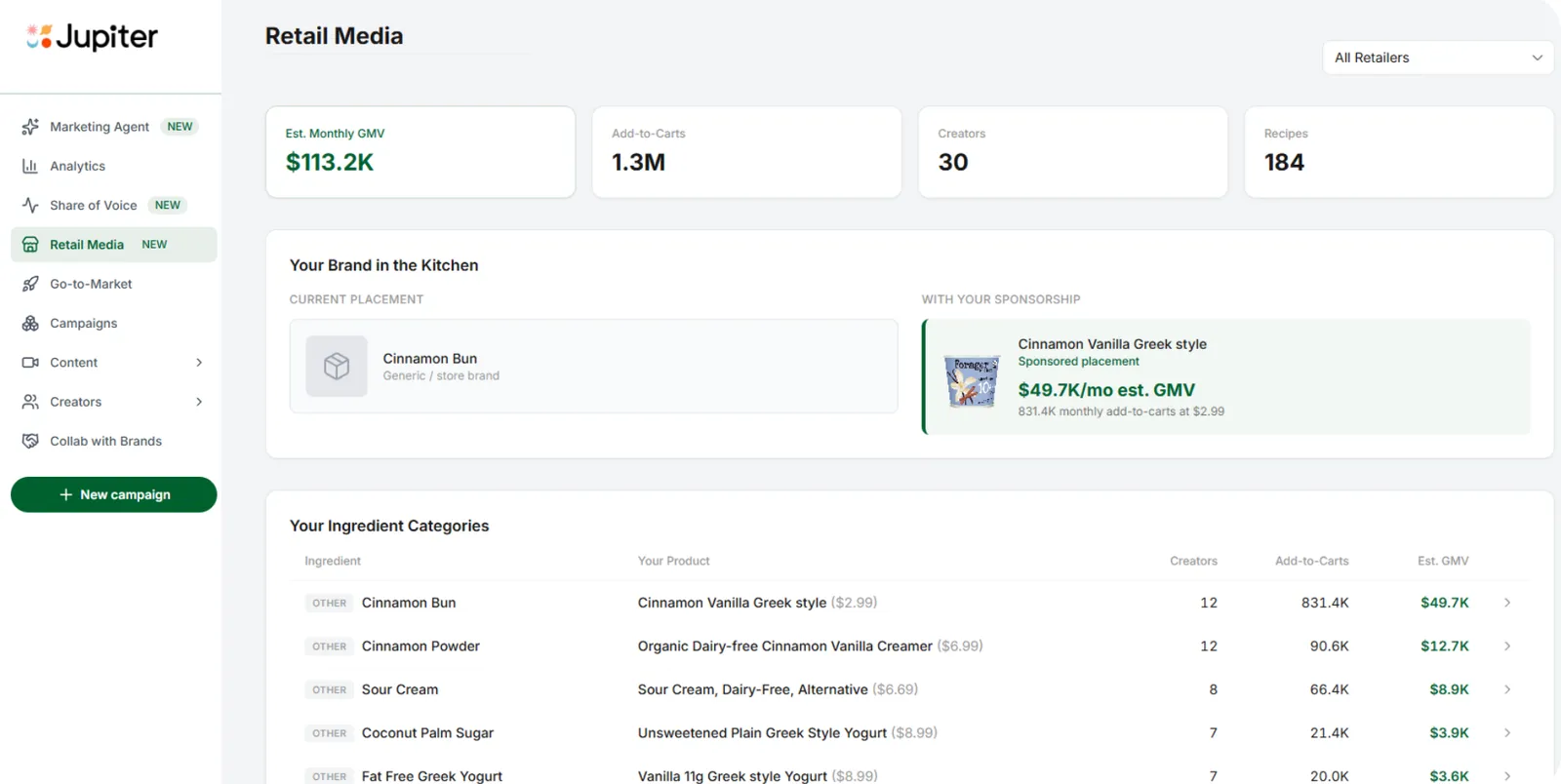
Jupiter Retail Media dashboard showing $113.2K estimated monthly GMV, 1.3M add-to-carts, 30 creators, and 184 recipes, with a "Your Brand in the Kitchen" placement preview and ingredient category breakdown.
This is not generic media inventory. Jupiter's Retail Media dashboard is built around your specific product catalog.
Once a brand uploads their products to Account Assets, every number in the dashboard recalibrates:
GMV estimates reflect your actual product price
Ingredient categories are filtered to only the categories your products map to
Creator inventory shows only the creators driving commerce in your relevant categories
The "before/after" visual preview shows exactly what your product would look like as the sponsored ingredient in a real creator recipe
If you haven't uploaded products yet, you'll see the top 15 ingredient categories network-wide by commerce volume — and a prompt to personalize. The signal is there. The opportunity is visible. It just gets sharper the moment your catalog is in the system.
The Creator Side: A Network Built for Commerce
Every food creator on Jupiter has their own recipe website at [handle].jupiter.recipes. These aren't Instagram posts or TikTok videos that disappear in a feed — they're permanent, shoppable content pages, owned by the creator, indexed by Google, and built to convert.
Creators earn from Jupiter through three streams:
Brand deals — sponsored content campaigns
Retail media commissions — the revenue share from ingredient placements
Programmatic ad revenue
This matters for brands because Jupiter's creators are economically incentivized to drive commerce outcomes, not just impressions. A creator on Jupiter is not just a reach vehicle. They're a commerce channel.
From a brand's perspective, the Creator Commerce Inventory dashboard gives you a sortable, searchable roster of every creator relevant to your ingredient categories — with their recipe count, monthly views, shop clicks, follower counts (Instagram and TikTok broken out), and a direct link to their storefront.
Performance-Tied, Not Reach-Tied
Let's name the structural difference clearly.
Traditional influencer marketing pays for reach — you pay an upfront fee for a post, a story, a video, regardless of what it converts. Retail Media on Jupiter is paid for commerce outcomes — add-to-carts and GMV, not impressions.
This flips the accountability model. The question is no longer "how many people saw the post?" It's "how many people added your product to their cart?"
That's a different kind of spend decision. And it sits differently on a marketing balance sheet.
How to Activate?
Jupiter's team will walk you through pricing, creator selection, and activation for Sponsored Ingredient placements.
Retail media for CPG brands is paid placement inside the shopping journey — not on a search results page, but inside the content that drives purchase decisions. The most effective emerging format is sponsored ingredient placement: a brand's product appears as the recommended ingredient inside a food creator's recipe at the moment a consumer decides to cook it. Clicking "Shop Recipe" routes directly to an Instacart or retail partner cart with the product already added.
What is a sponsored ingredient placement?▼
A sponsored ingredient placement is a paid media format where a CPG brand's product appears as the recommended ingredient in a food creator's recipe. When a consumer views the recipe and clicks "Shop Recipe," the brand's product is added directly to their Instacart or retail cart. Unlike search ads that intercept shoppers at the browse stage, sponsored ingredient placements intercept consumers at the moment of cooking inspiration — before they open a retailer app.
How is retail media different from influencer marketing for CPG brands?▼
Traditional influencer marketing pays creators a fixed fee for a post regardless of conversion — it's a reach-based model. Retail media on Jupiter is performance-tied — brands pay based on commerce outcomes like add-to-carts and estimated GMV, not impressions. Retail media also operates on a creator's permanent shoppable recipe page rather than a social feed post that disappears within 24–48 hours, making the placement work continuously rather than for a single campaign window.
What is estimated GMV in CPG retail media?▼
Estimated GMV in CPG retail media is the projected revenue a sponsored ingredient placement is expected to drive, calculated as: Shop Clicks × estimated checkout conversion rate × product retail price. Jupiter calculates this in real time using retailer-verified add-to-cart data synced directly from retail partners via BigQuery — not modeled or estimated from engagement proxies.
How does shoppable recipe commerce work for food brands?▼
Shoppable recipe commerce works by embedding a "Shop Recipe" button in food creator content. When a consumer clicks it, each ingredient is mapped to a specific brand's product and added to a retailer cart — on Instacart, Kroger, or other retail partners. CPG brands can sponsor specific ingredient categories to ensure their product is the recommended option whenever a consumer shops a recipe containing that ingredient, across an entire creator network simultaneously.
What CPG brands benefit most from sponsored ingredient placements?▼
CPG brands with products that map to core cooking ingredients — oils, sauces, proteins, dairy, grains, condiments, and specialty foods — benefit most from sponsored ingredient placements because they appear across the widest range of recipe content. A brand can own an entire ingredient category across every creator in a network who uses that ingredient, making it the CPG equivalent of owning a shelf category — except it lives in content rather than a store aisle.
How does Jupiter measure sponsored ingredient placement performance?▼
Jupiter tracks three signals per recipe per ingredient category, updated on a rolling 30-day basis: page views (how many consumers saw the recipe), shop clicks (confirmed purchase intent), and add-to-carts (retailer-verified cart additions synced via BigQuery). These three signals feed into an estimated monthly GMV figure visible in the Retail Media dashboard in real time — before a brand commits spend to a placement.