TikTok Shop Strategy for Food Brands: Turn Creator Content into Sales in 2026
TikTok Shop is not a replacement for Instacart attribution for grocery brands. It is a parallel commerce channel with different mechanics, different buyer behavior, and different content requirements. Here is how to run both.
TikTok Shop is a direct-commerce layer inside TikTok where a viewer watches a creator's recipe video, taps a tagged product link, and buys without leaving the app. For grocery food CPG brands it is a parallel channel, not a replacement for Instacart attribution: TikTok Shop converts impulse discovery buyers in-app within seconds, while Instacart attribution captures grocery-planning buyers who purchase hours or days later through Whole Foods, Kroger or Sprouts.
Key takeaways
- TikTok Shop runs on three mechanics: creator affiliate links, live shopping, and Spark Ads amplification from the creator's handle
- It converts impulse buyers in-app; Instacart attribution captures grocery-planning buyers days later. Most grocery brands need both
- Strongest categories: condiments and hot sauces, snacks with unusual texture, functional beverages, specialty pantry items
- Weakest: perishables needing cold chain, regionally constrained distribution, everyday staples with no impulse trigger
- Run Spark Ads only after organic conversion data exists, since amplifying an unproven post scales unproven efficiency
Trusted by leading CPG brands







On this page
▼
- How TikTok Shop Works for Food Brands
- Creator affiliate links
- Live shopping
- Spark Ads amplification
- TikTok Shop vs Instacart Attribution: Two Funnels, Different Jobs
- TikTok Shop targets the impulse discovery buyer
- Instacart attribution targets the grocery-planning buyer
- Brief Structure: TikTok Shop Content vs Instacart Content
- TikTok Shop brief priorities:
- Instacart attribution brief priorities:
- Food Categories Working on TikTok Shop Right Now
- Condiments and hot sauces
- Snack foods and crackers
- Beverages and functional drinks
- Specialty pantry items
- Organic TikTok Shop vs Spark Ads Amplification
- How to Build a Repeatable TikTok Content Engine for Food Brands
- A standing creator roster, not a campaign-by-campaign search
- A brief library organized by content type and objective
- A weekly performance review habit, not a quarterly reporting habit
- A creator-to-brief feedback loop
- How Jupiter Supports Both TikTok and Instacart Attribution
TikTok Shop for food brands is a direct-commerce layer built into TikTok's existing content infrastructure, where a viewer can watch a creator post a recipe, tap a product link embedded in the video, and complete a purchase without leaving the app. For food and beverage CPG brands, TikTok Shop represents a meaningful shift in how TikTok creator content can generate measurable revenue, not just impressions. But it solves a specific problem for a specific buyer profile, and it does not replace the attribution model that grocery brands need for the majority of their retail volume.
This guide covers how TikTok Shop works for food brands, the content brief structure that drives conversion in-app, which food categories are performing on TikTok Shop right now, how to measure TikTok Shop against Instacart attribution, and how to build a repeatable content engine that serves both channels simultaneously.
How TikTok Shop Works for Food Brands
TikTok Shop allows food brands to list products directly on the platform and make them purchasable through creator content, live shopping events, and a dedicated shop tab on the brand's profile. The mechanics operate across three distinct formats.
Creator affiliate links
Brands list products in TikTok Shop and invite creators to join their affiliate program. Creators add a product link to their video, which appears as a tagged product overlay visible during playback. When a viewer taps the overlay and completes a purchase, the creator earns a commission and the brand receives attributed revenue data tied to that specific creator and post. This is the closest analog to a DTC affiliate link within a social platform context, with the critical difference that the purchase happens inside TikTok rather than routing the buyer to an external site.
Live shopping
A creator or brand host runs a live session featuring products available for real-time purchase. Food brands use live shopping for product launches, limited-edition SKUs, and recipe demonstrations where the host cooks with the product on camera and viewers can purchase mid-stream. Live shopping on TikTok follows the pattern established by Asian social commerce platforms and performs most strongly with food products that have visual purchase triggers: textural products, visually distinctive packaging, and products whose preparation creates a satisfying watch.
Spark Ads amplification
Spark Ads allow brands to boost an organic creator post, including one with a TikTok Shop product link embedded, as a paid ad running from the creator's handle. The content retains its organic appearance because it distributes from the creator's account, while the brand controls targeting, budget, and spend. For food brands running TikTok Shop, Spark Ads are the mechanism that takes a high-performing organic post with a strong purchase conversion rate and extends its commercial reach beyond the creator's existing audience.
Major CPG brands including Mars and Coca-Cola have joined TikTok Shop as an additional commerce channel, using it specifically for new flavor launches, limited-edition products, and R&D validation, categories where the speed of TikTok's discovery-to-purchase loop has commercial value that traditional retail timelines do not offer.
TikTok Shop vs Instacart Attribution: Two Funnels, Different Jobs
The most common strategic mistake food brands make with TikTok Shop is treating it as a substitute for Instacart attribution. It is not. The two channels serve different buyer behaviors at different stages of the retail relationship.
TikTok Shop targets the impulse discovery buyer
A consumer watching a creator recipe video at 9pm, sees a hot sauce product link, and taps to purchase before the video ends. That buyer is in discovery mode, not grocery-planning mode. The purchase happens because the product is novel, the creator's endorsement is credible, and the friction to buy is near-zero. TikTok Shop's two-click checkout is specifically engineered for this behavior. The food categories that convert best in TikTok Shop (more on this below) are products that benefit from impulse discovery, visual intrigue, and low deliberation.
Instacart attribution targets the grocery-planning buyer
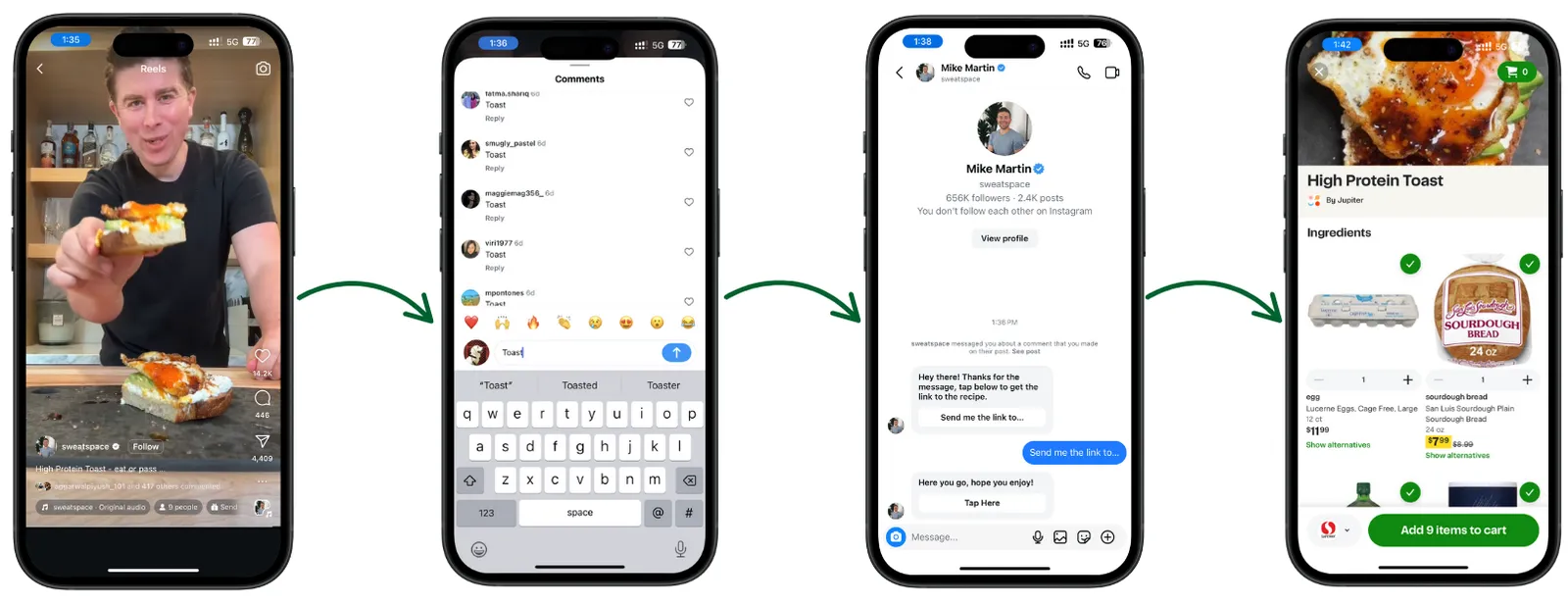
A consumer watches a recipe creator's pasta video on Wednesday evening, saves it to make on Friday, and adds the featured sauce to their Instacart order while building their weekly grocery list. That buyer is in planning mode. The purchase decision happens hours or days after the content exposure, routes through a grocery retail channel the brand already sells through, and requires a different attribution infrastructure: Jupiter's comment-to-cart mechanic, where a viewer comments with a keyword and receives a shoppable Instacart DM with a link pre-loaded with the product.
The important point is that most grocery food brands sell primarily through Whole Foods, Kroger, Sprouts, and Instacart, not through TikTok Shop. TikTok Shop reaches a specific buyer segment and converts them through a specific funnel. It does not capture the majority of the purchase behavior that TikTok creator content drives for brands in grocery retail. Both channels need measurement infrastructure because they are capturing different parts of the same audience's purchase behavior.
TikTok Shop | Instacart Attribution | |
|---|---|---|
Buyer behavior | Impulse discovery, in-app purchase | Grocery planning, retail purchase |
Purchase timing | Immediate (during or just after video) | Delayed (hours to days later) |
Best food categories | Snacks, condiments, beverages, novelty products | Full grocery range, everyday staples |
Attribution mechanism | TikTok Shop affiliate link, in-app checkout | Comment-to-cart DM, Instacart link |
Brand infrastructure needed | TikTok Shop product listing, creator affiliate program | Jupiter comment-to-cart setup, Instacart partnership |
Measurement | TikTok Shop dashboard, creator-attributed revenue | Cart adds per creator and post via Jupiter |
Amplification | Spark Ads from creator handle | Organic + paid amplification on IG or TikTok |
Jupiter manages your TikTok creator campaigns and Instacart attribution in one platform
Brief creation, creator selection, content review, and Instacart comment-to-cart attribution across both Instagram and TikTok, built exclusively for food and beverage CPG brands.
Brief Structure: TikTok Shop Content vs Instacart Content
The creative brief for a TikTok Shop campaign and the brief for an Instacart attribution campaign have different jobs, and they should be written as different documents even when the same creator is executing both.
TikTok Shop brief priorities:
The buy CTA is the center of the brief, not a footnote. The entire creative arc of a TikTok Shop post should build toward a purchase action. Hook the viewer with a visual product moment in the first two seconds, demonstrate the product's distinctive quality in a way that creates want, and close with an explicit tap-to-buy prompt: "linked below" or "shop in my bio." The product link overlay must be integrated into the content's natural flow, not appended awkwardly at the end.
Price and product availability matter more on TikTok Shop than in any other brief format. If the product has a competitive price point relative to grocery retail, state it. If it is a limited-edition SKU available only through TikTok Shop, that exclusivity is the hook. Scarcity and price visibility are conversion accelerants in the in-app purchase environment that do not apply to Instacart content.
Novelty over familiarity. TikTok Shop converts most strongly when the product has a visual surprise, an unusual texture, an unexpected flavor combination, or a preparation moment the viewer has not seen before. A familiar grocery staple does not need to be purchased impulsively. A hot honey with a distinctive pour, a condiment with a viral application, or a new beverage format with visual interest does.
Instacart attribution brief priorities:
The recipe CTA is the center of the brief. Content should orient the viewer around a specific dish, with the product earning its place as an essential ingredient. The retail callout (available at Whole Foods, Kroger, or Instacart) is the commercial call to action, not a buy link. The comment-to-cart keyword prompt should be woven into the content naturally, not delivered as a hard sales line.
Realistic usage over novelty. The viewer adding your product to an Instacart order is planning to cook with it this week. The recipe should be achievable in a home kitchen in under 45 minutes, with ingredients the viewer is likely to already have or to pick up at the same grocery shop. Weekly-use positioning outperforms specialty-occasion positioning for Instacart attribution content.
Food Categories Working on TikTok Shop Right Now
Not every food product converts equally in a TikTok Shop environment. The categories showing the strongest in-app conversion share three characteristics: high visual appeal in short-form video, low purchase deliberation required, and a price point that makes an impulse decision feel low-risk.
Condiments and hot sauces
Distinctive pour, versatile application, dramatic flavor claim. Hot honey, flavored salts, specialty hot sauces, and globally-inspired condiments consistently generate strong TikTok Shop conversion because the product is visually interesting, affordable, and has a low barrier to first purchase. The "I need to try this" response happens in seconds.
Snack foods and crackers
Products with unusual textures, interesting flavor combinations, or health-credential novelty (high-protein, grain-free, unexpected ingredients) perform well on TikTok Shop. The price point is typically low enough that an impulse purchase feels reasonable. The packaging moment matters: a distinctive opening, a textural reveal, or an unexpected crunch on camera is a conversion trigger.
Beverages and functional drinks
Sparkling waters with unusual flavors, functional beverages with wellness claims, and canned drinks with strong visual branding convert well on TikTok Shop. The discovery-to-purchase loop is short because beverages have near-zero preparation friction: you receive it and drink it.
Specialty pantry items
Artisan olive oils, specialty vinegars, globally-sourced sauces, and premium pasta products with a craft story perform well on TikTok Shop when the content demonstrates a use scenario that makes the specialty price point feel justified. A specialty oil drizzled over a dish in a satisfying pour moment converts differently than the same oil photographed on a shelf.
What does not work as well on TikTok Shop: perishables requiring cold chain logistics, products with regional retail distribution constraints, and grocery staples where there is no purchase motivation to buy online rather than at an existing grocery retailer.
Organic TikTok Shop vs Spark Ads Amplification
Every TikTok Shop creator program starts organic. A creator posts with a product link, viewers purchase, and the brand sees conversion data tied to that creator and post. The organic phase tells you which creator-product-content combinations convert at rates worth amplifying.
Spark Ads enter after the organic data exists. When a creator's TikTok Shop post shows a conversion rate that justifies paid amplification, the brand boosts that specific post as a Spark Ad running from the creator's handle. The product link stays embedded in the content. The paid distribution extends the post's reach beyond the creator's existing audience. The content still looks organic because it comes from the creator's profile, not the brand's.
The discipline required in this model is resisting the urge to Spark Ads amplify before organic conversion data exists. Amplifying a post that has not yet proven its conversion rate at organic scale scales unproven conversion efficiency. A post that converts 1 creator purchase per 1,000 organic views will convert at approximately the same rate under paid distribution. Amplifying a post that converts 8 purchases per 1,000 organic views compounds that efficiency at paid scale.
The same principle applies to Instacart attribution: the Instacart influencer marketing campaign playbook covers how to identify the creator and post combinations that drive the highest cart-add rates organically before committing to amplification.
Running TikTok creator content without Instacart attribution? You are measuring half the purchase behavior.
Jupiter tracks Instacart cart adds by creator and post across TikTok and Instagram campaigns, so the grocery purchase behavior your content drives is visible, not invisible.
How to Build a Repeatable TikTok Content Engine for Food Brands
The brands generating consistent TikTok Shop and Instacart revenue from creator content are not running one-off campaigns. They are running a repeatable content engine with a defined structure that produces new content at cadence.
The engine has four repeating components.
A standing creator roster, not a campaign-by-campaign search
The overhead of sourcing, evaluating, and briefing new creators every campaign cycle is the primary reason most brands run fewer campaigns than their budget would support. A standing roster of 6 to 12 food creators who understand your brand, have proven their content converts, and are under ongoing or retainer relationships produces content more efficiently than a new search every 60 days.
A brief library organized by content type and objective
A TikTok Shop brief template, an Instacart attribution brief template, a seasonal brief template, and an evergreen recipe brief template. Each brief covers the objective-specific elements (buy CTA vs recipe CTA, novelty framing vs weekly-use framing) without starting from scratch. Jupiter's brief library in Account Assets stores all brief templates and surfaces them as one-click quick-select cards when a new campaign is created.
A weekly performance review habit, not a quarterly reporting habit
TikTok content has a short performance window. A post that generates strong engagement in the first 48 hours and strong conversion in the first week tells you something worth acting on before the next posting cycle. Jupiter's campaign analytics dashboard tracks estimated vs. actual impressions, Instacart cart-add attribution, and campaign health at the green/yellow/red level across all active campaigns, updated continuously rather than at campaign close.
A creator-to-brief feedback loop
After each campaign cycle, identify which creator-brief-product combinations drove the highest TikTok Shop conversion and the highest Instacart cart-add rates. Feed that learning back into the next brief cycle. The creators and content angles that prove their conversion rate in one cycle should be the anchor of the next cycle, not discarded in a search for novelty.
How Jupiter Supports Both TikTok and Instacart Attribution
Jupiter's TikTok influencer marketing infrastructure manages the full creator campaign workflow on TikTok: creator discovery with TikTok-specific view and engagement data, brief creation with platform-specific content direction, content review before posting, and campaign performance analytics including actual vs. projected impressions and CPM per creator.
Instacart attribution runs through Jupiter's comment-to-cart mechanic: a viewer comments on a creator's TikTok or Instagram post with a specific keyword, receives an automated DM with a unique shoppable Instacart link tied to that creator and post, and any resulting cart add is tracked back to the originating creator and post. Jupiter is one of Instacart's fastest-growing affiliate partners. A single post running this mechanic drove 6.5 million views and more than 1,000 Instacart cart adds for a Jupiter brand partner.
The Jupiter AI Marketing Agent, built on 21 specialized tools, can surface TikTok-specific creator recommendations, compare estimated CPM across creator combinations, identify which creators drove the most Instacart adds relative to their impressions, and draft campaign briefs differentiated by TikTok Shop vs. Instacart objective in plain language, without the user leaving the chat interface.
For brands building their TikTok creator program as part of a broader platform strategy, the TikTok influencer marketing platforms guide for CPG covers platform selection in detail.
TikTok creator campaigns and Instacart attribution in one platform, built for food CPG.
Jupiter manages the full TikTok creator workflow from brief to performance tracking, with Instacart comment-to-cart attribution across every post. Used by 58+ CPG brands including Banza, Pete & Gerry's, and Kettle & Fire.
FAQs
Quick answers to common questions.
Does TikTok Shop work for grocery CPG brands?▼
TikTok Shop works best for food CPG brands in categories with high impulse purchase appeal: condiments, hot sauces, snack foods, specialty beverages, and premium pantry items with strong visual content potential. It is less effective for grocery staples with no purchase motivation to buy online versus in a grocery store, and for perishable products requiring cold chain logistics. For brands that sell primarily through Whole Foods, Kroger, Sprouts, and Instacart, TikTok Shop is an additional commerce channel rather than a primary one. Instacart attribution via Jupiter's comment-to-cart mechanic captures the grocery purchase behavior that TikTok content drives through retail channels, which TikTok Shop analytics will not show.
What is the difference between TikTok Shop and Instacart attribution for a food brand?▼
TikTok Shop captures impulse buyers who purchase directly inside TikTok during or immediately after watching creator content. Instacart attribution captures grocery planning buyers who see creator content on TikTok or Instagram and add the product to their Instacart order hours or days later. TikTok Shop requires in-app product listings and creator affiliate links. Instacart attribution requires a comment-to-cart mechanic that triggers a shoppable Instacart DM when a viewer comments with a specific keyword. Most grocery food brands need both, because the two channels are capturing different buyer segments at different stages of the purchase decision.
What food categories work best on TikTok Shop?▼
The food categories showing the strongest TikTok Shop conversion in 2026 are condiments and hot sauces with strong visual appeal, snack foods with unusual textures or flavor combinations, functional beverages and sparkling waters, and specialty pantry items with a craft or origin story. Products that convert best share three characteristics: high visual appeal in short-form video, a price point that makes an impulse decision feel low-risk, and a clear novelty element that creates a "I need to try this" response rather than a deliberated consideration. Perishables, products with regional distribution constraints, and everyday grocery staples with no impulse trigger perform less well.
How do Spark Ads work for TikTok Shop food content?▼
Spark Ads allow food brands to boost a creator's organic TikTok post, including one with a TikTok Shop product link embedded, as a paid advertisement running from the creator's handle. The content retains its organic appearance because it distributes from the creator's profile rather than the brand's. The brand controls targeting, budget, and duration. The product link in the original post remains active for viewers who tap through. Spark Ads should be applied after organic conversion data exists — amplify posts that have already proven their conversion rate at organic scale, not posts that have generated high views without conversion.
How do you set up TikTok Shop for a food brand?▼
Setting up TikTok Shop for a food brand requires creating a TikTok Shop seller account, listing products with descriptions, images, and pricing, and enrolling in TikTok's creator affiliate program to allow creators to tag your products in their content. The setup process is managed through TikTok's Seller Center. Brands then invite specific creators to their affiliate program or make products available to any creator in TikTok's open affiliate marketplace. Food brands should prioritize recruiting creators who already post about their product category and have existing TikTok Shop affiliate experience rather than starting with creators new to the format.
How should food brands measure TikTok Shop conversion vs Instacart attribution?▼
TikTok Shop conversion is measured through TikTok's native Shop dashboard, which shows attributed revenue, conversion rate, and sales by creator and post. Instacart attribution is measured through Jupiter's comment-to-cart mechanic, which tracks cart adds back to the originating creator and post. The two measurement systems are separate because they capture different purchase channels. A complete picture of TikTok creator content's commercial impact requires both: TikTok Shop conversion data for the in-app buyer segment, and Instacart cart-add data for the grocery retail buyer segment. Brands that measure only one miss a significant portion of the purchase behavior their content drives.
More in Creator Commerce & Retail Media
More from Creator Commerce & Retail Media.