Jupiter vs. Statusphere: Which Platform Is Right for Food CPG Brands?
Statusphere automates micro-influencer product seeding at volume for consumer brands broadly. Jupiter runs full-cycle influencer campaigns with Instacart attribution for food CPG brands specifically. These are different platforms with different jobs. Here is how to choose.
Trusted by leading CPG brands


















On this page
▼
- Quick Verdict
- Platform Overview: Statusphere
- Where Statusphere genuinely excels:
- Platform Overview: Jupiter
- Instacart attribution via comment-to-cart
- 12-signal campaign optimizer with retailer proximity
- Pre-campaign CPM projections
- Feature-by-Feature Comparison
- Creator Network and Targeting
- Campaign Management Model
- Attribution and Performance Measurement
- Content Guarantee vs. Organic Sharing
- Fulfillment Infrastructure
- Two Purchase Journeys, Two Different Attribution Needs
- Who Should Use Statusphere
- Need high-volume, managed-service micro-influencer seeding
- Prioritize guaranteed content volume over attribution depth
- Sell primarily through DTC, Amazon, or brand-owned channels
- Operate across multiple product categories
- Who Should Use Jupiter
- Sell primarily through grocery retail and Instacart
- Need to prove creator spend drives grocery sales
- Want geographic precision in creator selection
- Are building a long-term ambassador program
- Want to own their creator strategy decisions
- Summary: Jupiter or Statusphere for Food CPG Brands
Quick Verdict
Jupiter and Statusphere are both influencer marketing platforms used by consumer packaged goods brands. They are not competing for the same job. Statusphere is a managed-service micro-influencer platform built for automation at volume: the goal is getting product into the hands of hundreds of creators per month with minimal manual overhead, across consumer categories broadly. Jupiter is a self-serve influencer campaign platform built exclusively for food and beverage CPG brands selling through grocery retail: the goal is connecting creator content to grocery purchase behavior through Instacart attribution, retailer proximity targeting, and the campaign analytics that food CPG teams need to justify creator spend to a CFO or retail buyer.
For food CPG brands, the choice between these two platforms comes down to one question: is your campaign goal volume of organic content, or is it attributable grocery trial?
Jupiter | Statusphere | |
|---|---|---|
Built for | Food and beverage CPG exclusively | Consumer brands broadly (including CPG) |
Campaign model | Self-serve with AI optimizer | Managed service with automation engine |
Creator network | 1,000+ vetted food and recipe creators | Large micro-influencer network (300+ data points per creator) |
Instacart attribution | Yes, comment-to-cart mechanic | No |
Retailer proximity targeting | Yes, 12-signal optimizer includes geo match | No dedicated retail geography signal |
CPM projections before spend | Yes, estimated CPM per creator combination | No pre-campaign CPM benchmarking |
Campaign health tracking | Yes, estimated vs. actual impressions | Engagement metrics and estimated media value |
Content review workflow | Yes, pre-post approval queue | Creators held to a brief; review options exist |
Ambassador program | Yes, 6-month minimum, graduation model | Not a primary feature |
Share of voice tracking | Yes, across Instagram, TikTok, YouTube, X | No |
Fulfillment handling | Brand-managed (CSV export/import) | Statusphere handles fulfillment (48-hour shipping) |
Guaranteed content | No — organic sharing always optional | Yes — guaranteed posts are a core product feature |
Starting price | Demo-based | $3,500/month (published on their pricing page) |
Best for | Food CPG brands needing grocery attribution and campaign optimization | Consumer brands needing high-volume organic content with minimal operational overhead |
Platform Overview: Statusphere
Statusphere is a micro-influencer marketing platform that describes itself as built for busy consumer brands, with a primary focus on automating product seeding at scale. Statusphere takes a managed-service approach to creator advertising: rather than offering a self-serve tool, Statusphere handles creator matching and product seeding on behalf of companies, making it a strong option for marketing teams that want results without managing creator workflows directly.
The platform's most distinctive operational feature is StevieOps, its automation engine that handles creator discovery, product shipment, delivery confirmation, posting notifications, and content tracking, making high-volume sampling campaigns operationally manageable without a large internal team. Statusphere evaluates over 300 creator data points including audience demographics, engagement rates, and content themes to match brands with creators, and the platform can enable food and beverage brands to collaborate with hundreds of creators each month on an ongoing basis.
Statusphere is trusted by 400+ companies and its platform has analyzed over 34,000 micro-influencer posts across nearly 1,000 campaigns. The platform has expanded its feature set to include TikTok Shop Collabs, a one-click solution that enables brands to filter for creators approved for TikTok Shop and requires a TikTok Shop product link within their posts, guaranteeing that every collaboration results in a shoppable social post.
Statusphere's pricing starts at $3,500 per month, with customized pricing based on each brand's specific needs.
Where Statusphere genuinely excels:
Automation at scale is Statusphere's defining strength. For a consumer brand that needs to seed 200 creators per quarter without a dedicated influencer marketing manager, Statusphere removes the operational overhead that makes high-volume seeding programs impractical for small teams. The fulfillment infrastructure (48-hour shipping, automated creator communications, delivery confirmation) handles the logistics layer that most platforms leave entirely to the brand.
Guaranteed content is a meaningful differentiator for brands whose primary campaign goal is UGC volume. Statusphere emphasizes that content generated is not just abundant but marketing-ready, with creators held to a creative brief to ensure you get what you are looking for. For a brand building a content library for paid social repurposing, the guarantee model has real value.
Broad consumer brand applicability means Statusphere's creator network and targeting infrastructure works across product categories beyond food, which suits holding company marketing teams or diversified CPG brands managing multiple categories from a single platform.
Platform Overview: Jupiter
Jupiter is the only influencer marketing platform built exclusively for food and beverage CPG brands selling through US grocery retail. The platform's infrastructure is built around a specific commercial problem that Statusphere and most other influencer platforms were not designed to solve: the grocery attribution gap.
CPG food brands sell through Kroger, Whole Foods, Sprouts, and Instacart. They do not own their checkout. A consumer who sees a creator post on Tuesday and buys the product at a grocery store on Thursday never clicks a link that the brand controls. Standard influencer analytics, including Statusphere's engagement metrics and estimated media value outputs, cannot capture that commercial outcome. Jupiter was built to capture it.
The platform's three structural differentiators for food CPG brands are:
Instacart attribution via comment-to-cart
When a viewer comments on a creator's post with a specific keyword, they automatically receive a DM with a unique shoppable Instacart link tied to that creator and post. Cart adds are tracked back to the originating creator and campaign. Jupiter is one of Instacart's fastest-growing affiliate partners. A single post running this mechanic drove 6.5 million views and more than 1,000 Instacart cart adds for a Jupiter brand partner.
12-signal campaign optimizer with retailer proximity
Jupiter's optimizer selects the creator combination that maximizes projected impressions within budget, scoring every eligible creator across content interest alignment, posting recency, retailer proximity (geographic concentration near your target retail locations), brand affinity from past collaboration history, creator attribute match, audience attribute match, engagement quality, view consistency, audience credibility, audience demographics, hashtag relevance, and geographic distribution. The retailer proximity signal alone is something Statusphere's broad-category matching does not provide.
Pre-campaign CPM projections
Before any creator is contacted or any dollar is spent, Jupiter shows the projected impressions and CPM for each creator combination, based on real creator performance data from the network. Brands know their expected delivery benchmark before launching. Statusphere's model does not include pre-campaign CPM benchmarking.
Beyond campaign management, Jupiter includes share of voice tracking across Instagram, TikTok, YouTube, and X, a full content review workflow with pre-post approval, an ambassador program with a 6-month minimum and a creator graduation model, brand collaboration campaigns for two brands co-funding shared creator content, and a 20-tool AI Marketing Agent that surfaces campaign data, creator recommendations, and competitive intelligence in plain language.
Jupiter is used by 58+ US food and beverage CPG brands including Banza, Pete & Gerry's, Nellie's Free Range Eggs, Kettle & Fire, La Tourangelle, Dr. Praeger's, and Bonafide Provisions.

Jupiter was built for the grocery purchase journey. Statusphere was not.
Instacart attribution, retailer proximity targeting, CPM projections before spend, and a 12-signal optimizer — built exclusively for food and beverage CPG brands selling through grocery retail.
Feature-by-Feature Comparison
Creator Network and Targeting
Statusphere's network is broad and multi-category, with 300+ targeting parameters covering audience demographics, engagement rates, content themes, lifestyle attributes, and (after the 2024 TikTok Shop Collabs launch) TikTok Shop affiliate status. For a consumer brand managing creator programs across several product categories, the breadth of the network has value.
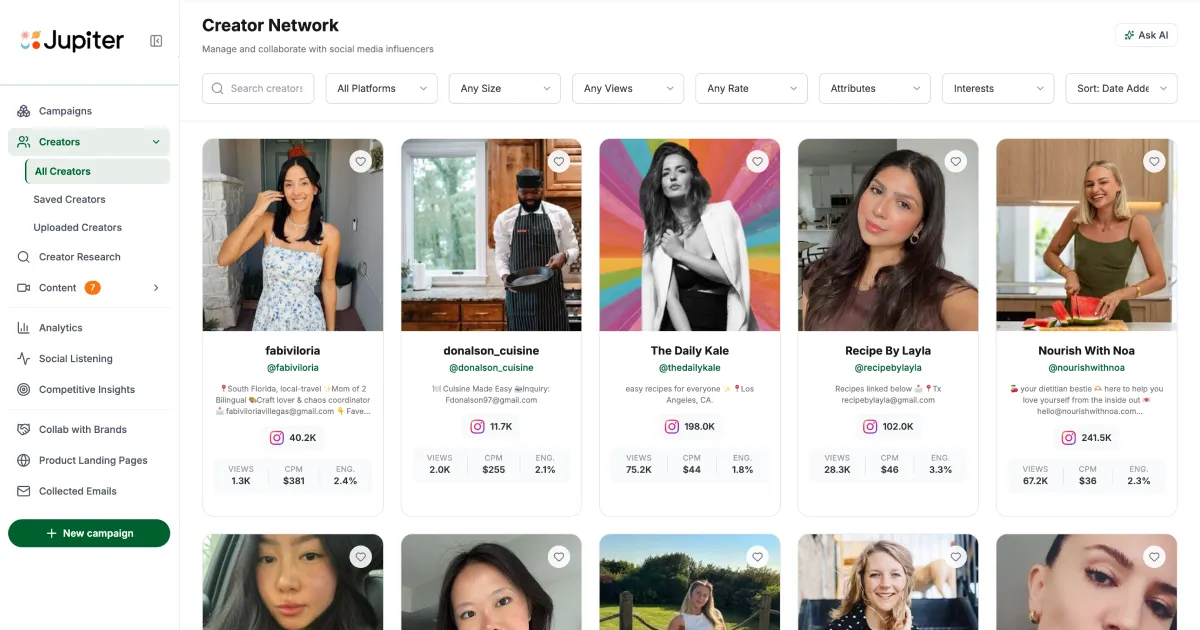
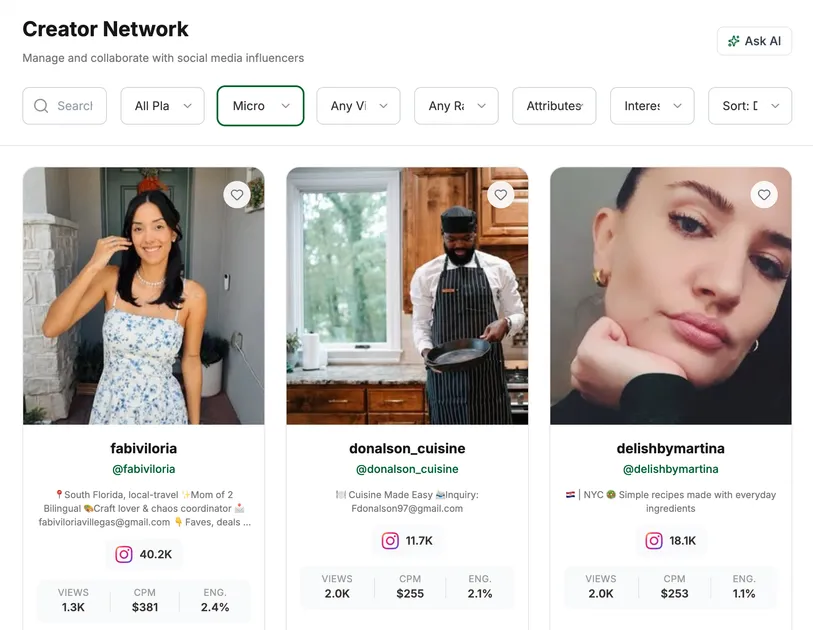
Jupiter's creator network is intentionally narrower: 1,000+ vetted food and recipe creators on Instagram and TikTok, with food-specific data surfaced at the creator profile level: average views per post, platform-specific CPM, content interest tags, credibility score, and retailer proximity data. For a food CPG brand whose campaign success depends on reaching consumers who cook from recipes and shop at specific grocery retailers, depth of food-specific creator data outperforms breadth of multi-category targeting parameters.
Campaign Management Model
Statusphere operates as a managed service. Statusphere's team handles creator matching, product fulfillment, and campaign logistics on the brand's behalf. This reduces internal operational overhead significantly and is genuinely valuable for marketing teams with limited bandwidth.
Jupiter is self-serve, with the campaign creation wizard, creator selection, brief building, and optimization handled by the brand's team with AI assistance from the 20-tool Marketing Agent. The self-serve model gives brands full control over creator selection decisions, brief content, and campaign configuration. For food CPG teams that want to own their creator relationships and strategic decisions rather than delegate them to a platform's matching algorithm, the self-serve model is preferable.
Attribution and Performance Measurement
This is the most significant functional difference between the two platforms for food CPG brands.
Statusphere has no Instacart attribution, no CPM benchmarking before spend, and limited support for the commerce attribution layer that connects creator content to grocery sales. Engagement metrics and estimated media value are the primary outputs. For a brand selling through grocery retail, estimated media value is a proxy metric that cannot close the loop between a creator post and a grocery purchase.
Jupiter's attribution model tracks Instacart cart adds by creator and post, compares estimated vs. actual impressions and CPM throughout the campaign (not just at close), flags campaign health at the green/yellow/red level based on delivery against projections, and surfaces creator cost efficiency as impressions per dollar across every campaign. These outputs are what a CPG marketing manager needs to justify creator spend to their CFO and to a retail buyer who is looking at velocity data.
Content Guarantee vs. Organic Sharing
Statusphere's guaranteed content model is a genuine product differentiator. Brands that need a defined quantity of posts for a campaign calendar, for paid social repurposing, or for a UGC content library benefit from knowing exactly how many pieces of content the campaign will produce.
Jupiter's approach to product seeding (through the Creator Sampling campaign type and Brand Gift Boxes) is built on optional organic sharing, where posting is never required and the Share Rate metric measures genuine affinity rather than contracted output. The content that results is more authentic by definition, because it was never obligated. For brands whose primary goal is driving grocery trial through trusted content rather than populating a content library, the optional sharing model produces higher-quality signals even if it produces fewer guaranteed posts.
Fulfillment Infrastructure
Statusphere handles product fulfillment directly, including shipping to creators, delivery confirmation, and logistics for products with complex shipping requirements (temperature-sensitive, fragile, or oversized). This is a meaningful operational advantage for food brands where shipping product to 200 creators per quarter is a genuine logistics challenge.
Jupiter's Brand Gift Boxes campaign type handles the digital workflow (invitation, application, selection dashboard, CSV export for brand-managed fulfillment, tracking number import, creator communications) while leaving physical fulfillment to the brand or their 3PL. For brands with existing fulfillment infrastructure, this is manageable. For brands without dedicated shipping operations, Statusphere's fulfillment handling removes a real overhead that Jupiter does not.
Two Purchase Journeys, Two Different Attribution Needs
Statusphere was built for the DTC and broad consumer brand purchase journey. A consumer brand that sells through a Shopify store, an Amazon storefront, or a brand-owned channel benefits from a platform that maximizes content volume and estimated media value, because the consumer who sees the content and wants to buy can do so immediately through a trackable link.
Jupiter was built for the grocery retail purchase journey. A consumer who sees a food CPG brand's creator content on Instagram or TikTok is not going to click through to a brand website. They are going to add it to their Instacart order, look for it at Whole Foods on their next grocery trip, or recognize it on a Kroger shelf because a creator made it feel familiar. The attribution chain for that purchase does not run through a link click. It runs through Instacart cart adds, retail velocity data, and share-of-voice movement. Jupiter's infrastructure is built to track that chain. Statusphere's is not.
This is not a criticism of Statusphere. It is a description of two platforms built for genuinely different commercial contexts. The mistake food CPG brands make is applying the wrong platform to their distribution model, because the wrong platform measures the wrong outcomes and produces the wrong decisions.
Measuring your food CPG creator campaigns on estimated media value? There is a more complete model.
Jupiter tracks Instacart cart adds, estimated vs. actual CPM, campaign health, and share-of-voice movement — the metrics that connect creator content to grocery sales.
Who Should Use Statusphere
Statusphere is the right choice for consumer brands that:
Need high-volume, managed-service micro-influencer seeding
A brand that needs to run 200 to 500 creator posts per quarter without a dedicated influencer marketing manager benefits from Statusphere's managed service model and StevieOps automation. The operational overhead reduction is real and meaningful.
Prioritize guaranteed content volume over attribution depth
A brand building a UGC library for paid social repurposing, populating a retail content request, or running an always-on seeding strategy where post count is the primary KPI benefits from Statusphere's guaranteed content model.
Sell primarily through DTC, Amazon, or brand-owned channels
For brands whose purchase journey runs through a trackable link — where an affiliate click or TikTok Shop add can close the attribution loop — Statusphere's engagement and estimated media value metrics are sufficient for campaign measurement.
Operate across multiple product categories
For a holding company or diversified CPG brand managing influencer programs across food, personal care, household, and other categories from a single platform, Statusphere's broad-category creator network and targeting parameters serve multiple use cases simultaneously.
Who Should Use Jupiter
Jupiter is the right choice for food and beverage CPG brands that:
Sell primarily through grocery retail and Instacart
If the majority of your retail volume moves through Kroger, Whole Foods, Sprouts, Target, or Instacart, your attribution model needs to capture grocery purchase behavior, not link clicks. Jupiter's comment-to-cart mechanic and Instacart partnership are built specifically for this distribution model.
Need to prove creator spend drives grocery sales
If you present creator campaign results to a CFO, a retail buyer, or a board, and the question is "what did this spend do for our velocity," Jupiter's attribution infrastructure gives you the data to answer that question. Estimated media value does not.
Want geographic precision in creator selection
A brand entering Whole Foods distribution in the Pacific Northwest needs creators whose audiences shop at Pacific Northwest Whole Foods locations, not a national audience with 8% Pacific Northwest concentration. Jupiter's retailer proximity signal in the 12-signal optimizer delivers that geographic precision in creator selection.
Are building a long-term ambassador program
Jupiter's ambassador infrastructure, including the 6-month minimum, two-posts-per-month cadence, creator graduation model, and meaningfully reduced per-post rates for long-run relationships, is purpose-built for food CPG brands building sustained creator relationships rather than one-cycle campaigns.
Want to own their creator strategy decisions
Jupiter's self-serve model keeps creator selection, brief writing, and campaign optimization in the brand team's hands, supported by AI assistance from the Marketing Agent rather than delegated to a managed service.
Summary: Jupiter or Statusphere for Food CPG Brands
Statusphere is a well-built platform for what it does: automating high-volume micro-influencer seeding for consumer brands that need guaranteed content with minimal operational overhead. For food CPG brands whose primary channel is grocery retail, it is the wrong tool for the job — not because it is a bad platform, but because its measurement model cannot see the commercial outcomes that grocery retail performance depends on.
Jupiter was built specifically for food and beverage CPG brands selling through grocery retail. Its Instacart attribution, retailer proximity targeting, pre-campaign CPM projections, and campaign health infrastructure are the tools that connect creator content to grocery sales, which is the only outcome that justifies creator spend for a brand whose product sells at Whole Foods, not on a brand website.
For food CPG brands: Jupiter is the clear choice.
For consumer brands selling primarily through DTC, Amazon, or TikTok Shop who need high-volume organic content with minimal internal overhead: Statusphere is worth a serious evaluation.
Built for the grocery purchase journey, not the DTC checkout.
Instacart attribution, retailer proximity targeting, CPM projections before spend, and a 20-tool AI marketing agent — built exclusively for food and beverage CPG brands. Used by 58+ brands including Banza, Pete & Gerry's, and Kettle & Fire.
FAQs
Quick answers to common questions.
What is the difference between Jupiter and Statusphere for CPG brands?▼
Jupiter and Statusphere are both influencer marketing platforms used by CPG brands, but they solve different problems. Statusphere is a managed-service platform focused on automating micro-influencer product seeding at volume for consumer brands broadly, with guaranteed content output and a fulfillment infrastructure that handles physical shipping. Jupiter is a self-serve platform built exclusively for food and beverage CPG brands selling through grocery retail, with Instacart attribution, retailer proximity targeting, pre-campaign CPM projections, and campaign health tracking that connect creator content to grocery purchase behavior. Statusphere is better for volume and automation. Jupiter is better for grocery attribution and campaign optimization.
Does Statusphere have Instacart attribution for food CPG campaigns?▼
No. Statusphere does not offer Instacart attribution. The platform's primary measurement outputs are engagement metrics and estimated media value, which are useful for brands tracking content volume and organic reach but do not close the attribution loop from a creator post to a grocery purchase. Jupiter's comment-to-cart mechanic tracks Instacart shopping list adds back to the specific creator and post that generated them, making it the only platform with direct grocery purchase intent attribution for food CPG brands.
How much does Statusphere cost compared to Jupiter?▼
Statusphere's pricing starts at $3,500 per month, as published on their pricing page, with customized pricing based on brand-specific needs. Jupiter is demo-based with pricing built around campaign type and creator program structure. For food CPG brands evaluating the two platforms, the relevant cost comparison is not just monthly fee but effective CPM across campaign types: Jupiter's pre-campaign CPM projection tool lets brands see their expected cost-per-thousand before committing spend, while Statusphere's model does not include pre-campaign CPM benchmarking.
Is Statusphere good for food CPG brands specifically?▼
Statusphere serves food and beverage brands and offers food-specific creator filtering including vegan creators, brands with dietary restrictions, and food content categories. For food CPG brands whose campaigns are measured on content volume, organic reach, and estimated media value, Statusphere's automation model works. For food CPG brands whose campaigns need to prove grocery sales attribution, retailer velocity lift, or Instacart cart-add performance, Statusphere's measurement infrastructure does not provide the attribution depth that the grocery retail purchase journey requires.
Which platform is better for micro-influencer campaigns: Jupiter or Statusphere?▼
Statusphere is purpose-built for micro-influencer campaigns at high volume, with automated creator matching, fulfillment handling, and guaranteed content output designed to run hundreds of micro-creator posts per quarter efficiently. Jupiter includes nano and micro creator campaigns through its Creator Sampling and Brand Gift Boxes campaign types, but is optimized for campaign efficiency and attribution quality rather than volume at scale. For food CPG brands, the more important question than "which platform is better for micro-influencer campaigns" is "which platform measures whether those campaigns drove grocery trial" — and the answer to that question is Jupiter.
Can food CPG brands use both Jupiter and Statusphere?▼
Technically yes, but the use cases should be clearly separated to avoid measurement overlap. A food CPG brand might use Statusphere for high-volume content generation and UGC library building across a broad creator pool, while using Jupiter for strategically targeted campaigns with Instacart attribution, retailer proximity optimization, and campaign health tracking tied to specific retail moments. In practice, most food CPG brands at the growth stage benefit from focusing on one platform where the full campaign workflow, creator selection, attribution, and analytics run in a single system rather than being split across two platforms with different data models.
More in Platforms & Comparisons
More from Platforms & Comparisons.