How the Comment-to-Cart Mechanic Turns Creator Content Into Instacart Orders
Most influencer content can't prove it drove a grocery sale. Instacart-connected attribution closes that gap. Here's how the mechanic works.
Trusted by leading CPG brands


















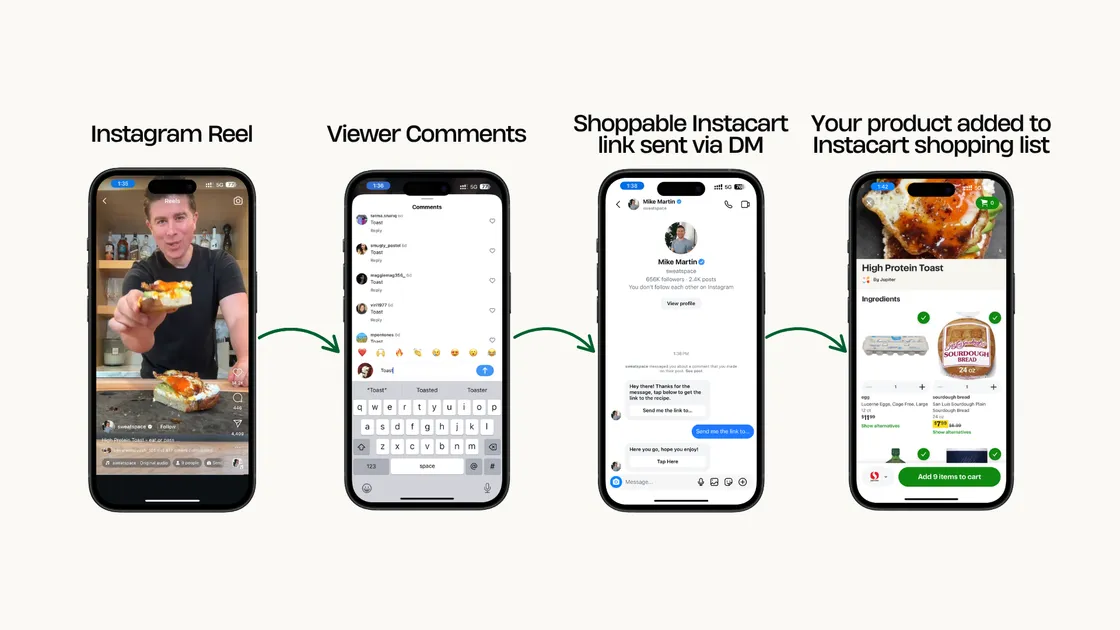
Instacart influencer marketing connects creator content directly to grocery purchase behavior, closing the gap between a viewer watching a recipe video and that same viewer adding ingredients to an Instacart cart. For food and beverage CPG brands, this solves the single hardest problem in influencer marketing: proving that a post actually drove a sale at retail, not just a view.
Most influencer attribution stops at engagement. A brand can see likes, comments, and views, but has no reliable way to connect those numbers to what happened next at checkout. Instacart-connected attribution changes that by building the purchase path directly into the content interaction itself.
How the comment-to-cart mechanic actually works
The mechanic runs in four steps, all triggered by a single viewer action. A creator posts recipe content featuring a brand's product. A viewer comments on the post with a specific keyword. That comment automatically triggers a direct message to the viewer containing a unique, shoppable Instacart link, tied specifically to that creator and that post. The viewer opens the link and finds an Instacart cart already pre-loaded with the ingredients from the recipe, including the featured product.
The result is a purchase path with almost no friction between watching content and buying the product it features, and every cart add can be attributed back to the specific creator and specific post that generated it. That last part is what most influencer marketing can't do. A brand doesn't just know that a campaign generated impressions, it knows which piece of content, from which creator, generated a specific cart action.
Why this closes a gap other attribution methods can't
Generic influencer marketing typically relies on discount codes or affiliate links that live outside the platform where the content lives, requiring a viewer to remember a code, navigate to a separate site, and manually add items. Each of those steps loses viewers. A comment-triggered DM keeps the entire path inside the platform the viewer is already using, and pre-loading the cart removes the final friction point of manually searching for and adding each ingredient.
This matters specifically for grocery purchase behavior. A viewer who's mildly interested in a recipe video is unlikely to open a new tab, find a discount code, navigate to a retailer site, and rebuild a shopping list from memory. The same viewer is far more likely to complete a purchase when the path is one comment and one pre-loaded cart away.

See the comment-to-cart mechanic in action
Every step from creator post to Instacart cart, attributed back to the specific creator and post.
The proof point that matters
One Instagram Reel using this mechanic generated 6.5 million views and drove over 1,000 Instacart cart adds directly attributed to that single post. That's not a projection, it's a real result from a real campaign, and it illustrates the actual purpose of comment-to-cart attribution: turning a large but otherwise unmeasurable view count into a specific, countable retail action.
For context on where Jupiter sits in the Instacart ecosystem, it's one of Instacart's fastest-growing affiliate partners, reflecting how quickly comment-to-cart attribution has been adopted by CPG brands looking to close the measurement gap between social content and grocery sales.
Where this fits into a broader retailer strategy
Comment-to-cart attribution isn't limited to Instacart alone as a concept, it's part of a broader approach to connecting creator content to specific retail moments. Brands running campaigns timed to Whole Foods placements or Kroger promotions get more value from creator content when there's a direct, trackable path from the post to a purchase action, rather than relying on a viewer's memory to translate interest into an in-store purchase days later.
Can't currently prove your influencer content drives grocery sales?
See how creator-and-post-level cart attribution closes that measurement gap.
What this means for campaign measurement
Standard influencer metrics, impressions, engagement rate, follower growth, describe how content performed as content. Comment-to-cart attribution describes how content performed as a sales channel, which is a different question and, for most CPG marketing leadership, the more important one. A campaign with modest impressions but strong comment-to-cart conversion can outperform a campaign with far higher reach but no purchase path at all, in terms of what actually matters to the business.
This is also why comment-to-cart data belongs in campaign analytics alongside impressions and CPM rather than as a separate, disconnected metric. Reviewing cart-add data next to campaign health status gives a fuller picture of which creators are driving actual purchase intent versus which are driving views without conversion.
How Jupiter handles this for food CPG brands
Jupiter's comment-to-cart mechanic is built directly into the platform for every campaign where a brand wants Instacart-connected attribution, not offered as a separate add-on requiring additional integration work. The Instacart campaign playbook covers execution specifics, but the core mechanic, comment triggers DM, DM contains a unique creator-and-post-tied link, link opens to a pre-loaded cart, runs the same way across every campaign using it. As one of Instacart's fastest-growing affiliate partners, Jupiter has built this specifically for the grocery retail purchase journey that generic influencer platforms, built around e-commerce and discount codes, weren't designed to handle.
See exactly how a creator post turns into an Instacart cart
Jupiter's comment-to-cart mechanic attributes every cart add back to the creator and post that drove it.
FAQs
Quick answers to common questions.
What is Instacart influencer marketing?▼
Instacart influencer marketing connects creator content directly to Instacart purchase actions, most commonly through a comment-triggered mechanic that sends viewers a shoppable, pre-loaded cart link tied to a specific creator and post.
How does the comment-to-cart mechanic work?▼
A viewer comments a specific keyword on a creator's post, which triggers an automated direct message containing a unique Instacart link. That link opens to a cart pre-loaded with the recipe's ingredients, including the featured product.
Can Instacart influencer marketing prove a post drove sales?▼
It can attribute specific cart adds back to the specific creator and post that generated them, which is a more direct measurement than impressions or engagement alone, though a cart add doesn't guarantee a completed checkout.
Is Jupiter the largest Instacart affiliate partner?▼
Jupiter is one of Instacart's fastest-growing affiliate partners. Specific ranking claims beyond that aren't something Jupiter publishes or verifies.
What's the difference between comment-to-cart and a discount code?▼
A discount code requires a viewer to remember it and manually navigate to a retailer site to redeem it. Comment-to-cart keeps the interaction inside the platform where the content lives and pre-loads the cart, removing several friction steps.
Does comment-to-cart attribution work for every retailer, or just Instacart?▼
The comment-to-cart mechanic specifically is built around Instacart's platform. Attribution approaches for other retailers, like in-store promotions tied to Whole Foods or Kroger campaigns, use different mechanics suited to those purchase paths.
More in Attribution & Measurement
More from Attribution & Measurement.