TikTok Influencer Marketing for Food and Beverage Brands
TikTok has caught up with Instagram for food and beverage brand conversation, but most CPG brands are still spending most of their creator budget on Instagram. Here's how the gap creates the opportunity, and what the playbook for TikTok influencer marketing actually looks like for food brands in 2026.
Trusted by leading CPG brands







On this page
▼
- Why TikTok matters for food CPG in 2026
- The opportunity: where conversation has moved versus where brand spend has moved
- What TikTok influencer marketing looks like for food brands
- How TikTok creator selection differs from Instagram
- How TikTok views actually scale with follower tier
- Pricing for TikTok food influencers
- Measuring TikTok influencer marketing for CPG
- Common mistakes CPG brands make on TikTok
- How Jupiter handles TikTok influencer marketing for food CPG
TikTok influencer marketing for food brands means partnering with recipe creators to drive grocery discovery and attributed retail sales. TikTok now holds 40.6% of food CPG conversation, nearly Instagram's 42.8%, while most brands still under-spend on the channel.
If you are a CPG marketing manager who has run influencer campaigns on Instagram and is now being asked to "make TikTok work," this guide covers what changes, what stays the same, and what to budget for. Jupiter handles both Instagram and TikTok creator campaigns in one workflow, with platform-specific attribution and creator data. See how the campaign management platform works.
Why TikTok matters for food CPG in 2026
The single most important shift in food CPG social marketing over the last two years is that TikTok has caught up with Instagram for food and beverage brand conversation.
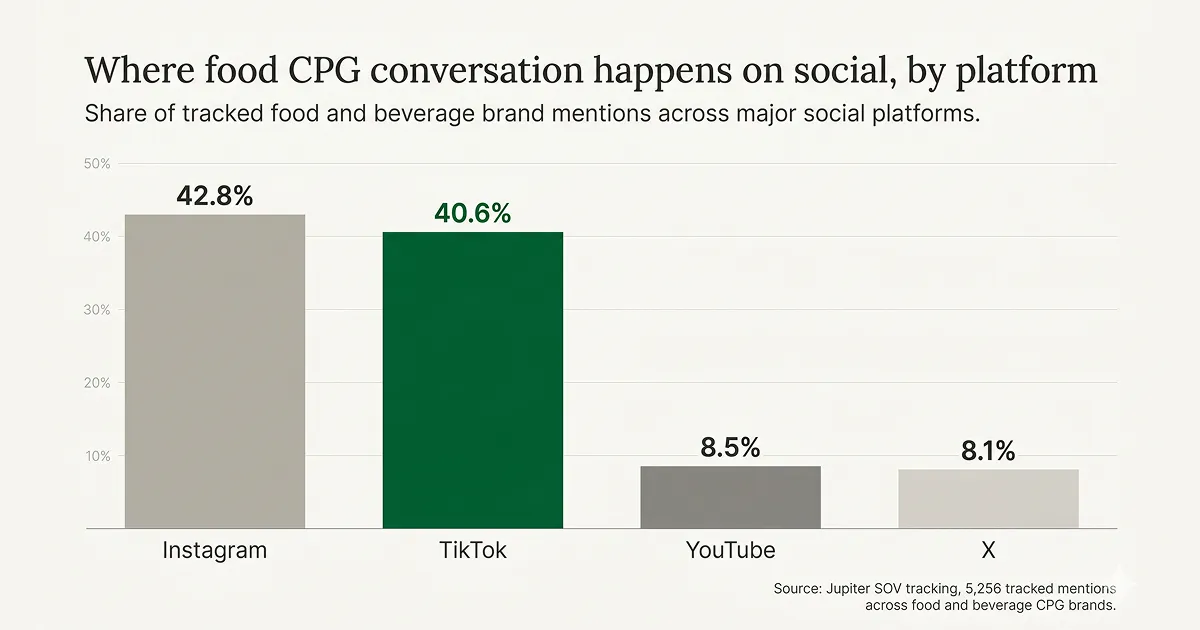
Across food and beverage brand mentions tracked through Jupiter's share-of-voice infrastructure, Instagram and TikTok are nearly tied: Instagram captures 42.8% of category mentions, TikTok captures 40.6%, with YouTube and X each carrying meaningful but smaller shares. For CPG brands accustomed to thinking of Instagram as the dominant food platform with TikTok as an emerging secondary channel, this is a structural shift. The two platforms are now operationally co-equal for food category conversation.
Three structural reasons explain why TikTok has caught up.
The first is search behavior. A growing share of consumers (especially under 35) now uses TikTok as a search engine for food queries before turning to Google or Pinterest. Searches like "easy weeknight dinner," "high protein snacks," and "what to eat for lunch" now route through TikTok at meaningful rates. Brand presence in those search results matters as much as ranking on Google for the same query.
The second is the recipe loop. TikTok's algorithm rewards saves and rewatches, both of which spike on recipe content. A 45-second recipe video using a sauce, cheese, or snack bar gets shown to thousands of viewers who self-identify as food enthusiasts. The platform handles category targeting that brands previously had to buy through paid media.
The third is purchase behavior. Consumers who discover a product on TikTok report higher purchase intent within 7 days than consumers discovering on most other platforms. The "TikTok made me buy it" cultural pattern is now well-established, and a meaningful share of those purchases happens at grocery, not just on Amazon.
For food and beverage CPG, the implication is clear: TikTok is no longer optional. It has structurally caught up with Instagram as the place where category discovery happens.
The opportunity: where conversation has moved versus where brand spend has moved
Even as TikTok has caught up with Instagram in food CPG conversation share, brand spend has not caught up at the same pace.
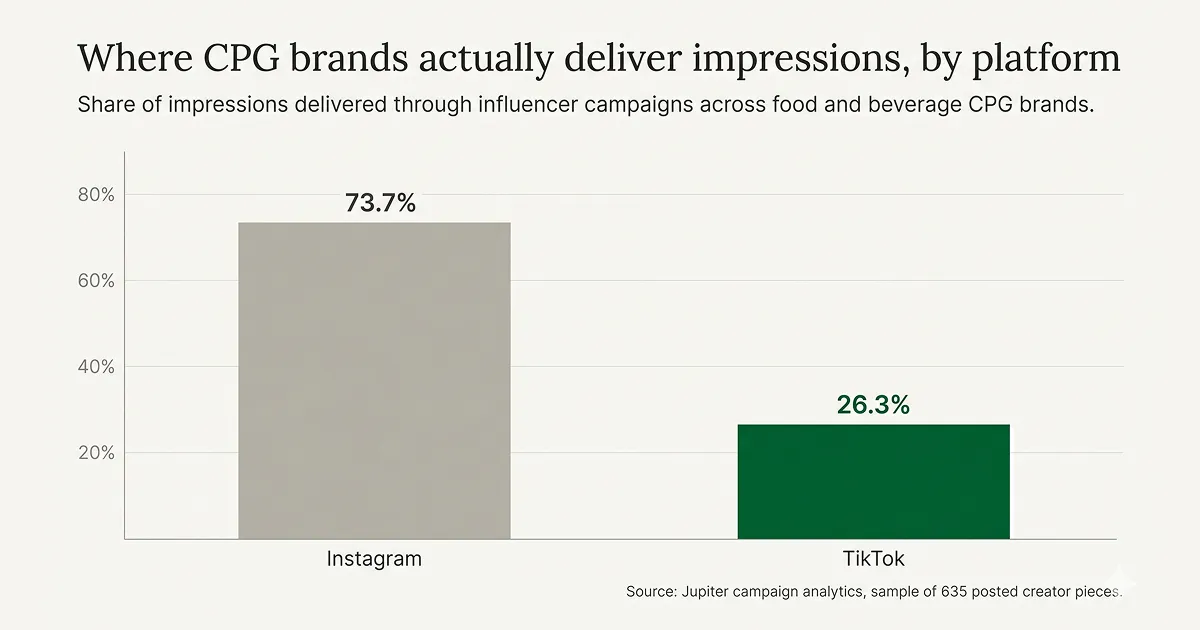
Across creator campaigns run through Jupiter, 73.7% of delivered impressions come from Instagram and 26.3% come from TikTok. The gap between conversation share (40.6% TikTok) and impression delivery (26.3% TikTok) is the opportunity. CPG brands are still under-allocating creator marketing budget to TikTok relative to where their audiences actually are.
This is not a forecasting argument. It is a current-state observation. Brands that recalibrate their creator mix toward TikTok in 2026 catch up with where the category conversation is already happening. Brands that delay continue to spend disproportionately on Instagram while their competitors gain share of voice on TikTok.
What TikTok influencer marketing looks like for food brands
A TikTok food influencer campaign typically includes three components.
Recipe creators, the largest category, build content around cooking with the product. Think weeknight dinners, meal prep, or "5 ways to use" formats. Audience size ranges from 10K to 5M followers, with the most efficient cost-per-impression usually sitting in the 50K to 250K range.
Ingredient swap creators position the product as a healthier, faster, or trendier alternative to a category staple. This is especially powerful for plant-based brands, gluten-free brands, and better-for-you snacks where the swap is the hook.
Lifestyle and food review creators integrate the product into broader content like grocery hauls, "what I eat in a day" videos, or restaurant-style reviews. Lower direct conversion intent, higher reach.
A typical CPG TikTok campaign runs 4-8 creators across these categories over 2-3 months. Each creator delivers 1-3 pieces of content. Total spend usually lands between $15,000 and $80,000 depending on creator tier and SKU support.
How TikTok creator selection differs from Instagram
If you have run Instagram campaigns, you already know how to evaluate followers, engagement rate, and content fit. On TikTok, three additional signals matter more.
Average view count is the real performance metric. Across Jupiter's TikTok food creator network, median average views per post scale roughly 10x per follower tier from Nano (1,062 median views) to Top-tier (99,037 median views). Follower count and view count generally correlate, but the variance within each tier is substantial. A creator with 30K followers averaging 200K views per video reaches more people than a 100K-follower creator averaging 40K views, and platforms that surface those exceptions are more useful than platforms that show only follower count.
Recency of viral hits matters. A creator who had a 5M-view video 14 months ago and has averaged 20K views since is in algorithmic decline. A creator with 100K followers and three videos over 500K views in the last 60 days is on an upward curve. Pick the curve.
Niche specificity beats general food. A creator known specifically for high-protein recipes, dairy-free baking, or gluten-free meal prep converts better for relevant brands than a general food creator with a larger audience. The TikTok algorithm rewards specialization, and specialized creators have audiences that buy.
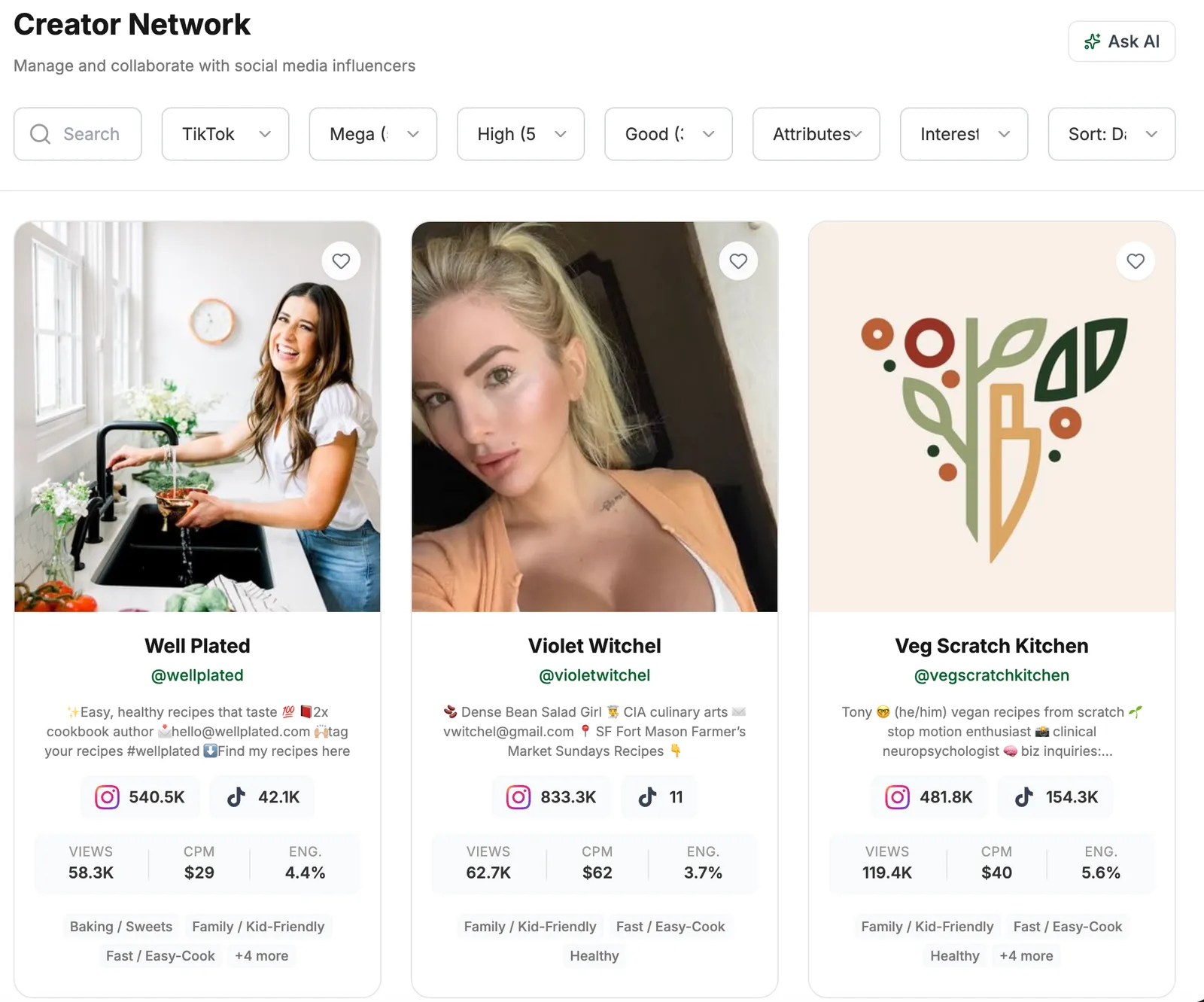
Jupiter's creator network is filtered specifically for food CPG. Every creator is a recipe creator, chef, home cook, or food lifestyle creator with audience interest data, average view counts per platform, and content interest tags that map to specific food categories. You can find a creator with 28K TikTok followers averaging 180K views per video, focused on plant-based recipes, located near targeted Whole Foods stores, in minutes rather than days.

See how Jupiter ranks TikTok food creators
Filter 1,000+ recipe creators by platform, average views, retailer proximity, and brand fit in seconds. Built for food and beverage CPG brands.
Book a 20-minute demoHow TikTok views actually scale with follower tier
Generic industry advice often claims that TikTok's algorithm flattens follower differences entirely. The data from food creators specifically tells a more nuanced story.
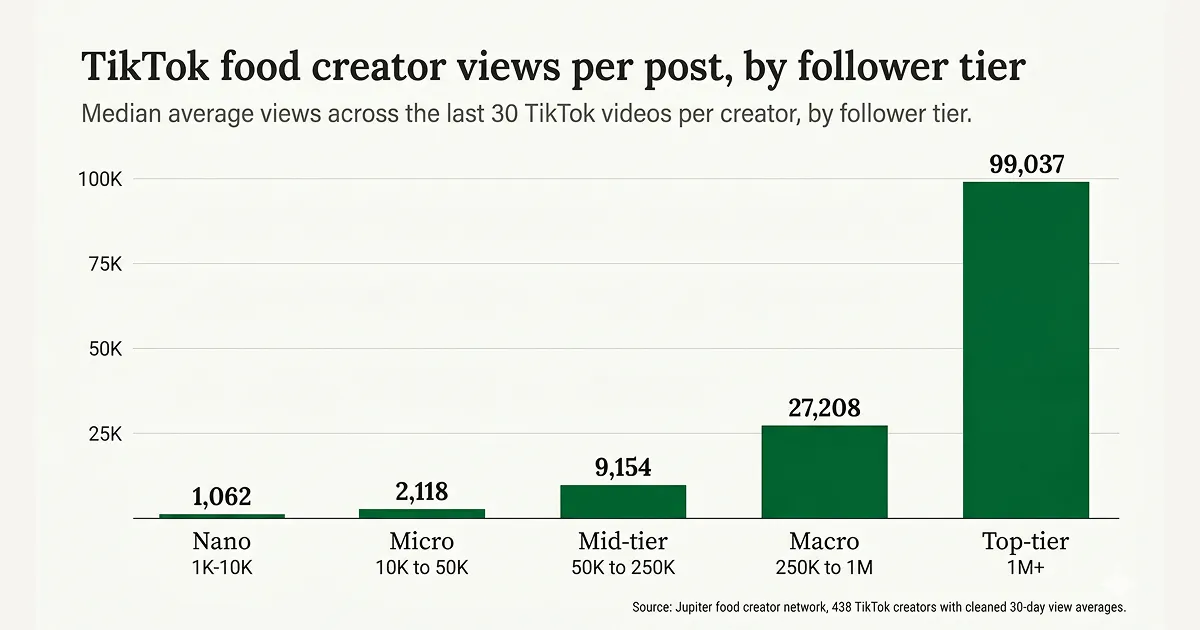
Across 438 food creators in Jupiter's TikTok network, median average views per post scale roughly 10x per tier: Nano creators (1K to 10K followers) average 1,062 views per post, Micro creators (10K to 50K followers) average 2,118, Mid-tier creators (50K to 250K followers) average 9,154, Macro creators (250K to 1M followers) average 27,208, and Top-tier creators (1M+ followers) average 99,037.
What this means for campaign design: follower count is a directional signal, not a vanity metric. Larger creators do reach more people on average. The opportunity for brands is finding the exceptions: the creator within a given tier whose average views meaningfully exceed their tier's median. Those exceptions exist in every tier, but identifying them requires looking at view data, not just follower count.
Want to see which TikTok creators in your category beat their tier's median views?
Jupiter surfaces the creators outperforming their follower tier on views, engagement, and audience match for your specific category.
Find them on JupiterPricing for TikTok food influencers
TikTok pricing for food creators in 2026 follows roughly this market structure. Nano creators (1K to 10K followers) typically charge $150-$500 per post. Micro creators (10K to 50K followers) charge $400-$1,500. Mid-tier creators (50K to 250K followers) charge $1,200-$5,000. Macro creators (250K to 1M followers) charge $4,000-$15,000. Top-tier creators with 1M+ followers charge $12,000-$50,000+.
These are TikTok-only rates. If you bundle Instagram cross-posting (Reels), expect 1.4-1.7x the single-platform rate. Most CPG brands negotiate platform-specific rates rather than flat creator fees.
For brands new to TikTok, the most efficient starting point is mid-tier creators (50K to 250K followers) with strong average view counts. The cost per thousand impressions usually beats macro creators by 2-3x, and the audience is engaged enough to drive shopping list adds.
Measuring TikTok influencer marketing for CPG
This is where most food brands lose the plot. TikTok views are easy to track. Sales attribution from TikTok to grocery is not.
The four-layer attribution model that works for CPG brands applies on TikTok the same way it applies on Instagram. We covered the full framework in our influencer marketing ROI guide for CPG brands, but the TikTok-specific notes are these:
Estimated vs. actual impressions matter even more on TikTok because the algorithm makes view counts highly variable. A creator who averaged 200K views might deliver 80K on your video and 800K on the next. Your estimated CPM going in needs to bake in this variance.
TikTok-specific link tracking requires using either link-in-bio tools or DM-based redirects, since TikTok suppresses external links in captions for some accounts. Per-creator trackable links to Instacart product pages are the standard approach for CPG brands measuring TikTok-driven cart intent.
Instacart shopping list attribution is the closest thing to revenue tracking for CPG brands on TikTok. Per-creator Instacart links allow brands to attribute resulting cart adds to the specific creator and video that drove them, broken down by region and product.
Share of voice on TikTok captures the long-term brand-building value of campaigns that don't drive immediate clicks. A campaign that increases your category SOV from 8% to 14% on TikTok is generating market share value that won't appear in your link click dashboard but will show up in scanner data. Jupiter tracks this automatically. See how share of voice tracking works.
Common mistakes CPG brands make on TikTok
Treating TikTok like Instagram. TikTok rewards native behavior. A creator post that looks polished, brand-managed, or like an ad gets suppressed by the algorithm. The brief should specify "make this feel like your normal content" rather than "match our brand guidelines exactly."
Demanding too much creative control. Brands that mandate specific phrasing, exact product positioning, or scripted intros consistently underperform on TikTok. Give creators direction on the message, then trust them on the format. The platform is built for creator voice, not brand voice.
Optimizing for follower count over view count. Already covered above. Average views and view-to-follower ratio matter more than raw audience size, and the variance within follower tiers is meaningful enough that picking creators on followers alone misses the best performers.
Skipping the creative hook. TikTok content lives or dies in the first 1.5 seconds. Briefs should specify a strong hook concept, even if the brand leaves the execution to the creator.
Not measuring beyond views. A 5M-view campaign with zero shopping list adds, zero comments asking where to buy, and zero sales lift is a vanity campaign. The metrics that matter are engagement rate, link clicks, and trackable conversions.
How Jupiter handles TikTok influencer marketing for food CPG
Jupiter is built exclusively for food and beverage CPG brands, with TikTok creator data, retailer attribution, and AI-driven creator selection in one place.
The creator network includes recipe creators across both Instagram and TikTok, with platform-specific pricing, average view counts, engagement rates, and credibility scores (the percentage of audience estimated to be real vs. bots). The campaign optimizer scores eligible creators across 12 signals, including geographic proximity to target retailers, audience match, content interest alignment, engagement quality, audience credibility, content recency, and brand affinity from past collaboration history. The system then selects the combination of creators that maximizes projected impressions within budget.
For brands running Instagram campaigns today and adding TikTok as a second channel, Jupiter handles both in the same workflow. Same brief, same creator selection, same analytics, with platform-specific pricing and attribution baked in. The Jupiter AI Marketing Agent can pull TikTok creators by city, follower range, content niche, and average view count in plain language, no spreadsheets, no manual filtering.
See Jupiter's TikTok creator network in action.
Filter 1,000+ recipe creators, project CPM before you spend, and track Instacart attribution from TikTok content.
Book a 20-minute demo.FAQs
Quick answers to common questions.
How much should a CPG brand spend on TikTok influencer marketing?▼
A typical CPG brand entering TikTok influencer marketing spends $15,000 to $80,000 per campaign, depending on creator tier and product category. The most efficient starting budget for brands new to the platform is $25,000 to $40,000, distributed across 4-6 mid-tier creators (50K to 250K followers) with strong average view counts.
What's the difference between TikTok and Instagram influencer marketing for food brands?▼
TikTok rewards native, creator-led content and pushes posts to non-followers through algorithmic discovery, while Instagram is more follower-dependent. TikTok has caught up with Instagram for food CPG conversation share (40.6% TikTok vs 42.8% Instagram across tracked food and beverage brand mentions), but most CPG brands still allocate the majority of their creator budget to Instagram. Most CPG brands now run both, with TikTok prioritized for product discovery and Instagram for sustained brand presence.
How do I measure TikTok influencer marketing ROI for a CPG brand?▼
CPG brands measure TikTok influencer marketing ROI through four layers: estimated vs. actual impressions and CPM, creator-level cost efficiency, trackable links to retail platforms like Instacart, and share of voice tracking across the category. Because most CPG products sell through grocery retail rather than DTC checkout, attribution proxies like Instacart shopping list adds and SOV deltas are the most reliable signals.
What's a good engagement rate for TikTok food creators?▼
A solid engagement rate for TikTok food creators is 5% or higher, calculated as (likes + comments + shares + saves) divided by views. Strong creators in the food category often hit 10% or higher. Saves are particularly meaningful for recipe content because they signal the viewer plans to make the recipe.
Should I use macro or micro creators on TikTok?▼
For most CPG brands, mid-tier and micro creators (50K to 250K followers) deliver the best cost-per-impression on TikTok. Macro creators reach more people but at significantly higher CPM, while nano creators are efficient but require coordinating more relationships to hit meaningful reach. The right answer depends on whether the campaign goal is reach, engagement, or attributable conversion.
How does TikTok influencer marketing drive grocery sales?▼
TikTok influencer marketing drives grocery sales through three mechanisms: direct attribution via shoppable Instacart links sent in response to comments, retailer-specific demand created by location-tagged content (driving foot traffic to nearby stores), and category share-of-voice growth that improves long-term brand consideration. Platforms like Jupiter track all three and report them in a single analytics view.
More in Strategy & Guides
More from Strategy & Guides.