Best Food Influencer Marketing Platforms for CPG Brands (2026)
Most influencer platforms are built for Shopify. Food CPG brands sell through Kroger, Whole Foods, and Instacart — and need a platform that knows the difference.
Trusted by leading CPG brands













On this page
▼
- What Makes an Influencer Platform Right for Food CPG?
- The Best Food Influencer Marketing Platforms for CPG Brands
- 1. Jupiter - Best Overall for Food CPG
- 2. Archive - Best for UGC Capture and Content Tracking
- 3. Aspire - Best for Creator Marketplace Discovery
- 4. GRIN - Best for DTC Food Brands with Shopify
- 5. Statusphere - Best for Automated Product Seeding
- 6. Upfluence - Best for Existing Customer Influencer Programs
- Head-to-Head Comparison
- How to Choose the Right Platform for Your Brand
- The Bottom Line
The best food influencer marketing platform for CPG brands is one that tracks grocery sales — not just impressions. Most general influencer platforms are built for DTC e-commerce and measure success through Shopify revenue or engagement rate. Food CPG brands sell through Kroger, Whole Foods, and Instacart, which requires a completely different attribution model. A platform that can't connect a creator post to a shopping list add on Instacart isn't solving the actual problem.
This guide compares the top six platforms specifically evaluated for food and beverage CPG use cases — creator network quality, retail attribution, campaign analytics, and pricing transparency. If you're still managing creator campaigns through spreadsheets and Instagram DMs, this is where to start. Teams weighing agency retainers against in-house ops may also want Jupiter's software vs agency comparison for CPG brands before choosing a platform.
What Makes an Influencer Platform Right for Food CPG?
Before comparing platforms, it helps to define what food CPG brands actually need — because the requirements are meaningfully different from DTC or lifestyle brands.
Retail attribution, not Shopify revenue. CPG brands don't own their checkout. A consumer sees a creator post on TikTok, drives to Kroger two days later, and picks your product off the shelf. There's no pixel, no cookie, no checkout flow you control. A platform that measures success through Shopify clicks is measuring the wrong thing entirely. The attribution model needs to extend to Instacart shopping list adds, in-store retailer lift, or both.
A food-specific creator network. Not every influencer is a food creator. A lifestyle influencer with 500K followers who occasionally posts a recipe is a fundamentally different proposition than a dedicated recipe creator with 40K followers and a 6.8% engagement rate who cooks every day for an audience that trusts their ingredient recommendations. Platform creator networks built for beauty, fashion, or general lifestyle don't translate cleanly to food CPG campaigns.
CPM benchmarking before you spend. Most platforms tell you performance after the campaign ends. The best food CPG platforms model projected impressions and CPM upfront — so you're making a confident budget decision against a benchmark, not a guess you'll evaluate in retrospect.
Grocery retailer targeting. A creator in Portland, Oregon driving purchases at New Seasons Market is more valuable to a Pacific Northwest brand than a creator in Atlanta with double the followers. Platforms built for CPG understand retailer proximity and geographic targeting as a core input to creator selection — not an afterthought.
With those four criteria in place, here's how the top platforms stack up.
The Best Food Influencer Marketing Platforms for CPG Brands
1. Jupiter - Best Overall for Food CPG
Best for: Food and beverage CPG brands selling through grocery retail and InstacartCreator network: 1,000+ vetted recipe creators on Instagram and TikTokAttribution: Instacart shopping list attribution, trackable UTM links, estimated GMVPricing: Demo-based, no setup fees
Jupiter is the only influencer marketing platform built exclusively for food and beverage CPG brands. Every feature — creator discovery, campaign management, analytics, and attribution — is designed around how food brands actually sell: through grocery retail, not a DTC checkout flow.
Creator Discovery
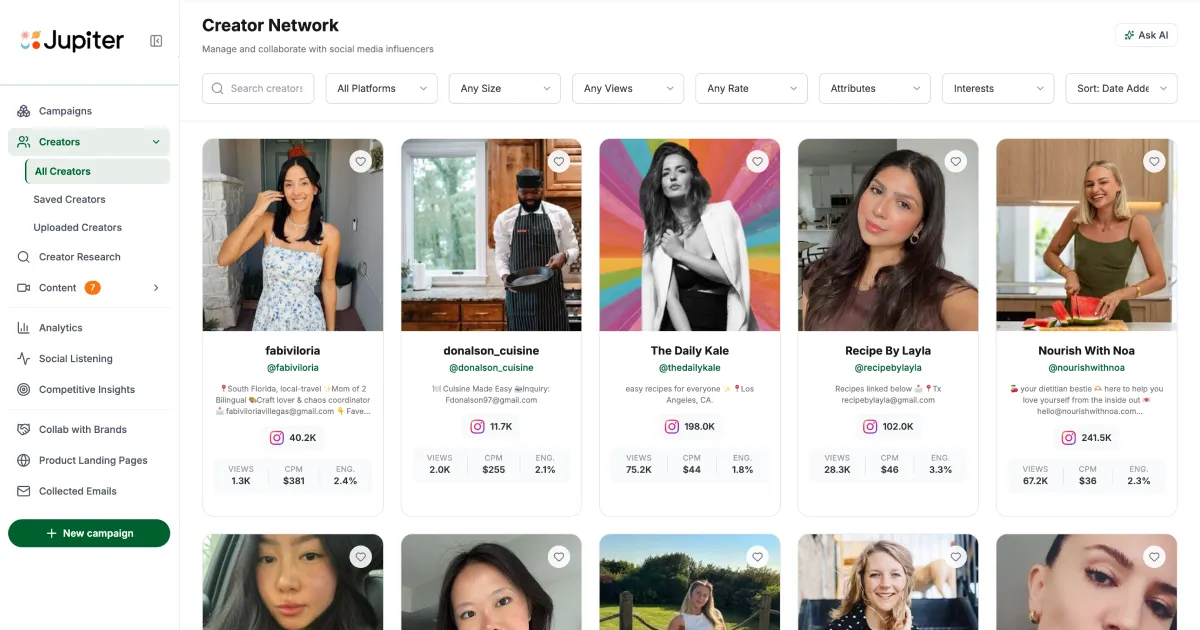
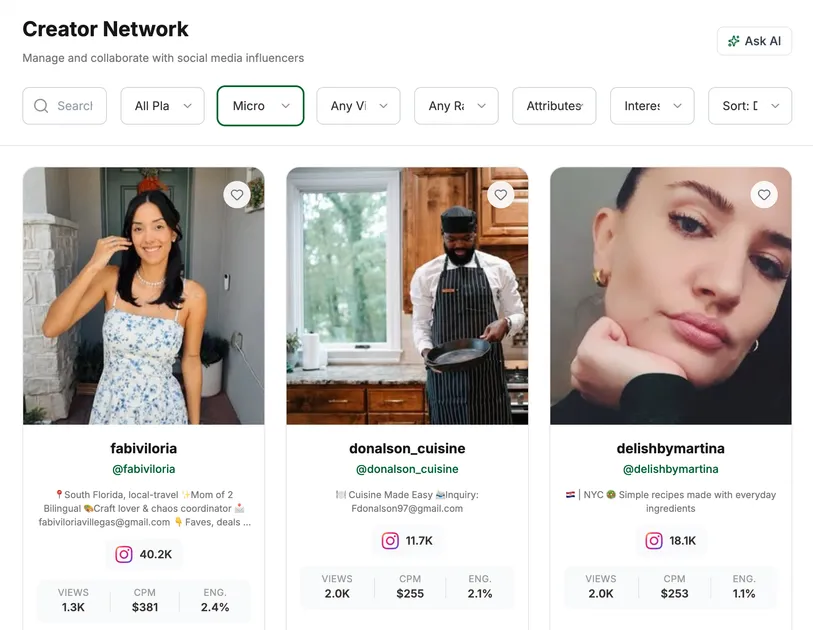
Jupiter's creator network is curated specifically for food CPG. Every creator is a recipe creator — chefs, home cooks, food lifestyle creators — with an audience that discovers products through cooking content and buys at grocery retailers. The discovery tool filters by platform, follower count, engagement rate, content interest, retailer proximity, and a credibility score that estimates the percentage of real vs. bot followers. You can find a micro-influencer with 28K followers in the Chicago metro area who specializes in plant-based recipes and has worked with dairy-free brands before — in minutes, not days.
Each creator profile includes estimated CPM based on historical performance data, so you know your projected cost efficiency before you reach out. This is the difference between a confident budget allocation and a hope-and-a-prayer.
Campaign Management and Optimization
Jupiter's campaign optimizer scores every eligible creator across six signals — content fit, posting recency, retailer proximity, brand affinity, audience match, and engagement rate — and then selects the creator combination that maximizes projected impressions within your budget. You can describe your campaign in plain language and Jupiter AI extracts the brief, builds the creator lineup, and projects CPM before you commit. Campaign briefs, content review, creator approval workflows, and performance tracking all live in a single platform. No Google Drive folders. No email chains.
Instacart Attribution — Jupiter's Defining Differentiator
This is what separates Jupiter from every other platform on this list. Jupiter is one of Instacart's fastest-growing affiliate partners. Every Jupiter campaign includes built-in Instacart commerce infrastructure: when a viewer comments on a creator's post, they're automatically sent a shoppable Instacart link via DM. Every shopping list add is tracked back to the original creator post.
This is not modeled data or estimated lift. It's actual consumer purchase intent, measured at the individual post level. A shopping list add on Instacart is the CPG equivalent of an add-to-cart event — the strongest purchase signal available outside of a completed transaction. Jupiter has driven 4.5M+ product adds to Instacart shopping lists annually across its brand network.
For brands whose CFO asks "what did this influencer campaign actually do for sales?" — Jupiter is currently the only platform that can answer that question with post-level data.
Analytics and Share of Voice
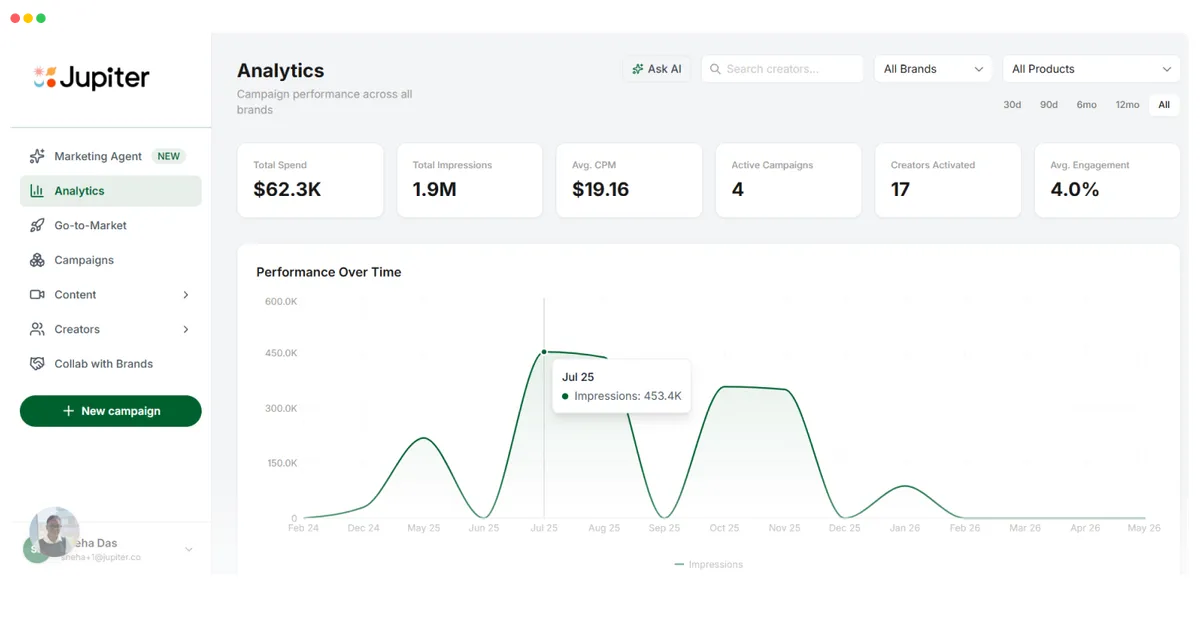
Every campaign feeds into a live analytics dashboard showing total spend, impressions, CPM, engagement rate, and Instacart shopping list adds — with period-over-period deltas and creator-level breakdowns. Jupiter also includes share of voice tracking: your brand's percentage of total social mentions across Instagram, TikTok, YouTube, and X compared to competitors in your category, updated continuously.
What it's not: Jupiter is purpose-built for food CPG. It is not the right platform for beauty brands, apparel, DTC subscription boxes, or B2B. If your products don't sell through grocery retail, the Instacart attribution layer — Jupiter's core differentiator — won't apply to your use case.
Brands using Jupiter: Banza, Pete & Gerry's, Nellie's Free Range Eggs, Kettle & Fire, La Tourangelle, Schweid & Sons, Vermont Creamery, and 50+ others.
2. Archive - Best for UGC Capture and Content Tracking
Best for: Brands that need comprehensive UGC tracking and content capture at scaleCreator network: Discovery tool, not a managed marketplaceAttribution: Engagement and EMV-based, no retail/Instacart attributionPricing: Paid subscription, free trial available
Archive's core product is social listening and UGC capture. It automatically tracks 100% of tagged Instagram content and approximately 98% of TikTok content, meaning brands never miss a post, story, or reel that mentions their product. For food brands running large-scale sampling programs or ambassador campaigns where creators are posting organically, this is genuinely useful — the manual screenshot workflow that most brands use misses a significant percentage of earned content.
Archive serves over 50,000 brands, including Quest Nutrition, Smartsweets, and Momofuku. Its AI-powered search lets you find content using natural language or reference images. It integrates with Shopify for e-commerce revenue attribution and provides competitor content tracking.
The significant gap for CPG brands: Archive has no Instacart attribution, no retail lift measurement, and no food-specific creator network. It's a content capture and analytics tool, not a campaign management platform. If you need to find creators, brief them, manage content review, and track Instacart sales in one place, Archive doesn't cover the full workflow. It's most useful as a complement to a campaign management platform, not a standalone solution.
Best used when: You have an existing creator program generating significant organic UGC and you need a system to capture, organize, and measure it all.
3. Aspire - Best for Creator Marketplace Discovery
Best for: Brands looking to browse creators who have opted into brand partnershipsCreator network: Marketplace model, broad across verticalsAttribution: Affiliate links, UTM tracking, Shopify integrationPricing: Paid subscription
Aspire operates as a marketplace where creators opt in to be discoverable by brands. Brands can browse creator profiles, filter by niche and demographics, and reach out directly. The platform handles contracts, content briefs, payment processing, and basic performance tracking.
For food brands, Aspire's creator database includes food creators but is not curated specifically for CPG. The discovery filters are functional but don't include grocery retailer proximity or CPG-specific signals like ingredient category alignment. Attribution runs through affiliate links and Shopify integration — which works for DTC food brands but doesn't address the retail channel attribution gap that most CPG brands face.
Aspire has seen significant growth and handles the operational workflow of influencer management reasonably well. The platform is a solid choice for brands that are primarily DTC, want a large searchable creator database, and don't need Instacart-specific tracking. For brands whose primary sales channel is grocery retail, the attribution layer will leave you with incomplete data.
Best used when: You're a food brand with a meaningful DTC or direct e-commerce channel alongside retail, and you want a large creator pool to search across.
4. GRIN - Best for DTC Food Brands with Shopify
Best for: Food brands with significant DTC revenue and Shopify infrastructureCreator network: Discovery tool, CRM for existing relationshipsAttribution: Shopify-native revenue attributionPricing: Enterprise subscription
GRIN is built around Shopify. Its core value proposition is connecting influencer activity directly to e-commerce revenue — a creator posts, a viewer clicks the link, buys on Shopify, and the sale is attributed to the creator. For DTC food brands — subscription boxes, direct-to-consumer specialty products, online-only brands — this is a clean and powerful attribution model.
The gap for traditional CPG brands is fundamental: GRIN's attribution model assumes you own the checkout. The moment your product sells through Kroger, Target, or Instacart, the attribution chain breaks. GRIN has no equivalent of Jupiter's Instacart shopping list tracking.
GRIN's creator management toolset is strong — discovery, outreach, contracts, product seeding, payment, and performance all in one place. If you're scaling a DTC influencer program and your primary KPI is revenue from creator-driven purchases on your own site, GRIN is one of the better platforms available. If you're trying to drive Instacart sales or in-store retail lift, it's the wrong tool.
Best used when: You're a food brand with a strong DTC component and want clean creator-to-Shopify-revenue attribution.
5. Statusphere - Best for Automated Product Seeding
Best for: Brands running high-volume product seeding and sampling programsCreator network: Opt-in creator community, automated matchingAttribution: Post-delivery tracking, engagement metricsPricing: Paid subscription
Statusphere's strength is automation. Its StevieOps engine automates creator discovery, product shipment, delivery confirmation, posting notifications, and content tracking — making high-volume sampling campaigns operationally manageable without a large internal team. If you're seeding 500 creators per quarter, Statusphere removes most of the manual coordination work.
The tradeoff is depth. Statusphere is optimized for reach and efficiency at scale, not for the kind of performance attribution that food CPG brands need when presenting results to a CFO or retailer. Engagement metrics and estimated media value are the primary outputs. There's no Instacart attribution, no CPM benchmarking before spend, and limited support for the commerce attribution layer that connects creator content to grocery sales.
Best used when: You have a sampling or seeding budget and want to maximize the number of creator posts with minimal manual management overhead.
6. Upfluence - Best for Existing Customer Influencer Programs
Best for: Brands who want to find influencers from within their existing customer baseCreator network: Database of 4M+ creator profiles, Shopify customer integrationAttribution: Sales tracking via affiliate links, Shopify integrationPricing: Paid subscription
Upfluence has a distinctive feature worth noting: it integrates with Shopify to identify which of a brand's existing customers are already creators with meaningful social followings. This "turn your customers into creators" angle resonates with food brands that have a loyal DTC customer base and want authentic ambassadors who already love the product.
Beyond that, Upfluence functions as a broad influencer database and campaign management tool. Like GRIN and Aspire, its attribution model is built around e-commerce — affiliate links, UTM tracking, Shopify revenue. Food CPG brands selling primarily through retail channels will hit the same attribution wall as they would with GRIN.
Best used when: You have a DTC Shopify store with an existing customer base you want to activate as creators, alongside retail distribution.
Head-to-Head Comparison
Feature | Jupiter | Archive | Aspire | GRIN | Statusphere | Upfluence |
|---|---|---|---|---|---|---|
Food-specific creator network | ✓ 1,000+ vetted | ✗ | Partial | ✗ | Partial | ✗ |
Instacart / retail attribution | ✓ | ✗ | ✗ | ✗ | ✗ | ✗ |
CPM benchmarking before spend | ✓ | ✗ | ✗ | Partial | ✗ | ✗ |
Grocery retailer geo-targeting | ✓ | ✗ | ✗ | ✗ | ✗ | ✗ |
Shopify / DTC attribution | ✗ | ✓ | ✓ | ✓ | Partial | ✓ |
✓ | ✓ | ✓ | ✓ | ✓ | Partial | |
Content review workflow | ✓ | Partial | ✓ | ✓ | ✓ | ✓ |
Share of voice tracking | ✓ | ✗ | ✗ | ✗ | ✗ | ✗ |
AI campaign optimizer | ✓ | ✗ | ✗ | ✗ | ✗ | ✗ |
YC-backed | ✓ | ✗ | ✗ | ✗ | ✗ | ✗ |
Food CPG focus | ✓ Exclusive | ✗ | ✗ | ✗ | ✗ | ✗ |
How to Choose the Right Platform for Your Brand
The decision comes down to one question: where does your product sell?
If your primary sales channel is grocery retail — Kroger, Whole Foods, Sprouts, Target, Instacart — you need a platform that can attribute creator content to retail outcomes. Right now, Jupiter is the only platform on this list built for that use case. Every other platform measures success through DTC e-commerce signals that don't apply to the grocery channel.
If you're a food brand with significant DTC revenue alongside retail distribution, the calculus changes. GRIN or Aspire may cover your DTC attribution needs, while a platform like Jupiter covers the retail side. Some brands run both.
If your immediate need is UGC capture and content management rather than campaign creation, Archive solves a specific operational problem well — particularly for brands running ambassador programs generating high volumes of organic creator content.
If volume and automation are the priority over attribution depth, Statusphere can operationalize a high-frequency sampling program efficiently.
For most food CPG brands whose growth depends on driving product off grocery shelves — and who need to prove that influencer spend is driving that outcome — the answer is Jupiter.
The Bottom Line
Most influencer marketing platforms were built for a world where the brand controls the checkout. Food CPG brands don't live in that world — and they shouldn't be using tools designed for it.
If your goal is to connect creator content to grocery sales, drive products off retail shelves, and prove the ROI of your influencer program to leadership, the platform architecture matters. Attribution that stops at a TikTok view or an Instagram engagement is not attribution — it's vanity metrics with extra steps.
Jupiter was built specifically to solve the attribution problem that every other platform on this list doesn't address. That's not positioning. It's the reason 58 food CPG brands chose it over the general-purpose alternatives.

The only platform built for CPG grocery sales
Instacart attribution, 1,000+ food creators, and CPM benchmarking — built exclusively for food and beverage brands.
FAQs
Quick answers to common questions.
What is the best influencer marketing platform for food CPG brands?▼
Jupiter is purpose-built for food and beverage CPG brands, with built-in Instacart attribution, a network of 1,000+ vetted recipe creators, and a campaign optimizer that projects CPM before spend. For brands that need Instacart or retail grocery attribution — not Shopify revenue — it's the only platform built specifically for that use case.
How is Jupiter different from GRIN and Aspire for CPG brands?▼
GRIN and Aspire are built for DTC e-commerce brands and measure ROI through Shopify revenue. Jupiter is built for CPG brands selling through grocery retail — Kroger, Whole Foods, Instacart. The core difference is attribution: Jupiter tracks shopping list adds on Instacart back to individual creator posts. GRIN and Aspire have no equivalent capability.
What should CPG brands look for in an influencer marketing platform?▼
CPG brands should look for four things: a food-specific creator network, Instacart or retail attribution, CPM benchmarking before spend, and grocery retailer targeting by region. Most general influencer platforms cover none of these because they're built for DTC, not retail CPG.
Is there a free influencer marketing platform for food brands?▼
Most enterprise influencer marketing platforms require a paid subscription. Jupiter offers a personalized demo with no setup fees and white-glove onboarding. For brands evaluating platforms, the key is not price but attribution — a cheaper platform that can't track grocery sales will cost more in wasted spend than a purpose-built solution.
More in Platforms & Comparisons
More from Platforms & Comparisons.