Influencer Marketing Strategy for Food Brands: The 2026 Framework
A food CPG influencer strategy that does not connect to grocery sales outcomes is just a content plan. This 5-phase framework builds the connection from the first decision you make.
Trusted by leading CPG brands









On this page
▼
- Why Most CPG Influencer Strategies Fail Before the First Post Goes Live
- Phase 1: Set Goals Tied to Retail Velocity, Not Vanity Metrics
- Phase 2: Define Your Audience Through Retailer Geography, Dietary Lifestyle, and Household Type
- Retailer geography
- Dietary lifestyle
- Household type
- Phase 3: Creator Selection: The 6 Signals That Predict Grocery Sales
- Signal 1: Retailer proximity
- Signal 2: Content interest specificity
- Signal 3: Save rate on recipe content
- Signal 4: Comment sentiment and purchase language
- Signal 5: Audience credibility score
- Signal 6: Brand affinity history
- Phase 4: Content Direction That Preserves Creator Authenticity
- Brief for the dish, not the product
- Specify the retail call-to-action
- Give one key message, not three
- Specify the platform natively
- Content review for product-claim accuracy
- Phase 5: Measurement Cadence: Weekly vs Monthly and What to Track at Each Level
- Weekly measurement
- Monthly measurement
- How to Adapt the Framework by Campaign Type
- New product launch campaigns
- Evergreen campaigns
- Seasonal sprint campaigns
- Ambassador programs
- How Jupiter Builds and Executes This Strategy in One Platform
An influencer marketing strategy for a food CPG brand is a structured plan for selecting creators, directing content, deploying budget, and measuring outcomes in a way that connects directly to grocery sales performance. Not to social engagement. Not to follower counts. To the behavior that determines whether your product stays on shelf: trial, restock velocity, and Instacart cart adds.
The majority of CPG influencer strategies never make that connection. They are built around awareness metrics from a DTC playbook applied to a grocery distribution model, and they systematically underdeliver because the measurement model cannot see the outcomes that actually matter. A brand can run a campaign that generates 3 million impressions and declining retail velocity at the same time, and the standard strategy framework gives them no signal that something is wrong.
This guide lays out the 5-phase framework that closes that gap, built specifically for food and beverage CPG brands selling through US grocery retail.
Why Most CPG Influencer Strategies Fail Before the First Post Goes Live
The failure is almost always upstream of execution. It happens in strategy, not in content.
The most common failure mode is misaligned goals. A brand sets campaign goals in impression volume or engagement rate because those are the metrics their influencer platform surfaces by default. They select creators optimized for those metrics. They brief for content that maximizes those metrics. They report against those metrics. And they never build a single data point that tells them whether their creator investment moved a grocery shopper.
The second failure mode is geography-blind creator selection. Food CPG brands sell in specific stores, in specific markets, at specific distribution points. A creator with 400,000 followers whose audience is concentrated in markets where your product is not distributed is generating no commercial value, regardless of engagement rate. A creator with 40,000 followers whose audience shops at exactly the retailers where your product sells is generating real commercial value that the standard strategy framework cannot see.
The third failure mode is treating creator content as a media buy rather than a consumer education asset. A media buy delivers impressions and stops. Creator content delivers impressions, saves, comments, recipe inspiration, and brand familiarity that compound across repeated exposures. Brands that brief creators like media vendors get media-buy results. Brands that brief creators like culinary collaborators get compounding consumer education.
The 5-phase framework is designed to eliminate all three failure modes before the first creator is contracted.
Phase 1: Set Goals Tied to Retail Velocity, Not Vanity Metrics
Every effective CPG influencer strategy starts with a goals phase that specifies what retail outcome the campaign is supposed to support. Not "increase brand awareness." Not "grow our social following." A specific retail outcome.
The retail outcomes worth building creator campaigns around are: driving trial for a new SKU in its first 90 days on shelf, increasing Instacart add-to-cart rate in a specific region, lifting velocity at a specific retail chain during a promotional window, and building category share of voice in advance of a line extension.
Each of these outcomes requires a different campaign structure, a different creator type, and a different measurement model. A trial campaign for a new SKU needs creator content that explains the product, names the retailer, and routes viewers toward a purchase action. A velocity campaign at a specific retailer needs creators geographically concentrated near that retailer's store footprint. A SOV campaign needs creator volume and posting cadence rather than individual creator star power.
State the retail goal before any other decision. If you cannot name a specific retail outcome the campaign is designed to support, the strategy is not ready to move to creator selection.
Phase 2: Define Your Audience Through Retailer Geography, Dietary Lifestyle, and Household Type
CPG brands sell to consumers with specific purchase behaviors, not to demographic buckets. The audience definition phase of a food CPG influencer strategy should use three filters, not two.
Retailer geography
Where does your target consumer shop? Name the specific chains (Whole Foods, Kroger, Sprouts, Trader Joe's, Target) and the regions where your distribution is strongest. This filter determines where your creators need to be located, not just what they need to post about.
Dietary lifestyle
What dietary identity does your target consumer hold? Plant-based, gluten-free, high-protein, Mediterranean, low-sugar, omnivore, family-cook. This filter determines which creator communities will have audiences pre-disposed to your product category. A creator whose entire content universe is dairy-free recipes has an audience that is already buying dairy-free products. Your product fits naturally without requiring the creator to make a case the audience is not ready to hear.
Household type
Who is doing the grocery shopping and cooking in your target household? Primary household grocery buyer with children, health-focused single consumer, couple cooking on weeknights, meal-prep focused fitness consumer. This filter determines which content formats will convert. A primary household grocery buyer responds to weeknight recipe content. A health-focused single responds to macro-counted meal prep. Briefing the wrong content format for the household type is how campaigns generate engagement without grocery purchase intent.
These three filters, applied in combination, produce an audience definition specific enough to guide creator selection and brief writing. A definition that ends at "millennial women aged 25 to 35 who care about health" does not.
Phase 3: Creator Selection: The 6 Signals That Predict Grocery Sales
Creator selection for food CPG is not a popularity contest. The signals that predict retail performance are different from the signals that predict view counts, and brands that confuse them hire the wrong creators consistently.
The 6 signals to evaluate for every creator you consider:
Signal 1: Retailer proximity
Is the creator physically located in a market where your product sells? A creator in the Phoenix metro area whose audience shops Sprouts is more commercially relevant for a brand with Sprouts distribution than a creator in New York with twice the following. Geographic concentration of both creator and audience is one of the strongest predictors of grocery impact.
Signal 2: Content interest specificity
Does this creator exclusively or primarily post about a category that contains your product? Specificity of content interest predicts specificity of audience purchase behavior. The more targeted the creator's content niche, the more pre-qualified their audience is for your product.
Signal 3: Save rate on recipe content
Saves indicate purchase intent. A viewer who saves a recipe plans to return to it, which means they plan to cook the dish and buy the ingredients. Track saves per video view or saves per reach on recent posts. A save rate above 2% on food content is strong. This metric is more predictive of grocery conversion than overall engagement rate.
Signal 4: Comment sentiment and purchase language
Read the comments on recent posts. Are viewers asking where to buy the ingredients? Saying they are adding something to their grocery list? Comments like "what brand is that" and "I need to find this at my Whole Foods" are commercial signals. Generic positive comments are not.
Signal 5: Audience credibility score
The estimated percentage of a creator's followers that are real, active accounts rather than bots or dormant profiles. A creator with 80,000 real engaged followers outperforms a creator with 150,000 followers and a 45% bot rate on every metric that connects to actual consumer behavior. Credibility scores are not surfaced by most platforms.
Signal 6: Brand affinity history
Has this creator worked with brands in adjacent categories? A creator with a track record of plant-based brand partnerships has an audience conditioned to trust their food brand recommendations. First-time brand partners have no track record to build confidence from.
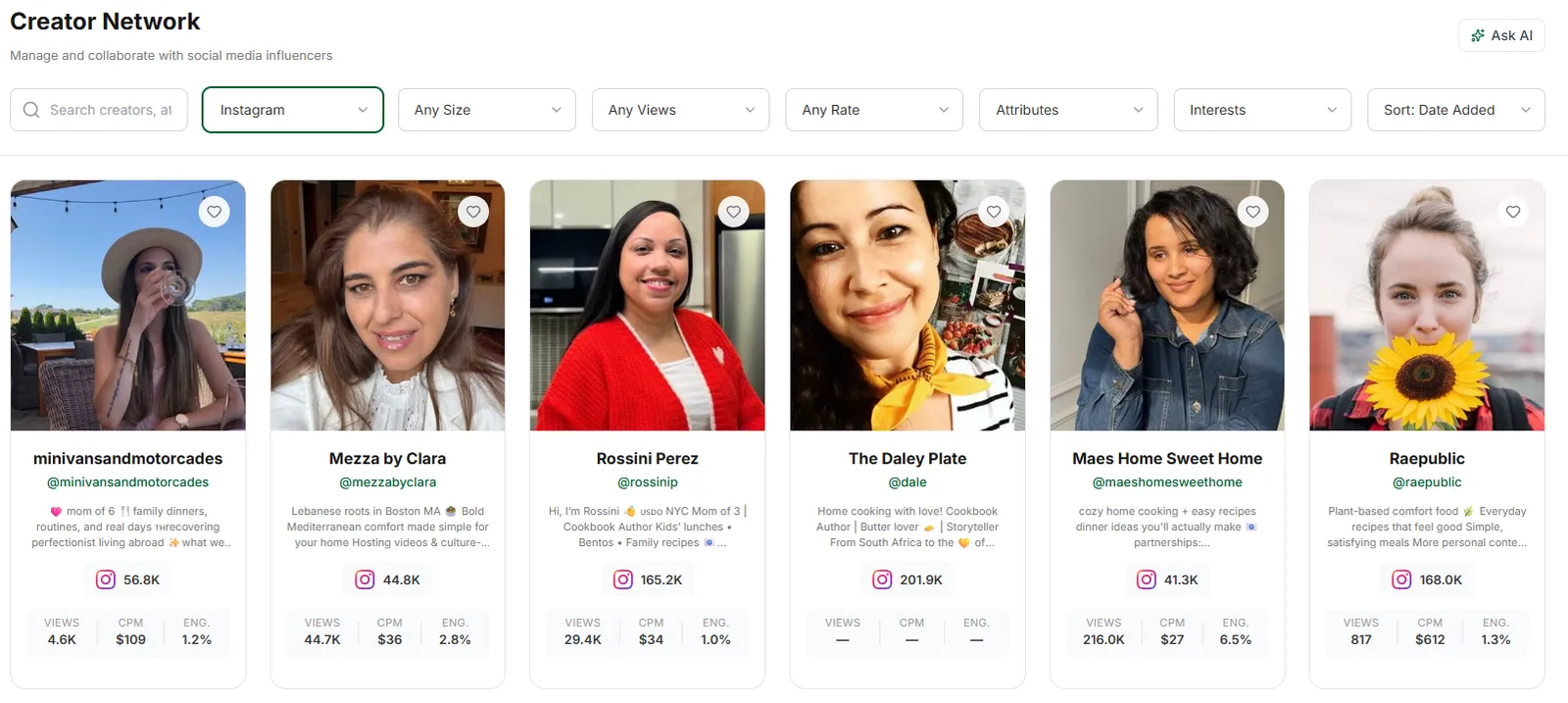
Jupiter's creator network of 1,000+ vetted recipe creators surfaces all six signals at the creator profile level, including credibility score, retailer proximity data, and brand affinity history. The Jupiter AI Marketing Agent can run creator searches filtered by any combination of these signals in natural language. Jupiter's 12-signal campaign optimizer then selects the creator combination that maximizes projected impressions within budget, accounting for all six selection signals plus engagement quality, view consistency, audience demographics, hashtag relevance, and geographic distribution across the full creator set.

Jupiter's 12-signal optimizer selects creators for your grocery campaign, automatically
Retailer proximity, content interest alignment, audience credibility, and brand affinity history built into every creator recommendation. 1,000+ vetted food creators on Instagram and TikTok.
Phase 4: Content Direction That Preserves Creator Authenticity
The brief is where most CPG influencer strategies lose the performance they spent Phases 1 through 3 building. Over-briefed content looks scripted. Under-briefed content misses the commercial objective. The goal of Phase 4 is a brief specific enough to deliver the retail goal and open enough to let the creator do what their audience came for.
Brief for the dish, not the product
The most effective food CPG content leads with a recipe or usage scenario that is genuinely useful to the creator's audience. The product earns its place as the ingredient that makes the dish better, more convenient, or more interesting. A brief that leads with the product and treats the recipe as secondary produces content that feels promotional.
Specify the retail call-to-action
Every brief for a grocery brand should name the specific retailers and confirm Instacart availability. "Available at Whole Foods and on Instacart" in the caption or verbal mention is the difference between driving purchase intent with nowhere to go and driving purchase intent to a clear action. This is the most commercially costly omission in food CPG briefs and the most common.
Give one key message, not three
What is the single thing you need the viewer to walk away knowing about this product? Name it explicitly in the brief. A creator who receives three key messages typically delivers none of them clearly. A creator briefed on one message will find their own language for it, and their version will always sound more authentic than your scripted version.
Specify the platform natively
A TikTok brief requires a hook concept, native pacing guidance, and a note on caption structure. An Instagram brief requires Reels vs. static post guidance and caption approach. Sending one brief for both platforms produces content optimized for neither. Split the brief by platform.
Content review for product-claim accuracy
If your product carries dietary certifications, nutritional claims, or retail availability information that the creator must get right, content review before posting is not optional. Build it into the brief so the creator plans their timeline around the submission window. Jupiter's content review workflow handles submission, approval, and rejection with optional feedback notes before any content goes live.
Phase 5: Measurement Cadence: Weekly vs Monthly and What to Track at Each Level
Measurement is not a post-campaign activity. It is a continuous process that produces better decisions during the campaign, not just better reports at the end of it.
Weekly measurement
Track campaign health against pre-campaign projections weekly. Jupiter's campaign health system flags each campaign as green (delivering 80% or more of projected impressions), yellow (50 to 80%), or red (below 50%). A campaign that turns yellow in week two gives you a correction window. A campaign that surfaces as red in the final report gives you a lesson but no leverage. The key metrics to check weekly are actual vs. estimated impressions, actual vs. estimated CPM per campaign, Instacart add-to-cart activity by creator and post, and any posts flagged for anomalous engagement activity (positive or negative).
Monthly measurement
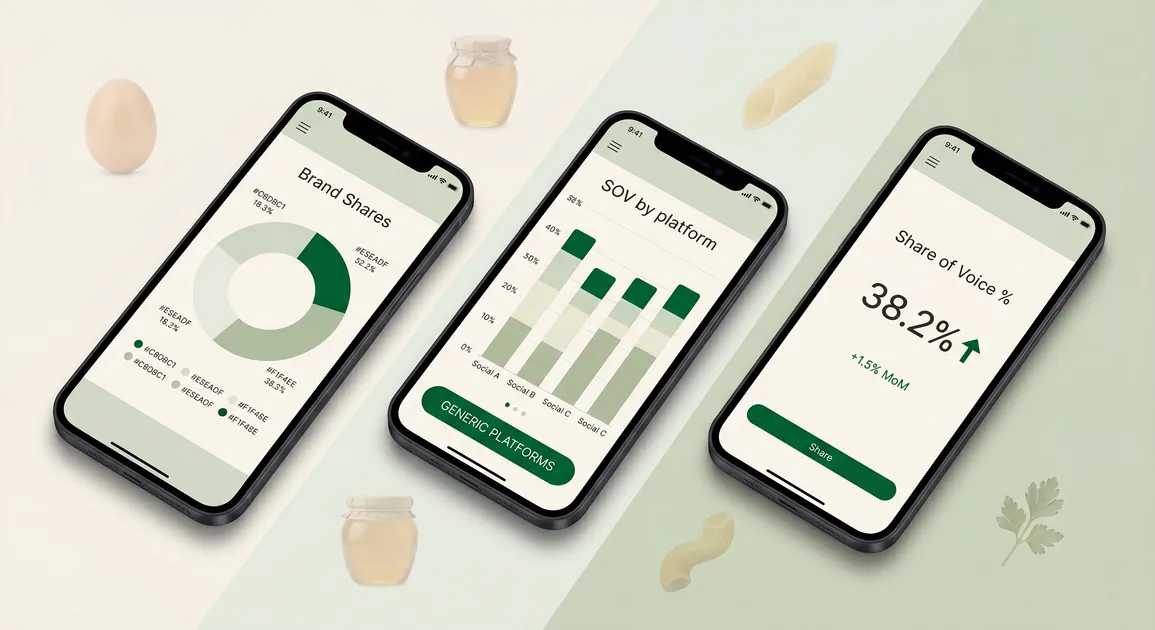
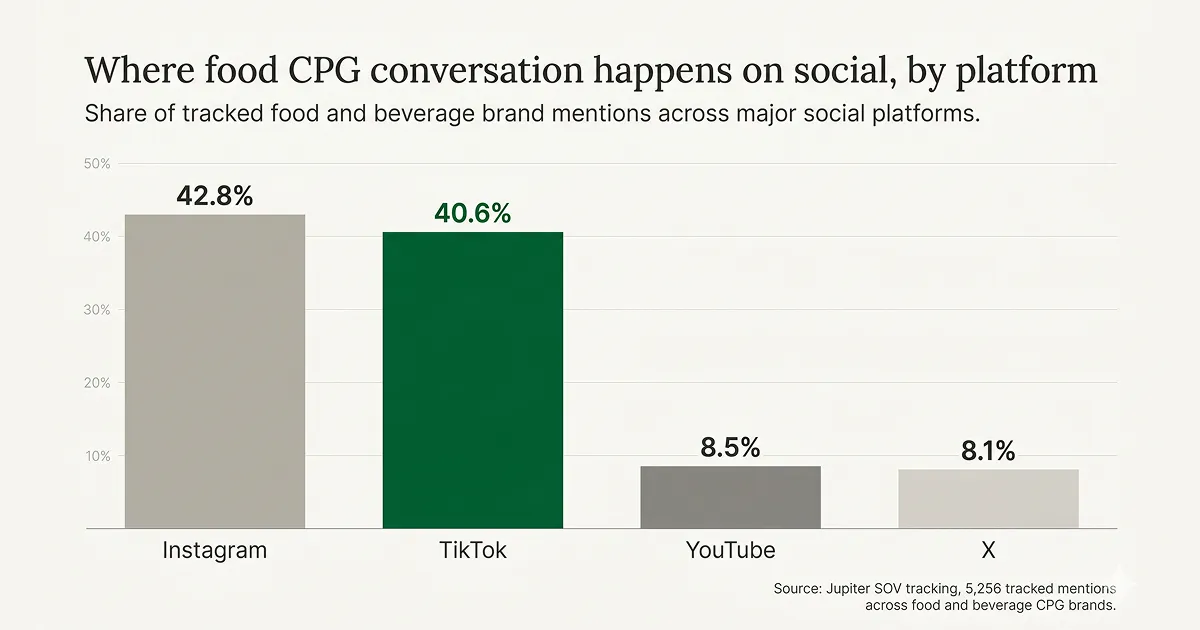
At the monthly level, track creator-level cost efficiency (impressions per dollar across all posts in the period), share-of-voice delta against the campaign period start, and the creator leaderboard across all active campaigns. SOV tracking across Instagram, TikTok, YouTube, and X, run continuously through Jupiter's share of voice tracking system, surfaces your brand's category conversation percentage against competitors automatically.
The post-campaign analysis should answer four questions: which creators delivered the best Instacart add-to-cart rate relative to their impressions, which content angles produced the highest save rates, which regions showed the strongest velocity correlation with creator geographic concentration, and what SOV movement occurred during the campaign period. The answers to these four questions are the inputs that make the next campaign materially more efficient than the current one.
For a complete breakdown of the four-layer attribution model that connects social data, Instacart data, and SOV into a single performance view, the CPG influencer marketing attribution guide covers the methodology in full.
Running campaigns without a measurement model tied to grocery outcomes? See what changes when you have one.
Jupiter tracks estimated vs. actual impressions, Instacart cart adds, creator cost efficiency, and SOV movement across every campaign, automatically.
How to Adapt the Framework by Campaign Type
The 5-phase framework applies across all campaign types but requires different emphasis at each phase depending on what the campaign is designed to do.
New product launch campaigns
Phase 1 emphasis: trial velocity in the first 90 days.
Phase 2 emphasis: retailer geography aligned with initial distribution footprint.
Phase 3 emphasis: creators with high save rates and explicit grocery-buying audience.
Phase 4 emphasis: brief that names the specific retailer and routes to Instacart.
Phase 5 emphasis: weekly cart-add tracking from the first post. Launches cannot be corrected after the retail window closes.
Evergreen campaigns
Phase 1 emphasis: sustained velocity and share-of-voice growth over six to twelve months.
Phase 2 emphasis: broad geographic coverage where distribution exists.
Phase 3 emphasis: creator mix across Instagram and TikTok for complementary reach patterns.
Phase 4 emphasis: rotating content angles across recipe, lifestyle, and product showcase to avoid content fatigue.
Phase 5 emphasis: monthly SOV delta and quarterly creator leaderboard review to rotate the roster based on efficiency data.
Seasonal sprint campaigns
Phase 1 emphasis: velocity lift during a specific purchase window (holiday, back-to-school, New Year).
Phase 2 emphasis: audience with the specific household type driving seasonal purchase behavior.
Phase 3 emphasis: creator posting cadence that peaks two weeks before the retail moment, not during it.
Phase 4 emphasis: brief that ties directly to the seasonal occasion without forcing a seasonal angle that does not fit the product naturally.
Phase 5 emphasis: week-by-week impression pacing against the seasonal window, not average delivery across the full campaign.
Ambassador programs
Jupiter's ambassador program structure runs on a 6-month minimum commitment with a minimum cadence of two posts per month per creator. The Phase 3 selection for an ambassador program carries more weight than a standard campaign because the relationship is long-term. The 6 signals still apply, but brand affinity history and content consistency carry additional weight over time. Jupiter's ambassador graduation model sources ambassador candidates from past campaign creators whose performance data already proves the commercial signal. For a deeper look at how to structure a long-term ambassador program, the brand ambassador programs guide covers the full structure.
How Jupiter Builds and Executes This Strategy in One Platform
Jupiter is built exclusively for food and beverage CPG brands, and the 5-phase framework maps directly to its feature set.
Phase 1 is supported by the Jupiter AI Marketing Agent, built with 20 specialized tools, which can pull live analytics across all active campaigns, surface campaign health and creator leaderboard data, and generate strategic recommendations grounded in your actual campaign history rather than generic benchmarks. Ask it "which of our campaigns last quarter had the best cost efficiency" and it pulls the creator-level data. Ask it "what CPM should I project for a 10-creator Instagram campaign targeting Whole Foods shoppers in the Northeast" and it runs the projection against real network data.
Phase 2 and Phase 3 are supported by the creator network and the 12-signal campaign optimizer. The network includes 1,000+ vetted recipe creators on Instagram and TikTok with retailer proximity data, credibility scores, brand affinity history, and content interest tags available at the creator profile level. The optimizer selects the creator combination that maximizes projected impressions within your budget.
Phase 4 is supported by the brief creation system in Account Assets, which includes a CPG-specific brief structure covering retailer call-to-action, recipe concepts, creative hooks, key messages, and platform-specific guidance. Briefs are stored in a reusable library. Past high-performing briefs appear as one-click quick-select cards when you create a new campaign. The AI agent can draft a brief from a plain-language description and flag fields that need review.
Phase 5 is supported by the analytics dashboard, which tracks estimated vs. actual impressions and CPM per campaign, campaign health at the green/yellow/red level, creator leaderboard ranked by impressions and cost efficiency, and SOV movement period-over-period. The complete CPG influencer marketing ROI measurement guide covers the full measurement framework for brands building out their measurement infrastructure.
Brands including Banza, Pete & Gerry's, Kettle & Fire, La Tourangelle, and Bonafide Provisions run their full influencer strategy across all five phases in Jupiter, from goal-setting and creator selection through brief management, content review, and performance measurement.
A food CPG influencer strategy that connects to grocery sales starts here.
Jupiter is the only platform built exclusively for food and beverage CPG brands, with a 12-signal campaign optimizer, Instacart attribution, and a 20-tool AI agent that builds and executes your strategy from one interface. Used by 58+ CPG brands including Banza, Pete & Gerry's, and Kettle & Fire.
FAQs
Quick answers to common questions.
How should food CPG brands brief creators differently for TikTok vs Instagram?▼
TikTok briefs should specify a hook concept (the first two to three seconds of the video that determines whether viewers continue watching), native caption structure (shorter, search-optimized), and posting timing guidance for the target audience. Instagram briefs should specify Reels vs. static post, caption length and tone, and hashtag approach. A single brief sent for both platforms consistently underperforms platform-specific briefs because content that feels native to one platform often feels misplaced on the other. The commercial call-to-action (retailer name, Instacart availability) belongs in both briefs but should be phrased in a way that fits each platform's native voice.
What is the difference between a product launch campaign and an evergreen influencer strategy?▼
A product launch campaign is a time-bounded effort, typically 90 days, designed to drive trial and velocity during the retail window when buyer attention and shelf placement are most at risk. The goal is concentrated impressions, high Instacart cart-add activity, and rapid SOV growth in the first weeks. An evergreen influencer strategy runs continuously across 6 to 12 months with a rotating creator roster, broader content angle variety, and a monthly measurement cadence focused on sustained velocity and SOV compounding. Most established CPG brands need both: a launch strategy for new SKUs and an evergreen strategy for core products already in distribution.
How many creators should a food CPG brand work with per campaign?▼
The right creator count depends on campaign budget, campaign type, and geographic distribution goals. A new product launch campaign for a brand with national grocery distribution typically works with six to fifteen mid-tier creators (50,000 to 250,000 followers) to balance geographic coverage with content quality management. A regional launch works with four to eight creators whose audiences are concentrated in the target distribution market. A creator sampling campaign can scale to 30 to 50 nano and micro creators when product cost is low and organic posting is the goal. Jupiter's 12-signal campaign optimizer selects the creator count that maximizes projected impressions within the campaign budget constraint.
How do you measure influencer marketing ROI for a grocery CPG brand?▼
ROI for a grocery CPG brand runs through four signals: estimated vs. actual impressions and CPM against pre-campaign benchmarks, Instacart add-to-cart rate by creator and post (via comment-triggered DM links), creator cost efficiency measured as impressions per dollar, and share-of-voice delta over the campaign period. Brands with access to scanner data can also correlate regional velocity spikes with creator geographic concentration during campaign periods. No single metric captures the full picture; tracking all four together gives the most complete view available without a closed DTC purchase loop.
What are the best practices for influencer marketing in the food CPG industry?▼
The most impactful best practices for food CPG influencer marketing are: set goals tied to a specific retail outcome (trial velocity, Instacart cart adds, velocity lift at a specific chain) rather than impressions alone; select creators based on retailer proximity, content specificity, and audience credibility score rather than follower count; brief for the recipe or dish first and let the product earn its place naturally; always include a named retail call-to-action in every brief; and measure weekly against pre-campaign projections rather than only in post-campaign reports. The brands running the most efficient grocery creator programs treat every campaign as data for the next.
What is an influencer marketing strategy for a food CPG brand?▼
An influencer marketing strategy for a food CPG brand is a structured plan for selecting creators, directing content, allocating budget, and measuring outcomes in a way that connects directly to retail sales performance. Unlike DTC influencer strategies that measure success through affiliate link clicks and Shopify revenue, a food CPG influencer strategy measures success through Instacart add-to-cart rates, retailer velocity, and share-of-voice growth, because grocery brands do not own their checkout and the purchase happens in a retail environment the brand cannot track with a pixel.
More in Strategy & Guides
More from Strategy & Guides.