Instacart Influencer Marketing: Campaign Execution Playbook
Instacart is the highest-converting attribution layer in food influencer marketing, but most CPG brands run campaigns that fail to capture the demand. Here's the end-to-end playbook for running an Instacart-attributed influencer campaign that actually drives shopping list adds.
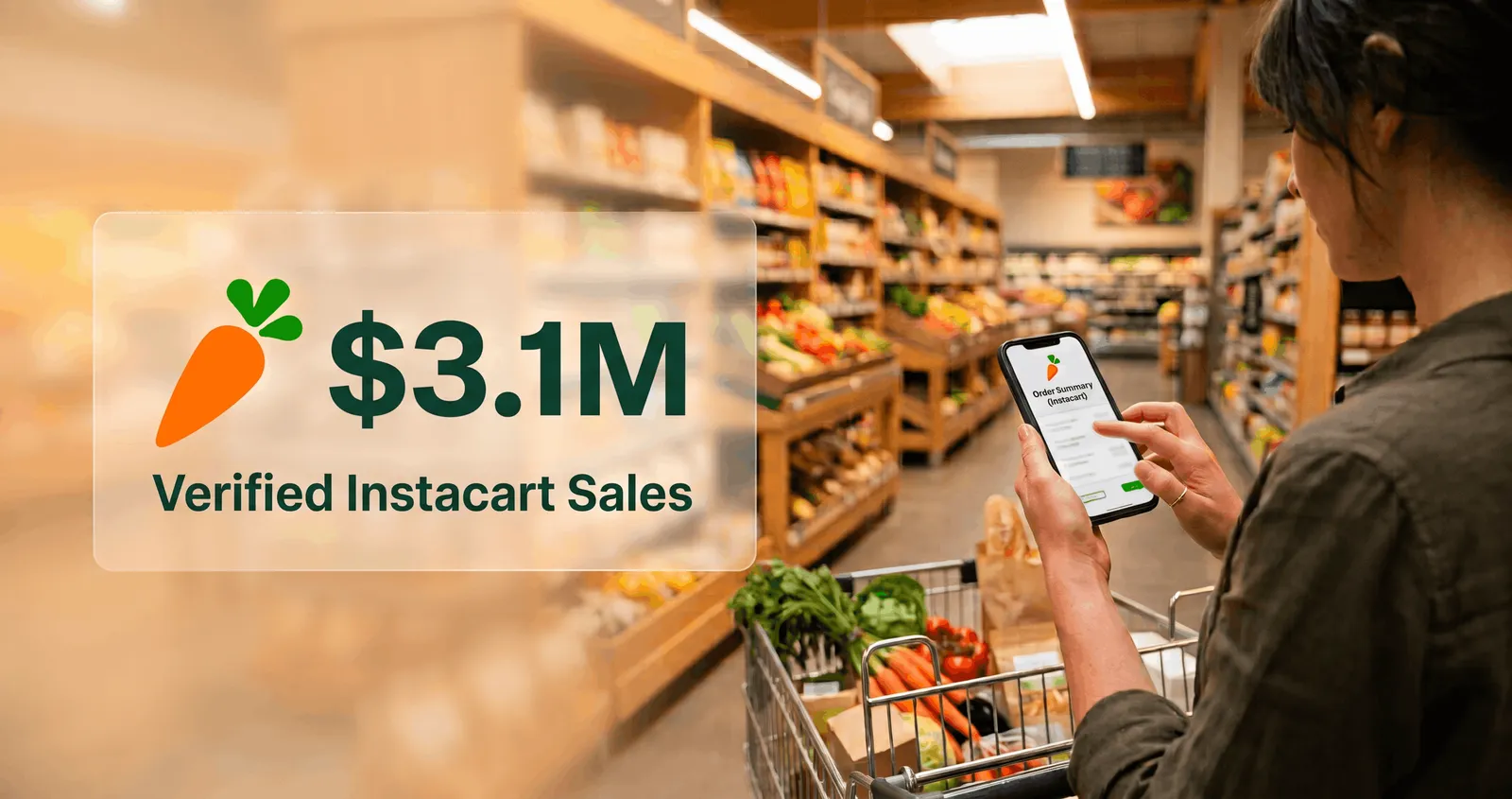
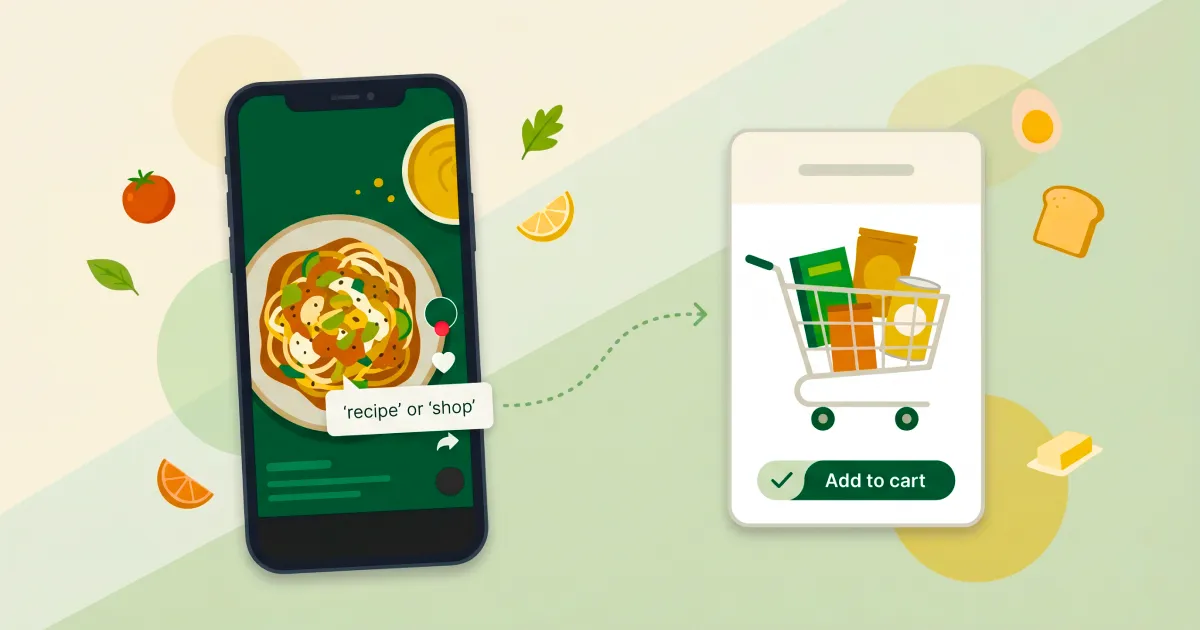
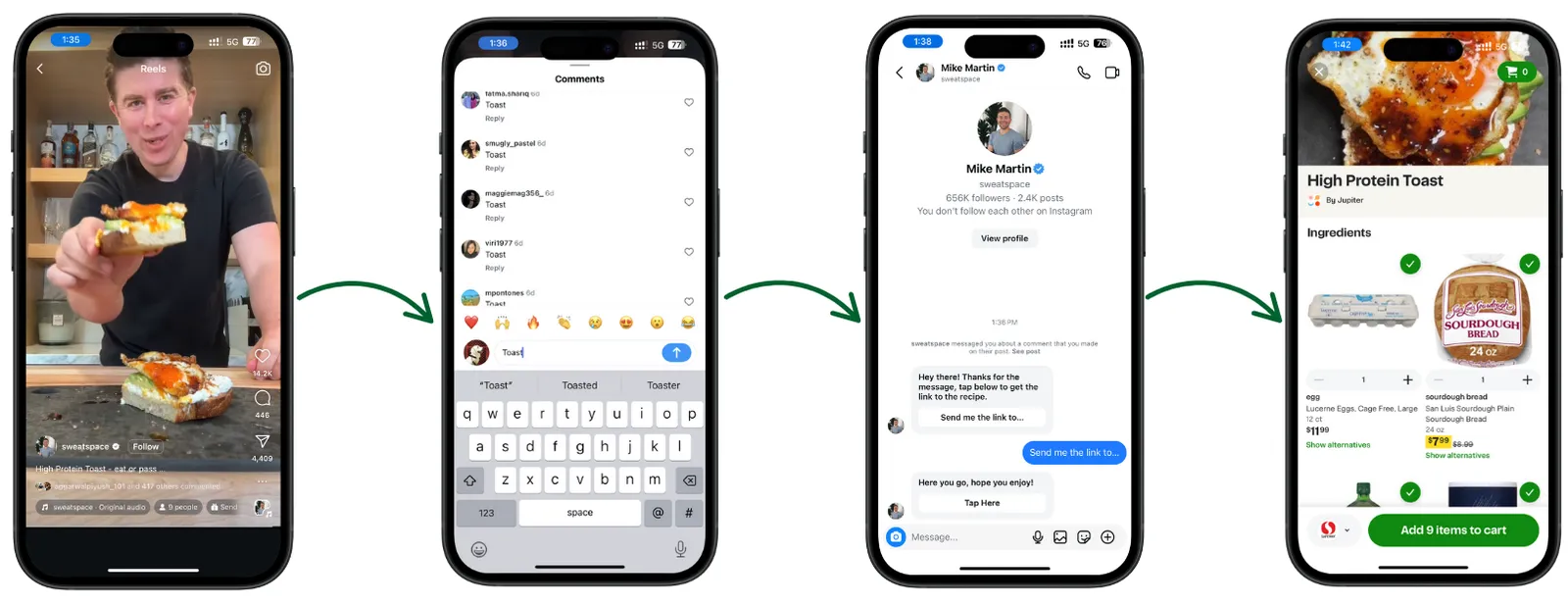
Instacart influencer marketing runs creator campaigns where every viewer engagement triggers a shoppable Instacart link, letting CPG brands attribute grocery cart adds back to a specific creator and post. A viewer watches a recipe video, comments on it, receives a shoppable Instacart link by DM, and adds the product to their cart, typically in under 30 seconds.
Key takeaways
- The mechanic is comment-to-cart: a keyword comment triggers an automated DM with a unique link tied to that creator and post
- Cart adds attribute back to the individual creator and post, not just the campaign
- One Instagram Reel running this mechanic drove 6.5 million views and over 1,000 Instacart cart adds
- The full path from creator content to purchase intent takes under 30 seconds
- Creator selection should weight retailer proximity, since the mechanic only works where Instacart covers the retailer
Trusted by leading CPG brands














On this page
▼
- Why Instacart attribution beats every other tracking method for CPG
- Step 1: Define the campaign objective and Instacart product setup
- Step 2: Select creators with Instacart conversion in mind
- Step 3: Brief creators for Instacart conversion
- Step 4: Set up the shoppable link infrastructure
- Step 5: Time the campaign with Instacart shopping behavior
- Step 6: Monitor and optimize during the campaign
- Step 7: Report on Instacart-attributed outcomes
- How Jupiter handles Instacart influencer marketing for food CPG
Instacart influencer marketing is the practice of running creator campaigns where every viewer engagement triggers a shoppable Instacart link, allowing CPG brands to attribute grocery cart adds back to specific creators and posts. For food and beverage brands selling through retail, Instacart is currently the highest-converting attribution layer in influencer marketing. A viewer watches a recipe video, comments on the post, receives a shoppable Instacart link in their DMs, and adds the brand's product to their cart. The full path from creator content to purchase intent happens in under 30 seconds.
The mechanics of Instacart attribution are straightforward. The execution is where most brands lose the value. This playbook covers how to run an Instacart-attributed influencer campaign end-to-end, from creator selection through post-campaign reporting, with specific tactics CPG marketing teams can implement in their next campaign.
If you are evaluating how to measure influencer marketing for a CPG brand more broadly, our guide to measuring influencer marketing ROI with Instacart attribution covers the full four-layer framework. This post is focused on campaign execution: what to do before, during, and after the campaign goes live.
Why Instacart attribution beats every other tracking method for CPG
Most influencer attribution methods break down for CPG brands. UTM links require viewers to leave the platform and complete a checkout you control, which CPG brands rarely have. Promo codes work for DTC but not for grocery retail. Brand lift studies are expensive and report months after the campaign ends.
Instacart attribution solves all three problems. Every comment on a creator's post triggers an automated DM with a unique shoppable link tied to that specific creator and that specific post. The link opens an Instacart cart pre-loaded with the brand's product. The viewer can add to cart, choose their preferred retailer (Whole Foods, Wegmans, Sprouts, ALDI, Costco), and complete the purchase. The brand sees attribution data within hours: which creator, which post, how many cart adds, what the conversion rate was.
This is the closest thing CPG brands have to a checkout pixel. It is the most defensible ROI signal in food influencer marketing and the reason it has become a defining differentiator in 2026.
Step 1: Define the campaign objective and Instacart product setup
Before a single creator is briefed, two things need to be in place.
The campaign objective needs to be specific to Instacart conversion. Awareness campaigns and Instacart-attributed campaigns optimize for different metrics. An awareness campaign optimizes for impressions and SOV. An Instacart-attributed campaign optimizes for shopping list adds per dollar spent. Decide upfront which one this is, because it changes creator selection, brief design, and reporting.
The Instacart product page needs to be ready to receive traffic. This means the brand's Instacart product detail pages have accurate images, descriptions, retailer availability across major chains, and current pricing. A campaign that drives 10,000 cart adds to a product page showing "out of stock at all retailers in your area" is wasted budget.
The most common mistake here is launching a campaign before the Instacart infrastructure is checked. Audit your product pages on Instacart 5-7 days before the campaign goes live. Confirm SKU availability, image quality, and retailer coverage in the geographic regions your creators reach.
Step 2: Select creators with Instacart conversion in mind
Creator selection for Instacart campaigns differs from creator selection for awareness campaigns in three ways.
Audience location matters more. Instacart works only in markets it covers, and conversion drops when a creator's audience lives outside Instacart's strong-coverage zones. A creator with 200K followers spread evenly across the U.S. converts differently than a creator with 80K followers concentrated in major Instacart metros (NYC, LA, Chicago, Bay Area, DC, Seattle). Filter for audience geography, not just creator location.
Recipe-format content beats lifestyle content. Viewers who save and rewatch recipe videos are in active purchase intent. Viewers consuming lifestyle content are in passive consumption. The former adds to cart, the latter scrolls past. For Instacart campaigns specifically, prioritize creators whose top content is recipe-format.
Comments-to-views ratio matters more than likes. Because the Instacart attribution mechanic is triggered by comments, creators whose audiences leave comments at high rates drive more shoppable link sends. Filter by comment rate, not just engagement rate. A creator at 4% engagement with 30% of that being comments outperforms a creator at 8% engagement with 5% comments for Instacart-attributed campaigns.
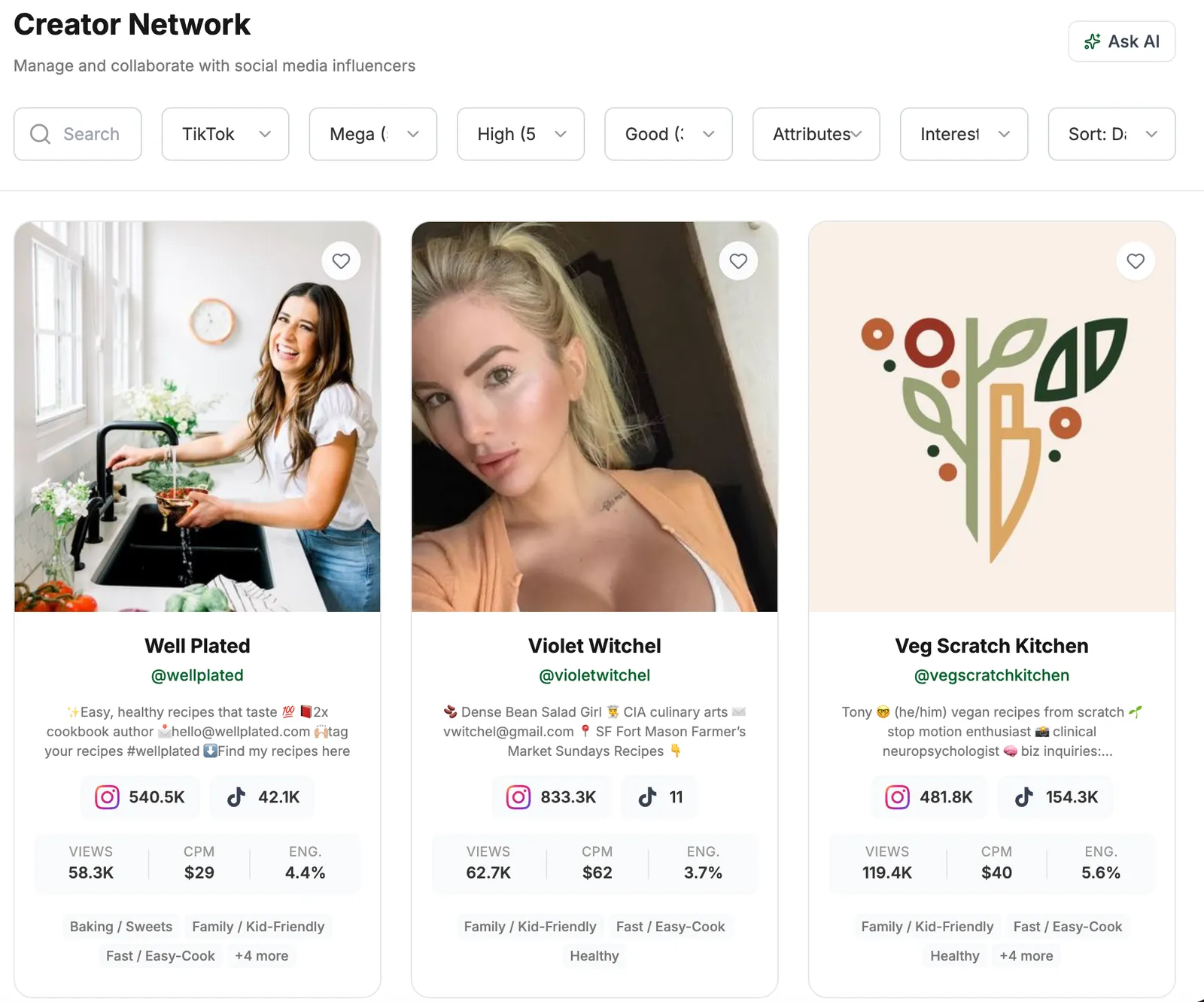
Jupiter's creator network is structured specifically around food CPG, and the campaign optimizer scores creators on six signals including retailer proximity, audience match, and content interest alignment. For Instacart campaigns, filtering by recipe content interest, geographic audience match, and comment engagement rate produces a creator shortlist optimized for cart adds rather than just impressions. You can see this end-to-end on the campaign management platform.
Step 3: Brief creators for Instacart conversion
The brief is where most Instacart campaigns leak conversion. A brief written for general influencer content produces general influencer content. A brief written for Instacart conversion produces shoppable content.
Three things every Instacart-focused brief should include:
A clear shoppable comment trigger. The creator needs to instruct viewers to comment a specific keyword (often "recipe," "shop," or the product name) to receive the Instacart link. The trigger phrase should be repeated twice in the video: once mid-content and once in the closing 5 seconds. Without this prompt, comment volume drops and Instacart attribution suffers.
Recipe-format integration. The product should be used naturally in a recipe, not held up as an ad. The viewer is in food discovery mode, not shopping mode. Conversion happens when the viewer thinks "I want to make this," not "I want to buy this." Specify recipe format, ingredient list (with the product naturally placed), and a finished-dish shot.
Retailer-agnostic language. Instacart fulfills through multiple retailers. Briefs that say "available at Kroger" cut conversion in half because half the viewers shop at Whole Foods, Wegmans, or Sprouts. Briefs that say "shoppable on Instacart from your favorite grocery store" capture the full audience.

See how Jupiter structures Instacart campaign briefs
AI-assisted brief creation pulls retailer focus, recipe format, and creative hooks into one structured workflow.
Book a demoStep 4: Set up the shoppable link infrastructure
This is the technical layer that makes Instacart attribution work. There are two ways to handle it.
Option A: Manual link distribution. The creator includes a link-in-bio path or pinned comment with the brand's Instacart link. Viewers click through, land on Instacart, and the click is tracked through UTM parameters. This works but loses 60-80% of potential attribution because most viewers do not navigate to bio links from recipe videos.
Option B: Comment-triggered DM with unique creator link. The brand or platform listens for keyword comments on the creator's post and automatically sends each commenter a DM with a unique shoppable Instacart link tied to that creator. Conversion is roughly 4-6x higher than Option A because the link arrives in the viewer's DMs the moment intent is highest.
Jupiter is one of Instacart's fastest-growing affiliate partners, and every Jupiter campaign includes the comment-triggered DM infrastructure built in. The brand does not have to manage the listening, the DM automation, or the per-creator link generation. The platform handles all of it, and the resulting cart adds attribute back to specific creators and posts in the analytics dashboard.
Step 5: Time the campaign with Instacart shopping behavior
Instacart cart adds are not evenly distributed across the week. Roughly 60-65% of grocery shopping on Instacart happens Thursday through Sunday, with peak shopping on Saturday morning and Sunday evening. Campaigns that publish creator content Tuesday-Thursday catch the buildup to weekend shopping. Campaigns that publish Friday-Saturday catch the peak.
Avoid Mondays. Posts that go live Monday morning typically convert at 30-40% lower rates because viewers are not in shopping mode that early in the week.
For multi-creator campaigns running 4-8 creators, stagger publishing across Wednesday-Saturday with 2-3 posts per day. This compounds reach across the high-conversion window without overwhelming any single day's algorithmic distribution.
Step 6: Monitor and optimize during the campaign
Instacart campaigns produce attribution data within hours, which means optimization can happen in real time rather than at campaign end. Three signals to watch:
Cart adds per creator post. If creator A is delivering 400 cart adds per post and creator B is delivering 40, the brief, the recipe, or the audience match is wrong for creator B. Either re-brief or pause creator B mid-campaign.
Comment-to-cart conversion rate. Different audiences convert at different rates from comment to cart add. Healthy rates are typically 25-45%. Below 20% suggests the Instacart product page or the link mechanic is broken. Above 50% suggests strong audience-product fit, and the creator should be considered for ambassadorship or repeat campaigns.
Geographic cart distribution. If 70% of cart adds are concentrated in one metro, the campaign is reaching a narrower audience than projected. Use the data to adjust creator selection in subsequent campaigns or to inform retailer-specific targeting.
Step 7: Report on Instacart-attributed outcomes
Post-campaign reporting for Instacart influencer marketing should include four numbers, in this order:
Total cart adds attributed to the campaign. The headline metric. This is the closest thing to revenue attribution that exists for CPG brands at scale.
Cost per cart add. Total campaign spend divided by cart adds. This is the cost-efficiency metric and the one to benchmark against future campaigns.
Top-performing creators by cart adds. Not by impressions. The creator with 1.2M impressions and 200 cart adds is less valuable than the creator with 180K impressions and 800 cart adds. Reporting needs to surface the latter.
Estimated GMV from cart adds. Cart adds multiplied by average cart value (typically $35-$60 for CPG creator-driven Instacart traffic, varying by category) gives an estimated revenue figure. This is the number to present to leadership and to use in next-quarter budget planning.
[IMAGE: Custom data visualization. A horizontal funnel showing impressions → comments → DM link sends → cart adds → estimated GMV, with brand color #00612E. Alt text: "Instacart influencer marketing attribution funnel for CPG brands"]
How Jupiter handles Instacart influencer marketing for food CPG
Jupiter is the only influencer marketing platform built exclusively for food and beverage CPG brands, and Instacart attribution is the defining differentiator. Every Jupiter campaign includes built-in Instacart commerce infrastructure: comment listening, automated DM delivery of unique shoppable links per creator, and full attribution reporting in a single analytics view.
The campaign workflow handles every step covered in this playbook. Creator selection runs through the optimizer with retailer proximity and audience match scoring. Briefs are AI-assisted and pre-populated with the structured fields Instacart-attributed campaigns need. Content review happens in-platform before posting. Live attribution data flows into the dashboard from the moment the creator publishes. Every cart add ties back to the specific creator and post that drove it.
Brands using Jupiter today include Banza, Pete & Gerry's, Nellie's Free Range Eggs, Kettle & Fire, La Tourangelle, Schweid & Sons, Vermont Creamery, and 50+ others.
Run your next Instacart-attributed campaign on Jupiter.
1,000+ recipe creators, built-in Instacart commerce infrastructure, full attribution from comment to cart add.
Book a demoFAQs
Quick answers to common questions.
How does Instacart influencer marketing actually work?▼
Instacart influencer marketing works by tying every creator post to a shoppable Instacart link. When a viewer comments on a creator's recipe video, they automatically receive a DM with a unique Instacart link pre-loaded with the brand's product. The viewer can add to cart from any retailer Instacart serves (Whole Foods, Wegmans, Sprouts, Costco, ALDI, and others), and the resulting cart adds are attributed back to the specific creator and post that drove them.
What is the typical conversion rate from a creator post to an Instacart cart add?▼
Conversion rates vary by creator, content quality, and audience match, but a healthy comment-to-cart conversion rate for CPG influencer campaigns on Instacart is 25-45%. Rates below 20% usually indicate a problem with the Instacart product page, the brief, or the audience targeting. Rates above 50% suggest strong audience-product fit.
Which creators are best for Instacart-attributed campaigns?▼
The best creators for Instacart-attributed campaigns are recipe-format creators whose audience is concentrated in Instacart's strong-coverage metros (NYC, LA, Chicago, Bay Area, DC, Seattle, Boston) and whose comment-to-views ratio is above the platform median. Audience geography and content format matter more than raw follower count for Instacart conversion.
How much does an Instacart influencer marketing campaign cost?▼
Most CPG brands running Instacart-attributed influencer campaigns spend $20,000 to $80,000 per campaign across 4-8 creators. The spend depends on creator tier, campaign duration, and SKU support. The most efficient starting point for brands new to Instacart attribution is $30,000 to $50,000 across mid-tier creators (50K-250K followers) with strong recipe content.
When should creators publish Instacart-attributed content?▼
Creator content should publish Wednesday through Saturday for highest conversion. Roughly 60-65% of Instacart shopping happens Thursday-Sunday, with peak shopping on Saturday morning and Sunday evening. Avoid Monday publishing, which typically converts at 30-40% lower rates because viewers are not in shopping mode that early in the week.
How is Instacart attribution different from UTM tracking or promo codes?▼
UTM tracking requires viewers to leave the social platform and complete a checkout the brand controls, which CPG brands rarely have because they sell through retail. Promo codes work for DTC but not for grocery retail. Instacart attribution solves both problems by giving each creator a unique shoppable link that opens directly in Instacart with the brand's product pre-loaded, allowing the viewer to purchase from any covered retailer.
More in Attribution & Measurement
More from Attribution & Measurement.