Food CPG Influencer Marketing: The Complete 2026 Platform Guide | Jupiter
If you're a food or beverage brand still managing creator campaigns through spreadsheets and Instagram DMs, this guide is for you.
Trusted by leading CPG brands











On this page
▼
- What Is Food Influencer Marketing?
- Why Food Influencer Marketing Is Harder Than It Looks
- What Good Food Influencer Marketing Actually Looks Like
- 1. They go beyond follower counts
- 2. They know their CPM before they spend
- 3. They reuse creative infrastructure
- 4. They treat content review as a structured workflow, not chaos
- 5. They monitor competitive share of voice
- The Biggest Mistakes CPG Brands Make With Food Influencer Marketing
- How to Choose the Right Food Influencer Marketing Platform
- Why Jupiter Was Built for This
What Is Food Influencer Marketing?
Food influencer marketing is the practice of partnering with content creators — chefs, home cooks, nutritionists, and food lifestyle creators — to promote your CPG products on social platforms like Instagram and TikTok.
Unlike traditional advertising, food influencer content feels native. A creator making a weeknight pasta using your sauce reaches an engaged, trusting audience in a way a banner ad never could. And for food and beverage brands specifically, the stakes are high: consumers discover new products on social media and then go buy them at Whole Foods, Kroger, or Instacart.
The question isn't whether food influencer marketing works. The question is whether your brand is doing it in a way that's measurable, repeatable, and efficient.
Most aren't. Here's what's getting in the way — and how to fix it.
Why Food Influencer Marketing Is Harder Than It Looks
CPG marketing teams managing food influencer campaigns typically deal with the same set of painful realities:
Finding the right creators is a full-time job. The food creator space is massive and noisy. Follower count tells you almost nothing — a creator with 80K followers and a 1.2% engagement rate will underperform a creator with 25K followers and a 6.8% engagement rate every single time. Without the right data, you're guessing.
Campaign briefs take forever to write. Every campaign needs a brief. Every brief covers brand story, product description, recipe concepts, creative hooks, key messages, and content guidelines. If you're running 4–6 campaigns a year, you're rewriting similar documents over and over.
Influencer pricing and budgeting is guesswork. How many impressions will this campaign actually deliver? What CPM should you expect? What's the right influencer marketing cost for your category — and should you be working with macro creators or leaning into micro influencer marketing? Most brands don't know until after the campaign ends — at which point the budget is already spent.
Content review is scattered. Approving creator content before it goes live typically means a chaotic mix of email threads, shared Google Drive folders, and someone chasing a creator on WhatsApp at 11pm the night before their post goes up.
Performance data lives everywhere. Instagram Insights here, a TikTok analytics export there, a manually built spreadsheet tying it all together. By the time you have a clear picture of campaign ROI, the next campaign has already started.
Competitive intelligence is an afterthought. Most food brands have no systematic way to track what competitors are doing on social — which creators they're working with, how much share of voice they're capturing, or what content is actually resonating in their category.
What Good Food Influencer Marketing Actually Looks Like
The brands winning at creator-led commerce have a few things in common.
1. They go beyond follower counts
The best food influencer programs use multi-signal creator selection — not just who has the biggest audience, but:
Engagement rate (are followers actually watching and interacting?)
Content interest alignment (does their content genuinely fit your category, or are they just a generalist lifestyle creator?)
Credibility score (what percentage of their followers are real, not bots?)
Retailer proximity (are they located near the stores where your product sells?)
Brand affinity history (have they worked with brands like yours before?)
Audience demographics (does their audience actually match your customer?)
When you run creator selection through these signals, campaign performance becomes far more predictable.
2. They know their CPM before they spend
Before launching any campaign, high-performing food brands model out expected impressions and cost-per-thousand based on each creator's historical performance data. This is the difference between a confident budget allocation and a hope-and-a-prayer.
If you can't answer "what CPM should this campaign deliver?" before you launch, you're flying blind.
3. They reuse creative infrastructure
Great campaign briefs don't get written once and thrown away. They get versioned, reused, and iterated on. The brands running the most efficient influencer programs have a library of brand briefs — tested creative direction documents — that they pull from for new campaigns. The goal is to spend less time on setup and more time on optimization.
4. They treat content review as a structured workflow, not chaos
When content review is embedded into the campaign workflow — with clear submission deadlines, approval/rejection tracking, and automatic notifications — the whole process gets faster and more consistent. Creators know what's expected. The brand team isn't hunting for videos in their inbox.
5. They monitor competitive share of voice
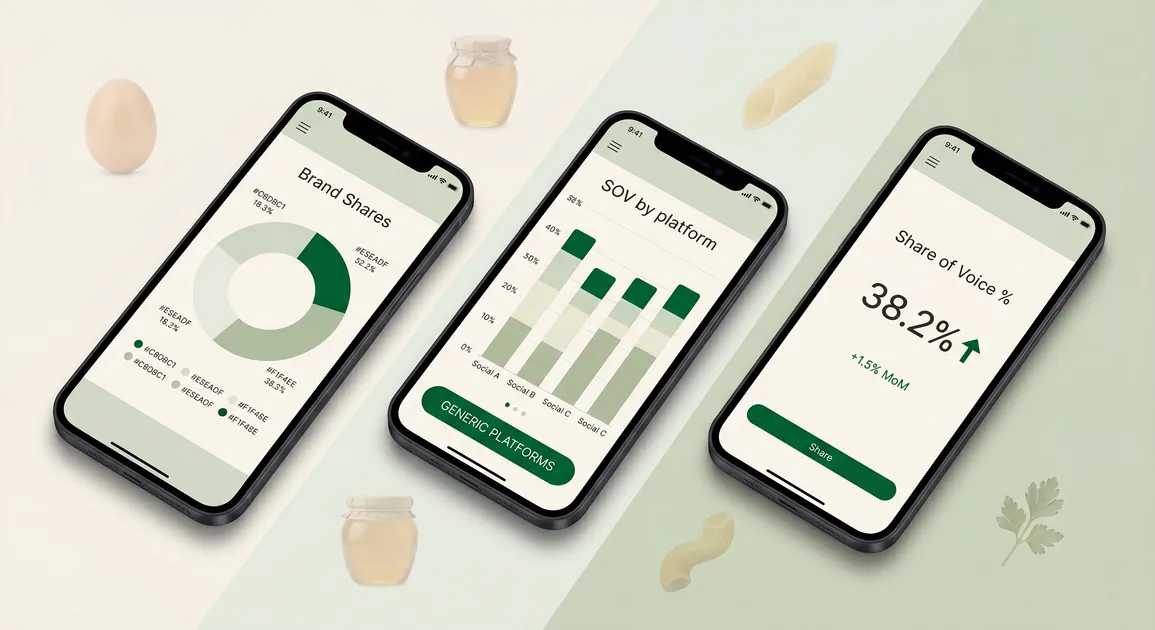
Knowing your brand's share of total social mentions in your category — and tracking whether that number is growing or shrinking — is table stakes for serious CPG marketers. Which creator is your biggest competitor working with? What content format is crushing it for them? These aren't nice-to-know questions. They're strategic inputs.
The Biggest Mistakes CPG Brands Make With Food Influencer Marketing
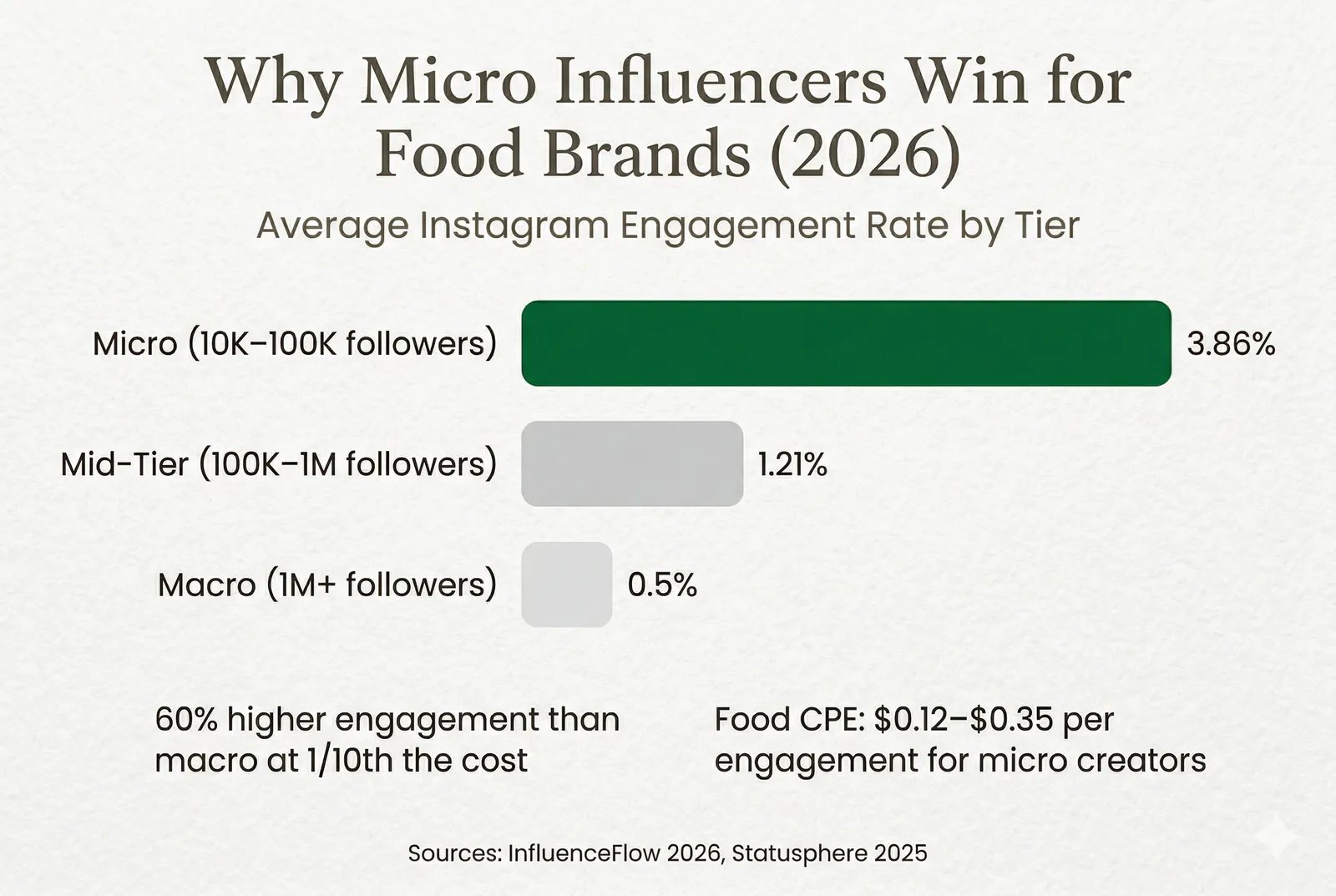
Prioritizing reach over relevance. A macro influencer with 500K followers in a general lifestyle niche will almost always underperform a micro influencer with 30K followers who exclusively creates dairy-free recipe content — if you're a dairy-free brand. Micro influencer marketing consistently delivers higher engagement rates and more targeted reach for CPG brands. Fit matters more than size.
Not setting clear content guidelines. Vague briefs produce vague content. If your brief doesn't specify the recipe format, the platform requirements, the key message, the retail call-to-action, and the dos and don'ts — you'll get posts that feel off-brand and drive zero purchase intent.
Measuring vanity metrics. Likes and follower counts are easy to see and easy to fake. The metrics that matter for CPG brands are impressions, engagement rate, CPM, and — ideally — retail lift data tied to specific creator posts.
Running campaigns in isolation. Each campaign should feed the next. Which creators over-delivered? Which under-delivered? Which creative angles drove the most engagement? If you're not capturing this systematically, you're rebuilding from scratch every time.
Ignoring the competitive landscape. If a competitor is quietly capturing 40% more share of voice in your category while you're not watching, you'll feel it in sales before you ever understand what happened.
How to Choose the Right Food Influencer Marketing Platform
If you're managing more than 2–3 creator campaigns a year, a spreadsheet is not a system. Here's what to look for in a dedicated influencer marketing platform:
Influencer discovery with real data. You need influencer discovery tools that let you filter by engagement rate, content category, audience demographics, location, and credibility score — not just follower count and category tags.
Influencer pricing transparency. The best influencer management tools will show you estimated market rates per creator before you reach out — so you can plan your budget with confidence, not sticker shock.
Budget optimization. The platform should tell you what impressions and CPM to expect from a given creator mix before you commit budget. If it can't do this, it's not a planning tool — it's just a database.
Brief and campaign management in one place. Brief creation, creator selection, content review, and performance tracking should all live in the same system. Every tool handoff introduces friction and data loss.
Competitive intelligence. Share of voice tracking across Instagram, TikTok, YouTube, and X — broken down by brand, platform, and content type — should be built in, not something you commission separately.
AI that actually understands CPG. Generic AI marketing software can draft content and answer questions. A CPG-specific AI marketing platform can pull your live campaign data, draft a brief for your new SKU, recommend creators based on your past campaign performance, and tell you which campaigns are at risk of missing impression targets. That's a different category of tool.
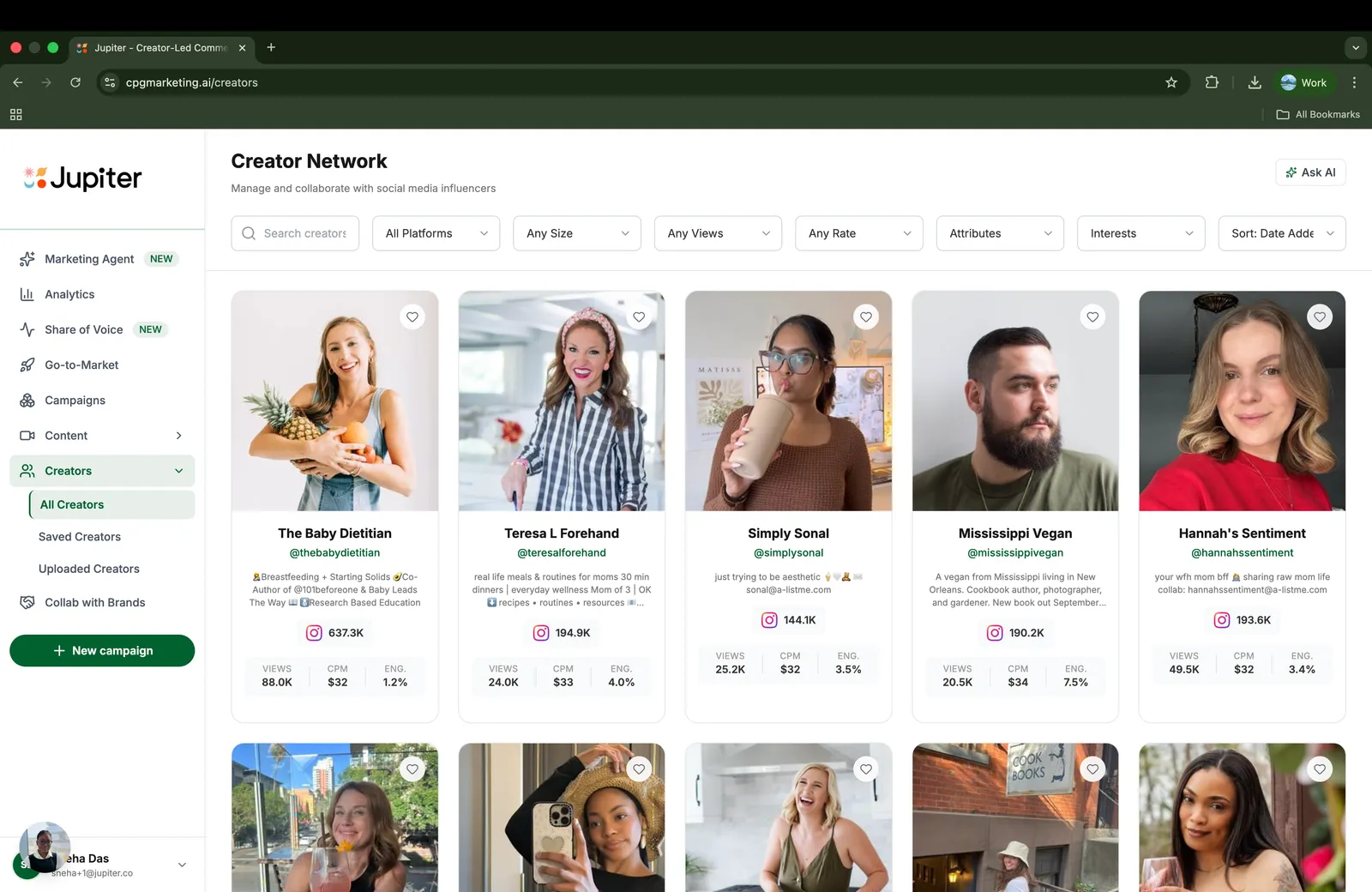
Jupiter's influencer marketing platform for food brands
Why Jupiter Was Built for This
Jupiter is an AI-powered marketing platform built exclusively for food and beverage CPG brands. It's the only platform purpose-built around how food brands actually work — with retailer targeting, product SKU structure, recipe content formats, and the metrics that matter to CPG marketers baked in from day one.
Here's what that looks like in practice:
Before you spend a dollar, Jupiter's campaign optimizer models projected impressions and CPM based on real creator performance data — so you're making a confident budget decision, not a guess.
Creator selection runs through a 6-signal fit score: content interest alignment, posting recency, retailer proximity, brand affinity, creator attribute match, and audience match. The knapsack algorithm then maximizes expected impressions given your budget.
The Jupiter AI agent can draft your campaign brief, pull your last three campaigns' performance data, find food creators in a specific city with a minimum engagement rate, and answer questions about your competitive share of voice — all in a single chat interface, without leaving the platform.
Content review is built into the workflow: submission → approval/rejection → posting, with deep-linked notifications so your team always knows what needs attention.
Share of Voice tracking starts automatically when you add your brand — Jupiter identifies your category, discovers your top competitors, and begins monitoring mentions across platforms within 24 hours.
The result: food brands that use Jupiter run campaigns faster, spend budgets more efficiently, and build a compounding asset of creator intelligence that makes every subsequent campaign better than the last.
Ready to See It in Action?
Launch creator-led campaigns faster with better ROI visibility.
Book a demo

If you're running food influencer campaigns today and any part of this guide felt like a description of your current workflow — the spreadsheets, the scattered content review, the post-campaign guesswork — it's worth seeing what a purpose-built system looks like.
We'll walk through your current campaign workflow, show you how the optimizer works with real creator data, and give you a clear picture of what's possible.
FAQs
Quick answers to common questions.
What is food influencer marketing?▼
Food influencer marketing is the practice of partnering with recipe creators, chefs, and food lifestyle creators on Instagram and TikTok to promote CPG products to engaged, trusting audiences. Unlike traditional advertising, food influencer content feels native — a creator making a weeknight pasta using your sauce reaches consumers at the moment of cooking inspiration, driving both brand awareness and measurable grocery sales.
How do you find the right food influencers for a CPG brand?▼
The best food influencer programs use multi-signal creator selection — not just follower count. The signals that actually predict campaign performance are engagement rate, content interest alignment, credibility score, retailer proximity, brand affinity history, and audience demographics. A creator with 25K followers and a 6.8% engagement rate will consistently outperform a creator with 200K followers and a 1.2% engagement rate for food CPG campaigns.
What is a good CPM for food influencer marketing?▼
A good CPM for food CPG influencer marketing is below $10. Jupiter campaigns average under $10 CPM across 800M+ impressions, compared to $20–40 CPM for paid social advertising. The key is modeling expected CPM before you spend — not discovering it after the campaign ends when the budget is already gone.
How is food influencer marketing different for CPG brands vs DTC brands?▼
DTC brands track influencer marketing ROI through Shopify clicks and direct purchases. CPG brands sell through grocery retail — Kroger, Whole Foods, Instacart — so there's no checkout pixel they control. CPG influencer marketing requires a different attribution model: Instacart shopping list adds, retailer lift data, and share of voice movement rather than last-click e-commerce attribution.
What metrics should CPG brands track for food influencer campaigns?▼
CPG brands should track five metrics: estimated vs. actual impressions and CPM, creator-level cost efficiency (impressions per dollar), UTM-tracked link clicks, Instacart shopping list adds, and share of voice delta. Most brands only track the first two. The brands winning at creator-led commerce measure all five and use them to make each subsequent campaign more efficient than the last.
What types of food influencer campaigns work best for CPG brands?▼
The campaign types that drive the strongest results for food CPG brands are recipe-based Instagram Reels and TikTok videos, Instacart-integrated shoppable campaigns, ambassador programs with long-term creator partners, and retail pick-up campaigns that geo-target creators near specific store locations. Sampling in Stories campaigns work well for new brands building initial awareness at a lower cost.
How much does food influencer marketing cost for a CPG brand?▼
Food influencer marketing costs for CPG brands vary by creator tier and campaign type. Micro-influencers (10K–100K followers) typically cost $300–$2,000 per post. Macro creators (100K–500K) range from $2,000–$10,000 per post. The more useful metric is CPM — the cost per 1,000 impressions — which should be benchmarked before spend. Jupiter campaigns average under $10 CPM, significantly below paid social rates.
More in Strategy & Guides
More from Strategy & Guides.