Jupiter vs Archive: Choosing the Right Creator Marketing Platform for Food Brands
Jupiter and Archive are both described as creator marketing platforms, but they solve fundamentally different problems. Archive captures and organizes content creators have already posted. Jupiter manages campaigns from brief to Instacart attribution. For food CPG brands evaluating both, understanding the distinction saves significant time and budget.
Trusted by leading CPG brands
















On this page
▼
- The core distinction: running campaigns vs capturing content
- Platform overview: Archive
- Where Archive is genuinely strong:
- Where Archive is not designed to go:
- Platform overview: Jupiter
- Feature-by-feature comparison
- Creator discovery
- Campaign management
- Attribution and ROI measurement
- Content repurposing for paid media
- Pricing structure
- Jupiter first, Archive later
- Who should use Archive
- Who should use Jupiter
- Summary
Jupiter and Archive are both described as creator marketing platforms. They solve different problems, operate at different moments in the creator marketing workflow, and comparing them as if they are interchangeable tools creates more confusion than clarity for food CPG marketing teams.
Archive is a social listening and creator discovery platform built for short-form video that helps brands capture UGC, source creators, automate manual workflows, and prove ROI across TikTok, Instagram (including Stories and Reels), and YouTube Shorts. It is designed to make sure brands never miss a creator post about their product and to give them a system for turning that content into paid media assets.
Jupiter is an end-to-end campaign management platform built exclusively for food and beverage CPG brands. It runs structured paid creator campaigns from brief to Instacart attribution: creator discovery through a 12-signal optimizer, brief creation with food-CPG-specific fields, content review before posting, Instacart trackable link generation per creator, and live attribution reporting. It is designed to manage creator campaigns that have been actively planned, briefed, and launched.
The core distinction: running campaigns vs capturing content
The clearest way to understand the difference between Jupiter and Archive is through what happens before a creator post goes live versus what happens after.
Jupiter operates before and during the campaign. The brand defines a campaign, selects creators through the optimizer, sends briefs, manages content review before posting, tracks Instacart attribution in real time once content goes live, and reviews campaign health against projections. The brand is driving everything. The creator is responding to a structured program.
Archive operates after a creator post goes live. A creator posts a recipe video featuring the brand's product. Archive automatically detects the post, captures it, tags it, organizes it into the brand's content library, and flags it for usage rights acquisition and paid media repurposing. The creator acted independently. Archive makes sure the brand captures the value.
Both directions matter in a complete creator marketing program. But they are not substitutes for each other. A brand that only uses Archive has content capture and no campaign management. A brand that only uses Jupiter has structured campaign performance and may miss organic creator activity between campaign windows. For most food CPG brands building a creator program, the campaign infrastructure comes first.
Platform overview: Archive
Archive is a social listening and creator discovery platform built for short-form video that helps brands capture every piece of UGC creators post about them, organize it, obtain usage rights for repurposing in paid ads and email, and report on earned media value across TikTok, Instagram, and YouTube Shorts.
Archive serves 50,000 brands including Allbirds, Notion, DoorDash, and Uniqlo, with automatic content detection that captures 100% of tagged Instagram content and 98% of TikTok posts.
Archive's AI watches video, listens to audio, and reads text to turn every detected post into searchable data, enabling brands to find UGC using natural language queries or visual similarity searches across their full content library.
Archive moved to a credit-based pricing model in 2026 with three core plans: Startup, Growth, and Enterprise, plus an Agency Standard plan for agencies managing multiple brands.
Where Archive is genuinely strong:
Automated UGC capture at scale. For food CPG brands whose products appear regularly in creator content without formal briefs, Archive ensures none of that content is missed and all of it is available for paid media repurposing. This is the tool's primary strength.
Usage rights and paid media workflow. Archive manages the process from content capture through usage rights request through whitelisting for paid social ads. For brands running creator content through paid channels, this workflow removes significant manual overhead.
Gifting and seeding program tracking. For brands running product seeding programs without formal contracts, Archive tracks which seeded creators posted, how the content performed, and which creators are worth moving into paid partnerships.
Competitive creator intelligence. Archive surfaces which creators are posting about competitor brands, giving food CPG teams visibility into the creator landscape in their category beyond their own programs.
Where Archive is not designed to go:
Archive does not manage the pre-launch campaign workflow. It does not handle brief creation, creator outreach, contract management, or content review before posting. It does not generate per-creator trackable Instacart links. It does not attribute creator posts to grocery cart adds or retailer-specific demand. It does not select creators based on retailer proximity or audience geography mapped to specific store footprints.
These are not gaps in Archive's product. They are simply not what Archive was built to do. For food CPG brands whose primary need is running structured paid campaigns with grocery retail attribution, Archive does not address that need.
Platform overview: Jupiter
Jupiter is built exclusively for food and beverage CPG brands. Every feature is designed for one specific context: brands selling through grocery retail and Instacart that need to run structured creator campaigns and measure the results in terms that matter for grocery marketing leadership.
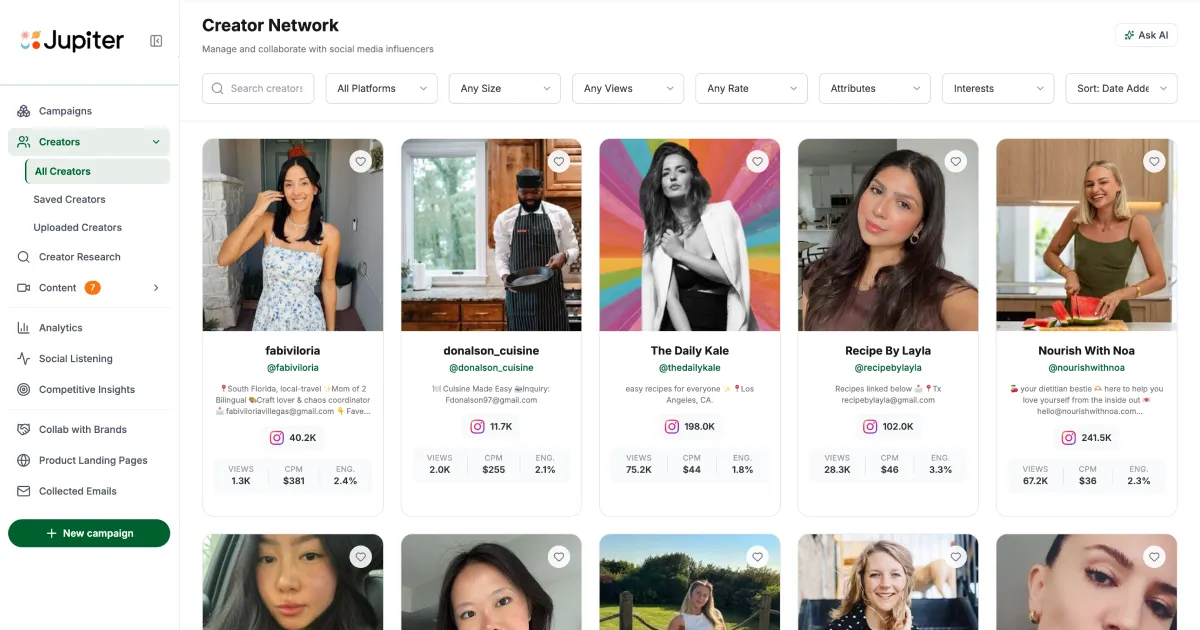
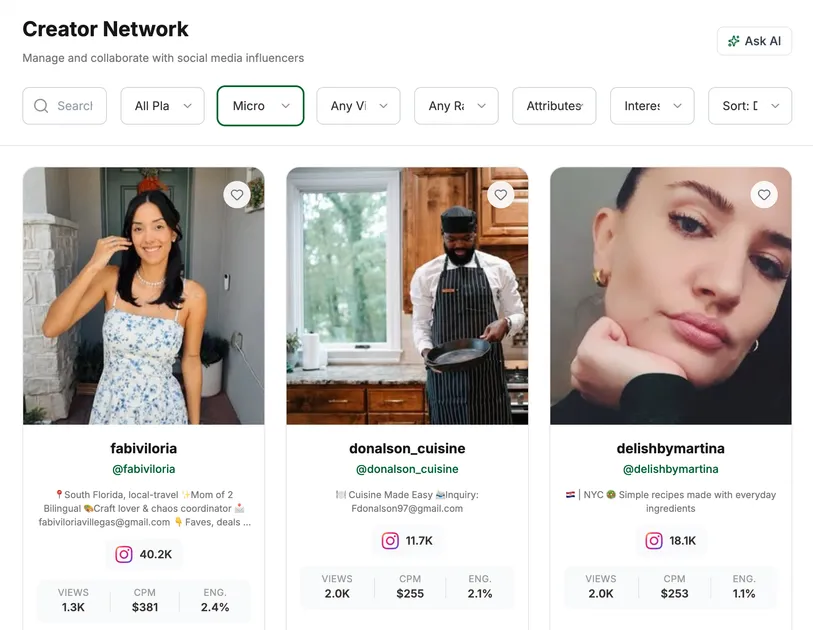
Jupiter's creator network contains 1,000+ food creators curated specifically for recipe and food lifestyle content. Every creator has per-platform average view counts, engagement rates, save rates, content interest tags mapped to food categories, audience geography down to metro level, and credibility scores. The campaign optimizer scores every eligible creator across 12 signals: geographic match, demographic alignment, content interest overlap, engagement quality, view consistency, audience credibility, content recency, brand affinity from past collaboration history, retailer proximity to target stores, creator attribute match, audience attribute match, and hashtag relevance.
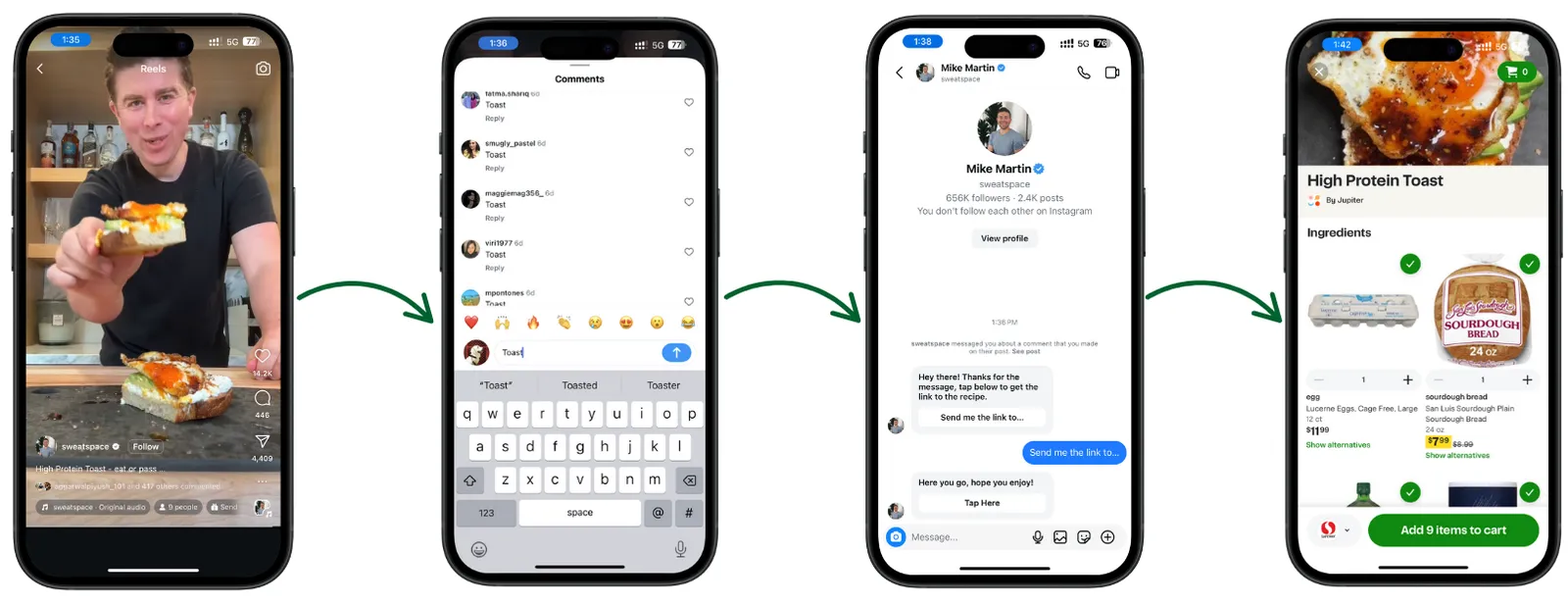
Instacart attribution is the defining differentiator for food CPG brands. When a viewer comments on a creator's post with a specific keyword, they automatically receive a DM with a unique shoppable Instacart link tied to that creator and post. Cart adds attribute back to the specific creator and post that drove them, giving the brand per-creator ROI data that no generic platform provides.
The Jupiter AI marketing agent is a 20-tool conversational assistant that handles creator search, brief drafting, campaign analytics, and performance reporting using the brand's actual platform data. The analytics dashboard surfaces estimated vs. actual impressions, creator-level cost efficiency, Instacart attribution data, and real-time campaign health indicators. Share of voice tracking monitors brand mentions across Instagram, TikTok, YouTube, and X continuously.

See what end-to-end CPG campaign management looks like in Jupiter
1,000+ food creators, Instacart attribution, 12-signal optimizer, and a 20-tool AI marketing agent built exclusively for food and beverage CPG brands.
Feature-by-feature comparison
Creator discovery
Archive discovers creators reactively: the platform surfaces creators who are already posting about the brand or competitor brands organically. This is a useful signal for identifying advocates worth formalizing into paid partnerships, but it requires organic creator activity to exist before it produces useful results.
Jupiter discovers creators proactively: the brand defines campaign requirements and the optimizer produces a ranked shortlist of food creators who fit, before any outreach happens. For food CPG brands actively planning campaigns, this is the model that produces actionable shortlists on demand rather than waiting for organic activity to surface candidates.
Campaign management
Archive tracks campaign performance for programs in progress (which creators posted, how content performed, content organized by campaign). It does not manage the campaign before it launches: no brief creation, no creator outreach, no contract management, no content review before posting, no Instacart attribution setup.
Jupiter manages the full lifecycle: brief creation with CPG-specific fields (recipe concept, retailer call-to-action, certifications, shoppable comment trigger), creator selection through the optimizer, campaign request delivery, content review before posting, Instacart trackable link generation per creator, and live attribution reporting throughout the campaign window.
For food CPG brands that need to run campaigns rather than just track them, Jupiter handles what Archive does not.
Attribution and ROI measurement
Archive reports on earned media value, impressions, engagement, and follower counts across captured content. For brands running gifting programs or wanting to quantify the value of organic creator activity, this reporting is useful. It does not connect creator content to grocery purchases.
Jupiter reports on the metrics that food CPG leadership actually asks about: estimated vs. actual impressions, creator-level cost efficiency (impressions per dollar), Instacart trackable link clicks and cart adds per creator, geographic distribution of Instacart traffic, and campaign health against projections. For food CPG brands that need to answer "did this creator campaign drive grocery sales?", Jupiter provides the data that makes that question answerable. Our four-layer influencer marketing ROI framework covers the full measurement model.
Content repurposing for paid media
Archive is the stronger tool here. The workflow from content capture through usage rights request through whitelisting for paid social ads is Archive's core value for many brands. Jupiter focuses on pre-post content review and post-campaign performance tracking, not on routing creator content into paid media channels.
For food CPG brands running creator content through paid social (Instagram Ads, TikTok Ads), Archive's paid media workflow is genuinely useful and Jupiter does not replicate it.
Pricing structure
Archive operates on a credit-based pricing model with Startup, Growth, and Enterprise tiers, scaling with UGC volume rather than a flat subscription.
Jupiter is demo-based with no setup fees, structured around campaign volume and program scope. The relevant cost comparison for food CPG brands is not Archive versus Jupiter as a binary but rather what each tool's cost delivers within a complete program: Jupiter as the campaign operating layer, Archive as a potential complement for organic content capture.
Running food CPG campaigns without Instacart attribution?
See how Jupiter connects creator posts to grocery cart adds and what per-creator attribution data actually tells you about campaign ROI.
Jupiter first, Archive later
For most food CPG brands, the right sequencing is Jupiter first.
Without active campaigns generating structured creator content and Instacart attribution data, there is limited organic creator activity to capture systematically, and no campaign performance data to report against. The paid campaign infrastructure comes first. The organic content capture layer adds value once the brand's creator community has grown to the point where manually tracking organic posts between campaign windows is genuinely unmanageable.
Archive becomes a natural complement for food CPG brands that have already built an active paid creator program and are seeing significant organic creator activity outside formal campaigns. A brand running four to six Jupiter campaigns per year across a growing creator roster will start to notice recipe creators posting independently about the product between campaign windows, gifted product generating organic content, and brand mentions accumulating across social platforms. At that point, Archive's automated capture ensures none of that value is lost.
Getting the sequencing backwards (buying Archive before having a structured campaign program) gives the brand a content capture tool with limited organic activity to capture. Getting it right (establishing the campaign infrastructure in Jupiter first, then adding Archive as organic volume grows) builds a program where each tool does the job it was designed for.
For food CPG brands at the beginning of their creator marketing program, Jupiter is the tool that generates the results, the data, and the creator relationships that make a broader program worth building. Archive is for when that program has grown to a scale that needs systematic management of organic activity alongside the active campaigns.
Who should use Archive
Archive is the right tool in specific situations regardless of where a food CPG brand is in their creator marketing journey.
Brands with high organic creator activity. If the brand's products appear regularly in creator recipe content without formal briefs (strong retail presence, distinctive products, or an existing creator community), Archive ensures none of that content is missed.
Brands running gifting or seeding programs. Product seeding without formal contracts is harder to track than paid campaigns. Archive tracks which seeded creators posted, what the content looked like, and how it performed.
Brands that run creator content through paid social. For food CPG brands running UGC through Instagram Ads or TikTok Ads, Archive's usage rights and whitelisting workflow removes significant manual overhead.
Brands that want competitive creator intelligence. Archive's visibility into which creators are posting about competitor brands gives food CPG teams useful category intelligence that can inform both paid campaign creator selection and organic community building.
Who should use Jupiter
Jupiter is the right tool for food and beverage CPG brands that need to run structured paid creator campaigns with grocery retail attribution.
Brands selling through grocery retail and Instacart. If the primary distribution channel is Whole Foods, Kroger, Sprouts, Costco, Target, or Instacart, Jupiter was designed for the attribution model that connects creator content to those specific purchase paths.
Brands that need to answer "did this drive sales?" For food CPG leadership that asks for ROI in terms of grocery sell-through rather than impressions and engagement, Jupiter's Instacart attribution layer is the infrastructure that makes that question answerable.
Brands running retailer-windowed campaigns. Whole Foods endcap programs, Kroger Mega Sale activations, and regional distribution launches require creator audience geography matched to retailer footprints. Jupiter's 12-signal optimizer handles this. Archive does not.
Brands building long-term ambassador programs. Jupiter's ambassador campaign type (six-month minimum, two-posts-per-month cadence, graduated from past campaigns) provides the structure for sustained creator partnerships with program-level analytics across cycles.
Small and mid-market food CPG teams. The Jupiter AI marketing agent's 20 tools reduce the operational overhead of running a quality creator program enough that a team of one or two people can execute at a level that previously required dedicated influencer marketing headcount.
Summary
Archive and Jupiter are not competing for the same use case. The comparison resolves clearly once the use cases are separated.
Archive captures organic content that already exists. It is genuinely useful for brands with significant organic creator activity, gifting programs, and paid media amplification workflows. It is not a substitute for a campaign management platform because it does not run campaigns, brief creators, select creators based on retailer proximity, or track Instacart attribution.
Jupiter runs creator campaigns built for the grocery retail purchase journey. It is the right primary tool for food and beverage CPG brands selling through grocery retail and Instacart who need structured campaign management and attribution data that reaches the grocery purchase.
For food CPG brands asking which tool to prioritize: if you need to run creator campaigns that drive grocery sales and measure those sales at the creator level, start with Jupiter. That is the problem Jupiter was built to solve, and it is the problem that most food CPG marketing teams need solved first.
For a broader view of how Jupiter fits into the creator marketing platform landscape, our review of the best food influencer marketing platforms covers the full comparison. For the attribution model underlying Jupiter's grocery retail measurement, our influencer marketing ROI guide covers the four-layer framework.
See Jupiter's end-to-end campaign management for food CPG brands.
1,000+ curated recipe creators, Instacart attribution, retailer proximity scoring, and a 20-tool AI marketing agent. Used by 58+ leading food and beverage CPG brands including Banza, Pete & Gerry's, and Kettle & Fire.
FAQs
Quick answers to common questions.
What is the difference between Jupiter and Archive for food CPG brands?▼
Jupiter is an end-to-end campaign management platform built exclusively for food and beverage CPG brands, running structured paid creator campaigns from brief creation through Instacart attribution and retailer-specific analytics. Archive is a UGC capture and social listening platform that automatically detects and organizes content creators post about a brand, manages usage rights for paid media repurposing, and tracks earned media value from organic creator activity. The tools operate at different moments in the creator marketing workflow and are largely complementary rather than competing.
Which platform should a food CPG brand start with: Jupiter or Archive?▼
For food and beverage CPG brands selling through grocery retail and Instacart, Jupiter is the right starting point. Structured paid campaign management, Instacart attribution, and retailer-aware creator selection are the capabilities that drive grocery sales, and these are what Jupiter was built for. Archive adds meaningful value once a brand has an active paid creator program and enough organic creator activity to need systematic capture. Start with Jupiter. Add Archive when organic UGC volume grows to the point where manual tracking is unmanageable.
Does Archive manage influencer campaigns?▼
Archive handles campaign tracking for ongoing programs (monitoring which creators have posted and tracking performance across posted content) but does not manage the pre-launch campaign workflow: brief creation, creator outreach, contract management, content review before posting, or Instacart attribution setup. For structured paid creator campaigns with formal briefs and Instacart attribution requirements, Jupiter handles the full workflow that Archive does not.
Does Jupiter capture organic UGC like Archive does?▼
Jupiter does not automatically capture organic UGC that creators post outside formal campaign windows. Jupiter manages actively-briefed creator campaigns and tracks posted content performance within those campaigns. For brands that need automated capture of all creator content about their brand including organic posts from non-partnership creators, Archive covers that workflow and Jupiter does not. Most food CPG brands benefit from both tools once their creator program reaches meaningful scale.
Can Archive track Instacart attribution for food CPG campaigns?▼
Archive does not currently offer Instacart attribution. The platform tracks earned media value, impressions, engagement, and follower counts across captured creator content. For food CPG brands that need to attribute creator content to Instacart cart adds or grocery purchase intent, Jupiter's Instacart attribution layer (per-creator trackable links, comment-triggered DM delivery of shoppable links, and cart-add attribution per creator and post) provides this capability and Archive does not.
More in Platforms & Comparisons
More from Platforms & Comparisons.