Micro Influencer Marketing for CPG: Why Smaller Creators Drive Bigger Grocery Sales
A macro creator with 1 million followers and a micro creator with 40,000 followers cost very different amounts per post. But cost per impression and cost per grocery sale are different calculations entirely. Here is why micro influencers consistently outperform their larger counterparts for food CPG brands, and the three ways to deploy them effectively.
Trusted by leading CPG brands

















On this page
▼
- The micro influencer advantage: why smaller creators outperform for grocery sales
- Engagement quality beats engagement quantity
- Audience trust compounds with niche specificity
- Retailer proximity is more actionable at micro scale
- Cost efficiency compounds across a roster
- Content volume enables testing and optimization
- What Jupiter's food creator data actually shows
- Three ways to deploy micro influencer programs for food CPG
- 1. Product seeding for content volume at predictable cost
- 2. Structured micro influencer campaigns with Instacart attribution
- 3. Micro creator ambassador programs for compounding long-term reach
- Choosing the right deployment model for your campaign goals
- The micro influencer case for food CPG in numbers
- Common mistakes food CPG brands make with micro influencer marketing
- 1. Optimizing for follower count instead of view count
- 2. Running micro creators nationally when the campaign is regional
- 3. Using product seeding as a substitute for structured attribution campaigns
- 4. Not graduating top-performing seeding creators
- 5. Evaluating micro creators on total engagement instead of save rate
- How Jupiter handles micro influencer marketing for food CPG
Micro influencer marketing for CPG brands is the practice of running creator campaigns with food creators in the 10,000 to 250,000 follower range, where the combination of niche audience specificity, high engagement rates, and lower per-post rates produces a cost per impression and cost per Instacart cart add that consistently outperforms larger creator tiers for grocery retail outcomes.
The case for micro influencers is not about reach. It is about conversion. A macro creator with 800,000 followers reaches a broad, loosely-defined audience at a premium rate. A mid-tier micro creator with 60,000 followers who posts exclusively about plant-based weeknight cooking reaches an audience that is concentrated, specific, and actively shopping for exactly the category your brand operates in. For food CPG brands selling through grocery retail and Instacart, that specificity is worth more than the reach differential.
This post covers why micro influencers outperform for food CPG specifically (not just in general), what the performance data from Jupiter's food creator network actually shows, and three ways to deploy micro influencer programs depending on your campaign goals.
The micro influencer advantage: why smaller creators outperform for grocery sales
Five structural reasons explain why micro influencers consistently deliver stronger grocery-relevant outcomes for food CPG brands than macro creators at equivalent spend levels.
Engagement quality beats engagement quantity
Micro influencers consistently deliver higher engagement rates than macro creators on identical content formats. But for food CPG brands, the more important metric is save rate, not overall engagement. Saves on recipe content indicate the viewer plans to make the recipe, which is the highest-intent signal available before an Instacart add or in-store trip. Micro food creators produce content with higher save rates per view because their audiences are niche-specific and recipe-motivated rather than broadly entertainment-oriented. A 4% save rate on 40,000 views (1,600 saves) converts to more grocery trips than a 0.4% save rate on 800,000 views (3,200 saves), because the 1,600 savers are food-motivated shoppers and the 3,200 savers include a high proportion of passive entertainment consumers.
Audience trust compounds with niche specificity
A creator who posts exclusively about dairy-free baking has built audience trust around a specific content territory. When they recommend a product, the recommendation carries the authority of their niche expertise, not just their follower count. For food CPG brands in specific categories (plant-based, gluten-free, high-protein, organic, allergen-friendly), a micro creator who has built a following within that specific dietary context converts at a meaningfully higher rate than a general food creator with a larger audience whose niche alignment with the brand is weaker.
Retailer proximity is more actionable at micro scale
For food CPG brands running retailer-windowed campaigns (a Whole Foods endcap in the Bay Area, a Kroger Mega Sale activation in the Midwest), audience geography is as important as audience size. A micro creator with 45,000 followers whose audience is 65% concentrated in Bay Area metros is more valuable for a Northern California Whole Foods campaign than a macro creator with 400,000 nationally-distributed followers. Jupiter's campaign optimizer scores creator candidates on retailer proximity as one of its 12 signals, which is why micro creators with strong geographic concentration in target retailer markets frequently outrank larger creators with weaker geographic alignment.
Cost efficiency compounds across a roster
The cost-per-impression math almost always favors micro creators over macro creators at equivalent total spend. A $40,000 campaign can pay one macro creator for a single post or twelve to twenty micro creators for twelve to twenty posts across a month. The twelve to twenty post version compounds reach across the algorithm's distribution windows, saturates the target audience across multiple content touchpoints, and produces more Instacart attribution events because more posts are generating more shoppable comment triggers. The single macro post produces a single attribution event regardless of how many views it generates.
Content volume enables testing and optimization
Running twelve micro creators gives a brand twelve data points on brief variations, recipe concepts, retailer call-to-action phrasing, and audience response. Running one macro creator gives one data point. For food CPG brands still learning which content approaches drive Instacart conversion most efficiently, the micro roster produces the learning velocity that a single macro post cannot.
What Jupiter's food creator data actually shows
The argument for micro influencers sometimes gets presented as a volume play: more creators, more content, lower individual cost. The Jupiter platform data shows the argument is more nuanced.
Across 438 food creators in Jupiter's TikTok network, median average views per post scale roughly ten times per follower tier: Nano creators (1K to 10K followers) average 1,062 median views, Micro creators (10K to 50K followers) average 2,118, Mid-tier (50K to 250K followers) average 9,154, Macro (250K to 1M followers) average 27,208, and Top-tier (1M+ followers) average 99,037.
The ten times view progression is directionally consistent, but the cost progression does not scale at the same rate. Micro creators (10K to 50K followers) typically charge $400 to $1,500 per post. Mid-tier creators (50K to 250K followers) charge $1,200 to $5,000. Macro creators charge $4,000 to $15,000. The view-to-cost ratio (impressions per dollar) is most favorable at the mid-tier and micro range, which is why most food CPG brands running Jupiter campaigns concentrate their creator spend in the 10K to 250K follower band.
But the view data also shows something important about variance. The median is a useful benchmark, and the interquartile range reveals the real opportunity. Within every follower tier, some creators dramatically outperform the median. A Micro creator with 35K followers averaging 180K views per post is not an outlier in the abstract; it is a creator whose content is algorithmically outperforming their follower count, and those are the creators whose cost-per-impression is not just better than Macro creators but dramatically better. Jupiter's optimizer surfaces these by sorting on average view count within tier rather than follower count, which is how food CPG brands find the micro creators whose actual performance is worth a mid-tier budget.
Three ways to deploy micro influencer programs for food CPG
The right deployment model depends on the campaign goal. Three distinct approaches fit different food CPG use cases.
1. Product seeding for content volume at predictable cost
Product seeding is the highest-volume, most cost-efficient micro influencer deployment for food CPG brands that need a library of authentic creator content without the overhead of bespoke influencer contracts.
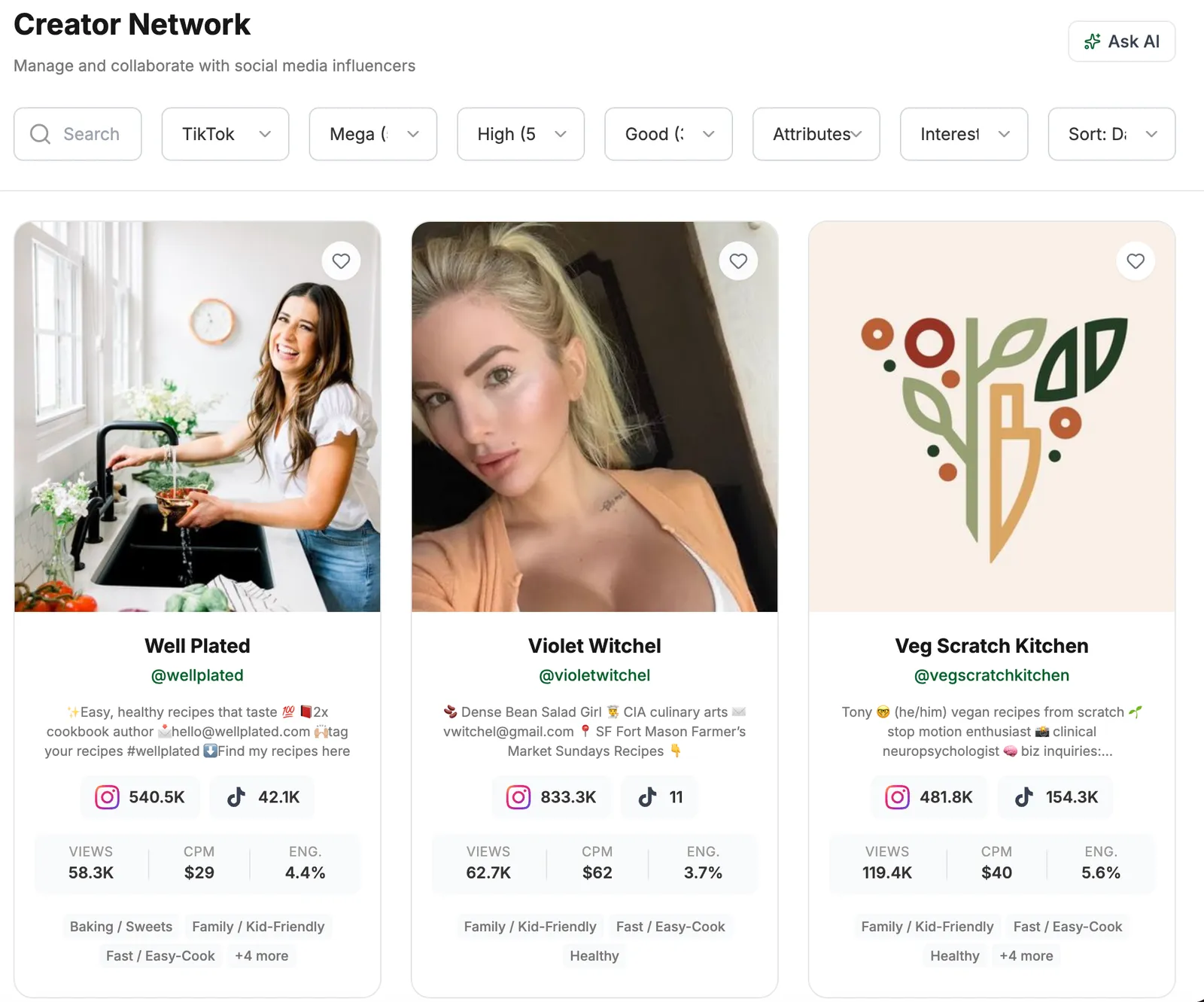
The mechanics are straightforward: the brand sets a total budget and a flat fee per creator (for example, $200 per creator on a $10,000 budget). The platform surfaces eligible food creators from the vetted network who match the brand's targeting (platform, follower size, content type, category). Interested creators apply by submitting a recipe concept and why they are a fit. The brand reviews applications, shortlists their preferred creators, and ships product. Creators produce content, submit it for brand review, and publish once approved. Creators are paid only for approved content.
The output: a $10,000 budget at $200 per creator produces up to 50 pieces of authentic recipe or product-in-use content, all reviewed and approved by the brand before going live.
Product seeding is the right model when the primary goal is content volume: fueling a brand's social channels, building a library of UGC for paid social amplification, retail deck photography, and product page imagery, or generating broad brand awareness across a large group of recipe creators simultaneously. It is not the right model when the primary goal is measurable Instacart attribution per creator, because product seeding uses flat organic fees rather than structured campaign briefs with shoppable comment triggers.
Product seeding is also one of the best mechanisms for identifying which micro creators perform well with the brand before committing to a more expensive structured campaign. A creator who delivers exceptional content and audience engagement on a $200 seeding post is a candidate for a $1,200 structured paid campaign with Instacart attribution in the next cycle.
2. Structured micro influencer campaigns with Instacart attribution
When the campaign goal is measurable grocery sales rather than content volume, structured paid micro influencer campaigns with Instacart attribution are the right deployment model.
In this model, each micro creator receives a structured brief (recipe concept, retailer call-to-action, shoppable comment trigger phrase, certification mentions, and posting timeline), a per-post fee reflecting their standard rate, and a unique per-creator trackable Instacart link. When a viewer comments on the creator's post with the specified trigger keyword, they automatically receive a DM with a unique shoppable Instacart link pre-loaded with the brand's product. The resulting cart adds attribute back to the specific creator and post.
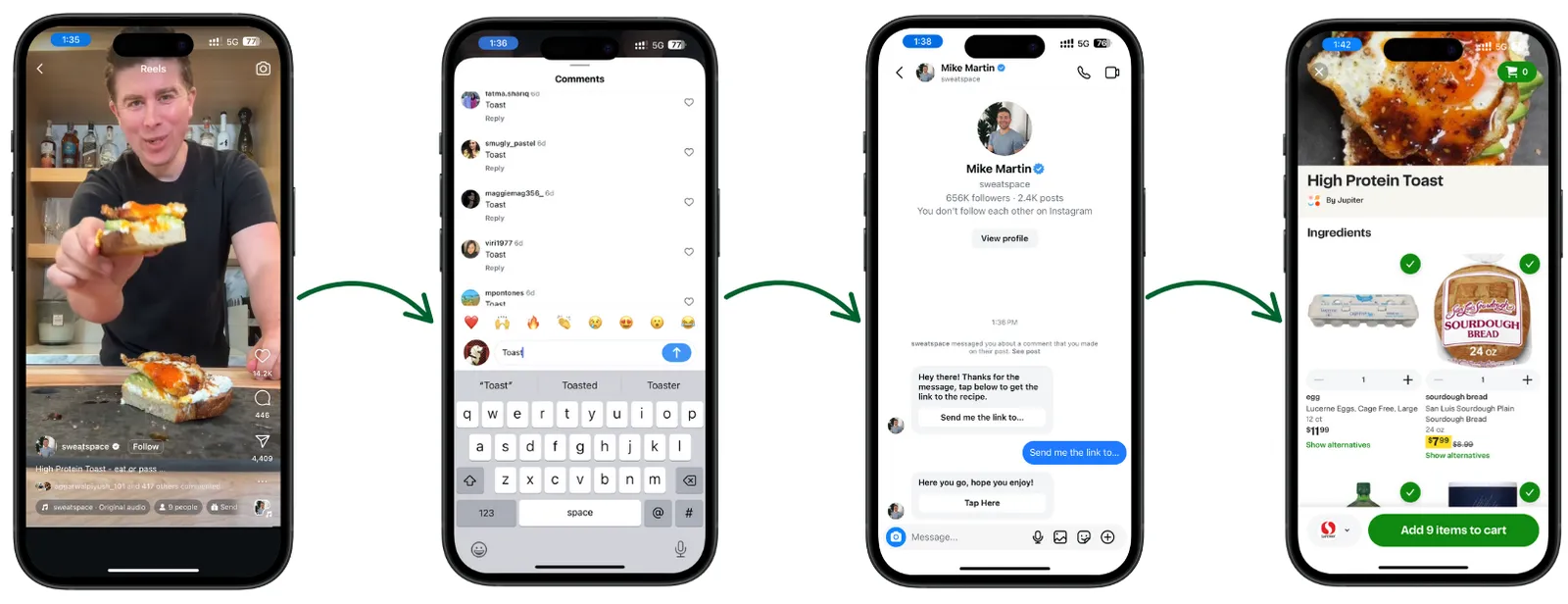
The micro tier is particularly effective for Instacart attribution because micro creators' audiences are more comment-active than macro audiences (proportional to views), which means more comment triggers fire per view, more shoppable links get delivered, and more cart adds occur per thousand impressions than from an equivalent macro creator campaign. The per-creator CPM is lower and the per-creator cart-add rate is higher, which is the combination that maximizes Instacart-attributed ROI per dollar spent.
Jupiter handles this entire workflow: creator selection through the optimizer, brief delivery, content review before posting, per-creator Instacart link generation, and live attribution reporting in the campaign analytics dashboard. The 12-signal optimizer scores micro creator candidates on retailer proximity, brand affinity from past food category collaborations, audience geography, view consistency, and engagement quality, which produces shortlists matched to the specific retailer and regional targets of the campaign.
For a deeper dive into the full Instacart attribution workflow, our Instacart campaign execution playbook covers the end-to-end mechanics.

See how Jupiter deploys micro creators for food CPG grocery campaigns
Product seeding for content volume, structured campaigns for Instacart attribution, and ambassador programs for long-term compounding reach. One platform, three deployment models.
3. Micro creator ambassador programs for compounding long-term reach
The third deployment model converts the best-performing micro creators from one-off campaigns into long-term ambassadors. This is the highest-value deployment for food CPG brands that have identified a roster of micro creators whose audiences are consistently responsive to the brand's category.
Micro creator ambassador programs run at six-month minimums with two posts per creator per month, at ambassador-tier rates that are meaningfully reduced from one-off campaign rates in exchange for the guaranteed multi-month commitment. The per-post economics are more favorable than one-off structured campaigns, the content quality rises across the program as creators become more fluent with the brand, and the audience association compounds across twelve or more posts rather than peaking with a single campaign post.
For food CPG brands building a regional creator program (a group of micro creators in Bay Area Whole Foods markets, or a group concentrated in Kroger Midwest banner markets), a micro ambassador roster produces sustained category share-of-voice growth in specific retailer markets that single campaigns cannot replicate. Jupiter's share of voice tracking captures this SOV growth across Instagram, TikTok, YouTube, and X throughout the program window.
The graduation model is the strongest starting point for micro ambassador programs. Rather than cold-recruiting ambassadors from the general creator pool, brands identify their highest-performing seeding or structured campaign creators and convert them into ambassadors in the next cycle. This eliminates selection risk (the brand already has performance data) and produces better program outcomes than starting fresh with new creators each time. Our brand ambassador programs guide covers the full graduation model and program structure.
Choosing the right deployment model for your campaign goals
The three models are not mutually exclusive. Most food CPG brands running mature micro influencer programs use all three in rotation depending on campaign objectives.
Product seeding runs as an always-on content generation layer: a continuous stream of affordable authentic creator content fueling social channels, retail decks, and paid media libraries.
Structured paid campaigns with Instacart attribution activate around specific retail moments: Whole Foods endcap launches, Kroger Mega Sale windows, new regional distribution, or Instacart-featured placement.
Micro ambassador programs build the long-term creator roster: a small group of consistently-performing micro creators who sustain brand presence in specific retailer markets across multiple cycles.
The sequencing that works: run a product seeding campaign to identify which micro creators perform well with the brand. Promote the top performers into structured paid campaigns with Instacart attribution. Promote the most consistent structured campaign performers into a micro ambassador program. The data compounds at each step, and each cycle produces a stronger roster than the one before.
The micro influencer case for food CPG in numbers
Three data points from Jupiter's food creator network put the micro influencer case in concrete terms.
Across 438 TikTok food creators in Jupiter's network, mid-tier creators (50K to 250K followers) produce median average views of 9,154 per post at rates between $1,200 and $5,000 per post. The cost per thousand views at the mid-tier median is roughly $130 to $550 per thousand views. At the Macro tier (250K to 1M followers), median average views are 27,208 at rates between $4,000 and $15,000 per post. Cost per thousand views at Macro median runs roughly $150 to $550 per thousand views. The view-to-cost ratio converges at the top of the mid-tier, which explains why the 50K to 250K follower range is the most-used tier in Jupiter campaigns.
Across creator campaigns run through Jupiter, 73.7% of delivered impressions came from Instagram and 26.3% from TikTok across 635 posted pieces of creator content. The Instagram concentration reflects where food CPG brands are currently allocating micro influencer budget, and the TikTok share is growing as brands see the organic algorithmic amplification that TikTok's discovery layer provides for recipe content.
Category share of voice for food CPG brands tracked in Jupiter's SOV infrastructure shows Instagram and TikTok nearly tied (42.8% vs 40.6%) for food brand conversation share. Micro creators, who post more niche-specific content with higher category relevance, contribute disproportionately to the earned SOV that moves these numbers. A macro creator post about a food brand reaches a broad audience and generates brand awareness. A micro creator post about a plant-based egg brand reaches a plant-curious audience and generates category share of voice in the specific segment that matters most for that brand.
Running macro creator campaigns but not seeing grocery sales lift?
See how Jupiter's 12-signal optimizer identifies micro creators whose niche audiences and retailer proximity drive Instacart cart adds rather than just impressions.
Common mistakes food CPG brands make with micro influencer marketing
1. Optimizing for follower count instead of view count
Follower count is a lagging indicator on both Instagram and TikTok. Average views per post is the live signal. Within any follower tier, the creators whose average views meaningfully exceed their tier's median are the ones whose content is algorithmically performing above expectations. Jupiter's optimizer surfaces these by sorting on views within tier.
2. Running micro creators nationally when the campaign is regional
A micro creator with 40,000 nationally-distributed followers is the wrong choice for a Sprouts Mountain West launch. A micro creator with 25,000 followers whose audience is 70% concentrated in Denver, Salt Lake City, and Phoenix is the right choice. Audience geography relative to retailer footprint matters more than total reach for retailers with regional distribution.
3. Using product seeding as a substitute for structured attribution campaigns
Product seeding generates content volume and brand awareness. It does not generate Instacart attribution data because it uses flat organic fees without shoppable comment trigger mechanics. Brands that use seeding as their only micro influencer model are generating content but not measuring whether that content drives grocery purchases.
4. Not graduating top-performing seeding creators
The best micro creator discovery mechanism is a well-designed seeding campaign. Brands that run seeding campaigns and then start fresh with new creators the next cycle are leaving their best performers on the table. The graduation model (seeding → structured campaign → ambassador) is the highest-ROI path for building a food CPG micro creator roster.
5. Evaluating micro creators on total engagement instead of save rate
For recipe content specifically, saves are the highest-intent engagement signal. A micro creator with 3% engagement dominated by saves is a stronger food CPG partner than a micro creator with 5% engagement dominated by likes, because saves signal purchase-adjacent intent rather than passive approval.
How Jupiter handles micro influencer marketing for food CPG
Jupiter is built exclusively for food and beverage CPG brands, and micro creators form the core of the platform's 1,000+ creator network. The campaign management platform handles all three deployment models: product seeding campaigns with application review and approval workflows, structured paid campaigns with Instacart attribution through per-creator shoppable links, and ambassador programs with six-month program structure and automatic content scheduling.
The campaign optimizer scores micro creator candidates across 12 signals including retailer proximity to the brand's distribution markets, audience geographic concentration, brand affinity from past food category collaborations, view consistency across the most recent 30 posts, engagement quality, and audience credibility. This is the signal set that identifies which micro creators will drive Instacart cart adds in specific retailer markets rather than generating broad impressions with no grocery relevance.
The Jupiter AI marketing agent handles creator search, brief drafting, and campaign analytics in plain language. Ask it to find micro creators in Denver with plant-based content focus and strong save rates, pull how micro creators in the last three campaigns compared on cost per Instacart click, or draft a product seeding brief for a new oat milk SKU launching at Natural Grocers. The analytics dashboard surfaces per-creator performance, Instacart attribution, and campaign health in real time. Share of voice tracking captures the category SOV movement that micro creator programs drive across the full program window.
Brands using Jupiter today include Banza, Pete & Gerry's, Nellie's Free Range Eggs, Kettle & Fire, La Tourangelle, Schweid & Sons, Vermont Creamery, and 50+ other food and beverage CPG brands, many of whom run micro creator programs as their primary always-on creator marketing layer.
Build a micro influencer program that drives real grocery sales.
Product seeding for content volume, Instacart-attributed campaigns for measurable ROI, and ambassador programs for long-term compounding reach. One platform built exclusively for food and beverage CPG.
FAQs
Quick answers to common questions.
What is micro influencer marketing for CPG brands?▼
Micro influencer marketing for CPG brands is the practice of running creator campaigns with food creators in the 10,000 to 250,000 follower range, where niche audience specificity, high engagement rates, and lower per-post rates produce cost-per-impression and Instacart cart-add economics that consistently outperform larger creator tiers for grocery retail outcomes. For food CPG brands selling through Whole Foods, Kroger, Sprouts, or Instacart, micro influencers combine affordable reach with the niche content specificity that drives grocery purchase intent.
Why do micro influencers outperform macro influencers for food CPG brands?▼
Micro influencers outperform macro influencers for food CPG brands for five reasons: higher save rates on recipe content (which is the highest-intent signal before an Instacart add), audience trust compounded through niche content specialization, more actionable retailer proximity when audiences are geographically concentrated in target retailer markets, better cost-per-impression efficiency at equivalent total spend levels, and more learning velocity from running multiple micro creators simultaneously versus a single macro creator.
What is the difference between product seeding and structured micro influencer campaigns?▼
Product seeding is a high-volume model where brands send product to a large group of micro creators at flat fees, generating authentic content at predictable cost for brand awareness and UGC library building. Structured micro influencer campaigns use formal briefs, per-post rates, and Instacart trackable links to attribute specific creator posts to grocery cart adds. Product seeding optimizes for content volume. Structured campaigns optimize for measurable grocery sales attribution. Both are valid deployment models for food CPG brands and serve different campaign objectives.
How many micro influencers should a food CPG brand work with per campaign?▼
Most food CPG brands running micro influencer campaigns through Jupiter work with 6 to 20 creators per structured campaign, depending on budget and geographic scope. Product seeding campaigns typically involve 25 to 50 creators at flat fees. Ambassador programs run 8 to 15 micro creators across tiered structures. The right number depends on the campaign's geographic scope (regional programs need fewer, more concentrated creators; national programs need more), the campaign type (seeding runs more creators than attribution campaigns), and the total budget available.
What metrics matter most for micro influencer marketing in food CPG?▼
The metrics that matter most for food CPG micro influencer programs are: save rate on recipe content (highest-intent pre-purchase signal), average views per post relative to follower count (identifies algorithmically outperforming creators within each tier), Instacart trackable link clicks and cart adds per creator (measures grocery purchase intent directly), geographic concentration of audience in target retailer markets (determines campaign regional relevance), and audience credibility score (percentage of real versus bot audience). Follower count and total engagement rate are useful secondary signals but should not drive creator selection for food CPG programs.
How does product seeding work for CPG food brands?▼
Product seeding for food CPG brands works through a campaign structure where the brand sets a total budget and flat fee per creator, eligible food creators in the network apply with recipe concepts, and the brand reviews applications and selects which creators receive product. Creators produce content, submit it for brand approval, and publish once approved. Creators are paid only for approved content. A $10,000 seeding budget at $200 per creator generates up to 50 pieces of authentic recipe or product-in-use content, all reviewed before going live. Product seeding is best used for content volume and brand awareness rather than Instacart attribution.
More in Creator Selection & Pricing
More from Creator Selection & Pricing.