Jupiter vs GRIN: Which Platform Is Better for Food CPG Brands?
GRIN is one of the most recognized influencer marketing platforms on the market. Jupiter is built exclusively for food and beverage CPG. Here's an honest comparison of both, covering creator networks, attribution, retailer targeting, pricing, and which platform is actually right for brands selling through grocery retail.
Trusted by leading CPG brands














On this page
▼
- Quick verdict
- Platform overview: GRIN
- Where GRIN genuinely excels:
- Where GRIN shows its DTC roots when used for grocery CPG:
- Platform overview: Jupiter
- Where Jupiter excels for food CPG:
- Where GRIN is the stronger choice:
- Feature-by-feature comparison
- 1. Creator network and discovery
- 2. Attribution and ROI measurement
- 3. Campaign brief and content workflows
- 4. Retailer targeting and proximity scoring
- 5. Analytics and reporting
- 6. Pricing
- Two purchase journeys, two very different attribution needs
- Who should use GRIN
- Who should use Jupiter
- GRIN vs Jupiter: the questions that matter
- Summary
If you're a food or beverage CPG brand evaluating influencer marketing platforms, GRIN and Jupiter will both come up quickly in your research. GRIN is one of the most established creator management platforms in the market, trusted by hundreds of DTC brands across fashion, beauty, health and wellness, and consumer goods. Jupiter is built exclusively for food and beverage CPG brands, with Instacart attribution, retailer proximity scoring, and a creator network curated specifically for recipe and food lifestyle content.
This comparison is written by Jupiter, so it would be dishonest to claim neutrality. What it can be is specific about where each platform genuinely wins, where the differences actually matter for food CPG brands, and how to make the decision based on what your brand actually needs rather than on which sales deck is more polished.
The short version: if your brand sells primarily through a Shopify DTC store, GRIN is an excellent platform with a strong track record. If your brand sells through Whole Foods, Kroger, Sprouts, Target, or Instacart, you are asking GRIN to do something it was not designed for, and the gap shows up in attribution, creator selection, and campaign ROI in ways that matter.
Here is the full comparison.
Quick verdict
Jupiter | GRIN | |
|---|---|---|
Built for | Food and beverage CPG exclusively | DTC brands across all verticals |
Creator network | 1,000+ curated food and recipe creators | 190M+ creators across all verticals |
Instacart attribution | Built in | Not available |
Retailer proximity scoring | Built in | Not available |
CPG-specific brief workflows | Built in | Generic brief templates |
Shopify integration | Not the focus | Deep, core differentiator |
Affiliate program management | Not the focus | Strong, core differentiator |
AI assistant | 20-tool Jupiter AI marketing agent | Gia AI agent (newer, affiliate-focused) |
Pricing | Demo-based, no setup fees | Custom quote, ~$2,200/month and up |
Best for | Food CPG selling through grocery retail and Instacart | DTC brands running affiliate and creator programs on Shopify |
Platform overview: GRIN
GRIN was founded in 2014 and has built a strong reputation as an all-in-one creator management platform designed to help brands discover, manage, and nurture influencer relationships. It is one of the longest-standing platforms in the influencer marketing software category and has a genuinely strong track record with DTC e-commerce brands.
GRIN's core architecture is built around Shopify. The platform integrates deeply with Shopify to sync product catalogs, automate product gifting to creators, track affiliate link conversions, and attribute creator-driven sales back to specific creators and posts. For DTC brands running a Shopify store, this integration is genuinely useful and hard to replicate through manual workflows. Users consistently praise GRIN for its ease of use and Shopify integration, noting it significantly reduces time spent on tracking and payments.
GRIN recently launched Gia, described as an AI-powered creator marketing agent that automates campaign workflows, content strategy, and creator engagement. The platform also recently introduced a free-tier affiliate product, positioning GRIN as both a full-suite creator management solution and an entry-level affiliate program tool.
GRIN's pricing is not publicly listed and uses a custom-quote model based on the number of creators managed, content volume, team size, and required integrations. Third-party pricing analyses cite starting costs around $2,200 per month, typically with annual commitments.
Where GRIN genuinely excels:
Creator relationship management at scale (CRM for influencers, email outreach, contract management)
Product seeding and gifting through Shopify
Affiliate program management with tracking links and codes
Creator payment processing built into the platform
Large cross-vertical creator database
Established platform with a decade of product development
Where GRIN shows its DTC roots when used for grocery CPG:
Attribution is built around Shopify checkout conversions, not Instacart cart adds or in-store sales
Creator network is cross-vertical and not curated for food and recipe content specifically
No retailer proximity scoring (which creators' audiences actually live near your Whole Foods or Kroger stores)
No Instacart commerce infrastructure
Brief templates are generic, not structured around recipe concepts, certifications, or retailer call-to-actions
Some users note the platform becomes limiting when working with TikTok and YouTube specifically
Platform overview: Jupiter
Jupiter is built exclusively for food and beverage CPG brands. Every feature in the platform, from creator discovery to brief creation to attribution reporting, is designed around one specific context: brands that sell through grocery retail and Instacart, not through a DTC Shopify checkout.
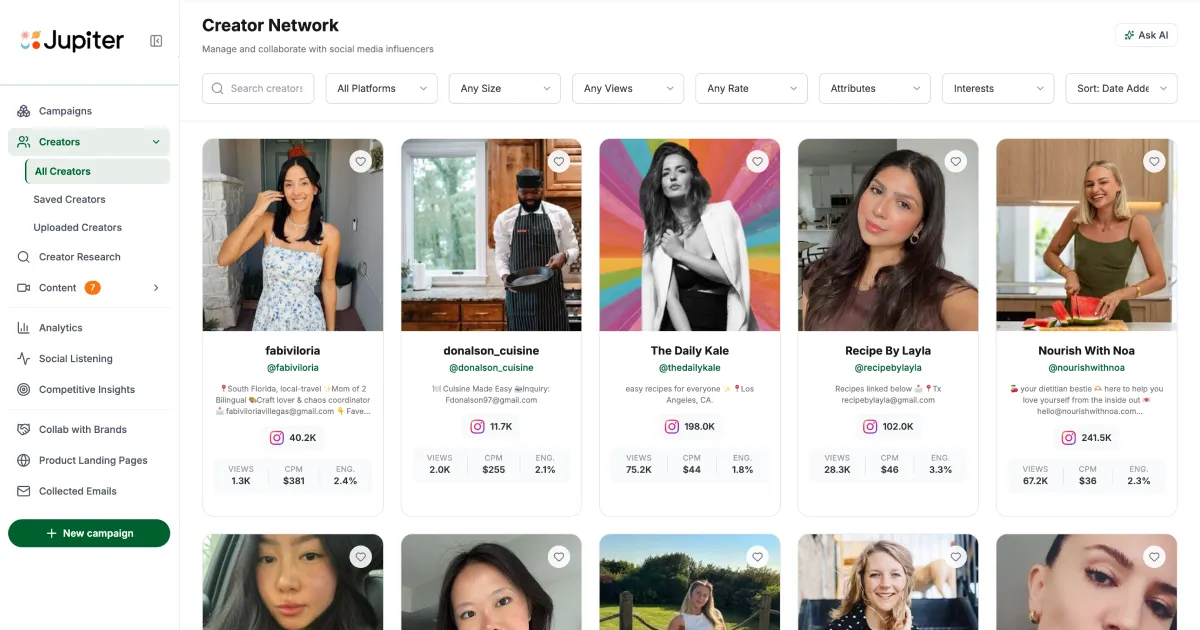
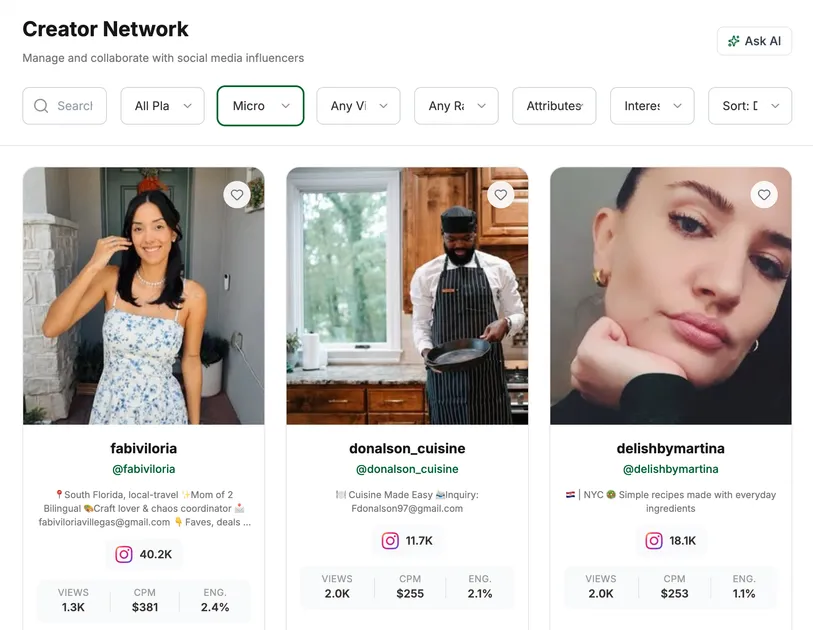
Jupiter's creator network is curated specifically for food CPG: every creator is a recipe creator, chef, home cook, or food lifestyle creator. The network covers both Instagram and TikTok with platform-specific performance data: Reels avg views, save rates, engagement rates, content interest tags mapped to food categories, audience geography down to metro level, and credibility scores estimating the percentage of real vs. bot audience. See the full creator network here.
The campaign optimizer scores every eligible creator across 12 signals: geographic match, demographic alignment, content interest overlap, engagement quality, view consistency, audience credibility, content recency, brand affinity from past collaboration history, retailer proximity to target stores, creator attribute match, audience attribute match, and hashtag relevance. The result is a creator shortlist ranked by projected fit, not just follower count.
Instacart attribution is the defining differentiator. When a viewer comments on a creator's post with a specific keyword, they automatically receive a DM with a unique shoppable Instacart link tied to that specific creator and post. The viewer adds to cart from whichever retailer Instacart serves in their area. The brand sees which creator drove the add, how many adds came in, and where geographically. This is the closest thing food CPG brands have to a checkout pixel, and it is not available on GRIN, Aspire, Upfluence, or any other cross-vertical influencer platform.
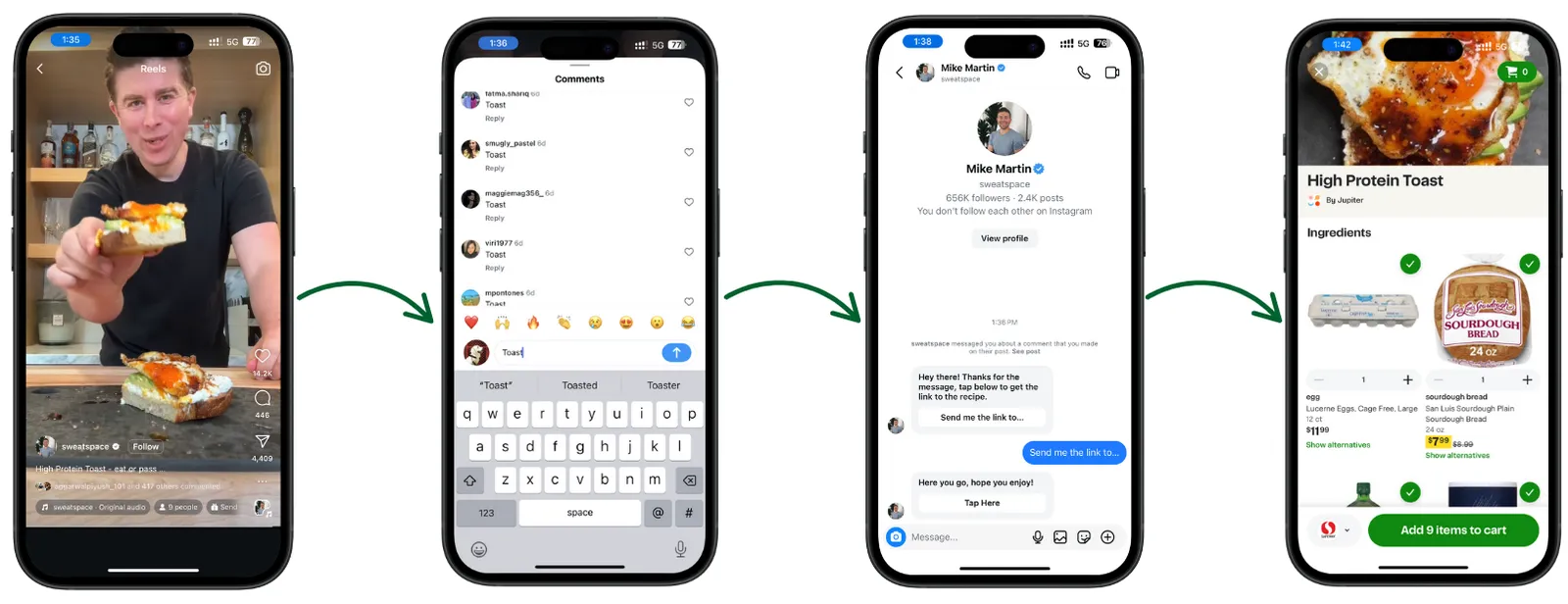
One proof point on scale: one Instagram Reel run through Jupiter, 6.5 million views, 1,000+ customers added that brand's products to their Instacart carts. The content was doing the job. The attribution layer is what made it measurable.
Jupiter's 20-tool AI marketing agent handles brief drafting and creator selection in plain language. Ask it to find TikTok food creators in LA with over 50K followers and strong engagement, or pull how your last three campaigns performed against estimated CPM, or draft a campaign brief for a new oat milk SKU launching at Whole Foods in March. The agent works with your actual platform data, not generic knowledge.
Where Jupiter excels for food CPG:
Instacart attribution built natively into every campaign
Creator network curated specifically for food and recipe content
12-signal campaign optimizer with retailer proximity and brand affinity scoring
CPG-specific brief workflows (recipe concept, certifications, retailer call-to-action)
Share of voice tracking across Instagram, TikTok, YouTube, and X
AI-assisted campaign creation, creator discovery, and analytics in one agent
Real-time campaign analytics dashboard with estimated vs. actual impressions, health indicators, and creator leaderboard
Used by Banza, Pete & Gerry's, Nellie's Free Range Eggs, Kettle & Fire, La Tourangelle, Schweid & Sons, Vermont Creamery, and 50+ other food CPG brands
Where GRIN is the stronger choice:
DTC brands running Shopify-integrated affiliate programs
Brands that need built-in creator payment processing at scale
Cross-vertical programs spanning beauty, fashion, and food together

See how Jupiter handles what GRIN was not built for
Instacart attribution, retailer proximity scoring, and food-specific creator selection in one platform built exclusively for CPG brands selling through grocery retail.
Feature-by-feature comparison
1. Creator network and discovery
GRIN has a large cross-vertical creator database. The breadth is useful for brands running programs across multiple verticals. For food CPG specifically, the depth is the issue: a database with 190M creators across beauty, fitness, gaming, fashion, and food does not mean 190M food creators. The food subset is much smaller, and filters for food-specific audience behavior (save rates on recipe content, audience grocery shopping habits, content interest depth in specific food categories) are not the primary signals the platform was built to surface.
Jupiter has 1,000+ creators and that number is intentional. Every creator in the network is a food and recipe creator specifically, with audience interest data, per-platform view counts, engagement rates, content interest tags mapped to specific food categories, and audience geography breakdown by metro. The signal quality is higher because the network is curated rather than aggregated.
For food CPG brands, the practical difference is this: a GRIN search for "food creators in Los Angeles with over 50K Instagram followers" returns a list that requires significant manual vetting to find actual recipe creators with grocery-shopping audiences. A Jupiter search returns only recipe creators, ranked by how well they match the brand's category, retailer footprint, and audience profile.
2. Attribution and ROI measurement
This is the most important category for food CPG brands and the widest gap between the two platforms.
GRIN's attribution is built around Shopify checkouts. A creator posts with an affiliate link. A viewer clicks the link. They land on a Shopify store. They buy. The conversion is tracked. This is clean, accurate, and well-executed for DTC brands. It does not work for CPG brands selling through Kroger, Whole Foods, Sprouts, or Instacart because there is no Shopify checkout to land on. The "ROI" GRIN reports for food CPG campaigns is clicks and engagement, not cart adds or sales at retail.
Jupiter's attribution model was designed for exactly this problem. Our four-layer attribution framework covers estimated vs. actual impressions and CPM, creator-level cost efficiency, trackable link clicks to Instacart product pages, and Instacart shopping list adds per creator. The Instacart layer is the differentiator: per-creator shoppable links, comment-to-DM automation, and cart-add attribution back to specific posts. This is the signal that answers "did this creator post actually drive grocery sales?" GRIN cannot answer that question for brands selling through retail.
3. Campaign brief and content workflows
GRIN has brief and campaign management tools with email outreach automation, contract management, and content tracking. The brief templates are generic: key message, deliverables, campaign timeline. These are functional for general influencer programs and work well for DTC campaigns where the product is shipped directly to the creator.
Jupiter's brief workflow is structured specifically for food CPG: recipe concept, ingredient placement, retailer call-to-action, shoppable comment trigger, certifications to highlight (USDA Organic, Non-GMO, B Corp), and seasonal retailer windows to align with. The AI marketing agent pre-fills brief fields from a plain-language campaign description, which means a campaign that used to take a day to set up takes minutes. See how the campaign management platform handles the full workflow from brief to posted content.
For CPG brands running Whole Foods endcap campaigns, Kroger Mega Sale activations, or Instacart-attributed recipe campaigns, the brief structure matters as much as the creator selection. A generic brief produces generic content. A food-CPG-specific brief produces shoppable recipe content that drives grocery trips.
4. Retailer targeting and proximity scoring
GRIN does not have retailer targeting as a creator selection signal. Geographic filtering in GRIN is typically based on creator location, not audience location broken down by proximity to specific retailers. A CPG brand launching at Whole Foods in the Bay Area cannot use GRIN to find creators whose audiences are concentrated in Northern California Whole Foods metros. This is a structural gap for retail-distributed CPG brands where the campaign goal is in-store sell-through, not DTC conversion.
Jupiter's campaign optimizer includes retailer proximity scoring as one of its 12 signals. The optimizer calculates each creator's geographic proximity to the brand's targeted retail footprint, cross-referenced against audience location data broken down by metro. For a Whole Foods Northern California launch, Jupiter surfaces creators with audiences concentrated in Bay Area, Sacramento, and San Jose zip codes who are within range of Whole Foods store clusters. For a Kroger Midwest launch, it surfaces creators with audiences in Cincinnati, Columbus, Indianapolis, and Detroit metros. This is the difference between a nationally-distributed campaign that wastes impressions and a regionally-targeted campaign that drives in-store demand where the product is actually on shelf.
5. Analytics and reporting
GRIN has reporting tools that cover campaign performance, creator attribution (via Shopify affiliate links), content delivery tracking, and ROI metrics. For DTC brands, the reporting is comprehensive and well-designed. For CPG brands, the reporting shows what is measurable through the Shopify lens (clicks, affiliate conversions) rather than what matters at retail (Instacart cart adds, sell-through lift, share of voice movement).
Jupiter's analytics dashboard is designed for the CPG context. Six headline KPIs with period-over-period deltas: total spend, total impressions, average CPM, active campaigns, creators activated, and average engagement rate. Per-creator leaderboard ranked by impressions and cost efficiency. Campaign health indicators comparing estimated vs. actual impressions in real time (green at 80%+ of estimate, yellow at 50-80%, red below 50%). Posted content feed with per-post metrics updated continuously from the social platform APIs. Creator outreach funnel from total creators to requests sent to accepted to posts delivered. Share of voice tracking across Instagram, TikTok, YouTube, and X.
6. Pricing
GRIN does not publish pricing publicly. The platform uses a custom-quote model based on the number of creators managed, content volume, team size, and required integrations. Third-party sources cite starting costs around $2,200 per month with annual commitments, scaling up from there depending on program size, seat count, and module requirements. Optional modules including product seeding fulfillment, payment processing, and advanced analytics add to the base subscription cost, and some modules carry ongoing transaction fees.
Jupiter is demo-based with no setup fees and no published per-seat pricing. Pricing is structured around campaign volume and program scope. For brands evaluating cost, the right comparison is not monthly subscription fee but total program cost including platform fees, per-campaign overhead, and attribution capability. A GRIN subscription at $2,200+ per month plus manual Instacart attribution work (which typically requires a separate measurement vendor) often costs more in total than a Jupiter program that includes Instacart attribution natively.
Currently using GRIN for a food CPG program? 🤔
See specifically what changes when you add Instacart attribution, retailer proximity scoring, and a food-curated creator network to your campaign workflow.
Two purchase journeys, two very different attribution needs
It is worth being precise about why GRIN underperforms for food CPG, because the issue is structural rather than a feature checklist gap.
GRIN was built for a specific purchase journey: consumer sees creator content → clicks affiliate link → lands on Shopify → buys. This journey is clean, measurable, and efficient for DTC brands. GRIN executes it well. The platform's architecture, attribution model, creator database, and pricing assumptions all reflect this journey.
Food CPG brands have a fundamentally different purchase journey: consumer sees creator content → gets inspired → adds to Instacart list or drives to Kroger → buys at retail. There is no Shopify in this journey. There is no affiliate link that closes the loop. The creator post and the purchase are separated by a retailer the brand does not control, an in-store trip that leaves no digital trace, or an Instacart cart that requires a completely different attribution infrastructure.
Asking GRIN to handle this journey is asking it to do something it was not designed for. The platform will manage the creator relationship, track the content delivery, and report on impressions and engagement. It will not tell you whether the campaign moved product off Kroger shelves or drove Instacart cart adds. For a CPG brand whose CMO asks "what did this $50,000 creator campaign actually do for sales?", GRIN cannot answer the question.
Jupiter was designed to answer that question. The Instacart attribution layer, the retailer proximity scoring, the food-curated creator network, and the CPG-specific brief workflows all exist because food CPG brands sell through grocery retail and the measurement problem is fundamentally different from DTC. This is why Jupiter is built exclusively for food and beverage CPG rather than as a general influencer platform with a food category filter.
Who should use GRIN
GRIN is genuinely the right platform for certain brand profiles. Be honest about this before evaluating either platform.
GRIN fits well if your brand sells primarily through a Shopify DTC store with a meaningful affiliate and creator program. The Shopify integration is deep, the affiliate tracking is accurate, and the creator relationship management tools are well-built for brands managing dozens or hundreds of creator relationships simultaneously.
GRIN also fits well if your brand runs a cross-vertical program spanning food, beauty, lifestyle, and fitness together. The breadth of the creator database is a real advantage when the program is not food-exclusive.
And GRIN fits well if your team's primary need is a creator CRM with outreach automation, contract management, and payment processing, and attribution is a secondary concern. For brands at earlier stages of influencer marketing where the priority is operational efficiency rather than closed-loop ROI measurement, GRIN's workflow tools are strong.
Who should use Jupiter
Jupiter fits food and beverage CPG brands specifically. If your products sell through Whole Foods, Kroger, Sprouts, Costco, Target, Publix, or Instacart, Jupiter is designed for your workflow.
Jupiter fits well at any team size. The AI-assisted campaign creation, 12-signal creator optimizer, and automated content scheduling mean a marketing team of one or two people can run the same quality program that a larger team would run with manual tools. The AI marketing agent handles creator search, analytics queries, campaign drafting, and performance reporting in plain language without requiring platform expertise.
Jupiter fits brands at growth stage and beyond: brands launching at new retailers and needing creator campaigns that drive sell-through within specific regional footprints, brands running Whole Foods endcap programs that need influencer support timed to merchandising windows, brands that have run a few creator campaigns and are now asking "but did any of this actually drive sales?" and need attribution infrastructure to answer that question.
For brands running their first influencer campaign with no existing creator relationships and no internal marketing capacity, the right answer might be starting with a managed service or agency while building toward platform ownership. Jupiter is not an agency; it is software that requires someone to operate it. For teams with the bandwidth to run it, the ROI is stronger than an agency model at meaningful campaign cadence.
GRIN vs Jupiter: the questions that matter
Most platform comparisons list features side by side and leave the decision to the reader. The questions that actually determine which platform is right for your brand are more specific.
Does your attribution end at clicks? If you use GRIN for a food CPG campaign and the campaign delivers strong impressions and engagement but you have no data on Instacart cart adds or in-store sell-through, you have an incomplete ROI picture. If that gap is acceptable given your current measurement maturity, GRIN can work. If you need to close that gap, you need Jupiter.
Are your creators selling to Shopify or to grocery? GRIN's Shopify integration is its strongest feature. If your product has a DTC Shopify component alongside retail distribution, GRIN handles the DTC attribution cleanly while Jupiter handles the retail and Instacart attribution. Some brands run both platforms for exactly this reason.
Does your creator selection depend on where audiences actually live? A national brand with Whole Foods distribution and a regional endcap in the Bay Area needs creators whose audiences are concentrated in the Bay Area, not creators with 500K nationally-distributed followers. If retailer footprint should drive creator selection, you need a platform with retailer proximity scoring. GRIN does not have it. Jupiter does.
Do you run programs across verticals beyond food? If your brand portfolio includes beauty or lifestyle alongside food and beverage, GRIN's cross-vertical creator database may be worth the tradeoff. If your program is exclusively food and beverage CPG, the tradeoff runs the other way.
Summary
GRIN is a well-built platform with a strong track record for DTC brands that sell through Shopify. Its creator relationship management, affiliate program tools, product seeding workflows, and Shopify integration are genuinely differentiated. It is the right platform for a meaningful set of brand profiles.
It is not the right platform for food and beverage CPG brands selling through grocery retail, specifically because the purchase journey (creator post → grocery store → product sale) is structurally different from the DTC journey GRIN was built for. The attribution gap, the missing retailer targeting, and the non-curated food creator network are not bugs in GRIN's product. They are the correct outputs of a platform designed for a different business model.
Jupiter is built for the grocery retail purchase journey specifically. Every feature in the platform, from Instacart attribution to retailer proximity scoring to food-curated creator selection to CPG-specific brief workflows, exists because food CPG brands need a different operating system for creator marketing than DTC brands do.
If you want to see how that plays out in a real campaign workflow, the Instacart campaign execution playbook covers the end-to-end process. The complete guide to food influencer marketing covers the strategic context. And the best food influencer marketing platforms comparison covers how Jupiter compares to Aspire, Upfluence, CreatorIQ, and others in the same evaluation.
See Jupiter in action for food CPG brands.
1,000+ curated recipe creators, Instacart attribution, retailer proximity scoring, and a 20-tool AI marketing agent built exclusively for food and beverage CPG. Used by 58+ leading brands including Banza, Pete & Gerry's, and Kettle & Fire.
FAQs
Quick answers to common questions.
What is the difference between Jupiter and GRIN for food CPG brands?▼
Jupiter is built exclusively for food and beverage CPG brands selling through grocery retail and Instacart. GRIN is a creator management platform designed primarily for DTC e-commerce brands, with deep Shopify integration and strong affiliate program management tools. The core difference is attribution: Jupiter tracks Instacart cart adds per creator, GRIN tracks Shopify checkout conversions. For CPG brands selling through retail rather than DTC, Jupiter's attribution model fits the purchase journey and GRIN's does not.
How much does GRIN cost vs Jupiter?▼
GRIN does not publish pricing publicly and uses a custom-quote model. Third-party sources cite GRIN starting costs around $2,200 per month with annual commitments, scaling up based on creator volume, seat count, and required modules including payment processing and advanced analytics. Jupiter is demo-based with no published per-seat pricing and no setup fees, with pricing structured around campaign volume and program scope. For food CPG brands, the total cost comparison should include whether a separate measurement vendor is needed for Instacart attribution, which GRIN requires and Jupiter includes natively.
Does GRIN work for CPG brands?▼
GRIN works for CPG brands with a meaningful DTC Shopify component, where Shopify checkout attribution is the primary ROI measurement. GRIN is a weaker fit for CPG brands selling exclusively or primarily through grocery retail and Instacart, because the platform's attribution is built around Shopify conversions rather than Instacart cart adds or in-store sell-through. Brands in this category typically need Jupiter's Instacart attribution layer to answer the question "did this creator campaign drive grocery sales?"
Which platform has better creator discovery for food brands?▼
Jupiter's creator network is curated specifically for food and beverage CPG: every creator is a recipe creator, chef, home cook, or food lifestyle creator, with audience interest data, per-platform Reels avg views, engagement rates, content interest tags mapped to food categories, and audience geography broken down by metro. GRIN has a larger creator database across all verticals, but the food-specific data depth is shallower and retailer proximity scoring is not available. For food CPG brand campaigns specifically, Jupiter's smaller but curated network typically produces more actionable creator shortlists than GRIN's broader database.
Can I use both GRIN and Jupiter together?▼
Some brands with both DTC and retail distribution channels run both platforms: GRIN for Shopify-tracked DTC affiliate and creator programs, Jupiter for retail and Instacart-attributed grocery campaigns. This works operationally and avoids forcing one platform to handle both purchase journeys. For brands selling exclusively through grocery retail with no meaningful DTC component, Jupiter alone covers the full workflow.
What does GRIN's Gia AI agent do compared to Jupiter's AI marketing agent?▼
GRIN's Gia is an AI agent focused on creator onboarding, gifting sequencing, campaign activation, and creator relationship management, with current affiliate activation requiring Shopify. Jupiter's AI marketing agent is a 20-tool conversational assistant that searches the creator network, pulls live analytics, drafts campaign briefs, surfaces campaign health data, identifies top-performing posts, and reports on brand-level performance using your actual platform data. Jupiter's agent is designed around the food CPG campaign workflow, including retailer-specific queries, Instacart attribution summaries, and share of voice reporting across platforms.
More in Platforms & Comparisons
More from Platforms & Comparisons.