TikTok Influencer Marketing Platforms for CPG Brands
Most TikTok influencer platforms are built for DTC. CPG brands need creator data, retailer attribution, and Instacart commerce in one place. Here's how to evaluate the platforms that actually fit food and beverage marketing teams.
Trusted by leading CPG brands












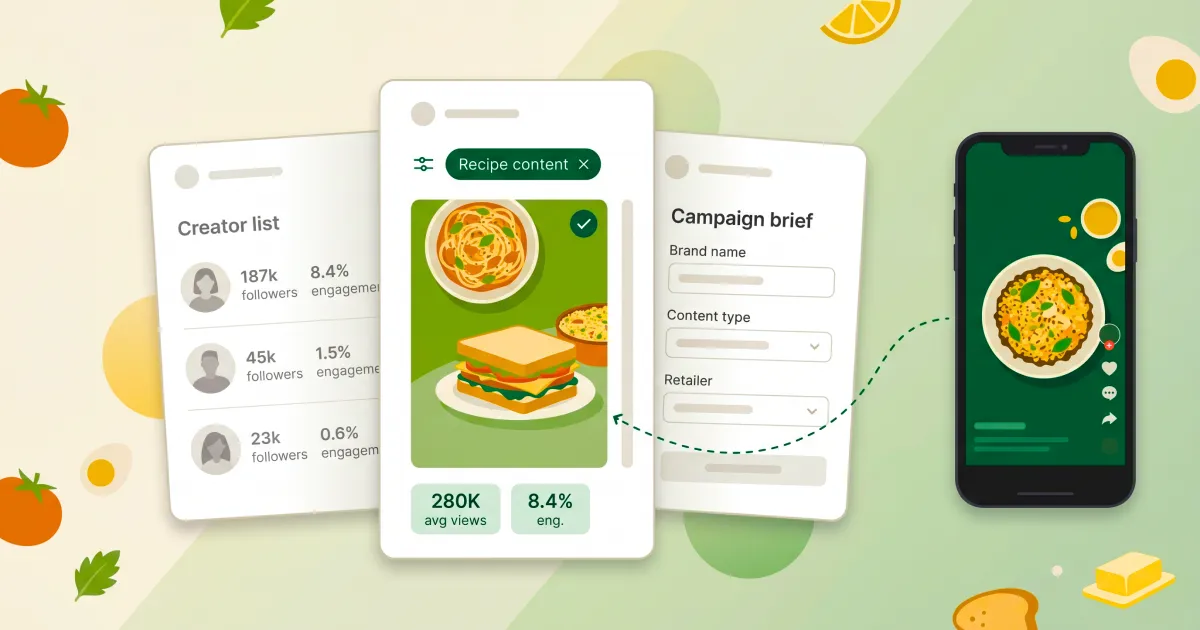
A TikTok influencer marketing platform is software that helps brands discover TikTok food creators, run campaigns, manage briefs and content review, and measure performance, usually within a single dashboard. For food and beverage CPG brands specifically, the right platform also handles retailer targeting, Instacart attribution, and platform-native pricing data, none of which generic influencer tools were built for.
The market is full of options. Most are built for DTC e-commerce brands and treat TikTok as one of several social channels. A handful are built for food CPG specifically, and that distinction matters because the metrics, the attribution, and the creator network are fundamentally different. This guide covers what to evaluate, what most platforms get wrong for food brands, and which platforms are actually built for CPG TikTok campaigns. If you want a broader view across Instagram and TikTok together, our complete review of food influencer marketing platforms covers the multi-platform comparison.
What a TikTok influencer marketing platform should actually do
Most platform marketing pages list 30 features. Five of them matter for CPG brands running TikTok campaigns.
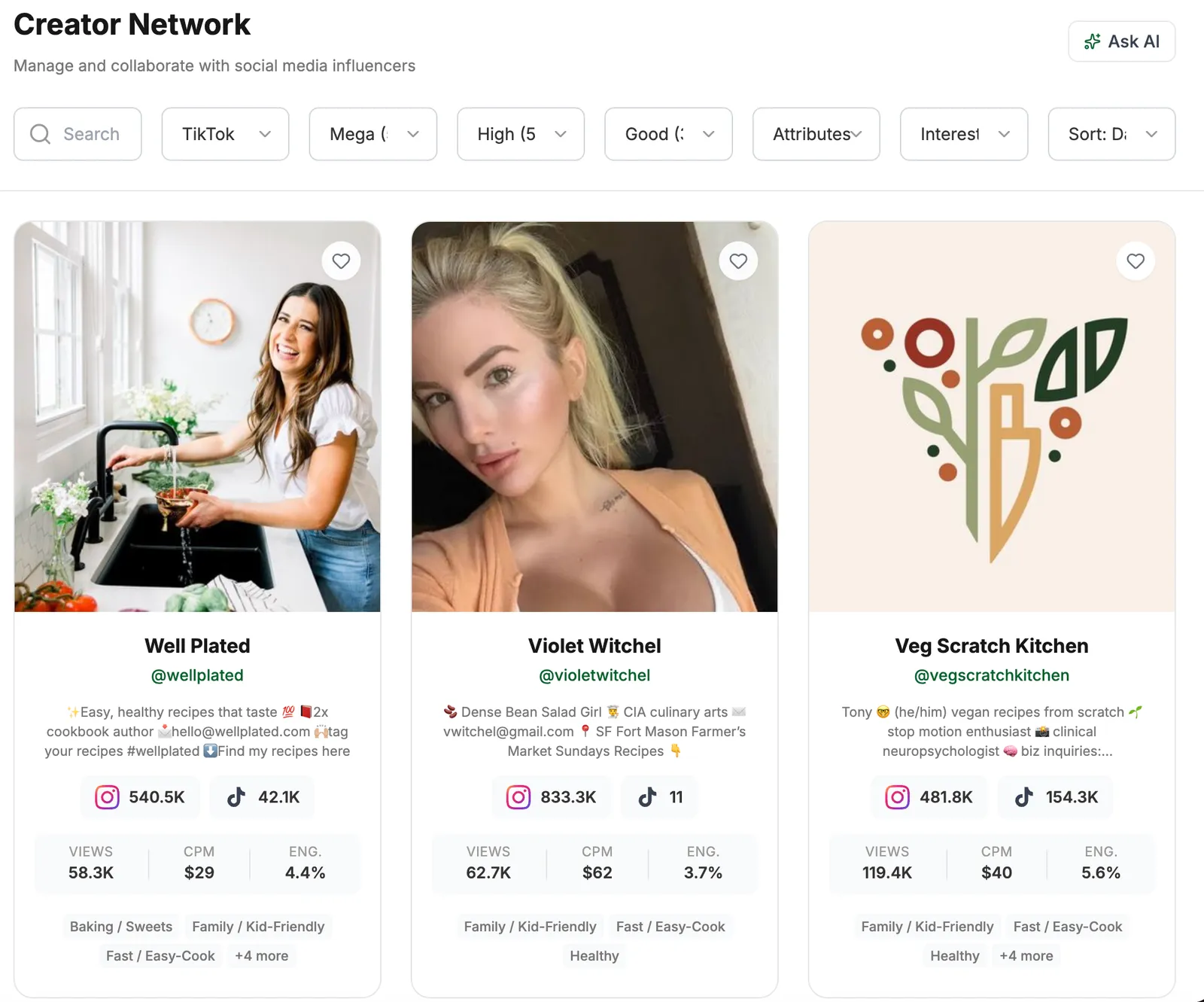
TikTok-native creator data. Average view count per video, comment-to-views ratio, save rate, and recency of viral content. Follower count alone is misleading on TikTok because the algorithm pushes content to non-followers. A platform showing only "100K followers" is showing the wrong number. The right platform shows "100K followers, 280K avg views, 6 videos over 1M views in last 60 days, 8.4% engagement rate."
Audience geography for retailer attribution. TikTok content reaches everyone, but Instacart conversion happens in specific metros. Platforms that surface where a creator's audience actually lives, broken down by Instacart-coverage zones, drive more cart adds per dollar than platforms that report only top-level demographics.
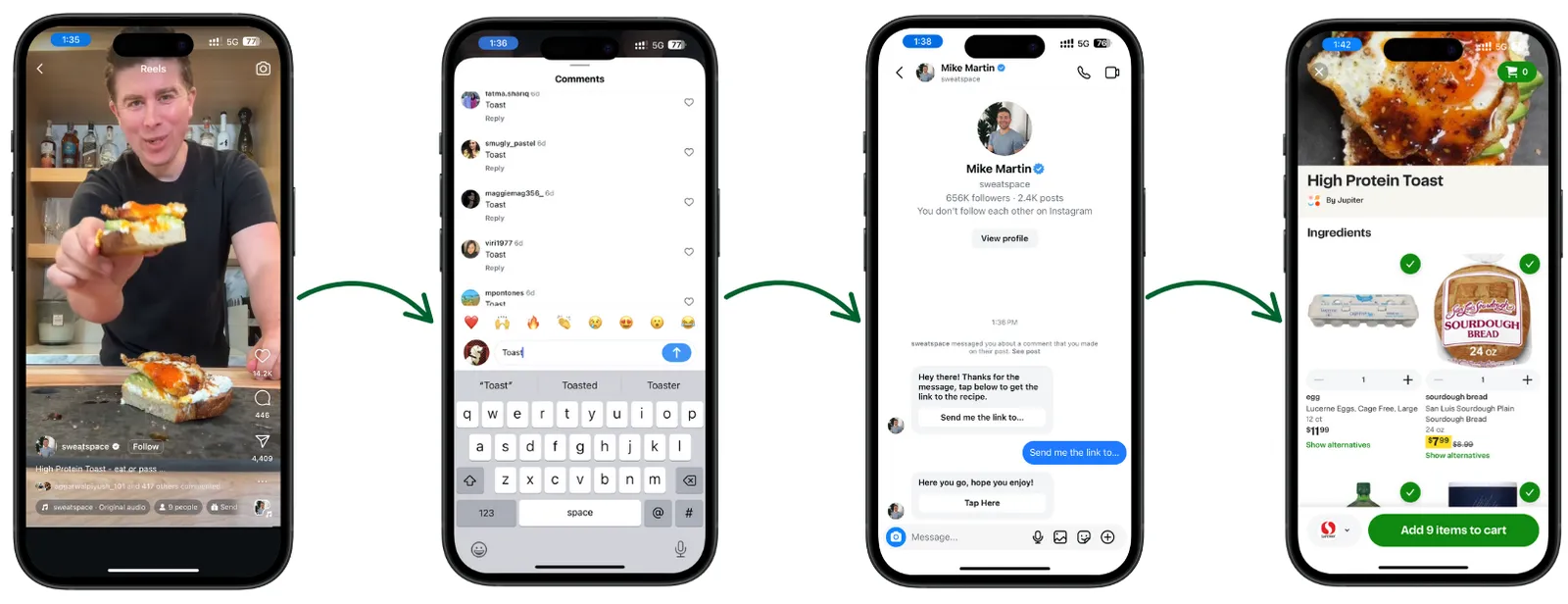
Comment-triggered DM infrastructure for Instacart. This is the mechanic that makes TikTok food campaigns actually convert. When a viewer comments on a creator's post, an automated DM sends them a unique shoppable Instacart link. Most platforms do not have this. The ones that do drive substantially higher attribution than the ones that route viewers to link-in-bio paths.
Brief workflows designed for recipe content. A brief template built for general influencer marketing asks for "key message" and "deliverables." A brief template built for food CPG asks for recipe concept, ingredient placement, retailer call-to-action, and shoppable comment trigger. The structure of the brief shapes the structure of the content, and most platforms do not have CPG-specific brief workflows.
Campaign reporting that ties TikTok content to grocery retail. Impressions and engagement rate are table stakes. The platforms worth using report cart adds per creator, comment-to-cart conversion rate, geographic distribution of conversions, and estimated GMV. Without these, "ROI" is a guess.
What most TikTok influencer platforms get wrong for CPG
The structural mismatch between generic TikTok influencer platforms and food CPG brands shows up in five places.
Attribution is built for Shopify checkouts. Most platforms tie ROI to a UTM parameter that lands on a brand-controlled checkout page. CPG brands sell through grocery retail and rarely have a checkout to land on. The "ROI" reported by these platforms is impressions and clicks, not cart adds or sales lift.
Creator networks are too broad. A platform with 5 million creators across beauty, fashion, fitness, gaming, and food sounds impressive in a sales call. In practice, the food creator subset is tiny, the audience data is shallow, and the retailer-relevant filters do not exist. Brands end up doing manual creator research outside the platform anyway.
Retailer targeting is missing entirely. A CPG brand launching at Sprouts wants creators whose audiences shop at Sprouts. A brand running an Instacart attribution campaign wants creators whose audiences live in Instacart-covered metros. A brand pushing a Whole Foods endcap wants creators near Whole Foods locations. Generic platforms have none of this.
Pricing data is wrong for food. Recipe creators with strong audiences have specific market rates. Platforms that report "estimated rate" using cross-vertical data underprice food creators, leading to outreach that creators ignore, or overprice them, leading to wasted budget.
Content review workflows are missing or generic. Food content has specific compliance requirements (allergen claims, nutritional accuracy, recipe instruction quality) that generic content review tools do not handle. CPG brands either skip review and risk off-brand content going live, or run review through email and Google Drive, which slows everything down.

See the TikTok creator network built for food CPG
1,000+ recipe creators, audience geography for Instacart attribution, and platform-specific pricing in one place.
Book a 20-minute demoTikTok influencer marketing platforms worth evaluating
Five platforms come up consistently in CPG TikTok platform evaluations. Each fits a different brand profile.
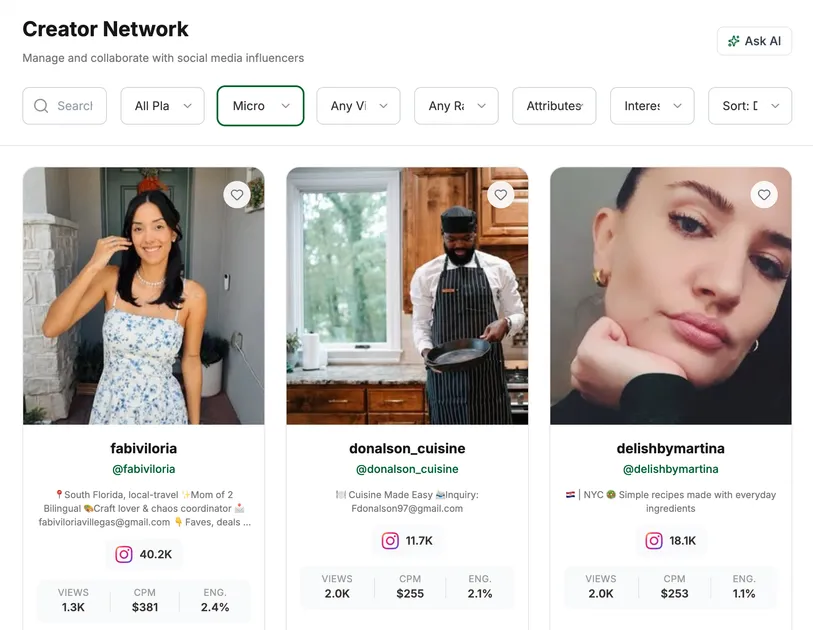
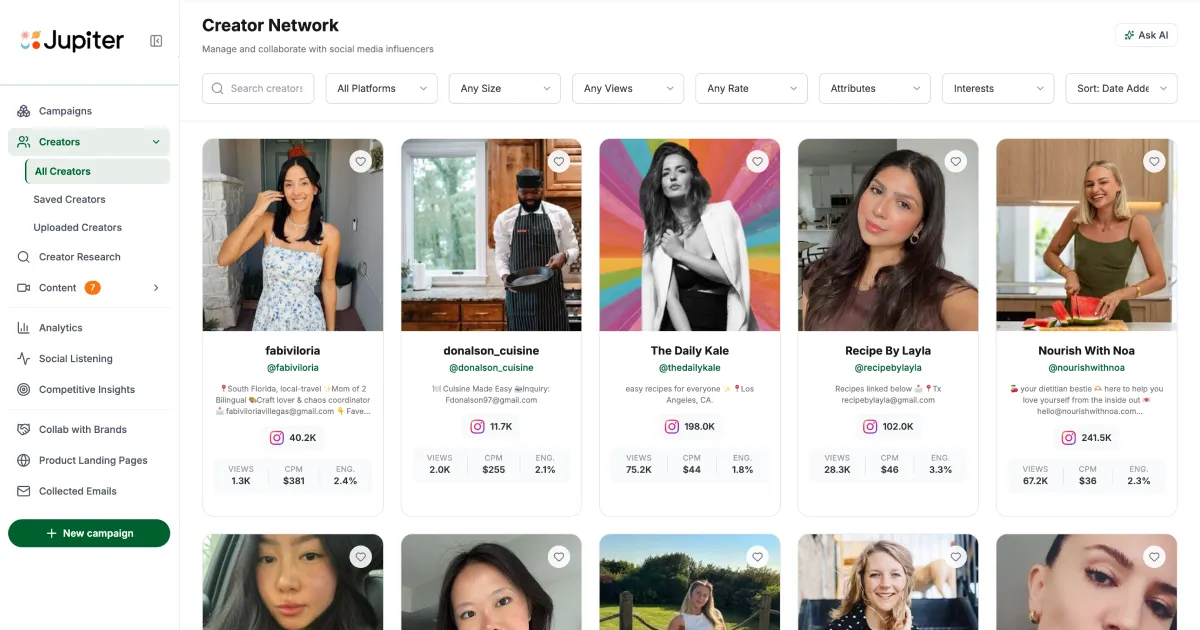
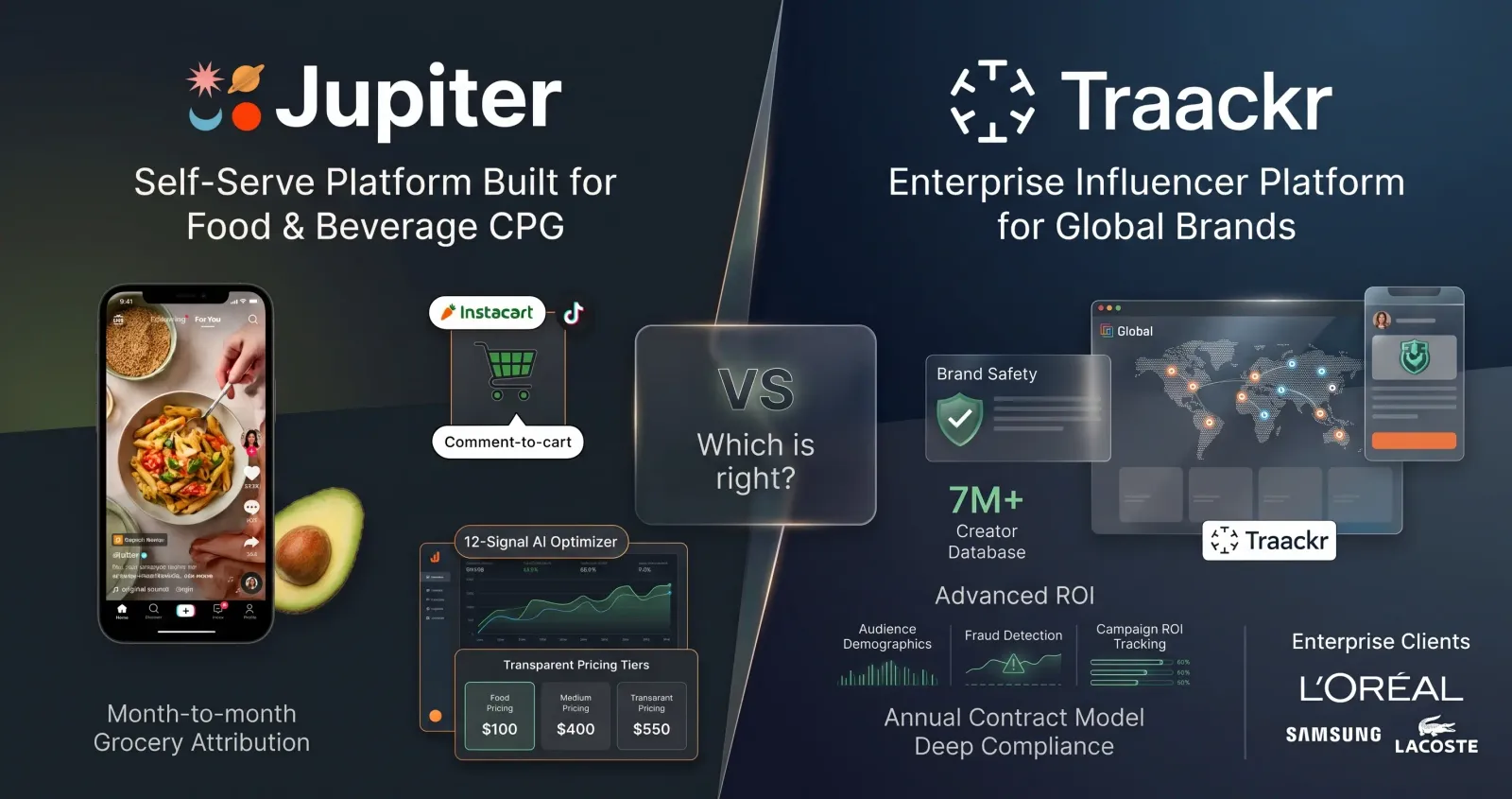
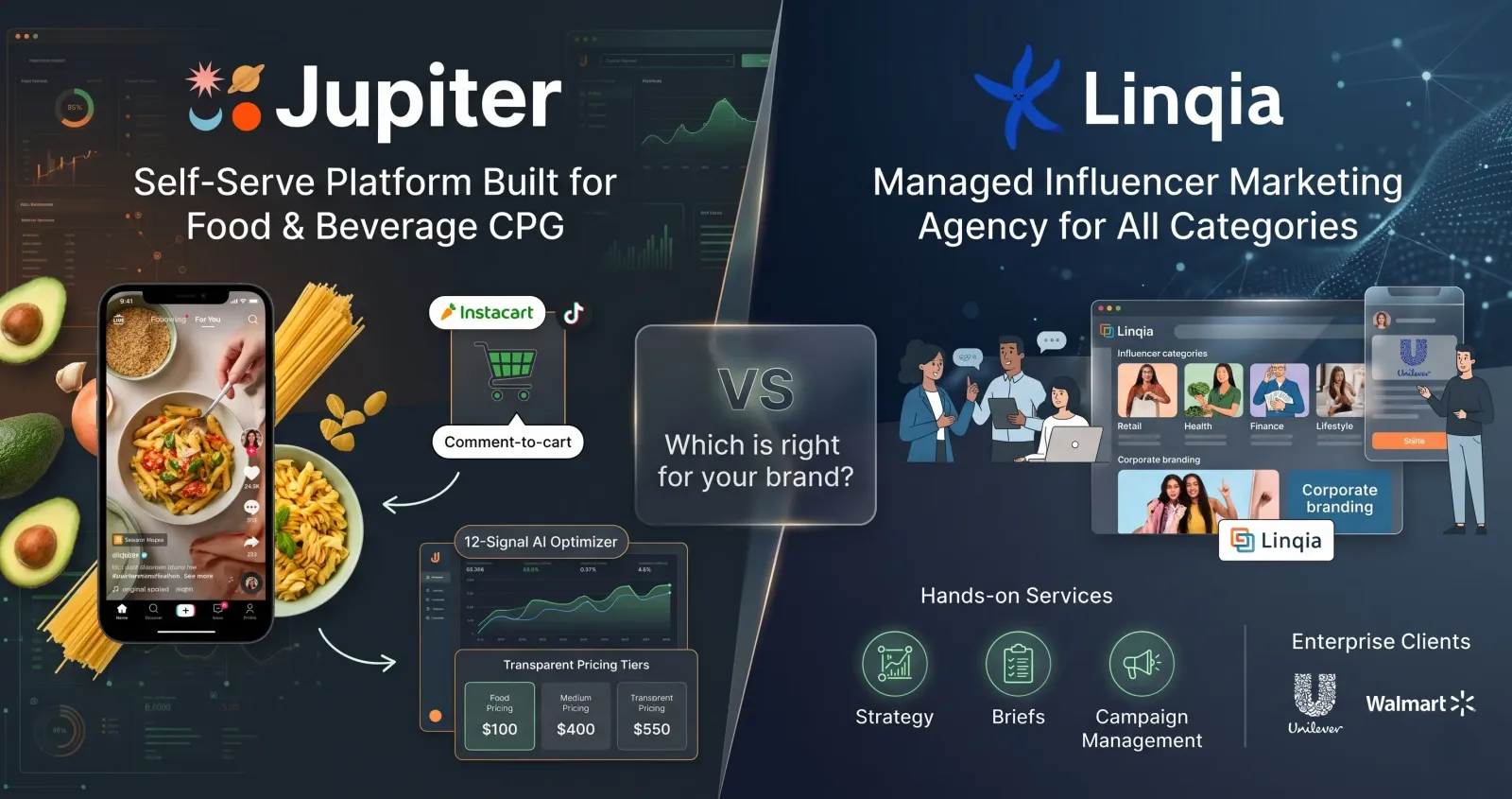
Jupiter. Built exclusively for food and beverage CPG. TikTok creator network curated for recipe content, with platform-specific average view counts, engagement rates, and credibility scores (the percentage of audience estimated to be real vs. bots). Built-in Instacart commerce infrastructure with comment-triggered DM delivery of shoppable links. Retailer proximity scoring as part of creator selection. AI-assisted brief workflow with CPG-specific fields. Used by Banza, Pete & Gerry's, Nellie's Free Range Eggs, Kettle & Fire, La Tourangelle, Schweid & Sons, Vermont Creamery, and 50+ other CPG brands. Best for food and beverage CPG brands selling through grocery retail or Instacart.
Aspire. A broad creator marketplace where creators opt into being discoverable. Strong for brands wanting to browse a wide pool, weaker for food-specific creator data and retailer attribution. Built for DTC e-commerce, not retail CPG. Best for brands that want a marketplace model and are willing to build their own attribution layer.
GRIN. A creator relationship management platform with strong workflow tools (email, contracts, payments) and good integration with Shopify. Limited food-specific creator data and no Instacart attribution. Best for DTC brands with a Shopify backend, less of a fit for retail CPG.
Archive. A content capture and analytics platform that tracks branded content across creators. Strong for measuring earned content and competitor activity. Not a campaign management platform. Best as a complement to a campaign platform, not as a standalone solution.
Upfluence. A large-scale platform with creator discovery and outreach tools across many verticals. Wide reach, shallow food-specific data. Best for brands running cross-vertical influencer programs at scale where TikTok food is one of several channels.
The pattern: if your brand is food and beverage CPG selling through grocery retail or Instacart, the platforms designed for that workflow will produce meaningfully different results than generic platforms. If your brand is multi-vertical or DTC-first, generic platforms can work.
What to ask in a TikTok platform demo
Most platform demos cover the same five features and skip the questions that actually matter for CPG. Bring these to your next demo.
"Show me how you find TikTok food creators in [specific metro area] whose audience is concentrated locally." Tests audience geography data quality. If the platform can only filter by creator location, not audience location, attribution will suffer.
"Walk me through how a viewer comments on a creator's TikTok post and ends up with a shoppable Instacart link in their DMs." Tests whether the comment-triggered DM infrastructure is built in or whether the brand has to build it. If the answer is "we don't do that, but you can use a third-party tool," attribution will be substantially lower than it should be.
"How does your campaign optimizer handle retailer targeting? Can I prioritize creators near Whole Foods stores in the Bay Area?" Tests retailer proximity scoring. If the platform treats geography as a single creator-location field, it cannot do this.
"What does the brief template look like for a recipe-focused TikTok campaign?" Tests CPG-specific brief structure. If the brief asks for "key message" and "platform" without any food-specific fields, the brand will be retrofitting the platform to its workflow rather than the other way around.
"Show me a real campaign report with cart adds per creator, comment-to-cart conversion, and estimated GMV." Tests reporting depth. If the report shows impressions and engagement only, the platform is not measuring what matters for CPG.
Already using a generic platform for TikTok food campaigns?
See what a platform built specifically for food CPG looks like, with retailer proximity scoring, Instacart attribution, and recipe-specific brief workflows.
See Jupiter in actionHow to evaluate TikTok platforms against your specific brand
Three filters narrow the platform decision quickly.
Where do you sell? If the answer is grocery retail and Instacart, prioritize platforms with Instacart attribution and retailer-aware creator selection. If the answer is Shopify or DTC, generic platforms can work.
What's your team size? If the marketing team is one or two people, an AI-assisted platform that pre-fills briefs and selects creators saves more time than a marketplace where the team has to do manual outreach. If the team is larger and has dedicated influencer ops, marketplace platforms with manual control may be acceptable.
What's the campaign cadence? If you run 1-2 campaigns per quarter, almost any platform works. If you run 6+ campaigns per quarter, the platform's ability to copy past campaigns, reuse briefs, and surface campaign-over-campaign performance data becomes the deciding factor. This is where most generic platforms break down at scale.
For food CPG brands selling through grocery retail at any team size, Jupiter is built specifically for this workflow. The Jupiter AI Marketing Agent handles brief drafting and creator selection in plain language. The campaign management workflow runs from brief through posted content. Attribution, share of voice, and analytics are in the analytics dashboard. The share of voice layer tracks competitive positioning across TikTok.
If you want the campaign-execution side of running a TikTok-into-Instacart campaign specifically, our Instacart Campaign Execution Playbook covers the end-to-end workflow.
See the TikTok influencer platform built for food CPG.
1,000+ recipe creators, Instacart commerce infrastructure, retailer-aware creator selection, and full attribution from comment to cart add. Used by 58+ leading CPG brands.
Book a 20-minute demoFAQs
Quick answers to common questions.
What is a TikTok influencer marketing platform?▼
A TikTok influencer marketing platform is software that helps brands discover TikTok creators, run campaigns, manage briefs and content review, and measure performance from a single dashboard. For CPG brands, the right platform also handles retailer targeting, Instacart attribution, and food-specific creator data. Generic platforms built for DTC e-commerce typically lack these capabilities.
Which TikTok influencer platform is best for food and beverage CPG brands?▼
Jupiter is built exclusively for food and beverage CPG, with a TikTok creator network curated for recipe content, built-in Instacart attribution, retailer proximity scoring, and CPG-specific brief workflows. Other platforms like Aspire, GRIN, and Upfluence have broader reach across verticals but lack the food-specific creator data and grocery retail attribution that CPG brands need.
How is a TikTok influencer marketing platform different from an Instagram one?▼
TikTok platforms need to surface average view count and recent viral hits as primary signals, not follower count. They also need to handle TikTok's algorithmic distribution, which pushes content to non-followers more aggressively than Instagram, and the comment-triggered DM mechanic that drives Instacart attribution. Most platforms support both Instagram and TikTok, but the depth of TikTok-specific data varies significantly.
How much does a TikTok influencer marketing platform cost?▼
Most TikTok influencer platforms operate on subscription pricing ranging from $500 to $5,000 per month for SMB tiers and $10,000+ per month for enterprise. Some platforms, including Jupiter, are demo-based with no setup fees and pricing tied to campaign volume. The right benchmark is not platform cost in isolation but cost per attributed cart add or cost per campaign delivered.
Can I run a TikTok influencer campaign without a platform?▼
Yes, but the workflow gets manual quickly. Brands running 1-2 campaigns per year can manage with spreadsheets, email outreach, and manual reporting. Brands running 4+ campaigns per year typically lose more in operational overhead and missed attribution than they save by avoiding platform fees. The break-even point usually sits around the third or fourth campaign per year.
What's the most important feature in a TikTok platform for CPG brands?▼
For food and beverage CPG brands, Instacart attribution is the single highest-value feature, because it converts views into measurable cart adds and ties revenue back to specific creators and posts. Without it, "ROI" is a proxy for impressions and engagement rather than actual purchase intent. Retailer-aware creator selection is the second most important, because it ensures campaigns reach audiences that actually shop where the brand sells.
More in Platforms & Comparisons
More from Platforms & Comparisons.