Influencer Pricing Guide for Food & CPG Brands: Rates by Platform and Tier (2026)
Influencer pricing is not a fixed rate card. It is a negotiation with 12 variables most brands do not know to ask about. Here is what food CPG brands are actually paying in 2026, and what drives the variation.
Food CPG brands in 2026 pay $50 to $300 per Instagram post at the nano tier (1K to 10K followers), $250 to $1,500 at micro (10K to 50K), $1,000 to $5,000 at mid-tier (50K to 250K), $3,500 to $15,000 at macro (250K to 1M), and $10,000 or more above 1M, for organic posting rights only. TikTok rates run 20 to 40% below Instagram at equivalent tiers.
Key takeaways
- Instagram food and recipe rates: nano $50-$300, micro $250-$1,500, mid-tier $1,000-$5,000, macro $3,500-$15,000, top-tier $10,000+
- TikTok runs 20 to 40% below Instagram at every tier, and the gap is narrowing
- Quoted rates cover organic posting only; paid amplification adds 30 to 50% for a 90-day window
- Test a rate by implied CPM: quoted rate ÷ average views × 1,000. Above $15 on an organic post alone warrants renegotiation
- Hidden costs: exclusivity premiums 25 to 100%, usage rights buyouts 30 to 65%, talent manager markups 10 to 20%
Trusted by leading CPG brands















On this page
▼
- Why Influencer Pricing Has Shifted From 2024 to 2026
- TikTok maturation
- Usage rights as a separate line item
- Nano and micro creator professionalization
- Instagram Rate Benchmarks by Tier — Food and Recipe Content (2026)
- TikTok Rate Benchmarks by Tier — Food and Recipe Content (2026)
- What Drives Price Variation Within a Tier
- Engagement rate and save rate
- Content production quality
- Content niche specificity
- Exclusivity requirements
- Usage rights scope
- Posting cadence in a relationship
- Hidden Costs That Push Total Campaign Spend Above Creator Fees
- Usage rights buyout
- Exclusivity premiums
- Revision rounds
- Agency or management markup
- Product cost for sampling campaigns
- How to Evaluate Whether a Creator's Rate Is Defensible
- Red Flags in Creator Pricing
- Rate card with no view data
- Engagement rate above 12% at mid-tier
- Audience credibility below 70%
- No rate distinction between organic and paid usage
- Ambassador rates quoted at single-post prices
- How Jupiter Shows CPM Before You Commit to Any Rate
Influencer pricing for food CPG brands in 2026 is not a fixed rate card you can look up and apply uniformly across your creator roster. It is a market rate with wide variance driven by platform, follower tier, engagement quality, content type, exclusivity requirements, and usage rights scope. A mid-tier Instagram food creator charging $3,500 per post and a different mid-tier creator charging $900 per post may have similar follower counts and still be priced correctly for their respective situations.
This guide covers the rate benchmarks by tier and platform specifically for food and recipe content, the variables that drive price up and down from the baseline, the hidden costs that push total campaign spend above what the creator fee line says, and how to evaluate whether any individual creator's rate makes commercial sense before you agree to it.
Why Influencer Pricing Has Shifted From 2024 to 2026
Three dynamics have moved creator pricing meaningfully in the last two years.
TikTok maturation
As TikTok has grown from a discovery channel to a full commerce platform, TikTok creator rates have risen faster than Instagram rates at every tier. Creators who were charging $150 per TikTok post in 2023 are charging $400 to $600 for the same post in 2026, because they have data showing that TikTok content drives Instacart and retail behavior that brands now specifically want. The arbitrage window on TikTok pricing has narrowed.
Usage rights as a separate line item
Brands have become more sophisticated about repurposing creator content in paid Meta ads and Instacart creatives. Creators have responded by separating usage rights fees from organic posting fees. A creator who charged $1,200 per post in 2024 with informal usage rights now charges $1,200 for organic rights and an additional $400 to $800 for paid amplification rights. The total spend for the same piece of content is 30 to 65% higher when usage rights are priced correctly.
Nano and micro creator professionalization
Nano and micro food creators who ran their first brand partnership in 2022 or 2023 now have performance data, media kits, and rate cards. The informal "I'll post for free product" era is not over, but it is no longer the default at the micro tier (10,000 to 50,000 followers). Brands relying on product-only compensation at the micro tier are losing the best-performing creators to brands willing to pay.
Instagram Rate Benchmarks by Tier — Food and Recipe Content (2026)
These are market rate ranges for a single Instagram Reel featuring food or recipe content, organic posting rights only. Usage rights, exclusivity, and revision fees are separate.
Creator Tier | Followers | Rate Range per Post | Notes |
|---|---|---|---|
Nano | 1K – 10K | $50 – $300 | Often product-only; paid rates emerging among experienced nano creators |
Micro | 10K – 50K | $250 – $1,500 | Widest variance tier; engagement quality drives the spread |
Mid-tier | 50K – 250K | $1,000 – $5,000 | Most common tier for food CPG campaigns; strong CPM efficiency |
Macro | 250K – 1M | $3,500 – $15,000 | Higher floor driven by production quality expectations |
Top-tier | 1M+ | $10,000+ | Rarely cost-efficient for grocery CPG; better for brand awareness plays |
The mid-tier is where most food CPG brands spend the majority of their creator budget, and where CPM efficiency is strongest relative to content quality. A mid-tier food creator at $2,000 per post delivering 120,000 views produces a CPM of $16.67 on the organic post alone, before any paid amplification. That compares favorably to paid social CPMs for the same audience, particularly for content with the engagement quality that algorithmic platforms reward.
At the micro tier, the range from $250 to $1,500 reflects engagement quality more than follower count. A micro creator with a 7% engagement rate, 85% audience credibility score, and a save rate above 2% on recipe content is correctly priced at $1,200 to $1,500. A micro creator with a 1.2% engagement rate and no save data is correctly priced at $250 to $400. Paying the same rate for both is the most common pricing mistake food CPG brands make.
TikTok Rate Benchmarks by Tier — Food and Recipe Content (2026)
TikTok pricing is more variable than Instagram at every tier because TikTok's algorithmic distribution means a single post can generate 10x the creator's average view count, or 20% of it. Creators price for their average. Brands should model for the distribution range.
Creator Tier | Followers | Rate Range per Post | Notes |
|---|---|---|---|
Nano | 1K – 10K | $25 – $200 | Median 1,062 views per post (Jupiter food network data); above-median outliers are the value play |
Micro | 10K – 50K | $150 – $1,000 | Median 2,118 views; TikTok CPM efficiency strongest at this tier for food content |
Mid-tier | 50K – 250K | $750 – $4,000 | Median 9,154 views; high ceiling posts at this tier are the best CPM outcomes on TikTok |
Macro | 250K – 1M | $2,500 – $12,000 | Median 27,208 views; pricing has caught up to reach faster than Instagram |
Top-tier | 1M+ | $8,000+ | Median 99,037 views; viral potential justifies the rate when product is TikTok-native |
The median view figures in this table are drawn from Jupiter's food creator network data across 438 TikTok food creators. The spread above the median is where TikTok creator selection decisions compound: a nano creator averaging 8,000 views per post should not be priced like a nano creator averaging 800 views per post, but follower count alone does not distinguish them. Average view count at the creator level is the pricing signal that matters on TikTok, not followers.
TikTok rates run 20 to 40% below Instagram rates at equivalent tiers for the same content, primarily because Instagram Reels have a longer algorithmic shelf life and because the established Instagram food creator economy has had more time to price up. That gap is closing, and brands that are still applying 2023 TikTok rate expectations to 2026 TikTok creators are losing good partners to competitors willing to meet the market.

Jupiter shows estimated CPM per creator before you commit to any rate
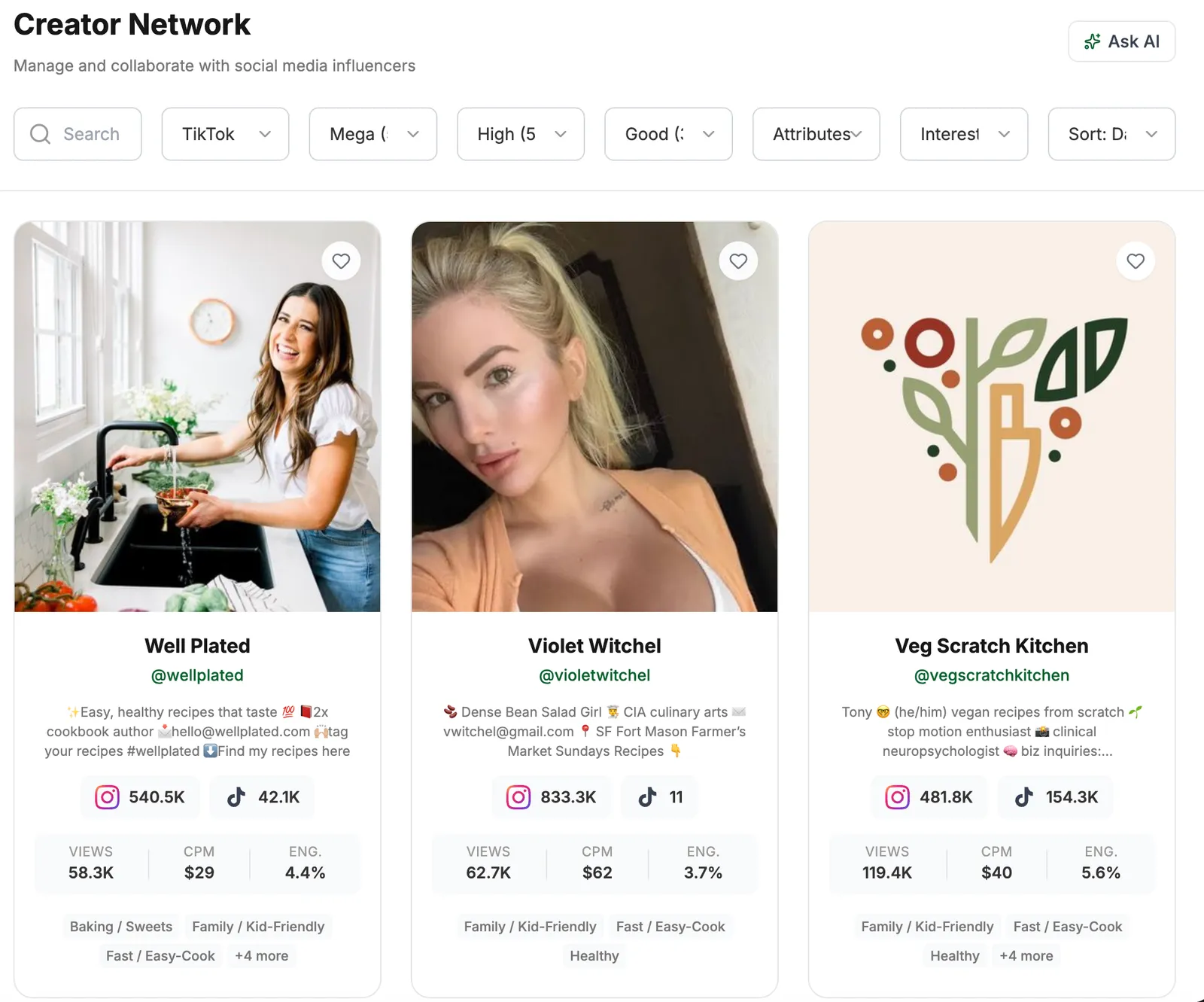
Every creator in Jupiter's network has platform-specific pricing and average view data surfaced at the profile level. See your projected CPM before you book.
What Drives Price Variation Within a Tier
Two food creators with identical follower counts can be correctly priced at $400 and $1,800 for the same deliverable. Here are the six variables that determine where within a range a specific creator sits.
Engagement rate and save rate
Engagement rate above 5% for food content at the micro and mid-tier adds a meaningful premium over the tier baseline. Save rate above 2% on recipe posts is the strongest purchase-intent signal in food CPG content and commands a premium that brands are increasingly willing to pay because it directly correlates with grocery trial. A creator who can show save rate data has pricing leverage that a creator reporting only likes and comments does not.
Content production quality
Creators who produce food content at a level that brands can repurpose in paid media without additional post-production charge more because they are delivering a more valuable asset. A well-lit, well-edited recipe video shot on a professional setup justifies a higher rate than a handheld phone video with poor audio. For brands planning to whitelist creator content in Meta ads, production quality has a direct bearing on the post's paid performance.
Content niche specificity
A creator who posts exclusively gluten-free recipes or exclusively high-protein meal prep has a more commercially specific audience than a general food creator. Niche-specific audiences buy the specific category more predictably, which makes the impression more commercially valuable and the rate defensibly higher.
Exclusivity requirements
If a brand requires that a creator not work with competing brands for 30, 60, or 90 days around the campaign, that exclusivity period has a cost. The creator is giving up potential income from competing partnerships. Exclusivity carve-outs (allowing the creator to work with non-competing brands freely while restricting only direct competitors) reduce the exclusivity fee significantly and are worth negotiating before paying a blanket exclusivity rate.
Usage rights scope
Organic social posting rights are the baseline. Paid amplification rights (running the content as a Meta whitelisted ad from the creator's handle) typically add 30 to 50% of the organic post rate for a 90-day window. Retail media rights (using the content in Instacart ad placements) require explicit negotiation and add further cost. A creator who does not distinguish between organic and paid usage rights in their rate card is leaving money on the table and is also signaling that they are not sophisticated about the rights they are actually selling.
Posting cadence in a relationship
Creators who commit to a multi-post campaign or a recurring brand relationship over multiple months accept rates meaningfully below their single-post rate, because the relationship provides guaranteed income and reduced effort per post as the creator becomes more familiar with the product. Ambassador programs specifically use this dynamic to achieve significant per-post rate reductions compared to one-off campaign pricing.
Hidden Costs That Push Total Campaign Spend Above Creator Fees
The creator fee is rarely the total cost of a campaign. These are the line items that surprise brands in their first few programs.
Usage rights buyout
If a campaign brief does not specify repurposing rights upfront and the brand later wants to whitelist top-performing content in Meta ads, the creator's post-hoc rate for paid amplification rights will be higher than it would have been if negotiated before content creation. Nail down usage rights scope in the brief before content is filmed.
Exclusivity premiums
An unexamined exclusivity requirement can add 25 to 100% to a creator's rate. Audit exclusivity requirements before briefing. If your product does not have a competitive differentiation reason to lock a creator out of all competing brands (for example, a specialty vinegar brand that would not actually compete with a hot sauce brand for the same audience), remove or narrow the exclusivity language.
Revision rounds
Many creators include one revision round in their base rate and charge $150 to $500 per additional revision. A brief that is too vague generates revision rounds. The 12-section brief structure covered in the influencer brief template guide reduces revision rounds by giving creators enough direction to get it right the first time.
Agency or management markup
Mid-tier and macro creators are frequently represented by talent managers who add a markup of 10 to 20% over the creator's base rate. This is disclosed in some negotiations and buried in others. Ask directly whether the rate quoted is the creator's rate or the managed rate before accepting.
Product cost for sampling campaigns
Product-sampling campaigns with nano and micro creators involve no creator fee but do involve product cost, shipping, and the operational overhead of managing 20 to 50 individual shipments. These costs are real and should be modeled into effective CPM calculations rather than treated as zero.
Evaluating creator rates without CPM projections? You are negotiating blind.
Jupiter surfaces estimated CPM per creator based on their actual average view data and your campaign budget before you commit. Know your delivery benchmark before any money moves.
How to Evaluate Whether a Creator's Rate Is Defensible
A creator's rate is defensible when the CPM it implies, calculated against their average view count, is competitive with the CPM you would pay for equivalent reach in paid social. Here is the math.
Take the creator's quoted rate and divide it by their average views per post, then multiply by 1,000. That is their implied CPM on the organic post alone.
A mid-tier Instagram food creator charging $2,500 per post with average views of 95,000 implies a CPM of $26.32. If your paid Instagram CPM for a food audience is $18 to $22, that rate is above market. A mid-tier creator charging $1,800 per post with average views of 120,000 implies a CPM of $15.00, which is at or below paid social benchmarks for the same audience, while also delivering the trust premium that creator content produces over brand advertising.
From Jupiter campaign data across food and beverage CPG brands, effective CPMs for creator campaigns range from under $2 at the nano and sampling tier to $1.50 to $3 for well-optimized general awareness campaigns, to $6 to $13 for premium ambassador programs and smaller-roster targeted campaigns. Any creator rate that implies a CPM significantly above the higher end of your category benchmark warrants negotiation or replacement.
Red Flags in Creator Pricing
Rate card with no view data
A creator who quotes a rate without offering average view data or engagement metrics is asking you to buy on follower count alone. Follower count does not price a campaign. Views price a campaign. Request average views per post before any rate discussion.
Engagement rate above 12% at mid-tier
Engagement rates above 10 to 12% for mid-tier and macro creators frequently indicate purchased engagement, comment pods, or bot activity rather than genuine audience interaction. High engagement rates at the nano tier are normal and expected. Suspiciously high rates at larger tiers warrant a credibility score review.
Audience credibility below 70%
A credibility score below 70% means more than 30% of the creator's followers are estimated to be bots or inactive accounts. The effective reach of every post is significantly lower than the follower count implies, and the engagement rate is inflated accordingly. Jupiter's creator profiles surface credibility scores at the creator level. For creators outside the network, third-party audience analysis tools can generate this data.
No rate distinction between organic and paid usage
A creator who quotes one flat rate for "all usage" either does not understand what usage rights they are selling or is pricing paid media rights significantly below market. Either situation creates risk for the brand. Request an itemized rate covering organic posting separately from paid amplification before agreeing to a flat rate.
Ambassador rates quoted at single-post prices
A creator who quotes their same-as-organic rate for a six-month ambassadorship has not adjusted for the relationship value. Ambassador programs that run two posts per month for six months represent 12 total posts. The per-post rate for a committed relationship should reflect the volume commitment. Brands running ambassador programs on Jupiter achieve meaningfully reduced per-post rates compared to single-campaign pricing because the multi-month commitment has real economic value to the creator.
How Jupiter Shows CPM Before You Commit to Any Rate
Jupiter's creator marketplace surfaces platform-specific pricing and average view data at the creator profile level across 1,000+ vetted food and recipe creators on Instagram and TikTok. Before committing to any creator rate, you can see their estimated CPM calculated from their actual average view data and your planned budget.
The 12-signal campaign optimizer takes this further. When you build a campaign, it projects total impressions and CPM across the creator combination you have selected, before launch. You can test different creator combinations, swap high-CPM creators for more efficient alternatives, and see the projected CPM impact of budget reallocation across the roster in real time. This is the pricing transparency model that replaces negotiating creator rates without benchmark data.
For brands comparing creator pricing across the micro and nano tiers specifically, the micro-influencer CPG grocery guide covers the full micro-tier selection and pricing framework in detail.
Know what you are paying for before any creator agreement is signed.
Jupiter surfaces estimated CPM, average views, platform-specific pricing, and credibility scores for 1,000+ vetted food creators before you commit a dollar. Used by 58+ CPG brands including Banza, Pete & Gerry's, and Kettle & Fire.
FAQs
Quick answers to common questions.
What is a fair rate for a food influencer with 100K Instagram followers?▼
A food creator with 100,000 Instagram followers (mid-tier) commands a market rate of $1,000 to $5,000 per Reel for organic posting rights, with the actual rate driven by engagement rate, save rate on recipe content, audience credibility score, and content production quality. A mid-tier creator with a 6% engagement rate, high save rates, and clean audience demographics is correctly priced toward the top of that range. A creator with a 1.5% engagement rate and no recipe-specific data is correctly priced toward the bottom. The rate should be evaluated against their implied CPM: divide the quoted rate by average views per post and multiply by 1,000. If the implied CPM is above your paid social benchmark for the same audience, negotiate down or find a better value creator.
Should I negotiate influencer rates directly or use a platform?▼
Both approaches have trade-offs. Direct negotiation gives the brand full control over rate terms and removes any platform markup, but requires access to creator contact information, the ability to verify performance data independently, and time to negotiate one by one across a roster of 6 to 15 creators per campaign. Platforms like Jupiter give you verified performance data, estimated CPM projections before any rate is agreed, and a streamlined workflow that reduces negotiation overhead significantly. For brands running more than two campaigns per year, the time saved and the data quality of platform-based selection justify the platform approach.
What is a good CPM for food influencer marketing?▼
A good CPM for food CPG influencer campaigns ranges from under $2 for optimized nano creator sampling programs to $1.50 to $3 for well-structured general awareness campaigns with mid-tier creators, based on Jupiter campaign data across food and beverage brands. CPMs between $5 and $13 are typical for premium ambassador programs, smaller-roster targeted campaigns, and creators in high-demand niche categories. Any creator rate that implies a CPM significantly above $15 on an organic post alone warrants renegotiation or replacement, unless the creator offers paid amplification rights, Instacart attribution potential, or content production quality that justifies the premium.
Do TikTok influencers charge less than Instagram influencers for food content?▼
Yes, in most cases. TikTok creator rates for food content currently run 20 to 40% below Instagram rates at equivalent tiers. The gap reflects Instagram's longer content shelf life, more established food creator economy, and higher save-oriented engagement for recipe content. The gap is narrowing as TikTok creator pricing has risen faster than Instagram since 2024. Brands applying 2023 TikTok rate benchmarks to 2026 negotiations are systematically underpaying or losing creators to brands that have updated their rate expectations.
What are the hidden costs of influencer campaigns that brands miss?▼
The five most common hidden costs in food CPG influencer campaigns are usage rights buyouts negotiated after content creation (30 to 65% above the organic post rate), exclusivity premiums for broad competitive lockout requirements (25 to 100% above base rate), revision fees for briefs that are too vague to get right on the first submission, talent manager or agency markups of 10 to 20% over the creator's base rate, and product and shipping costs for creator sampling programs that are not modeled into effective CPM calculations. All five can be mitigated by specifying rights scope, exclusivity terms, revision policy, and compensation structure in the brief before content creation begins.
How do ambassador programs affect influencer pricing for CPG brands?▼
Ambassador programs, which involve a creator committing to a minimum of two posts per month over a sustained period (typically six months or longer on Jupiter), produce meaningfully reduced per-post rates compared to single-campaign pricing. The volume commitment has real economic value to the creator, who receives guaranteed income across multiple months rather than project-by-project revenue. For food CPG brands, the per-post rate reduction from an ambassador structure can be significant enough that a six-month program with two posts per month costs materially less per post than six individual monthly campaigns with the same creator.
More in Creator Selection & Pricing
More from Creator Selection & Pricing.