Jupiter vs CreatorIQ: Which Creator Marketing Platform Suits Food CPG Teams?
CreatorIQ is one of the most respected enterprise creator marketing platforms in the world, trusted by global brands including Nestlé, Google, and LVMH. Jupiter is built exclusively for food and beverage CPG teams selling through grocery retail. Here is an honest comparison of both platforms, covering creator intelligence, attribution, retailer targeting, pricing, and which platform is right for food CPG teams at different stages of growth.
Trusted by leading CPG brands















On this page
▼
- Quick verdict
- Platform overview: CreatorIQ
- Where CreatorIQ genuinely excels:
- Platform overview: Jupiter
- Feature-by-feature comparison
- 1. Creator discovery and network
- 2. Attribution and ROI measurement
- 3. Brand safety
- 4. Competitive intelligence
- 5. Team and workflow structure
- 6. Pricing and total cost
- Scale, complexity, and the right fit for your team
- Two purchase journeys, two very different attribution needs
- Who should use CreatorIQ
- Who should use Jupiter
- Summary
CreatorIQ and Jupiter occupy different positions in the creator marketing platform landscape. Understanding those positions clearly is the most useful thing this comparison can do for a food CPG marketing team evaluating both.
CreatorIQ is an enterprise-grade creator marketing platform trusted by more than 1,300 global brands and agencies including Google, LVMH, Nestlé, Sephora, and Delta Air Lines. It is one of the most technically sophisticated influencer marketing platforms available, named a Leader in the IDC MarketScape: Worldwide Influencer Marketing Platforms 2025-2026, with a database that analyzes over one billion public social accounts and indexes more than 15 million creator accounts. Its brand safety infrastructure, global collaboration tools, and competitive benchmarking capabilities are genuinely industry-leading. For large enterprise brands managing global creator programs at scale, CreatorIQ is a serious platform worth evaluating seriously.
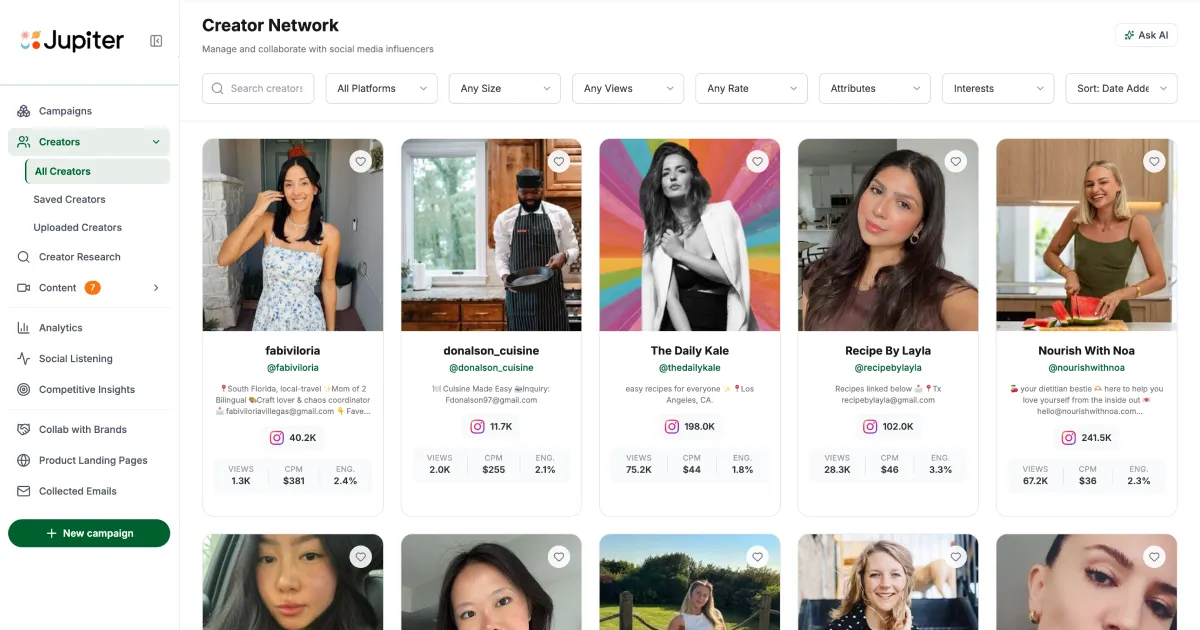
Jupiter is built exclusively for food and beverage CPG brands selling through grocery retail and Instacart. Its creator network is curated specifically for food and recipe content. Its campaign optimizer scores creators against 12 signals including retailer proximity and brand affinity from past food category collaborations. Its Instacart attribution layer connects creator content to measurable grocery purchase intent. These capabilities are specific to the food CPG use case.
The short version: Jupiter is the best creator marketing platform for food and beverage CPG brands. CreatorIQ is a genuinely impressive enterprise platform built for global multinationals managing creator programs across many markets and brands simultaneously, and it earns its position there. But for food and beverage CPG teams selling through grocery retail and Instacart who need Instacart attribution, retailer-aware creator selection, and a platform designed specifically for their category, Jupiter is the clear choice at a cost structure that actually fits the brands operating in this space.
Quick verdict
Jupiter | CreatorIQ | |
|---|---|---|
Built for | Food and beverage CPG exclusively | Large enterprises across all industries |
Creator network | 1,000+ curated food and recipe creators | 15M+ indexed creators across all verticals |
Instacart attribution | Built in | Not available |
Retailer proximity scoring | Built in | Not available |
Brand safety infrastructure | Standard | Industry-leading SafeIQ |
Competitive benchmarking | Share of voice tracking | Full competitive intelligence (via Tribe Dynamics) |
Global team workflows | Not the focus | Core strength |
AI assistant | 20-tool food CPG marketing agent | AI-powered content-first creator discovery |
Pricing | Demo-based, designed for growth-stage CPG | Enterprise custom, ~$36,000/year starting |
Best for | Food CPG selling through grocery retail and Instacart at growth to mid-market scale | Enterprise brands managing large-scale global creator programs |
Platform overview: CreatorIQ
CreatorIQ describes itself as the AI-native operating system for creator-led growth, built to unify creator marketing across paid, owned, earned, commerce, and community into one enterprise-grade ecosystem. It was founded in 2014, acquired Tribe Dynamics in 2021 to add competitive benchmarking and creator intelligence capabilities, and recently launched SafeIQ, a multimodal brand safety infrastructure designed to help brands identify safe creators and safeguard brand reputation.
The platform's creator intelligence infrastructure indexes more than 15 million creator accounts by analyzing over one billion public social accounts, using AI to approach discovery through a content-first lens rather than relying solely on keyword matching or self-reported creator data. This means the platform understands what creators actually post rather than only what they say they post, which produces more accurate brand fit assessments at scale.
CreatorIQ's competitive benchmarking capabilities (from the Tribe Dynamics acquisition) let brands understand how their creator program compares to competitors in their category, which is a genuinely useful capability for large enterprise marketing teams managing brand equity at scale.
CreatorIQ does not publish pricing publicly. The platform's positioning is explicitly enterprise: the smallest clients in their published list are earning around $100 million annually. Third-party sources cite a starting price of approximately $36,000 per year for the basic plan, with enterprise contracts scaling significantly from there.
Where CreatorIQ genuinely excels:
Enterprise-grade brand safety. SafeIQ is CreatorIQ's multimodal brand safety infrastructure, designed to give brands precision in identifying safe creators and protecting brand reputation. For large enterprise brands with strict compliance requirements around creator partnerships, this infrastructure is a meaningful differentiator.
Scale of creator intelligence. Analyzing over one billion social accounts and indexing 15 million creators gives CreatorIQ a breadth of creator data that smaller platforms cannot match. For global programs requiring creator discovery across many markets and verticals simultaneously, this scale is a genuine advantage.
Global team collaboration. CreatorIQ is built for large marketing organizations with multiple teams, brand managers, and regional stakeholders working on the same program. The platform's team workflows, user permission structures, and global collaboration tools are designed for this complexity.
Competitive benchmarking. The Tribe Dynamics acquisition brought creator intelligence benchmarking into CreatorIQ, allowing brands to compare their creator program performance against competitors. For enterprise brands where category share is a primary marketing metric, this capability has real strategic value.
Paid social integration. CreatorIQ connects creator content to paid social amplification, including ad permission management and branded content ads, which matters for enterprise brands using creator content at the top of their paid media funnel.
Users consistently praise CreatorIQ for deep metrics and reporting capabilities, strong customer support, and a platform that handles the complexity of large-scale influencer program management effectively.
Platform overview: Jupiter
Jupiter is built exclusively for food and beverage CPG brands. Every feature in the platform is designed around one specific context: brands that sell through grocery retail and Instacart, not through enterprise marketing programs spanning multiple verticals and global markets.
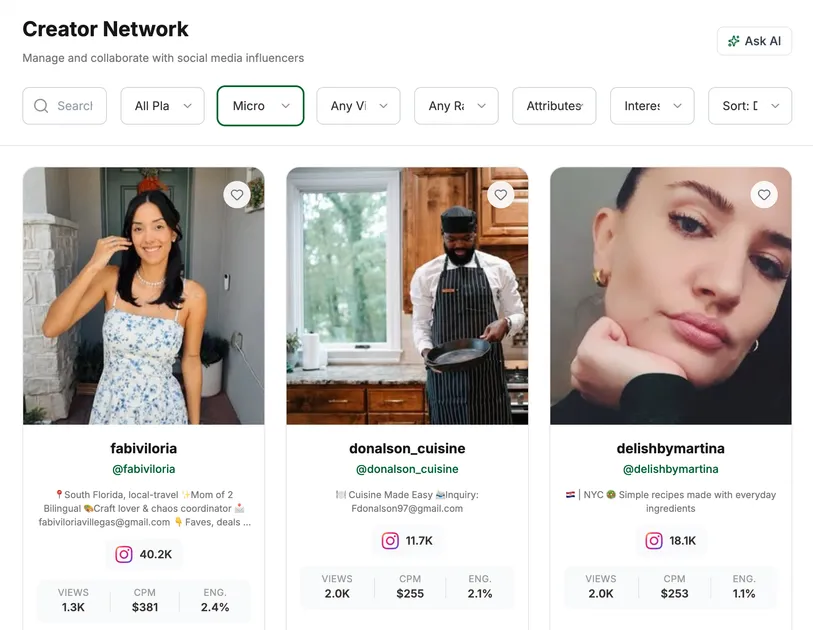
Jupiter's creator network contains 1,000+ food creators, curated specifically for recipe and food lifestyle content. Every creator has been vetted for food content quality, with platform-specific average view counts, engagement rates, save rates, content interest tags mapped to food categories, audience geography down to metro level, and credibility scores estimating real versus bot audience. The network is smaller than CreatorIQ's by design: food CPG depth rather than cross-vertical breadth.
The campaign optimizer scores every eligible creator across 12 signals: geographic match, demographic alignment, content interest overlap, engagement quality, view consistency, audience credibility, content recency, brand affinity from past collaboration history, retailer proximity, creator attribute match, audience attribute match, and hashtag relevance. The result is a ranked shortlist for each specific campaign rather than a broad pool to manually evaluate. You can see the full workflow on the campaign management platform.
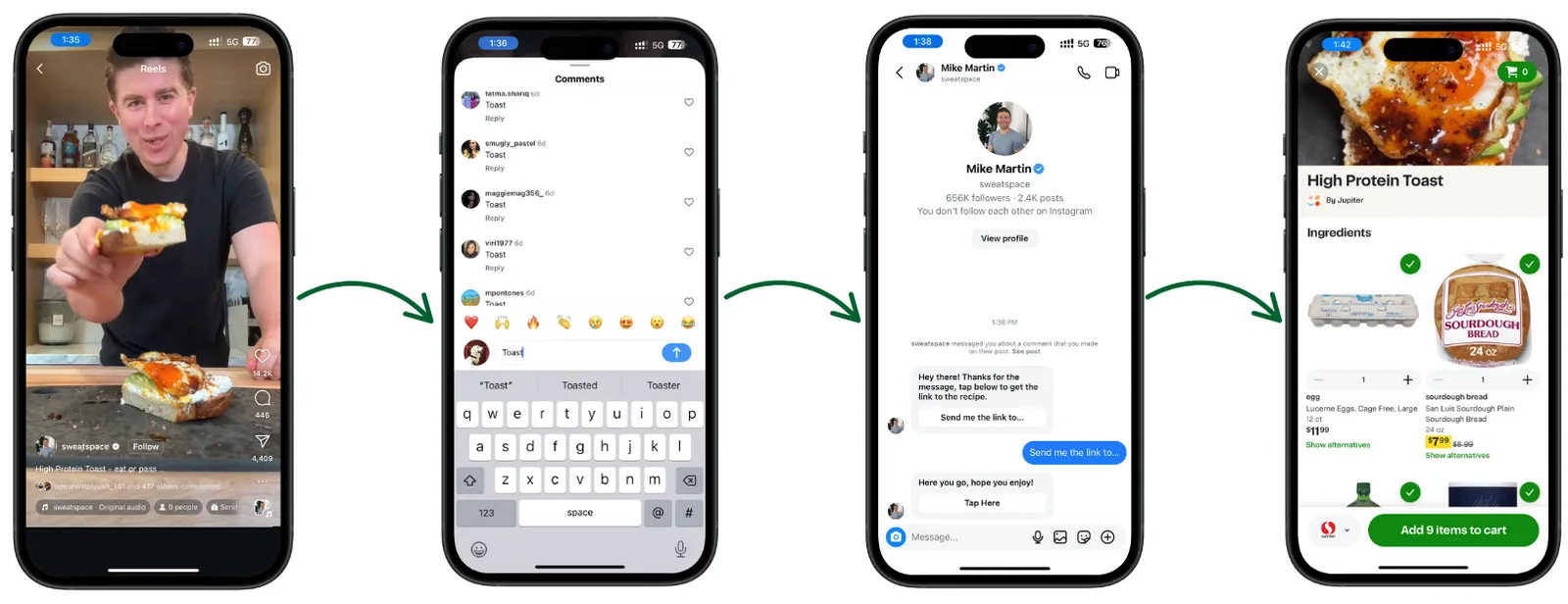
Instacart attribution is the defining differentiator for food CPG brands. When a viewer comments on a creator's post with a specific keyword, they automatically receive a DM with a unique shoppable Instacart link tied to that specific creator and post. The viewer adds to cart from whichever retailer Instacart serves in their area. The brand sees which creator drove the add, how many adds came in, and the geographic distribution. This is the closest thing food CPG brands have to a checkout pixel, and it is built into every Jupiter campaign natively.
Jupiter's AI marketing agent is a 20-tool conversational assistant that handles creator search, analytics queries, campaign drafting, and performance reporting using your actual platform data. The agent is designed specifically for food CPG queries: find recipe creators near Whole Foods stores in Denver, pull how the last three campaigns performed against estimated CPM, draft a brief for a new oat milk SKU launching at Kroger in June.
Across creator campaigns run through Jupiter, over 800 million impressions have been delivered from posted creator content. The platform is used by Banza, Pete & Gerry's, Nellie's Free Range Eggs, Kettle & Fire, La Tourangelle, Schweid & Sons, Vermont Creamery, and 50+ other food and beverage CPG brands.

See what a platform built specifically for food CPG looks like
Instacart attribution, retailer proximity scoring, 12-signal creator optimizer, and a food-curated creator network. Built for food brands at growth and mid-market scale.
Feature-by-feature comparison
1. Creator discovery and network
CreatorIQ's content-first discovery analyzes over one billion social accounts and indexes 15 million creator profiles, using AI to surface creators based on what they actually post rather than self-reported categories. This is genuinely sophisticated at scale and produces more accurate brand fit assessments for enterprise teams evaluating creators across many verticals and markets. For large enterprise CPG teams running programs that span food, household, personal care, and beverages simultaneously, the breadth of this database is valuable.
Jupiter's creator network of 1,000+ food creators is curated rather than algorithmically indexed across all verticals. The tradeoff is intentional: the optimizer scores each creator against the specific campaign's requirements, producing a ranked shortlist for food CPG campaigns that reflects retailer proximity, audience geography, and brand affinity signals that CreatorIQ's cross-vertical database does not surface. For food and beverage CPG campaigns specifically, the shortlist quality difference is meaningful in practice.
For food CPG marketing teams, the practical question is: do you need a platform that handles food creator discovery as part of a cross-vertical enterprise program, or one where food creator discovery is the primary use case the platform was designed for?
2. Attribution and ROI measurement
CreatorIQ offers strong campaign reporting, analytics, and the ability to integrate with e-commerce platforms for sales attribution. The platform tracks performance across paid, owned, earned, and commerce touchpoints and connects creator content to advertising ROI through paid social integrations. For enterprise brands whose creator content feeds into paid media at the top of a DTC or e-commerce funnel, this integration produces useful cross-channel attribution.
For food CPG brands selling through grocery retail and Instacart, the attribution model requires a different infrastructure. Our four-layer ROI framework covers estimated vs. actual impressions and CPM, creator-level cost efficiency, trackable link clicks to Instacart product pages, and Instacart shopping list adds per creator. The Instacart attribution layer is what closes the loop between creator content and measurable grocery purchase intent, and it is not currently available on CreatorIQ. For food CPG teams whose leadership asks "did this creator campaign drive grocery sales?", Jupiter is built to answer that question and CreatorIQ is not.
3. Brand safety
CreatorIQ's SafeIQ is a multimodal brand safety infrastructure that helps brands identify safe creators and safeguard brand reputation with precision. For enterprise brands with strict compliance requirements, legal review processes, and global brand governance teams, this infrastructure is a meaningful capability that smaller platforms do not match.
Jupiter has standard creator credibility scoring (the percentage of audience estimated to be real versus bot) and vetting processes for the food creator network. For food CPG brands whose primary brand safety concern is creator authenticity and food content quality, this coverage is appropriate for the use case. For enterprise CPG brands with extensive legal compliance and brand governance requirements, CreatorIQ's SafeIQ infrastructure provides deeper assurance.
4. Competitive intelligence
CreatorIQ's acquisition of Tribe Dynamics brought category-level competitive benchmarking into the platform, allowing brands to compare their creator program performance against competitors in their category. For enterprise marketing teams managing category share at scale, this is a meaningful strategic capability.
Jupiter's share of voice tracking monitors brand mentions across Instagram, TikTok, YouTube, and X continuously, tracking owned versus earned mentions, platform-by-platform breakdown, and category conversation share. For food CPG brands that need to understand how their creator program moves their share of category conversation, this covers the primary competitive intelligence use case. For enterprise teams that need deeper cross-platform benchmarking at global scale, CreatorIQ's Tribe Dynamics layer provides more comprehensive competitive analysis.
5. Team and workflow structure
CreatorIQ is designed for large marketing organizations with multiple teams, brand managers, agency partners, and regional stakeholders working on the same program simultaneously. The global collaboration tools, team permission structures, and multi-brand program management capabilities are built for this scale.
Jupiter is designed for food CPG marketing teams of one to five people running focused creator programs. The AI marketing agent reduces the operational overhead of creator search, brief writing, and analytics review, allowing a small team to run high-quality campaigns without requiring dedicated influencer marketing headcount. For food CPG teams at growth and mid-market scale, the platform is calibrated for this team profile. For enterprise teams managing programs across 10+ brands with global regional stakeholders, CreatorIQ's organizational features are more appropriate.
6. Pricing and total cost
This is the most consequential practical difference for most food CPG teams evaluating both platforms.
CreatorIQ does not publish pricing and its positioning is explicitly enterprise-scale, with the smallest published client accounts earning around $100 million annually. Third-party sources cite a starting price of approximately $36,000 per year for a basic plan, with enterprise contracts scaling significantly based on team size, creator volume, and required integrations. For large enterprise CPG brands with substantial influencer marketing budgets, this cost structure is proportionate to the platform's capabilities. For growth-stage and mid-market food CPG brands, it represents a meaningful budget commitment that requires careful evaluation of whether the full platform capability is needed for the use case.
Jupiter is demo-based with no setup fees. Pricing is structured around campaign volume and program scope, designed to fit food CPG brands at growth and mid-market scale. For food CPG teams evaluating total cost, the relevant comparison includes platform fees plus any additional measurement infrastructure needed for Instacart attribution, which CreatorIQ would require building separately and Jupiter includes natively.
Evaluating enterprise platforms for a food CPG program?
See what purpose-built looks like: Instacart attribution, retailer proximity scoring, and food-curated creator selection at a cost structure designed for growth-stage and mid-market food brands.
Scale, complexity, and the right fit for your team
The comparison between CreatorIQ and Jupiter is in many ways a question about what kind of platform your team actually needs.
CreatorIQ is built for scale and complexity: global enterprise teams managing creator programs across multiple brands, markets, and verticals simultaneously, with brand safety, compliance, and competitive benchmarking requirements that reflect the stakes of enterprise-level creator marketing. For a CPG multinational managing creator programs across food, household, personal care, and beverages in 15 markets with regional marketing teams and agency partners, CreatorIQ provides the organizational infrastructure to make that program manageable.
Jupiter is built for focus and specificity: food and beverage CPG teams who need a platform that understands their specific use case (recipe creators, grocery retail attribution, Instacart commerce, retailer proximity) rather than a platform that handles everything at enterprise scale. For a growth-stage oat milk brand launching at Whole Foods and Sprouts, or a mid-market better-for-you snack brand building its first serious creator program, Jupiter provides the category-specific depth that general enterprise platforms do not.
This framing is important because neither platform is universally better. CreatorIQ is the right platform for brands whose scale and organizational complexity require enterprise infrastructure. Jupiter is the right platform for food CPG brands whose primary need is category-specific creator marketing built around grocery retail and Instacart. The question for your team is which profile fits.
Two purchase journeys, two very different attribution needs
For food CPG brands specifically, the attribution question is worth addressing directly regardless of which platform is being compared.
CreatorIQ is capable of connecting creator content to e-commerce and paid media outcomes through its integrations. For enterprise CPG brands with a DTC component or brands using creator content at the top of a paid media funnel, these integrations produce useful attribution.
For the food CPG purchase journey that ends at a grocery store shelf or an Instacart cart, the attribution path is different. A consumer watches a recipe Reel on Instagram, gets inspired, adds the product to their Instacart cart three days later. There is no e-commerce checkout in this journey that CreatorIQ's integrations can capture. The creator post and the grocery purchase are separated by a retailer the brand does not control.
Jupiter's Instacart attribution layer is designed specifically for this journey. The per-creator trackable links, the comment-triggered DM mechanic that delivers unique shoppable links to viewers, and the campaign analytics dashboard that surfaces cart adds per creator are all built to make the grocery purchase journey measurable. This is not a capability gap in CreatorIQ; it is a use case that a general enterprise platform was not designed to prioritize because most of its enterprise clients' attribution flows through DTC or paid media, not grocery retail.
If grocery retail and Instacart attribution is the primary ROI measurement your team needs, Jupiter was built for that specific requirement. If your team's attribution needs are primarily around paid social, e-commerce, or global cross-channel measurement at enterprise scale, CreatorIQ's capabilities are more appropriate.
Who should use CreatorIQ
CreatorIQ is a strong choice for specific brand profiles, and it is worth being clear about where it has genuine advantages over any alternative.
CreatorIQ fits large enterprise CPG brands (typically $100M+ annual revenue) managing creator programs across multiple brands, markets, and verticals simultaneously. The organizational infrastructure, global collaboration tools, and brand safety capabilities are designed for this scale.
CreatorIQ fits brands with strict compliance and brand safety requirements around creator partnerships. The SafeIQ infrastructure provides a level of creator vetting and brand safety assurance that smaller platforms do not match, which matters for enterprise brands where a single creator incident can have material brand equity implications.
CreatorIQ fits enterprise CPG brands that use creator content as a top-of-funnel input into large-scale paid media programs. The paid social integrations and ad permission management tools are built for this workflow.
CreatorIQ fits brands that need deep competitive intelligence alongside program management. The Tribe Dynamics benchmarking capabilities provide category-level context that helps enterprise teams understand how their creator program is shifting category conversation share over time.
Who should use Jupiter
Jupiter fits food and beverage CPG brands at growth and mid-market scale who are selling through grocery retail and Instacart. The platform's Instacart attribution, retailer proximity scoring, food-curated creator network, and CPG-specific brief workflows are all designed for this use case specifically.
Jupiter fits food CPG marketing teams of one to five people. The AI-assisted campaign creation, 12-signal optimizer, and 20-tool AI marketing agent reduce the operational overhead of running a quality creator program without requiring the dedicated influencer marketing headcount that operating an enterprise platform typically requires.
Jupiter fits brands running retailer-windowed campaigns tied to endcap programs, new distribution launches, or seasonal grocery retail activations. The retailer proximity scoring and audience geography filtering produce creator shortlists that drive in-store demand in specific markets, which is the campaign outcome that matters for brands with regional grocery distribution.
Jupiter also fits large enterprise food CPG brands that need a purpose-built tool for their grocery retail and Instacart attribution workflows alongside an enterprise platform they already use for global program management. Running Jupiter for food CPG grocery retail attribution and CreatorIQ for global enterprise program management is a practical split that some large food CPG organizations use to get the depth of each platform where it fits.
Summary
CreatorIQ is one of the most technically sophisticated influencer marketing platforms available, with genuine strengths in brand safety infrastructure, enterprise-scale creator intelligence, global team collaboration, and competitive benchmarking. For large enterprise brands managing creator programs at global scale, it is a serious platform that deserves serious evaluation.
For food and beverage CPG brands at growth and mid-market scale, the most relevant question is not which platform is more capable in absolute terms but which platform was designed for your specific use case. Jupiter was built specifically for food and beverage CPG teams selling through grocery retail and Instacart. The Instacart attribution, retailer proximity scoring, food-curated creator network, and CPG-specific brief workflows are all the result of designing a platform for one specific use case rather than adapting a general enterprise platform to fit it.
If you want to see how Jupiter handles the food CPG workflow end to end, the Instacart campaign execution playbook covers the full attribution model. The complete guide to food influencer marketing covers the strategic context. And our review of the best food influencer marketing platforms compares the full landscape including how Jupiter sits alongside other options for food CPG brands at different stages.
See Jupiter in action for food and beverage CPG brands.
1,000+ curated recipe creators, Instacart attribution, retailer proximity scoring, and a 20-tool AI marketing agent built exclusively for food and beverage CPG. Purpose-built for grocery retail at a cost structure designed for growth and mid-market brands.
FAQs
Quick answers to common questions.
What is the difference between Jupiter and CreatorIQ for food CPG brands?▼
CreatorIQ is an enterprise-grade creator marketing platform designed for large global brands managing creator programs at scale, with strengths in brand safety infrastructure, deep creator intelligence, and global team collaboration. Jupiter is built exclusively for food and beverage CPG brands selling through grocery retail and Instacart, with Instacart attribution, retailer proximity scoring, and a creator network curated specifically for food and recipe content. The primary difference for food CPG teams is attribution: Jupiter tracks Instacart cart adds per creator, CreatorIQ is designed for enterprise-scale e-commerce and paid media attribution. The right choice depends on team scale and primary attribution requirements.
How much does CreatorIQ cost compared to Jupiter?▼
CreatorIQ does not publish pricing publicly. Third-party sources cite a starting price of approximately $36,000 per year for a basic plan, with enterprise contracts scaling based on team size, creator volume, and required integrations. The platform's positioning is explicitly enterprise: the smallest clients in their published list earn around $100 million annually. Jupiter is demo-based with no setup fees, structured around campaign volume and program scope, and designed to fit food CPG brands at growth and mid-market scale. For food CPG teams, the total cost comparison should account for whether a separate Instacart attribution solution would be needed alongside CreatorIQ, which Jupiter includes natively.
Is CreatorIQ too large for growth-stage food CPG brands?▼
CreatorIQ is positioned explicitly for enterprise-scale brands, with its smallest published clients typically earning $100 million or more annually. For growth-stage food CPG brands, the cost structure and platform complexity may be more than the program requires. Jupiter is designed for food CPG teams at growth and mid-market scale where Instacart attribution, retailer-aware creator selection, and food-specific brief workflows are the primary needs, without the global team collaboration infrastructure and brand safety compliance requirements that make CreatorIQ's enterprise cost proportionate for large multinationals.
Does CreatorIQ have Instacart attribution?▼
CreatorIQ does not currently offer Instacart attribution. The platform's attribution model is designed for e-commerce and paid social measurement, connecting creator content to advertising ROI through integrations with Meta, TikTok, and other platforms. For food CPG brands that need to attribute creator content to Instacart cart adds, Jupiter offers this natively as part of every campaign through per-creator shoppable links and comment-triggered DM delivery.
Can large enterprise food CPG brands use both CreatorIQ and Jupiter?▼
Yes. Some large enterprise food CPG organizations use CreatorIQ for global multi-brand program management, brand safety, and enterprise reporting, while using Jupiter specifically for their grocery retail and Instacart attribution workflows where CreatorIQ's e-commerce attribution model does not fit the purchase journey. The two platforms are complementary for brands operating across both DTC or paid media and grocery retail channels.
What does CreatorIQ's brand safety infrastructure do that Jupiter does not?▼
CreatorIQ's SafeIQ is a multimodal brand safety infrastructure that identifies safe creators using AI analysis of creator content, audience, and history to help brands protect their reputation. For enterprise brands with strict legal compliance, global brand governance, and high-visibility creator partnerships where a single brand safety incident has material consequences, this infrastructure provides a level of vetting that smaller platforms do not match. Jupiter has standard creator credibility scoring and vetting for the food creator network, which covers the primary brand safety requirements for growth and mid-market food CPG brands without the compliance infrastructure that enterprise brands require.
More in Platforms & Comparisons
More from Platforms & Comparisons.