UGC Platforms for Food & Grocery Brands: 2026 Buyer's Guide
Most UGC platforms were built for product photos, not recipe videos. For food and beverage CPG brands, that distinction changes everything from the review workflow to how the content gets repurposed.
Trusted by leading CPG brands












On this page
▼
- Recipe Content vs Product-Only UGC: Why the Distinction Matters
- The 4-Stage UGC Workflow for Food CPG Brands
- Stage 1: Capture
- Stage 2: Review
- Stage 3: Approve or Reject
- Stage 4: Repurpose
- What to Look For in a UGC Platform for Food CPG Brands
- Using Creator UGC in Meta Whitelisting and Instacart Ad Creatives
- The Rights Mistake That Creates Legal Exposure for Most CPG Brands
- How Jupiter Handles the Full UGC Workflow for Food CPG Brands
A UGC platform for food and grocery CPG brands is software that manages the full lifecycle of creator-generated content: collecting it, reviewing it for accuracy and brand compliance, approving or rejecting it with documented decision-making, and clearing it for repurposing in paid media, retail creatives, and Instacart ad placements. For food brands, the platform requirements are more specific than what general UGC tools were built to handle, because the content type is different, the compliance requirements are different, and the downstream repurposing channels are different.
This guide covers what food CPG brands actually need from a UGC platform, the four stages of an effective UGC workflow, what to evaluate when comparing platforms, and how to avoid the rights mistake that creates legal exposure for most brands running creator programs.
Recipe Content vs Product-Only UGC: Why the Distinction Matters
Most UGC platforms were designed around product photography and short product endorsement clips. Submit content, brand approves it, brand downloads it for use in ads. The workflow is simple because the content is simple.
Recipe content is not simple. A food creator's recipe video involves your product, three to eight supporting ingredients, specific preparation techniques, nutritional implications, and dietary claims (intentional or incidental). A creator might describe your pasta sauce as "low sodium" without checking the label. They might feature your oat milk in a recipe that is otherwise not aligned with your brand's health positioning. They might show your product next to a competitor's in the same shot.
These are not hypothetical scenarios. They happen in every food CPG creator program that does not have a systematic content review process, and they create three distinct problems: FTC compliance exposure if a paid partnership post lacks proper disclosure, inaccurate product claims that generate consumer complaints, and brand safety issues that surface when repurposing the content in paid media.
Recipe UGC requires a review workflow with the ability to approve content with conditions, reject content with specific feedback, and track the status of every submission across every creator and campaign simultaneously. A platform that routes UGC through a shared folder or email chain is not a UGC platform. It is a bottleneck.
The 4-Stage UGC Workflow for Food CPG Brands
A functional UGC workflow for a food or grocery CPG brand runs across four stages. Every stage has specific requirements. A gap in any stage creates either a compliance risk or a missed repurposing opportunity.
Stage 1: Capture
The creator submits their content through a structured channel before it is posted publicly. This is the stage most brands shortcut, and the most expensive one to shortcut. Content submitted after posting cannot be rejected or corrected. The capture stage requires a defined submission window written into the brief, a clear submission mechanism (platform upload, not email), and notification infrastructure so the review team knows when new content is waiting.
Stage 2: Review
A brand team member watches the full video, evaluates it against the brief and brand guidelines, checks product claims for accuracy, confirms FTC disclosure language is present, and makes an approve or reject decision. The review must be documented. If a piece of content later generates a complaint, the brand needs to show that a review process was followed.
Stage 3: Approve or Reject
Approval should include the ability to add optional feedback notes the creator receives alongside the approval. Rejection must require a specific reason, both for the creator's benefit and for the brand's legal record. A rejection with no documented reason creates ambiguity that becomes a creator relations problem later. Approved content moves directly to the repurposing stage. Rejected content returns to the creator with a revision window.
Stage 4: Repurpose
Approved content is cleared for use beyond its original organic post. For food CPG brands, repurposing channels include Meta whitelisting (running the creator's video as a paid ad from the creator's handle), Instacart shoppable ad creatives (recipe content embedded in Instacart search and product pages), and brand-owned organic channels. Each repurposing channel has different rights requirements, and the rights agreement with the creator must specify them explicitly before the content is collected.
What to Look For in a UGC Platform for Food CPG Brands
Use this evaluation matrix when comparing platforms. The criteria are ordered by commercial impact for food and grocery CPG brands specifically.
Capability | Why It Matters for Food CPG | What Weak Platforms Do Instead |
|---|---|---|
Pre-post submission workflow | Catches compliance issues before public exposure | Accept content only after it is already posted |
Approve/reject with documented notes | Creates a legal record and gives creators actionable feedback | Binary approve button with no reason field |
Per-creator, per-campaign status tracking | Lets you manage 10+ creators across multiple campaigns without a spreadsheet | Single content queue with no campaign or creator filtering |
Recipe content review (not just image review) | Video content requires watching, not just viewing a thumbnail | Designed for static images; video review is an afterthought |
Rights management with repurposing scope | Specifies which channels the brand can use the content in | Vague "brand use" language that does not cover paid media |
Instacart ad creative integration | Enables recipe content to run as shoppable Instacart placements | No retail media downstream integration |
Meta whitelisting support | Enables creator-handle paid amplification without new asset creation | No paid media amplification pathway |
Direct-link deep linking for reviewers | Campaign manager can share a link directly to a specific content item | Reviewers must navigate to content manually |
The gap between what most general UGC platforms offer and what food CPG brands need is widest on the last three rows: rights management that explicitly covers paid media, Instacart ad creative integration, and Meta whitelisting support. Most UGC platforms cover capture and basic approval. Almost none were built with retail media downstream repurposing as a primary use case.

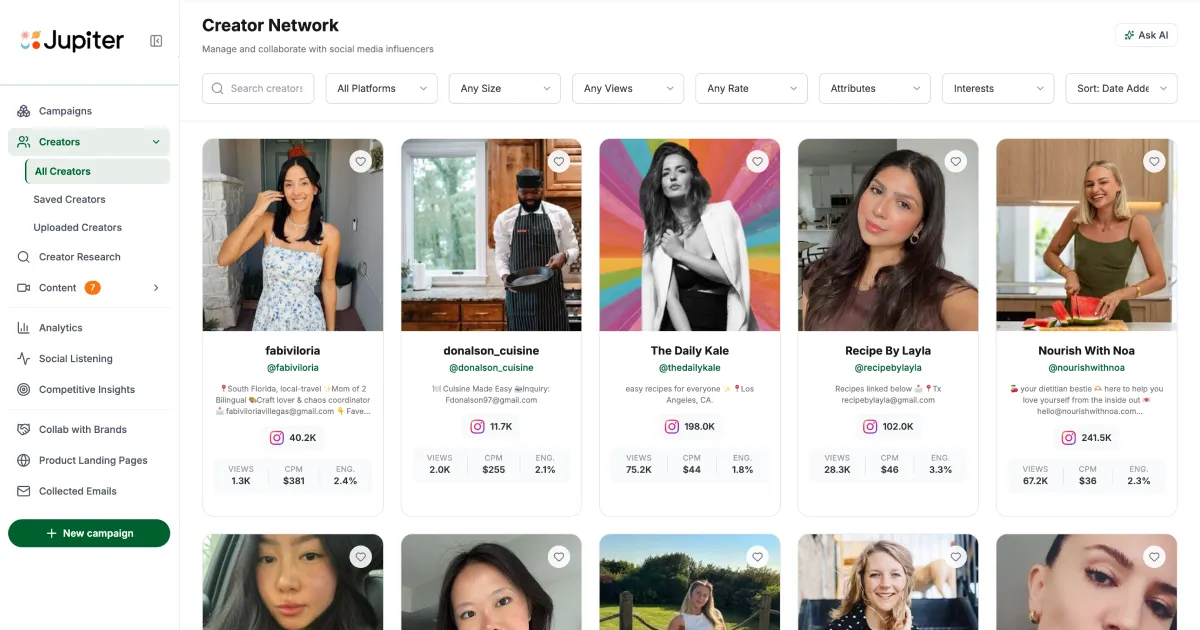
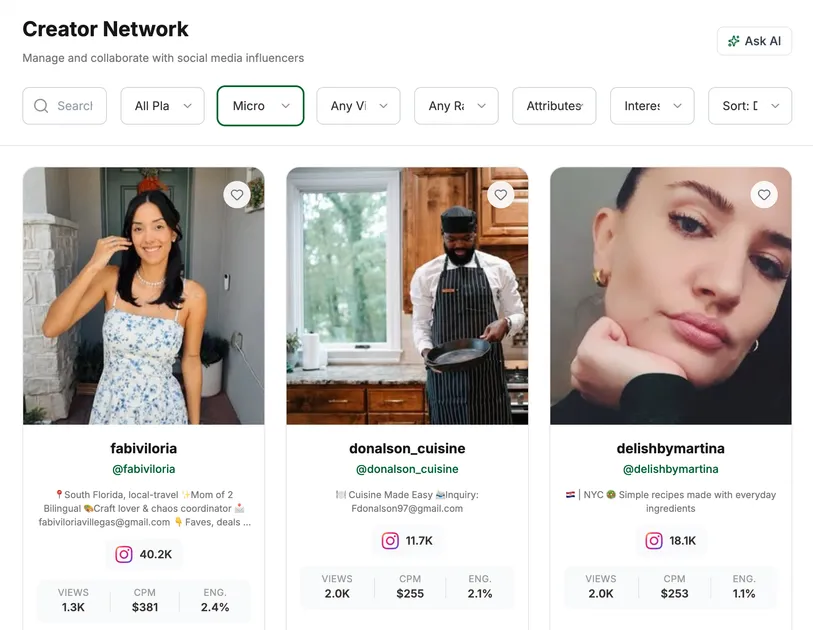
Jupiter's content review queue handles the full UGC workflow in one place
Submit, approve, reject with documented notes, and clear content for Instacart and Meta repurposing, across every creator and campaign simultaneously. Built exclusively for food and beverage CPG brands.
Using Creator UGC in Meta Whitelisting and Instacart Ad Creatives
Approved creator content has a second life in paid media that most food CPG brands are leaving unused. The two highest-value repurposing channels for food creator content are Meta whitelisting and Instacart ad creatives.
Meta whitelisting runs the creator's original video as a paid ad from the creator's own handle, not the brand's. The content retains its organic appearance because it posts from the creator's account, but the brand controls targeting, budget, and duration. Whitelisted creator content consistently outperforms brand-produced ad creative in CPM efficiency and engagement rate, because consumers engage differently with content from a person they follow than with content from a brand they recognize. The rights agreement with the creator must explicitly grant the brand paid amplification rights for this to be permissible.
Instacart ad creatives embed recipe video content from creators directly into Instacart's sponsored product placements and shoppable recipe features. A creator video showing your oat milk in a smoothie recipe, embedded in Instacart's search results for "oat milk," creates a commerce-connected exposure at the moment the consumer is actively shopping. This repurposing channel is highly specific to food and grocery brands and requires both rights clearance from the creator and integration with Instacart's ad platform.
Jupiter is one of Instacart's fastest-growing affiliate partners. The connection between Jupiter's content review workflow and Instacart's commerce infrastructure is built specifically for this use case.
The Rights Mistake That Creates Legal Exposure for Most CPG Brands
The most common rights mistake in food CPG UGC programs is using creator content in paid media without a rights agreement that explicitly covers that use.
A creator who agrees to post organic sponsored content has not agreed to let the brand run their face and voice as a paid advertisement on Meta. A creator who submits a recipe video for a brand's Instagram repurposing has not agreed to let the brand use that video in Instacart ad placements. These are different rights grants that require explicit language in the creator agreement.
The mistake happens because most food CPG brands do not have standardized creator agreements with clearly specified repurposing rights, and they repurpose content that performs well without checking whether the underlying rights agreement permits it. The discovery typically happens when a creator objects, publicly.
The fix is upstream: every creator brief and agreement should specify, before content is submitted, which repurposing channels the brand intends to use, for how long, and whether additional compensation applies. If the rights scope is not documented before capture, the content is only safely usable as organic repurposing on brand channels.
Running a creator program without a documented rights and review workflow? Here is what that costs you.
Jupiter's content review queue documents every approval and rejection with notes, and ties rights scope directly to the brief before content is submitted.
How Jupiter Handles the Full UGC Workflow for Food CPG Brands
Jupiter's content review queue manages the complete four-stage UGC workflow natively, built for video content rather than adapted from an image-first platform.
Creators submit content through the platform before posting. The review queue surfaces each submission with video thumbnail, creator name, campaign, recipe name, expected post date, and current status. Reviewers watch the video directly in the platform and make an approve or reject decision. Approvals include an optional notes field. Rejections require a specific reason, which is sent back to the creator automatically.
The queue filters across campaigns, creators, status, and date range simultaneously. Deep-link support means a reviewer can be sent a direct URL to a specific content item from an email notification and land directly on the submission, without navigating through the platform. For teams managing multiple campaigns with ten or more creators across them, this eliminates the coordination overhead that makes manual content review a bottleneck.
Approved content moves to the posted content feed, where it is tracked with live performance metrics: impressions, engagement rate, likes, comments, shares, and saves per post. The "Refresh metrics" function pulls current data from the social platform API so performance data stays current beyond the initial 48-hour window.
The rights and repurposing scope is built into the campaign brief and creator agreement flow within Jupiter's campaign management platform, so the repurposing permissions are documented at the point of content collection rather than discovered as an issue during the repurposing stage.
For brands building out a complete creator content strategy that connects UGC to campaign performance, the complete food influencer marketing guide covers the full workflow from brief to measurement.
The UGC review workflow food CPG brands actually need, not a general platform adapted for it.
Jupiter's content review queue handles capture, review, approval with documented notes, and repurposing rights, built for recipe video content and Instacart ad creatives. Used by 58+ CPG brands including Banza, Pete & Gerry's, and Kettle & Fire.
FAQs
Quick answers to common questions.
What is a UGC platform for food and grocery CPG brands?▼
A UGC platform for food and grocery CPG brands is software that manages the full lifecycle of creator-generated content: collecting submissions before public posting, reviewing content for brand compliance and accuracy, approving or rejecting with documented decisions, and clearing content for repurposing in paid media placements including Meta whitelisting and Instacart ad creatives. For food brands, the platform must support video review workflows for recipe content, not just image approval, because recipe videos involve product claims, dietary implications, and brand-adjacent ingredients that require human review before the content is posted or repurposed.
Who owns creator content after it is posted?▼
The creator owns the content they produce. A brand does not have the right to repurpose, amplify, or redistribute creator content in paid media without a rights agreement that explicitly grants those permissions. A creator who agrees to post organic sponsored content has not agreed to let the brand run that content as a paid Meta advertisement or embed it in Instacart ad placements. Rights agreements must specify the repurposing scope (organic brand channels, paid media, retail media), the duration of use, and any additional compensation for expanded rights, before content is submitted. Using creator content without documented rights clearance is the most common compliance mistake in food CPG creator programs.
Can I use creator UGC in Instacart ads?▼
Yes, if the rights agreement with the creator explicitly grants permission for retail media use. Instacart ad creatives, including shoppable recipe placements and sponsored product pages, are a paid media channel distinct from organic social repurposing. The creator's rights grant must cover paid retail media specifically. For brands that have secured proper rights clearance, embedding recipe creator content in Instacart placements at the moment a consumer is actively shopping for your category is one of the highest-value repurposing channels available for food CPG brands.
What is the difference between UGC and paid influencer content for a CPG brand?▼
Paid influencer content is content produced by a creator under a formal paid agreement, with a defined brief, deliverable, timeline, and compensation. UGC (user-generated content) is content produced by consumers or creators organically, without a paid agreement. For food CPG brands, the distinction matters primarily for rights and FTC disclosure. Paid influencer content requires FTC disclosure (#ad or paid partnership) and gives the brand defined repurposing rights based on the agreement. Organic UGC does not require disclosure but also does not come with automatic repurposing rights. Brands that want to use organic UGC in paid media must obtain explicit rights clearance from the creator before doing so.
What should I look for in a UGC platform for a food CPG brand specifically?▼
The five most important capabilities for food CPG brands are: pre-post submission workflow (content reviewed before it goes live, not after), recipe video review support (not just image approval), approve and reject with documented notes (creates a legal record and gives creators actionable feedback), rights management that explicitly covers paid media and Instacart ad creatives, and per-creator per-campaign status tracking that works across ten or more creators simultaneously. Most general UGC platforms cover basic capture and approval but were not built for recipe video content or retail media downstream integration.
How does content review work in Jupiter for food CPG campaigns?▼
Jupiter's content review queue allows creators to submit videos before public posting. Brand reviewers watch each submission directly in the platform and approve with optional notes or reject with a required reason, which is sent to the creator automatically. The queue filters by campaign, creator, status, and date range, and supports deep-link sharing so reviewers can be sent directly to a specific submission from an email notification. Approved content moves to the posted content feed with live performance metrics. Rights scope is documented in the campaign brief and creator agreement flow before content collection begins, eliminating the common post-hoc rights issue.
More in Platforms & Comparisons
More from Platforms & Comparisons.