Brand Ambassador Programs for CPG: How Food Brands Build Long-Term Creator Partnerships
The best brand ambassadors are graduated from past campaign creators, not cold-recruited. Here is how food and beverage CPG brands build long-term ambassador programs that compound performance across multi-month cycles, with specific structure, creator selection, and measurement frameworks.
Trusted by leading CPG brands


















On this page
▼
- The principle that separates programs that work from those that do not
- Why ambassador programs outperform one-off campaigns for food CPG
- Audience association compounds across posts
- Per-post economics improve substantially with commitment
- Content quality rises across the program
- Retailer support compounds across cycles
- Creator relationships become a brand asset
- Structuring an ambassador program: duration, cadence, and tiering
- Duration
- Posting cadence
- Tiering
- Creator selection for ambassador programs
- Past campaign performance
- Brand affinity from past collaboration history
- View consistency, not just view average
- Audience geographic concentration in target retailer markets
- Audience credibility
- Brief structure for ambassador programs
- The brief becomes a program brief, not a campaign brief
- Recurring content concepts replace one-shot creative hooks
- Retailer call-to-action varies across cycles
- Contract design and creator economics
- Per-post rate vs monthly retainer
- Exclusivity terms
- Renewal terms
- Measuring ambassador programs
- Program-level KPIs replace campaign-level KPIs
- Per-creator performance against estimated targets matters more
- Retail attribution should be tracked per cycle
- Share of voice during the program window
- Cold-recruiting ambassadors instead of graduating them
- Setting program duration too short
- Tiering for ego instead of efficiency
- Briefing one-off creative for a program
- Skipping mid-program performance reviews
- Not tracking which one-off campaigns produced the best ambassadors
- How Jupiter handles brand ambassador programs for food CPG
A brand ambassador program is a long-term creator partnership where a CPG brand commits to a multi-month relationship with a small group of creators who produce recurring content, build sustained audience association with the brand over time, and earn reduced per-post economics in exchange for the commitment and volume. For food and beverage brands, ambassador programs have become the highest-leverage form of creator marketing because they compound: each cycle's content reinforces the previous cycle, audiences develop genuine brand-creator association over time, and the cost per impression drops meaningfully as one-off campaign overhead disappears.
Most CPG brands run their first influencer marketing as one-off campaigns. The strongest food CPG brands then convert their best-performing campaign creators into long-term ambassadors. This post covers how to structure those programs end to end: how to identify ambassador candidates from existing campaign data, how the contract economics work, how to brief creators for sustained brand association rather than one-off conversion, and how to measure programs across multi-month cycles. Every framework here is specific to food and beverage CPG, where retail attribution, retailer-windowed campaigns, and the specific audience dynamics of food creator content shape how ambassador programs need to be designed.
If you are running one-off creator campaigns today and evaluating whether ambassadorship is the right next step, our Instacart campaign execution playbook covers the foundational campaign workflow that ambassador programs build on top of. For broader strategic context, our complete guide to food influencer marketing covers the full landscape.
The principle that separates programs that work from those that do not
The single most important shift in how to think about brand ambassador programs is this: the best ambassadors are graduated from creators who have already worked with the brand, not cold-recruited from a new pool.
Cold-recruited ambassadors fail at high rates because there is no shared performance history to inform the selection. The brand commits to a six-month or twelve-month relationship before knowing how the creator's audience actually responds to the product, whether the creator delivers on time, or whether the content quality meets expectations. Both sides go in without real data, and a meaningful share of these programs underperform or end early.
Graduated ambassadors solve this problem. The brand has already run a one-off campaign with the creator and has actual performance data from that campaign: impressions delivered against projection, audience response, content quality, on-time delivery, and how the brand's product integrated into the creator's content style. The creator has already experienced the brand's brief structure, payment timeliness, and creative process, and is committing to extend a working relationship rather than entering an unknown one. Both sides reduce risk by relying on actual performance history rather than intent and projected fit.
This graduation model is built directly into how Jupiter structures ambassador campaigns. Every ambassador campaign in the platform can reference the original awareness campaign it was graduated from, which means the brand can trace which one-off campaigns produced the most successful long-term partnerships over time. The data compounds: brands learn which creator profiles and campaign structures convert into reliable ambassadors and which do not, and creator selection for future ambassador programs becomes increasingly precise with each cycle.
Why ambassador programs outperform one-off campaigns for food CPG
Five structural reasons make ambassador programs outperform one-off campaigns for food and beverage brands.
Audience association compounds across posts
A creator's audience seeing the same brand referenced across twelve posts over six months develops a meaningfully stronger brand-creator association than the same audience seeing the brand once in a single campaign. For food CPG products competing in crowded grocery aisles, this association directly affects shelf-side recognition. The shopper standing in front of two oat milk brands reaches for the one their favorite creator has been cooking with for the past four months.
Per-post economics improve substantially with commitment
Long-term ambassador commitments unlock meaningfully better economics than one-off campaigns. Creators accept reduced per-post rates in exchange for guaranteed multi-month income and the stability of a committed partnership. Across a six-month program with twelve posts per creator, the brand's cost per impression typically drops significantly compared to running twelve separate one-off campaigns with the same creators.
Content quality rises across the program
Creators who have worked with a brand for six months understand the brand voice, ingredient story, retailer positioning, and creative direction in ways no one-off brief can fully convey. Content quality typically improves across the program duration rather than starting at peak and degrading, because the creator becomes increasingly fluent in the brand context with each posting cycle.
Retailer support compounds across cycles
A twelve-month ambassador program timed against retail moments (Whole Foods seasonal merchandising, Kroger Mega Sale events, Target Bullseye launches, Costco roadshow windows) creates layered support across multiple retail windows in the same year. Each window gets reinforced by ambassador content that already has brand context built in, rather than starting from scratch each time.
Creator relationships become a brand asset
One-off campaigns leave the brand without persistent creator relationships. Each new campaign starts from zero. Ambassador programs create a roster of creators who know the brand, return outreach quickly, and represent the brand's interests in their own creator networks. Over multiple cycles, this roster becomes one of the brand's most valuable and hard-to-replicate marketing assets.
Structuring an ambassador program: duration, cadence, and tiering
Three structural decisions shape every ambassador program.
Duration
Most effective ambassador programs run a minimum of six months. Below this threshold, the audience-association effect does not have time to compound, and the operational overhead of setting up the program consumes too much of the program's value relative to content output. Jupiter enforces a six-month minimum on ambassador campaigns for exactly this reason, not as an arbitrary policy but as a reflection of the minimum duration at which the structural advantages of ambassadorship exceed the setup overhead.
The twelve-month program is more common for established food CPG brands with year-round retail presence and a consistent seasonal merchandising calendar. The six-month program is more common for seasonal categories (summer beverages, back-to-school lunchbox foods, holiday baking), brands testing the ambassador model for the first time, or brands aligning programs to specific retail distribution windows.
Posting cadence
A consistent posting cadence, calendared in advance for the full program duration, is the operational backbone of an ambassador program. Content that posts erratically reduces audience association, complicates retailer-windowed coordination, and makes program-level performance analysis impossible. The standard cadence for food and beverage ambassador programs is two posts per creator per month, enough to maintain visible audience presence without saturating the creator's feed with brand content. Jupiter validates this cadence on ambassador campaigns and pre-generates content schedules across the full program at creation, removing month-by-month scheduling overhead from the brand team.
Tiering
Most multi-creator ambassador programs use a tier structure to manage different creator profiles within the same program. A typical food CPG ambassador program might run a top tier of two to three macro creators (250K+ followers, broader reach, premium per-post rates), a mid tier of four to six mid-tier creators (50K to 250K followers, balanced reach and engagement, the workhorse tier), and a base tier of six to ten micro creators (10K to 50K followers, high engagement, deep audience niche). Each tier has its own per-post rate, posting volume target, creator slot count, and budget allocation within the program. This structure lets the brand calibrate spend across reach (top tier), efficiency (mid tier), and depth (base tier) within a single coordinated program.
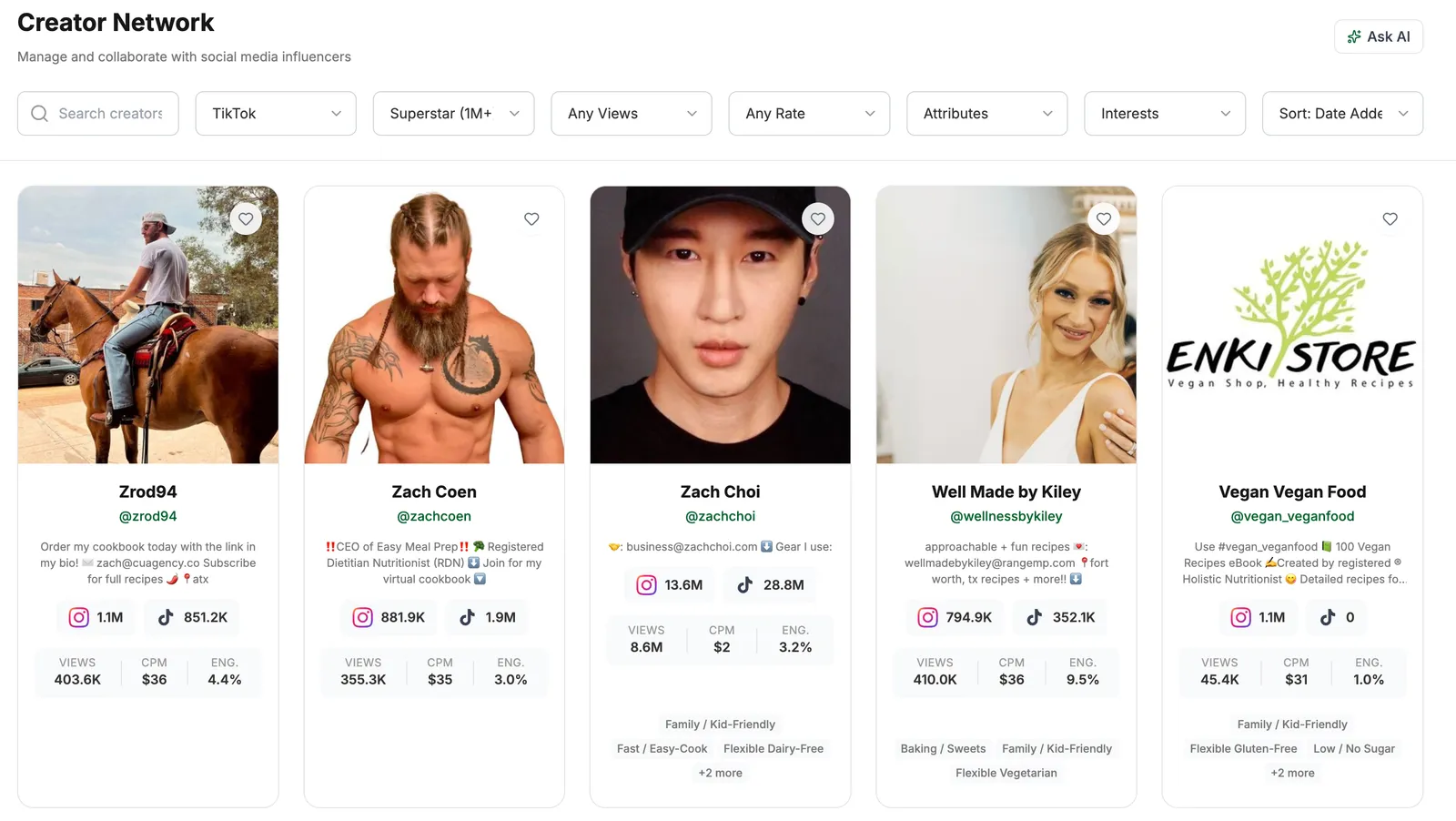

See how Jupiter structures ambassador programs for food CPG brands
Six-month minimum, 2-posts-per-month cadence, tiered creator selection, ambassador-rate pricing, and pre-generated content schedules built into one workflow.
Creator selection for ambassador programs
Selecting ambassadors is the single highest-leverage decision in the program. A program with the right roster outperforms even a well-structured program with a weaker one. Five filters narrow the selection.
Past campaign performance
The strongest signal is direct: did this creator deliver above expectations in a one-off campaign with the brand or with adjacent brands in the same category? Impressions delivered against estimate, engagement rate, on-time delivery, content quality, and audience response are all observable from past campaign data. Creators who exceeded estimated impressions in a one-off campaign tend to outperform in ambassador programs at meaningfully higher rates than creators who only met estimates.
Brand affinity from past collaboration history
Creators who have previously collaborated with brands in adjacent food CPG categories carry built-in audience credibility for the new brand. A creator who has worked with three plant-based brands has a plant-curious audience pre-conditioned to respond to a fourth plant-based brand. Jupiter's optimizer scores brand affinity directly: creators with prior posts featuring brands that match the new brand's category tags receive higher scoring, with creators who have multiple matching prior collaborations scoring meaningfully above creators with no matching history.
View consistency, not just view average
A creator who consistently averages 80K views per post is a more reliable ambassador than a creator who averages 200K views with high variance (one viral 800K-view post and several posts under 30K views). Ambassador programs need predictable monthly performance to deliver against estimated impressions. Jupiter tracks per-creator view consistency across four tiers, which allows program designers to prioritize consistency over peak.
Audience geographic concentration in target retailer markets
For food CPG brands selling through specific retailer footprints, ambassador audience geography matters as much as content quality. A program supporting Whole Foods national distribution should target creators with audiences distributed across major Whole Foods metros. A program supporting a regional Kroger banner launch should concentrate on creators with audiences in that banner's specific markets. Jupiter's campaign optimizer handles retailer proximity scoring automatically as one of its 12 signals.
Audience credibility
Creators with audiences that are predominantly real (rather than bot-inflated) deliver meaningfully better long-term performance because the brand association compounds within an actual audience. Jupiter scores audience credibility directly using third-party audience quality data. Programs that filter for higher credibility scores produce more reliable program-level performance.
The combined selection model is multi-signal. Jupiter's campaign optimizer scores eligible creators across 12 signals: geographic match, demographic alignment, content interest overlap, engagement quality, view consistency, audience credibility, content recency, brand affinity from past collaborations, retailer proximity, creator attribute match, audience attribute match, and hashtag relevance. The composite score drives ambassador selection, weighted toward the signals that matter most for the specific program.
Not sure which creators in your category make the strongest ambassadors?
Launch creatoJupiter's 12-signal optimizer scores food creators on brand affinity, view consistency, and retailer proximity so you can graduate the right creators from campaigns to long-term programs.r-led campaigns faster with better ROI visibility.
Brief structure for ambassador programs
Briefs for ambassador programs differ from briefs for one-off campaigns in three important ways.
The brief becomes a program brief, not a campaign brief
A one-off campaign brief specifies creative direction for a single piece of content. An ambassador program brief specifies creative direction for twelve pieces of content across six months: the brand voice, the recurring product positioning, the seasonal moments to align with, the retailer-specific calls-to-action for each cycle, and the variation expected from post to post. The brief is a creative system, not a one-shot document.
Recurring content concepts replace one-shot creative hooks
A one-off campaign might brief a single creative hook (the unexpected ingredient swap, the time-saving meal prep concept). An ambassador program briefs a recurring content series structure: a month-by-month recipe theme, a seasonal cooking arc, a retailer-windowed product moment. The creator builds variations on the structure across the program rather than executing a single hook once.
Retailer call-to-action varies across cycles
Ambassador programs spanning multiple retail windows need retailer language that shifts cycle to cycle. The Whole Foods endcap window in March might use specific Whole Foods language. The Kroger Mega Sale event in June shifts to Kroger-specific language. The Costco roadshow in July uses Costco-specific language. Ambassador briefs should map retailer call-to-action to the program calendar from the start rather than leaving this to per-cycle decisions.
Jupiter's platform supports brief reuse across ambassador cycles. The same foundational brief powers multiple cycles with cycle-specific updates layered in, preserving brand voice consistency while allowing creative variation. The reuse mechanism also tracks which briefs have powered which programs, so brand teams can identify which creative foundations consistently produce the strongest ambassador performance over time.
Contract design and creator economics
Three considerations shape ambassador contract structure.
Per-post rate vs monthly retainer
Most food CPG ambassador programs use a per-post rate structure: the creator is paid for each post delivered, at a reduced rate compared to standard one-off campaigns, in exchange for the multi-month commitment. Some programs use a monthly retainer instead, paying a flat amount per month for an agreed posting volume. Per-post structures are more common because they preserve performance accountability: a creator who posts late or skips a month does not get paid for content they did not deliver.
Exclusivity terms
Ambassador programs often include category exclusivity: the creator agrees not to work with directly competing brands during the program duration. The strength of this clause varies by creator tier and category competitiveness. Top-tier creators with high one-off campaign demand command tighter exclusivity terms. Mid-tier and base-tier creators often accept broader exclusivity in exchange for the program's stable income.
Renewal terms
The strongest ambassador programs treat each cycle as a renewal opportunity rather than an automatic continuation. Renewal terms can include performance-based bonuses for ambassadors who exceeded program targets, automatic re-onboarding for ambassadors who delivered consistently, and structured offboarding for ambassadors whose performance did not meet expectations.
Measuring ambassador programs
Ambassador program measurement differs from one-off campaign measurement in three meaningful ways.
Program-level KPIs replace campaign-level KPIs
A one-off campaign reports on impressions, engagement, and (for CPG) Instacart cart adds within the campaign window. An ambassador program reports on the same metrics across the full program duration plus program-specific KPIs: cumulative audience reach across the full program, cycle-over-cycle engagement trajectory, audience retention of attention across multiple posts, and brand search lift over the program window. Our four-layer influencer marketing ROI framework covers how to structure measurement for programs running across multiple cycles.
Per-creator performance against estimated targets matters more
In one-off campaigns, an underperforming creator delivers a weak campaign and the brand moves on. In ambassador programs, an underperforming creator drags down six months of program output. Mid-program performance review against estimated targets is essential. Jupiter's campaign health logic compares actual delivered impressions against estimated impressions on a clear ratio: programs delivering at or above 80% of estimate are healthy, programs between 50% and 80% need creator-level review, and programs below 50% require structural intervention. Real-time access to this health data through the analytics dashboard lets program managers swap underperforming creators mid-program rather than waiting until the program ends.
Retail attribution should be tracked per cycle
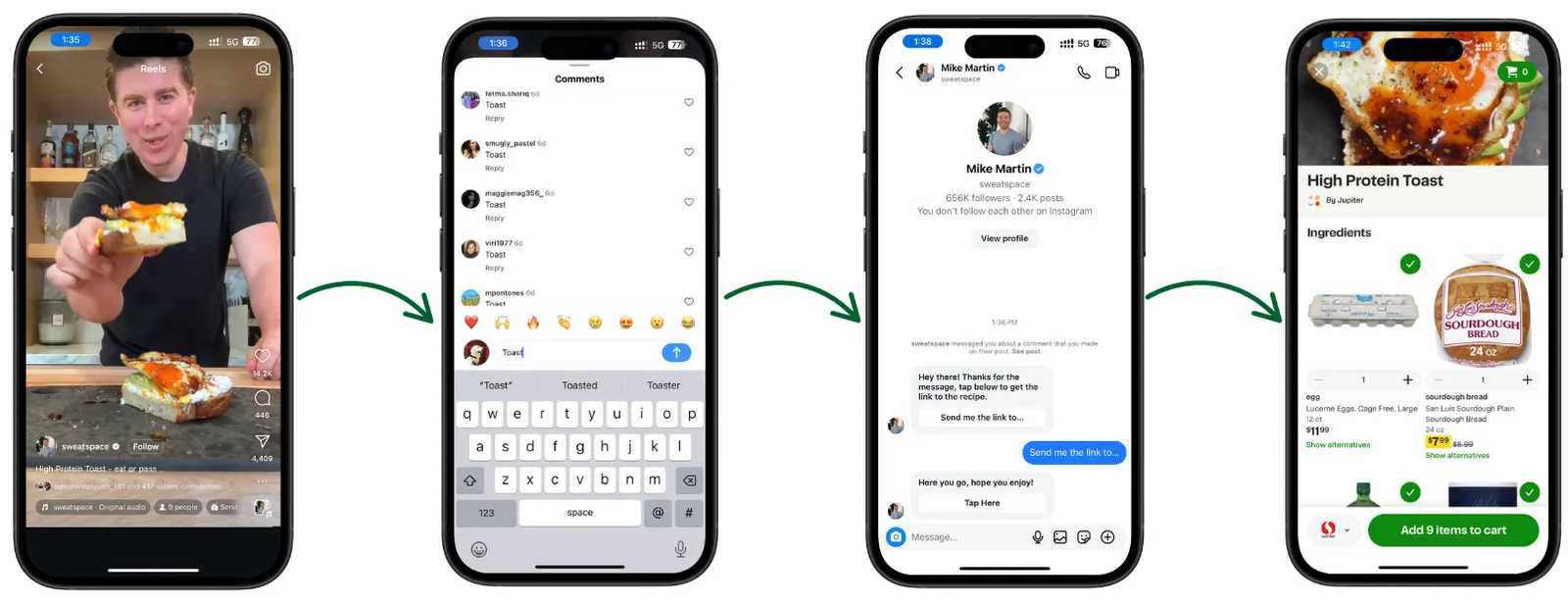
For food CPG brands, retail sell-through is the ultimate program KPI. Ambassador programs supporting retailer windows should track sell-through per cycle: did the March cycle drive measurable lift at the Whole Foods endcap? Did the June cycle drive measurable lift during the Kroger Mega Sale? Cycle-by-cycle tracking lets the brand identify which retail moments produce the strongest ambassador-driven lift and concentrate future program investment accordingly.
Share of voice during the program window
Ambassador programs are brand-equity investments as well as performance investments. Tracking category share of voice across Instagram, TikTok, YouTube, and X during the program window relative to baseline periods captures the brand-building value that direct attribution does not. Jupiter's share of voice tracking handles this across all four platforms automatically.
Common mistakes CPG brands make with ambassador programs
Cold-recruiting ambassadors instead of graduating them
The most common cause of program underperformance. Without past performance data, selection is guesswork and the commitment is a gamble rather than a calculated extension.
Setting program duration too short
Programs under six months do not generate enough audience-association compounding to justify the operational overhead. Brands that run four-month programs and conclude "ambassador programs do not work" are often measuring the wrong thing at the wrong time.
Tiering for ego instead of efficiency
Some brands structure ambassador programs around recruiting the most-followed creator they can afford rather than the right combination of creators across tiers. The right ambassador roster for a $300K program is rarely a single 1M-follower creator. It is usually a tiered roster of eight to twelve creators across follower bands, optimized for combined reach, engagement, and audience match.
Briefing one-off creative for a program
Ambassador briefs that read like one-off campaign briefs produce one-off-quality content repeated twelve times. Recurring content concepts, seasonal arcs, and retailer-windowed variations are what differentiate program briefs from campaign briefs.
Skipping mid-program performance reviews
Programs running for six to twelve months without checkpoint reviews end with underperformance discovered too late. Monthly or bi-monthly review cadences allow mid-program creator swaps and brief refinements that protect the program's overall ROI.
Not tracking which one-off campaigns produced the best ambassadors
Brands running multiple ambassador cycles over multiple years often do not track which past campaigns produced the most successful ambassadors. The data compounds when tracked: brands that map ambassador success rates back to the originating campaign profiles improve future creator-recruitment precision dramatically.
How Jupiter handles brand ambassador programs for food CPG
Jupiter is built exclusively for food and beverage CPG brands, and ambassador programs are a first-class campaign type in the platform. The ambassador campaign type enforces a six-month minimum duration, validates two-posts-per-month cadence per creator, and pre-generates content schedules across the full program at campaign creation. The creator selection workflow draws from creators who have previously delivered for the brand or from the brand's saved roster, with ambassador-tier pricing automatically calibrated against each creator's standard one-off rate. Every ambassador campaign can reference the awareness campaign it was graduated from, which builds a long-term data trail of which one-off campaigns produced the strongest ambassador conversions.
The campaign optimizer scores creator candidates across 12 signals including brand affinity from past collaboration history, audience credibility, retailer proximity to the brand's distribution markets, audience geographic concentration, content interest alignment with the brand's category tags, posting recency, view consistency, and engagement quality. Brief reuse across cycles preserves brand voice consistency while allowing per-cycle creative variation. Campaign health monitoring against estimated impressions runs in real time through the analytics dashboard, which lets program managers swap underperforming creators mid-program rather than discovering issues at program end. Share of voice tracking captures brand-equity lift across the program window across Instagram, TikTok, YouTube, and X.
Brands running ambassador programs on Jupiter include La Tourangelle, Banza, Pete & Gerry's, Nellie's Free Range Eggs, Kettle & Fire, Schweid & Sons, Vermont Creamery, and 50+ others, many of whom have run multiple program cycles with renewed ambassador rosters.
Run your next brand ambassador program on Jupiter.
Multi-month program structure, graduated ambassador selection, automatic content scheduling, brief reuse across cycles, and program-level analytics in one workflow built specifically for food and beverage CPG.
FAQs
Quick answers to common questions.
What is a brand ambassador program for a CPG food brand?▼
A brand ambassador program is a long-term creator partnership where a CPG brand commits to a multi-month relationship with a small group of food creators who produce recurring content across the program duration. Ambassador programs typically run a minimum of six months with creators delivering two posts per month, in exchange for reduced per-post economics compared to one-off campaigns. The structure builds sustained brand-creator audience association that compounds across cycles in ways one-off campaigns cannot match.
How is a brand ambassador program different from a one-off influencer campaign?▼
A one-off influencer campaign is a single-window engagement where creators produce one or a small number of posts within a defined campaign period. A brand ambassador program is a sustained multi-month relationship with recurring posting cadence, layered audience association, and structurally lower per-post economics. Ambassador programs also build a creator relationship asset that persists across cycles and informs future program design, while one-off campaigns end the relationship at campaign close.
How long should a CPG brand ambassador program run?▼
Most effective CPG brand ambassador programs run a minimum of six months, with twelve-month programs common for established brands with year-round retail presence. Programs shorter than six months typically do not generate enough audience-association compounding to justify the operational overhead of program setup and creator coordination. The six-month threshold is where the structural advantages of ambassador programs (compounding audience association, improved per-post economics, layered retailer support) exceed the setup overhead.
How should CPG brands select brand ambassadors?▼
The strongest CPG brand ambassadors are graduated from past one-off campaign creators who have already demonstrated above-target performance, on-time delivery, and brand-aligned content quality. Selection should weigh past campaign performance, brand affinity from prior collaboration history with adjacent CPG categories, view consistency across past content, audience geographic concentration in the brand's retailer markets, and audience credibility scores. Cold-recruiting ambassadors without prior performance data produces meaningfully higher program failure rates than graduating ambassadors from existing campaign rosters.
How are brand ambassadors paid in a CPG program?▼
Most CPG ambassador programs use per-post rate structures, where creators are paid for each post delivered at a rate reduced from their standard one-off campaign rate in exchange for the multi-month commitment. Some programs use monthly retainer structures instead. Per-post structures are more common because they preserve performance accountability: a creator who posts late or skips a posting window does not get paid for content they did not deliver.
How do CPG brands measure brand ambassador program ROI?▼
Ambassador program ROI is measured across program-level KPIs: cumulative audience reach across the full program duration, cycle-over-cycle engagement trajectory, Instacart cart adds per cycle for brands with Instacart attribution, retail sell-through per cycle aligned to retailer merchandising windows, and category share of voice across Instagram, TikTok, YouTube, and X relative to baseline periods. Mid-program performance reviews against estimated targets are essential to identify and replace underperforming creators before the full program completes.
More in Campaign Types & Programs
More from Campaign Types & Programs.