Jupiter vs Upfluence: Which Platform Drives More ROI for Food Brands?
Upfluence is a widely used influencer marketing platform built for e-commerce brands. Jupiter is built exclusively for food and beverage CPG brands selling through grocery retail and Instacart. Here is an honest comparison of both, covering creator discovery, attribution, retailer targeting, pricing, and which platform drives the ROI that food CPG marketing teams actually need to show.
Trusted by leading CPG brands















On this page
▼
- Quick verdict
- Platform overview: Upfluence
- Where Upfluence genuinely excels:
- Where Upfluence's e-commerce architecture shows its limits for grocery CPG:
- Platform overview: Jupiter
- The ROI gap: what each platform can and cannot measure
- Feature-by-feature comparison
- Creator discovery
- Campaign management
- Retailer targeting
- Attribution and reporting
- Pricing
- Two purchase journeys, two different platform requirements
- Who should use Upfluence
- Who should use Jupiter
- Summary
Upfluence and Jupiter are both influencer marketing platforms. The similarity ends there.
Upfluence positions itself as the number one influencer marketing platform for e-commerce brands, with native integrations with Amazon, Shopify, WooCommerce, Magento, and BigCommerce, designed to help brands increase sales through creator and affiliate partnerships. It is a well-established platform with genuine strengths in e-commerce creator discovery and affiliate program management.
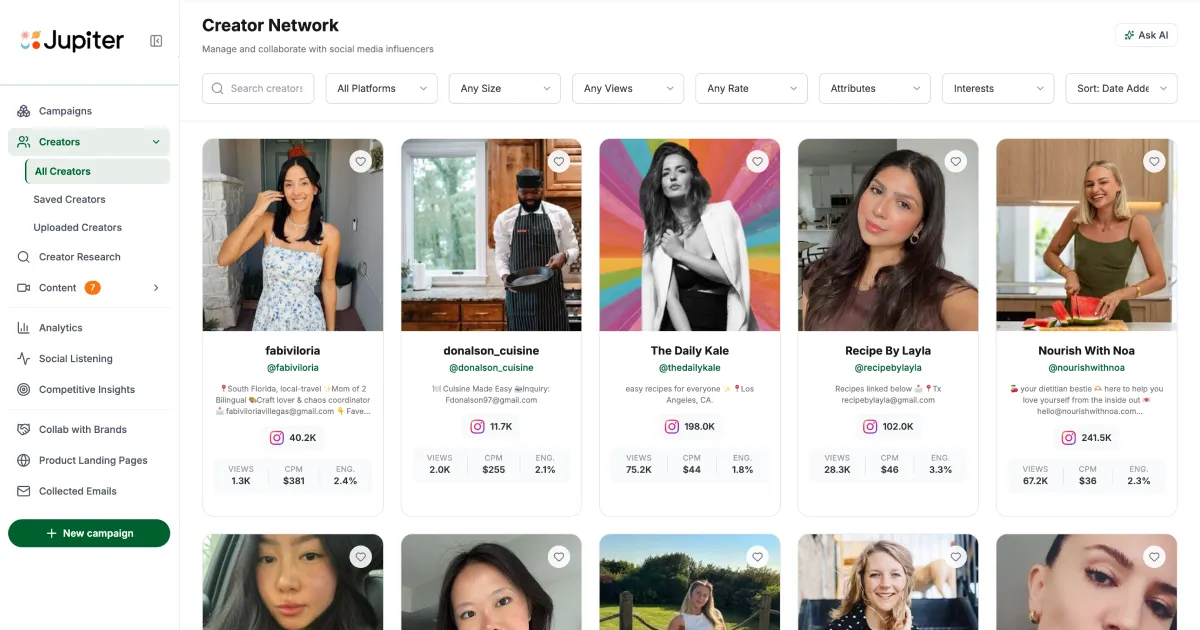
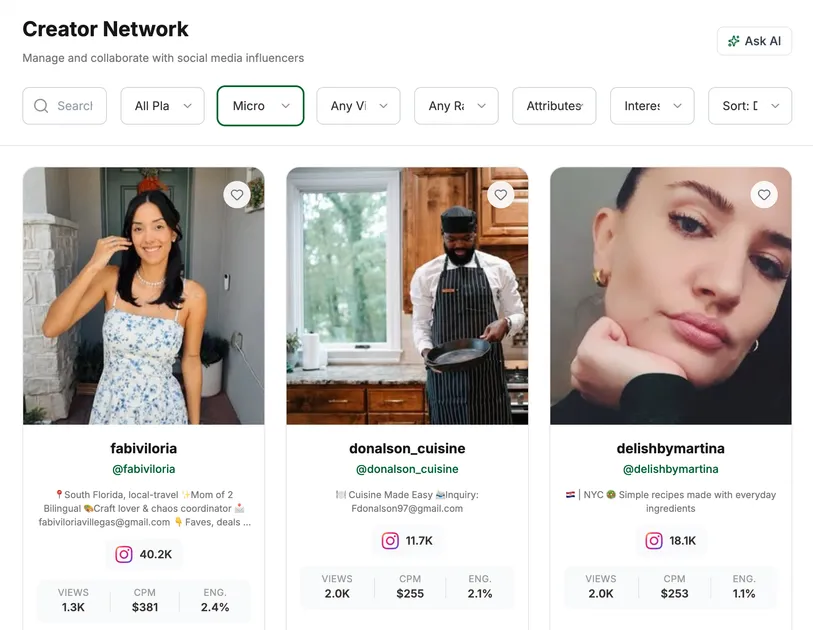
Jupiter is built exclusively for food and beverage CPG brands selling through grocery retail and Instacart. Its creator network is curated specifically for recipe and food lifestyle content. Its campaign optimizer scores creators across 12 signals including retailer proximity and brand affinity. Its Instacart attribution layer connects creator content to grocery cart adds per creator and post. These capabilities are not available on Upfluence.
The direct answer: Upfluence is an excellent platform for brands selling primarily through Amazon, Shopify, or WooCommerce where affiliate link attribution to a DTC checkout is the primary ROI model. For food and beverage CPG brands selling through Whole Foods, Kroger, Sprouts, or Instacart, Upfluence's e-commerce attribution model was built for a fundamentally different purchase journey. Jupiter was built for yours.
Quick verdict
Jupiter | Upfluence | |
|---|---|---|
Built for | Food and beverage CPG exclusively | E-commerce brands across all verticals |
Creator network | 1,000+ curated food and recipe creators | 4M+ profiles across all verticals |
Instacart attribution | Built in | Not available |
Retailer proximity scoring | Built in | Not available |
E-commerce integrations | Not the focus | Core strength: Amazon, Shopify, WooCommerce |
CPG-specific brief workflows | Built in | Generic templates |
Affiliate program management | Not the focus | Strong, core differentiator |
AI assistant | 20-tool food CPG marketing agent | AI for outreach and pricing recommendations |
Pricing | Demo-based, no setup fees | From $478/month, 12-month minimum contract |
Best for | Food CPG selling through grocery retail and Instacart | E-commerce brands running affiliate and creator programs on Amazon, Shopify, or WooCommerce |
Platform overview: Upfluence
Upfluence was built by co-founders who were originally looking to market their own e-commerce business through influencer partnerships, which explains why the platform's architecture is oriented around e-commerce creator discovery and affiliate-driven sales attribution.
Upfluence describes itself as the number one influencer marketing platform for e-commerce brands on Amazon, Shopify, Magento, BigCommerce, and WooCommerce, with native Amazon integration and a model that takes zero fees from sales generated through creator partnerships.
The platform has a database of over 4 million influencer profiles across social media platforms, and users consistently praise its search and filtering capabilities for narrowing down creators by audience demographics, niche, and engagement level. The platform also allows brands to identify influencers within their existing customer base, which is a genuine differentiator for DTC e-commerce brands that want to activate brand advocates.
Upfluence pricing starts at approximately $478 per month and is structured around subscription modules. Custom pricing is available based on modules required, with a minimum contract duration of 12 months.
Where Upfluence genuinely excels:
E-commerce sales attribution. Upfluence's integrations with Shopify, Amazon, WooCommerce, and BigCommerce allow the platform to track creator-driven sales through affiliate links and promo codes that route to brand-controlled checkouts. For brands with DTC e-commerce, this is clean, measurable attribution.
Creator discovery from existing customer base. Upfluence can analyze a brand's website visitors and customer data to identify customers who are also social media creators, which is a useful discovery channel for DTC brands with existing customer communities.
Large creator database with strong filtering. Users consistently praise Upfluence's search and filtering capabilities as one of the platform's strongest features, particularly the ability to drill down by audience demographics, niche, and engagement criteria.
Affiliate program management. Upfluence handles promo code generation, affiliate link tracking, and creator payment processing, which reduces the operational overhead of running affiliate programs at scale.
Amazon integration. Upfluence is the only influencer platform with native Amazon integration, which is a genuine differentiator for brands selling through Amazon alongside DTC channels.
Where Upfluence's e-commerce architecture shows its limits for grocery CPG:
While Upfluence's creator search is strong, users note that campaign management automation is a weaker area of the platform. For food CPG brands that need structured campaign management with briefed creators, content review, and multi-month program tracking, this gap creates operational overhead the platform does not solve.
Attribution is built around e-commerce checkouts. Upfluence's sales tracking requires a brand-controlled Shopify, Amazon, or WooCommerce checkout to close the attribution loop. CPG brands selling through Whole Foods, Kroger, or Instacart do not have a brand-controlled checkout. The attribution Upfluence provides for these brands stops at clicks and affiliate conversions that do not exist.
No Instacart attribution. For food CPG brands whose primary retail channel is Instacart, the per-creator shoppable link infrastructure that connects creator posts to grocery cart adds is not available on Upfluence.
No retailer proximity scoring. A CPG brand launching at Whole Foods in the Bay Area needs creators whose audiences are concentrated in Northern California Whole Foods metros. Upfluence's geographic filtering is based on creator location and audience demographics, not audience proximity to specific retailer footprints.
No food-curated creator network. Upfluence's 4M+ creator database spans all verticals. The food and recipe subset is a fraction of that, and filters for food-specific audience behavior (save rates on recipe content, grocery shopping audience habits, content interest depth in specific food categories) are not the primary signals the platform was built to surface.
Platform overview: Jupiter
Jupiter is built exclusively for food and beverage CPG brands. The campaign management platform handles the full campaign lifecycle: creator discovery through a 12-signal optimizer, brief creation with CPG-specific fields (recipe concept, retailer call-to-action, certifications, shoppable comment trigger), content review before posting, Instacart trackable link generation per creator, and live attribution reporting throughout the campaign window.
Jupiter's creator network contains 1,000+ food creators curated specifically for recipe and food lifestyle content. Every creator has per-platform average view counts, engagement rates, save rates, content interest tags mapped to food categories, audience geography down to metro level, and credibility scores. The campaign optimizer scores every eligible creator across 12 signals: geographic match, demographic alignment, content interest overlap, engagement quality, view consistency, audience credibility, content recency, brand affinity from past collaboration history, retailer proximity to target stores, creator attribute match, audience attribute match, and hashtag relevance.
Instacart attribution is the capability that changes the ROI conversation for food CPG brands. When a viewer comments on a creator's post with a specific keyword, they automatically receive a DM with a unique shoppable Instacart link tied to that specific creator and post. Cart adds attribute back to the specific creator and post that drove them. The brand sees which creator drove the add, how many adds came in, and where geographically they came from.
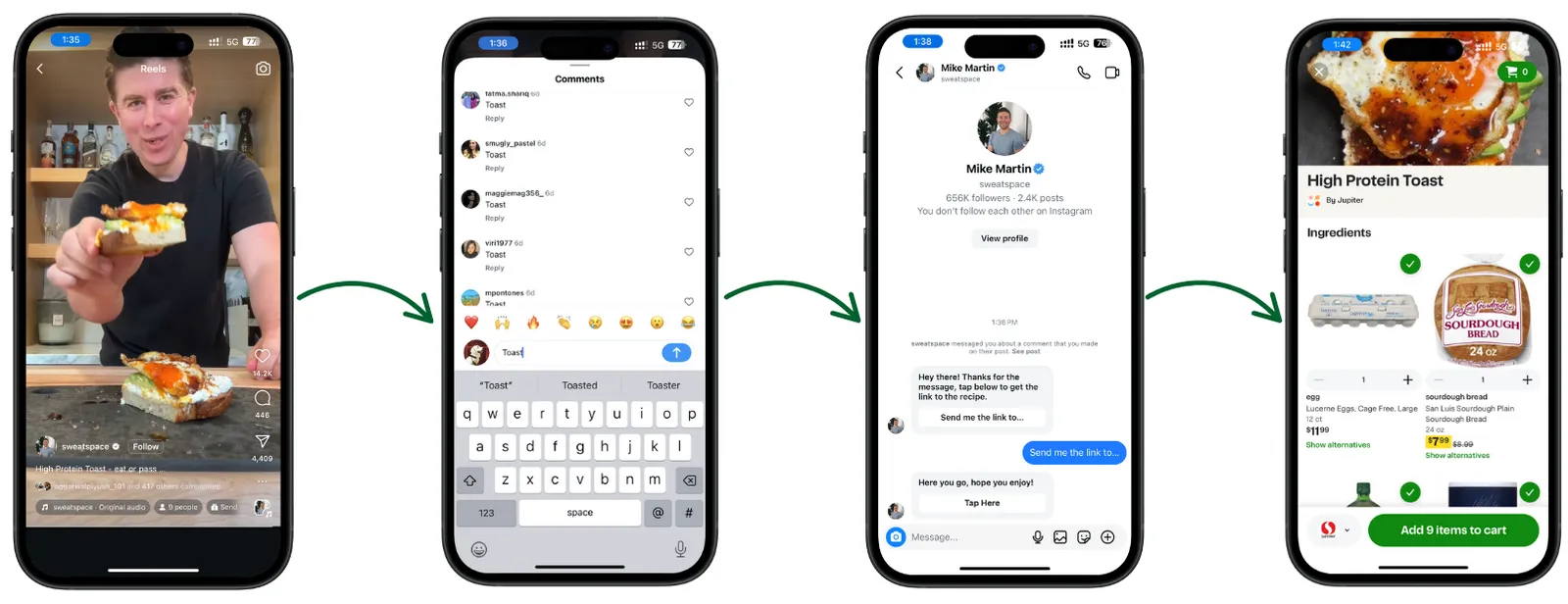
One proof point: one Instagram Reel run through Jupiter, 6.5 million views, 1,000+ customers added that brand's products to their Instacart carts. The content was doing the job. The attribution layer made it measurable.
The Jupiter AI marketing agent is a 20-tool conversational assistant that handles creator search, brief drafting, campaign analytics, and performance reporting using the brand's actual platform data. The analytics dashboard surfaces estimated vs. actual impressions, creator-level cost efficiency, Instacart attribution data, and real-time campaign health indicators. Share of voice tracking monitors brand mentions across Instagram, TikTok, YouTube, and X continuously.

See what food CPG campaign management actually looks like in Jupiter
1,000+ curated recipe creators, Instacart attribution, retailer proximity scoring, and a 20-tool AI marketing agent built exclusively for food and beverage CPG brands.
The ROI gap: what each platform can and cannot measure
This is the most important part of the comparison for food CPG brands and the clearest reason why the platforms are not interchangeable.
Upfluence measures ROI through e-commerce attribution: affiliate links, promo codes, and UTM parameters that route viewers to a brand-controlled checkout. The brand sees clicks, conversions, and revenue from creators who drove a viewer to complete a DTC purchase. This is accurate and useful for brands where the purchase journey ends at an e-commerce checkout.
For food CPG brands, the purchase journey ends at a grocery store shelf or an Instacart cart. A consumer watches a recipe Reel featuring a brand's oat milk, drives to Whole Foods on Saturday, and buys it. No affiliate link fired. No promo code was used. No DTC checkout recorded the transaction. Upfluence has no mechanism to capture this outcome, which means the "ROI" it reports for food CPG campaigns stops at clicks and engagement rather than actual grocery sales.
Jupiter's four-layer attribution framework was built specifically for this purchase journey. Estimated vs. actual impressions and CPM measure execution quality. Creator-level cost efficiency (impressions per dollar) identifies which creators deliver the best value. Instacart trackable links and cart adds per creator measure grocery purchase intent directly. Category share of voice movement captures brand equity gains that do not show up in click dashboards. These four layers together answer the question that Upfluence cannot: did this creator campaign drive grocery sales?
For food CPG marketing teams whose leadership asks for ROI in terms of grocery sell-through, Instacart cart adds, or retail velocity rather than DTC conversion, Jupiter is the platform that provides that answer. Upfluence is the platform that provides a different answer to a different question.
Feature-by-feature comparison
Creator discovery
Upfluence has a large cross-vertical creator database with strong filtering capabilities. The platform also has a Chrome extension that lets users pull analytics on an individual creator while browsing their social profile, which is a useful tool for brands doing manual creator research. The database breadth is genuine but the food-specific signal depth (save rates on recipe content, audience grocery shopping behavior, content interest in specific food categories) is not the primary use case the platform was built for.
Jupiter's creator discovery is food-specific by design. The optimizer scores food creators against the specific campaign's requirements including retailer proximity and brand affinity from food category collaboration history. For food CPG brands that need a ranked shortlist of recipe creators matched to a specific campaign rather than a broad database to search manually, Jupiter's approach produces more actionable results faster.
Campaign management
Users note that while Upfluence's influencer search is strong, campaign management automation is an area where the platform is weaker, with limited automated email sequencing and campaign workflow tools. For food CPG brands that need structured brief delivery, content review before posting, multi-month program scheduling, and live campaign health monitoring, this gap creates manual overhead that the platform does not solve.
Jupiter's campaign management is end-to-end: brief creation with CPG-specific fields, creator selection through the optimizer, campaign request delivery, content review before posting, Instacart link generation per creator, and live attribution reporting throughout the campaign. The AI marketing agent handles brief drafting, creator search, and analytics reporting in plain language, reducing the operational overhead that Upfluence's manual workflow creates.
Retailer targeting
Upfluence's geographic filtering is based on creator location and audience demographics. It does not score creators based on audience proximity to specific retailer footprints (Whole Foods stores in the Bay Area, Kroger banners in the Midwest, Sprouts stores in the Mountain West).
Jupiter's 12-signal optimizer includes retailer proximity scoring. For a brand launching at Whole Foods Northern California, the optimizer surfaces creators whose audiences are concentrated in Bay Area, Sacramento, and San Jose metros within range of Whole Foods clusters. For a Kroger Midwest campaign, it surfaces creators with audiences in Cincinnati, Columbus, and Indianapolis metros. This is the difference between a campaign that spreads impressions nationally and a campaign that drives demand in the specific markets where the product is on shelf.
Attribution and reporting
Upfluence reports on affiliate link clicks, promo code redemptions, e-commerce sales conversion, engagement rate, and earned media value. This reporting is accurate and useful for DTC e-commerce brands. It does not report on Instacart cart adds, retailer-specific geographic demand, or sell-through lift at specific grocery retail windows.
Jupiter reports on estimated vs. actual impressions, creator-level cost efficiency, Instacart trackable link clicks and cart adds per creator, geographic distribution of Instacart traffic, campaign health against projections, and category share of voice movement. For food CPG marketing teams, this is the reporting that answers leadership's actual questions.
Pricing
Upfluence pricing starts at approximately $478 per month with module-based pricing. A minimum 12-month contract commitment is required. For food CPG brands evaluating total cost, the relevant comparison includes platform fees plus any additional attribution infrastructure required for Instacart measurement, which Upfluence would require sourcing separately and Jupiter includes natively.
Jupiter is demo-based with no setup fees, structured around campaign volume and program scope. No minimum contract length is required before a brand sees the platform's value.
Using Upfluence for a food CPG program without Instacart attribution?
See what changes when retailer proximity scoring, per-creator shoppable links, and Instacart cart-add tracking are built into the platform rather than missing entirely.
Two purchase journeys, two different platform requirements
The reason Upfluence and Jupiter produce different outcomes for food CPG brands is structural, not a matter of feature count.
Upfluence was built for the e-commerce purchase journey: consumer sees creator content → clicks affiliate link → lands on Shopify, Amazon, or WooCommerce → buys. This journey is measurable end-to-end on Upfluence and the platform executes it well.
Food CPG brands have a different purchase journey: consumer sees creator content → gets inspired → adds to Instacart list or drives to Kroger → buys at retail. There is no DTC checkout in this journey. There is no affiliate link that closes the loop. The creator post and the grocery purchase are separated by a retailer the brand does not control, an in-store trip that leaves no digital trace, or an Instacart cart that requires a completely different attribution infrastructure.
Asking Upfluence to handle the grocery retail purchase journey is asking it to do something it was not designed for. The platform manages creator relationships, tracks content delivery, and reports on e-commerce conversions. It cannot tell a food CPG brand whether their creator campaign drove Instacart cart adds or moved product off Kroger shelves. Jupiter was built specifically to answer that question.
Who should use Upfluence
Upfluence is a strong choice for specific brand profiles.
Brands selling primarily through Amazon, Shopify, or WooCommerce. The native integrations with these platforms make creator-driven sales attribution clean and accurate. For brands with a significant DTC e-commerce component alongside retail distribution, Upfluence handles the DTC attribution side well.
Brands that want to activate creators from their existing customer base. Upfluence's ability to analyze website visitors and identify customers who are also creators is a genuine discovery channel for DTC brands with engaged customer communities.
Brands running large-scale affiliate programs across many verticals. The affiliate management tools, promo code generation, and creator payment processing are well-suited for brands managing affiliate programs at scale.
Brands that prioritize a large creator database with strong filtering over a curated food-specific network. For brands that want to search a large pool with custom filter criteria, Upfluence's database and filtering capabilities are among the strongest in the category.
Who should use Jupiter
Jupiter is the right platform for food and beverage CPG brands that need to run structured paid creator campaigns with grocery retail attribution.
Brands selling through grocery retail and Instacart. If the primary distribution channel is Whole Foods, Kroger, Sprouts, Costco, Target, or Instacart, Jupiter was designed for the attribution model that connects creator content to those specific purchase paths.
Brands that need to answer "did this drive grocery sales?" For food CPG leadership that asks for ROI in terms of Instacart cart adds or retailer sell-through rather than DTC conversion, Jupiter's attribution layer is the infrastructure that makes that question answerable. Upfluence is not.
Brands running retailer-windowed campaigns. Whole Foods endcap programs, Kroger Mega Sale activations, and regional distribution launches require creator audience geography matched to retailer footprints. Jupiter's 12-signal optimizer handles this. Upfluence does not.
Growth-stage and mid-market food CPG teams. The Jupiter AI marketing agent's 20 tools reduce the operational overhead of running a quality creator program significantly. For food CPG marketing teams of one to three people, the AI-assisted brief creation, optimizer-ranked creator shortlists, and plain-language analytics reporting mean Jupiter can be operated effectively without dedicated influencer marketing headcount. Upfluence's manual campaign workflow creates more overhead for small teams.
Brands building long-term ambassador programs. Jupiter's ambassador campaign type (six-month minimum, two-posts-per-month cadence, graduated from past campaigns) provides the structure for sustained creator partnerships with program-level analytics across cycles. For food CPG brands building a long-term creator roster, the data trail that Jupiter builds (which past campaigns produced the strongest ambassadors, which creator profiles deliver consistently) becomes a compounding strategic asset.
Summary
Upfluence is a well-built e-commerce influencer platform with genuine strengths in creator discovery, DTC sales attribution, affiliate management, and Amazon integration. For brands whose primary distribution is e-commerce and whose ROI model routes through a DTC checkout, it is a serious platform worth evaluating.
For food and beverage CPG brands selling through grocery retail and Instacart, Upfluence is an e-commerce-first discovery tool that was not built for the purchase journey your customers take. Jupiter is the full campaign operating system for food CPG: structured campaign management, Instacart attribution, retailer proximity scoring, a food-curated creator network, and the reporting that connects creator spend to grocery sales.
If your brand sells oat milk at Whole Foods or better-for-you snacks on Instacart and you need to show leadership that creator marketing is driving grocery sales, not just impressions, Jupiter was built specifically for that. Upfluence was built for a different buyer with a different outcome.
For a broader view of how Jupiter sits in the creator marketing platform landscape, our review of the best food influencer marketing platforms covers the full comparison. For the attribution model that makes grocery retail measurement possible, our influencer marketing ROI guide covers the four-layer framework in detail.
See Jupiter's full campaign OS for food and beverage CPG brands.
1,000+ curated recipe creators, Instacart attribution, retailer proximity scoring, and a 20-tool AI marketing agent. Used by 58+ leading food and beverage CPG brands including Banza, Pete & Gerry's, and Kettle & Fire.
FAQs
Quick answers to common questions.
What is the difference between Jupiter and Upfluence for food CPG brands?▼
Jupiter is an end-to-end campaign management platform built exclusively for food and beverage CPG brands selling through grocery retail and Instacart, with Instacart attribution, retailer proximity scoring, and a creator network curated for food and recipe content. Upfluence is an influencer marketing platform built for e-commerce brands with native integrations with Amazon, Shopify, and WooCommerce, designed to drive sales through affiliate links and promo codes that route to brand-controlled DTC checkouts. The core difference for food CPG is attribution: Jupiter tracks Instacart cart adds per creator, Upfluence tracks e-commerce checkout conversions. For brands selling through retail rather than DTC, Jupiter's attribution model fits the purchase journey and Upfluence's does not.
How much does Upfluence cost compared to Jupiter?▼
Upfluence pricing starts at approximately $478 per month with module-based pricing and a minimum 12-month contract commitment. Jupiter is demo-based with no setup fees and no minimum contract requirement, structured around campaign volume and program scope. For food CPG brands evaluating total cost, the comparison should include whether a separate Instacart attribution solution would be needed alongside Upfluence, which Jupiter includes natively.
Does Upfluence work for food CPG brands selling through grocery retail?▼
Upfluence works for food CPG brands that have a meaningful DTC e-commerce component through Shopify, Amazon, or WooCommerce, where affiliate attribution to a brand-controlled checkout is the primary ROI measurement. For food CPG brands selling primarily through grocery retail and Instacart, Upfluence's attribution model is built for a different purchase journey. Brands in this category typically need Jupiter's Instacart attribution layer to connect creator content to measurable grocery purchase intent.
Which platform has better creator discovery for food brands?▼
The right answer depends on the discovery model needed. Upfluence has a larger database (4M+ profiles) with strong filtering capabilities and can identify creators from a brand's existing customer base, which is useful for DTC brands. Jupiter's 1,000+ food creator network is curated specifically for recipe and food lifestyle content, with the optimizer scoring creators against campaign-specific requirements including retailer proximity and brand affinity. For food CPG brands that need a ranked shortlist of food creators matched to a specific campaign rather than a broad database to search manually, Jupiter's approach produces more actionable results.
Does Upfluence have Instacart attribution?▼
Upfluence does not currently offer Instacart attribution. The platform's attribution model is built around e-commerce checkout conversions through affiliate links and promo codes. For food CPG brands that need to attribute creator content to Instacart cart adds, Jupiter offers this natively through per-creator trackable shoppable links and comment-triggered DM delivery.
Can I use both Upfluence and Jupiter together?▼
Some food CPG brands with both DTC e-commerce and grocery retail distribution run both: Upfluence for the DTC affiliate and creator program where Shopify or Amazon attribution is the primary measurement, and Jupiter for the grocery retail and Instacart-attributed program. The two platforms address different purchase journeys and are complementary for brands operating in both channels. For brands selling exclusively through grocery retail with no significant DTC component, Jupiter alone covers the full workflow.
More in Platforms & Comparisons
More from Platforms & Comparisons.