Influencer Marketing Software vs Agency: When CPG Brands Should Choose Each
The software vs agency decision shapes every influencer campaign that follows. Here is a frank framework for food and beverage CPG brands evaluating both, with specific guidance on which fits brands at different stages of growth.
Trusted by leading CPG brands











On this page
▼
- The two models: what each one actually is
- Where agencies genuinely win
- The brand has no internal marketing capacity
- The brand is running its first influencer campaign and has no internal expertise
- The campaign requires creator relationships the platform does not have
- Where software wins
- Cost efficiency at scale
- Speed of execution
- Data ownership and continuity
- Direct creator relationships
- Real-time control
- The decision framework: which model fits your brand
- Campaign cadence per year
- Internal team size and bandwidth
- Category and retailer complexity
- Attribution requirements
- Long-term program ambition
- What CPG brands at different stages actually need
- Cost comparison: what each model actually costs for food CPG
- Common mistakes CPG brands make in the software vs agency decision
- How Jupiter fits into this decision
Every food and beverage CPG brand running influencer campaigns faces one foundational decision before a single creator is briefed: software or agency. The answer shapes cost structure, speed of execution, data ownership, and long-term scalability of the program. Most coverage of this question is biased in one direction: agencies argue for agencies, software companies argue for software.
The honest answer is that both models work, and the right choice depends on the brand's stage, team size, campaign cadence, category complexity, and attribution requirements.
The two models: what each one actually is
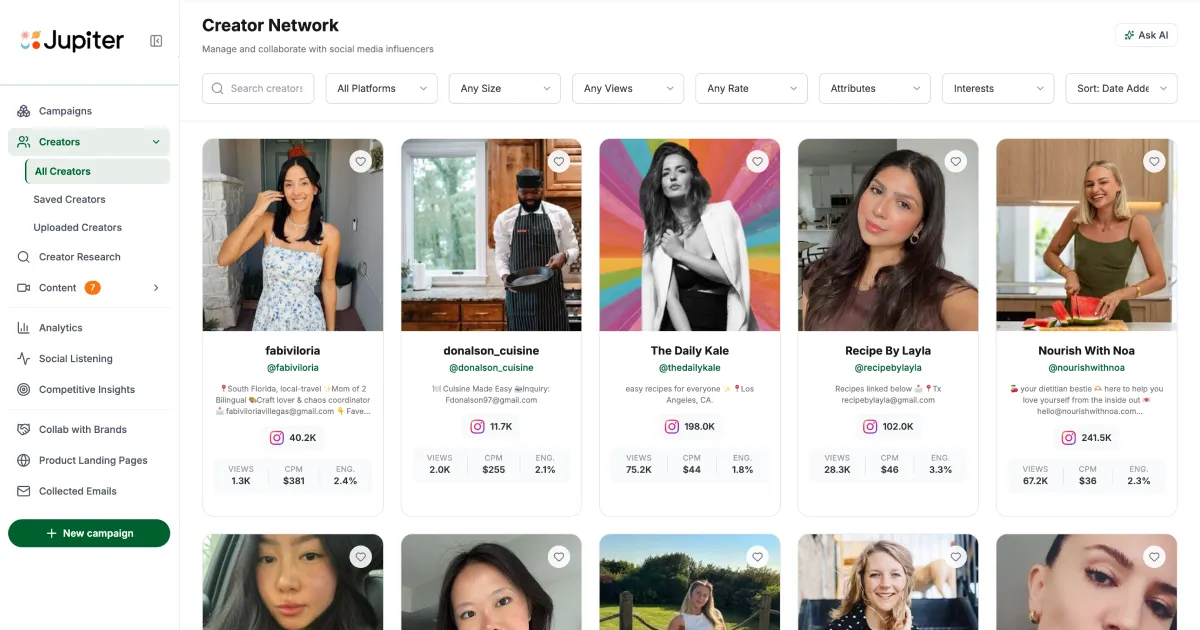
Influencer marketing software is a SaaS platform that handles creator discovery, brief management, content review, campaign execution, and analytics through a self-serve dashboard. The brand's marketing team operates the platform directly. Cost is typically a subscription, often tiered by usage. Examples include Jupiter (built specifically for food and beverage CPG), Aspire, GRIN, and CreatorIQ.
Influencer marketing agencies are service-based providers that run campaigns on behalf of brands. The agency handles strategy, creator selection, briefing, contract negotiation, content review, posting coordination, and reporting. The brand provides budget, brand assets, and approvals. Cost is typically a retainer plus campaign fees, often plus a percentage of media spend.
There is a third model worth acknowledging: hybrid setups where a brand uses software for creator discovery and analytics while contracting a freelancer or smaller agency for execution support. This works for some brands and is worth considering as a transition model between full agency reliance and full platform ownership.
Where agencies genuinely win
Three scenarios consistently favor agencies, and any honest comparison needs to say so clearly.
The brand has no internal marketing capacity
A founder-led food CPG brand with one marketing hire running ten other functions does not have bandwidth to operate a software platform. Software requires a person to use it. If that person does not exist, the agency model wins by default because the agency provides labor alongside expertise.
The brand is running its first influencer campaign and has no internal expertise
Agencies bring institutional knowledge that takes 6-18 months for an internal team to build from scratch. For a brand running its very first campaign, an agency's experience accelerates the learning curve. The brand pays a premium for that expertise, but the campaign is more likely to land correctly the first time.
The campaign requires creator relationships the platform does not have
Some specific creator types (large macro creators, celebrity-tier talent, traditional media personalities, talent-agency-rostered creators) sit inside specific agency relationships and outside most software platform networks. If the campaign requires those creators specifically, the agency relationship is the unlock.
Other scenarios where agencies tend to win: campaigns requiring extensive creative production beyond standard creator content, campaigns spanning multiple non-influencer channels simultaneously, and brands that need a strategic partner more than an operational tool.
Where software wins
For most CPG brands at most stages, software wins on five dimensions.
Cost efficiency at scale
Agency fees scale with campaign volume. A brand running one or two campaigns per year pays roughly the same total to an agency as to software. A brand running four or more campaigns per year pays significantly more to an agency than to comparable software, often for the same campaign quality. Software cost is largely fixed. Agency cost is largely variable. Above a certain campaign cadence, software is the only economically defensible choice.
Speed of execution
Software lets a marketing manager launch a campaign in days. Agencies typically take weeks to onboard a campaign because of strategy meetings, creator scouting rounds, and contract cycles. For brands running seasonal campaigns, retailer-windowed campaigns, or rapid-response programs timed to endcap launches, software speed is a structural advantage.
Data ownership and continuity
Software platforms accumulate the brand's campaign data, creator history, and performance signals in one persistent system. Agency relationships can deliver the same data, but it often lives in the agency's systems and gets lost or fragmented when the relationship changes. Brands that switch agencies usually start over. Brands that switch software keep the data.
Direct creator relationships
Software platforms let the brand build direct creator relationships that persist across campaigns. Agencies often manage creator relationships by design, which means when the agency relationship ends, the creator relationships sometimes end with it. For food CPG brands building a long-term creator roster, direct ownership of those relationships is a meaningful asset.
Real-time control
Software gives the marketing manager direct access to live campaign data, in-flight creator performance, and content review queues. Agencies typically run weekly or biweekly status reports. For campaigns that need mid-flight optimization (pausing underperforming creators, accelerating spend on standout posts, adjusting briefs based on early signals), software's real-time access is more actionable.
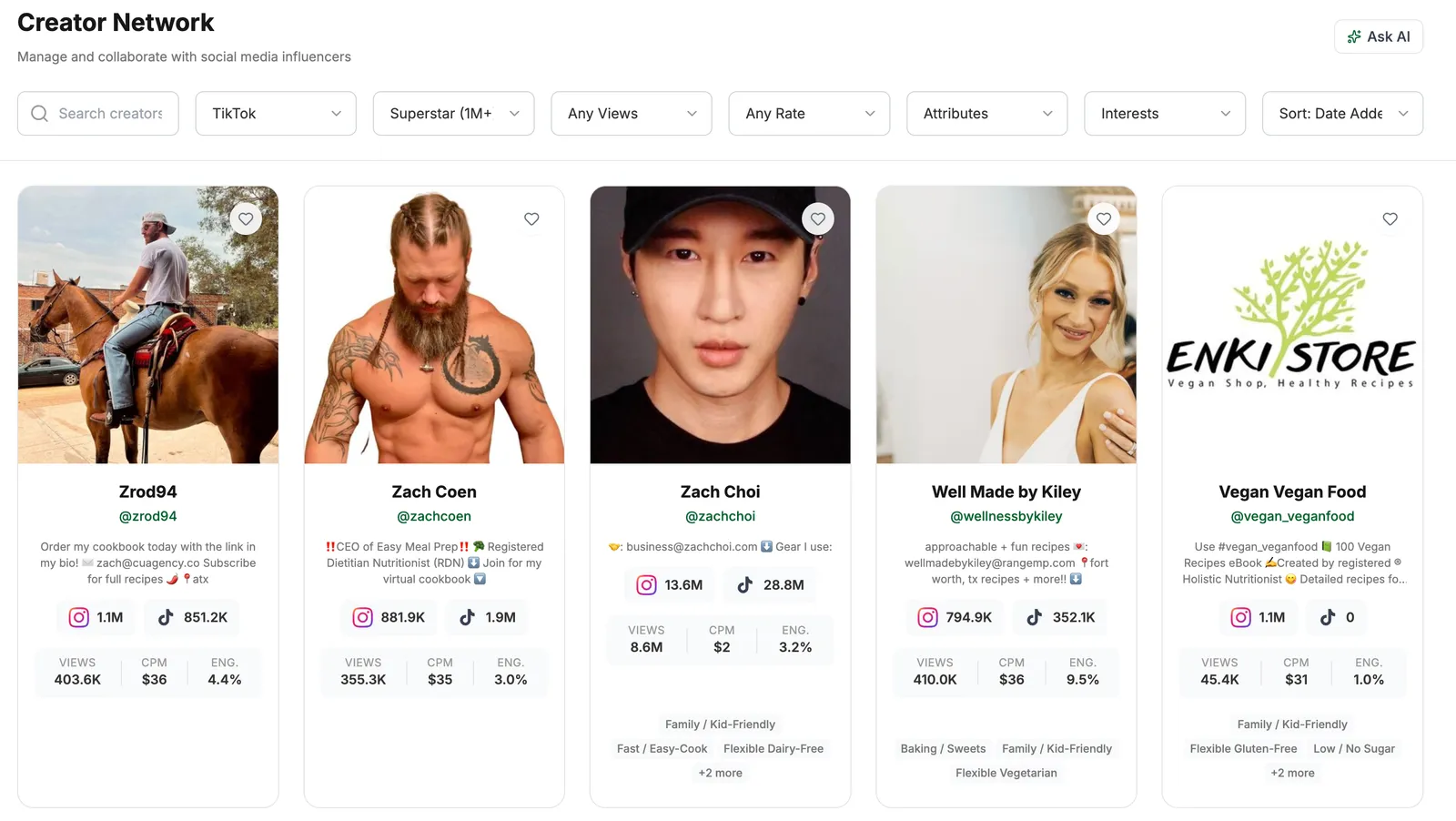

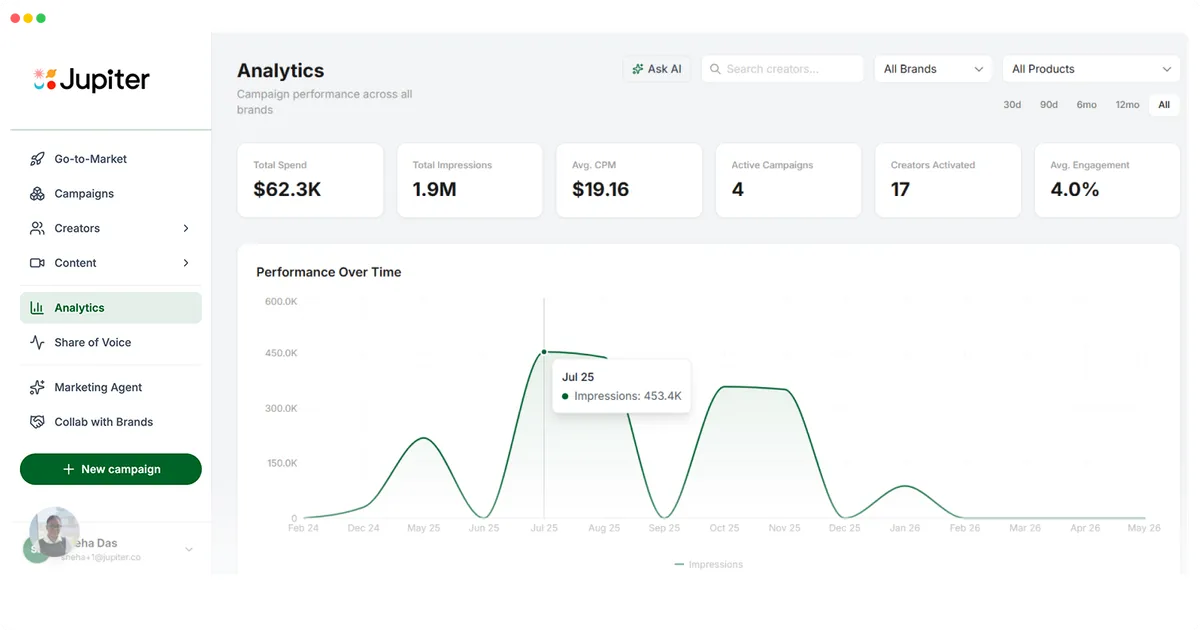
See what purpose-built influencer software looks like for food CPG
1,000+ recipe creators, Instacart attribution, retailer proximity scoring, and a 20-tool AI marketing agent. Built for food brands at growth and mid-market scale.
The decision framework: which model fits your brand
Five factors determine the right model for any given food CPG brand.
Campaign cadence per year
This is the single most important factor. Brands running one or two campaigns per year typically find agency cost defensible. Brands running three or more typically find software cost defensible. The break-even sits around the third or fourth campaign annually, depending on agency tier and platform pricing.
Internal team size and bandwidth
A marketing team of one or two people running multiple functions cannot operate a complex software platform without meaningful time investment. AI-assisted platforms reduce the labor requirement substantially, but software still requires someone to operate it consistently. Below a certain bandwidth threshold, agencies fill the gap that no platform can.
Category and retailer complexity
Food CPG brands selling through Whole Foods, Kroger, Sprouts, Costco, and Instacart have retailer-specific influencer playbooks that require retailer proximity scoring, audience geography matching, and Instacart attribution infrastructure. Generic agencies that work across categories often lack this food CPG and retailer-specific depth. Software designed specifically for food CPG handles it natively, which changes the cost-benefit calculation for this category specifically.
Attribution requirements
Brands that need closed-loop attribution to retail sales (Instacart cart adds, scanner data, sell-through lift at specific retailer windows) need software with attribution infrastructure built in. Most agencies report on impressions and engagement and partner with separate measurement vendors for harder attribution. Jupiter handles Instacart attribution natively in every campaign, which means brands comparing agency plus measurement vendor costs against platform costs should include both in the agency-side total.
Long-term program ambition
Brands building a multi-year creator marketing program where today's campaign creators become tomorrow's ambassadors benefit from owning the data, the relationships, and the platform infrastructure. Brands running one-off campaigns with no planned continuity can stay outsourced longer without significant cost.
What CPG brands at different stages actually need
The right answer changes meaningfully with brand stage.
Pre-launch and early-stage food CPG brands (Year 0-2, fewer than 5 SKUs). Most brands at this stage do not need a full agency relationship, and many are not yet ready for software either. The most efficient approach is often founder-led creator outreach for the first two or three campaigns to build intuition for the playbook, followed by software adoption when campaign cadence picks up. Hiring an agency at this stage often routes 30-50% of the budget to fees, which limits creator spend and reduces impressions delivered.
Growth-stage food CPG brands (Year 2-5, 5-30 SKUs, expanding retailer footprint). This is where software wins decisively. Campaign cadence is high enough to make software economical, the brand is sophisticated enough to operate a platform, and the retailer-specific playbooks (Whole Foods endcaps, Kroger Mega Sale windows, Sprouts regional launches) require the targeting depth that purpose-built software provides. Software designed for food CPG specifically is substantially more efficient at this stage than generic platforms or generic agencies.
Established CPG brands (Year 5+, 30+ SKUs, national distribution). Many established brands run hybrid models: software for ongoing always-on creator marketing, agencies for major launches and strategic campaigns requiring extensive creative production. The software handles 70-80% of campaign volume. Agencies handle the 20-30% that requires unique creative depth or specific talent-agency relationships. This is the most common configuration at large CPG companies that have made the transition.
Enterprise CPG brands (multi-brand portfolios). Enterprise brands typically run software as the operating layer for an in-house influencer team. Agencies remain useful for specific launches and global programs, but the day-to-day operating layer is software because the campaign volume requires it.
Cost comparison: what each model actually costs for food CPG
The actual cost of each model varies by scale, but the rough framework for a typical food CPG brand running four campaigns per year, each with six to eight creators, looks like this.
Agency model: a typical influencer marketing agency working with food CPG brands charges a retainer plus campaign management fees in the range of 15-25% of creator spend. For four campaigns at $40,000-$60,000 each in creator spend, total agency fees typically run $80,000-$120,000 per year on top of creator spend. For brands requiring separate Instacart attribution measurement, a third-party measurement vendor adds further cost.
Software model: a food CPG influencer software subscription is typically a fraction of total agency fees annually, with no per-campaign markup on creator spend and Instacart attribution included. For the same four campaigns at the same creator spend levels, the platform cost is the primary additional expense.
The software model is typically significantly cheaper annually for a four-campaign cadence, with the savings going either to additional creator spend (more reach) or back to the brand's margin. The savings compound at higher campaign cadence.
The framing changes at very low cadence (one or two campaigns per year), where software annual subscription costs approach the agency campaign fees and the labor savings of the agency model become more meaningful. Brands at that cadence should run the specific numbers for their situation rather than assuming one model is universally cheaper.
Common mistakes CPG brands make in the software vs agency decision
Choosing an agency because "we don't have time to learn a platform." Brands often choose agencies for this reason, then spend more time managing the agency relationship (briefing, reviewing, approving, reporting) than they would have spent operating modern AI-assisted software. The "no time to learn" argument is often a comfort argument, not a reality argument, for brands above a certain campaign cadence.
Choosing software and under-resourcing the team operating it. Brands often choose software because it costs less, then assign it to a team member as a side project alongside 12 other responsibilities, run inconsistent campaigns, and conclude software does not work. Software is cheaper than agencies if and only if someone is operating it consistently.
Picking generic software for a food CPG brand. Many brands choose generic multi-vertical influencer software and then hit walls on retailer-specific creator selection, food-specific creator data, and grocery retail attribution. Software designed for fashion or beauty struggles to handle the food CPG retailer playbook. Software designed specifically for food CPG handles it natively.
Not benchmarking the agency. Brands that have used the same agency for three or more years often have not benchmarked alternatives. The agency relationship may still be the right choice, but it should be re-evaluated annually against software alternatives, especially as platform capabilities have advanced significantly in 2025 and 2026.
Running three or more creator campaigns per year through an agency?
See what the same campaign quality looks like when your team owns the platform, the data, and the creator relationships directly.
How Jupiter fits into this decision
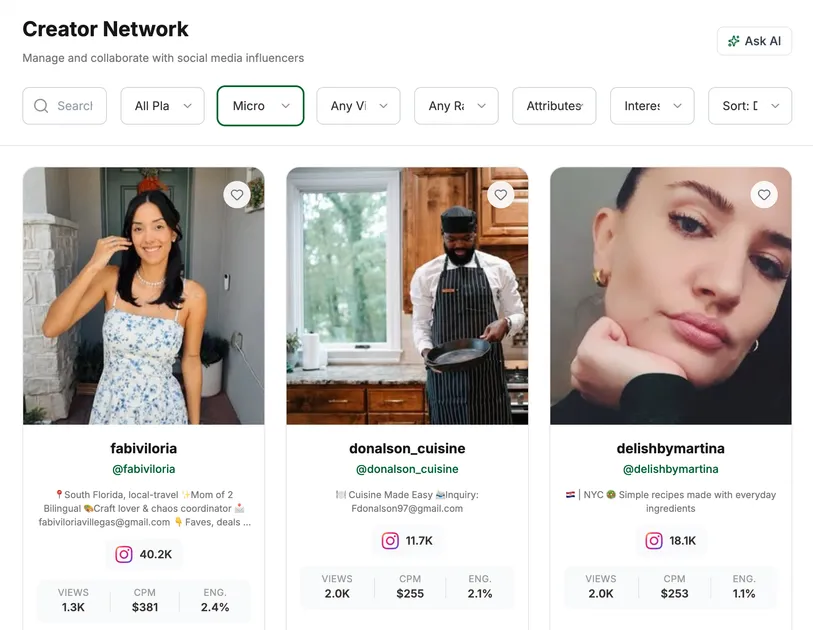
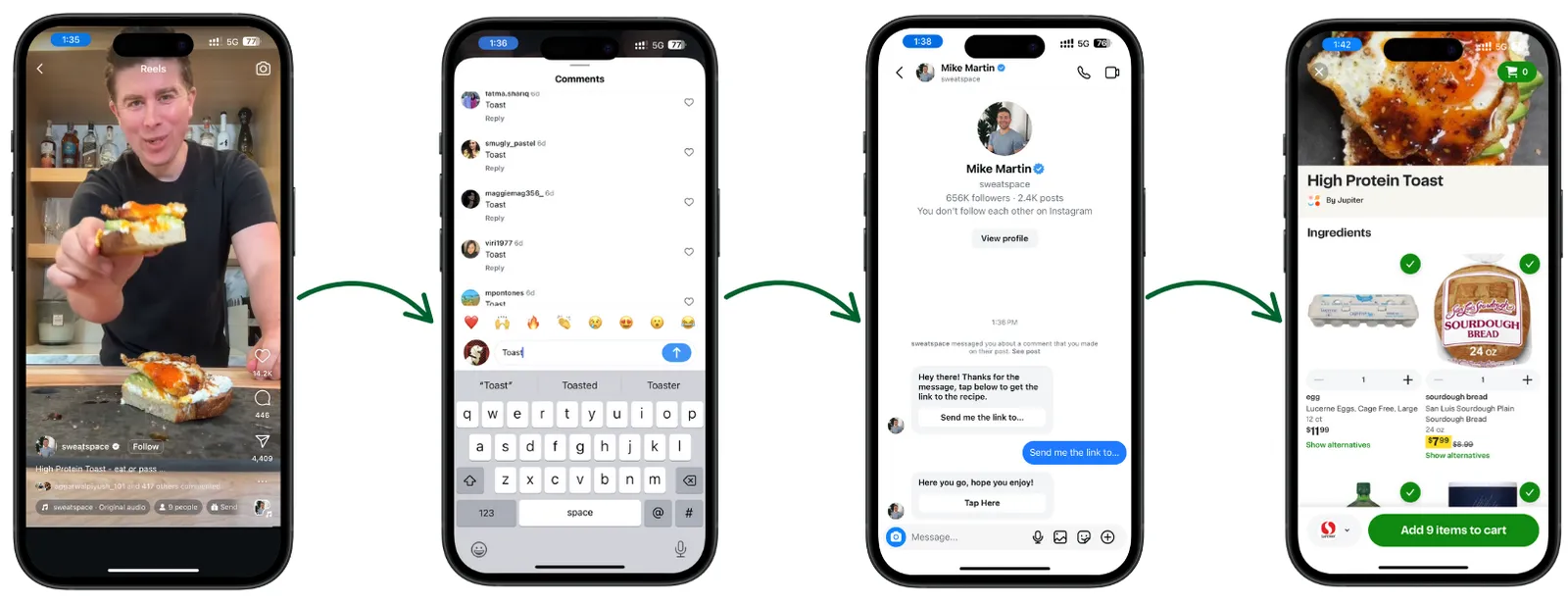
Jupiter is software built exclusively for food and beverage CPG. The campaign management platform handles creator discovery (1,000+ recipe creators with platform-specific performance data), brief workflows (CPG-specific fields including retailer focus, certifications, and digital coupon integration), campaign execution (content review, scheduling, posting coordination), and attribution (Instacart cart-add tracking through comment-triggered DM delivery of shoppable links, retailer proximity scoring, share of voice movement).
The Jupiter AI marketing agent is a 20-tool conversational assistant that handles creator search, brief drafting, campaign analytics, and performance reporting in plain language. For a marketing team of one or two people, the AI agent reduces the operational overhead of running a quality creator program without requiring the dedicated influencer marketing headcount that agency management also requires.
The campaign optimizer scores eligible creators across 12 signals including geographic match, retailer proximity, brand affinity from past collaboration history, content interest alignment, audience credibility, engagement quality, and view consistency. This is the signal set that produces food CPG-relevant creator shortlists rather than generic follower-count rankings.
For brands evaluating Jupiter against an agency, the typical comparison is: Jupiter gives the brand direct control, persistent data ownership, Instacart attribution built in, and structurally lower cost at meaningful campaign cadence. Agencies give the brand outsourced labor and institutional creator relationships in specific tiers. For most food CPG brands running three or more campaigns per year and selling through grocery retail or Instacart, the software model has stronger economics and stronger measurement.
For a platform-by-platform comparison of the software options specifically, our review of the best food influencer marketing platforms covers how Jupiter compares to Aspire, GRIN, CreatorIQ, and Upfluence. For the attribution model that makes software measurable for retail CPG, our influencer marketing ROI guide covers the four-layer framework.Brands using Jupiter today include Banza, Pete & Gerry's, Nellie's Free Range Eggs, Kettle & Fire, La Tourangelle, Schweid & Sons, Vermont Creamery, and 50+ other food and beverage CPG brands, many of whom transitioned from agency-managed programs or generic software platforms.
See if Jupiter is the right fit for your food CPG brand.
1,000+ recipe creators, Instacart attribution, retailer-aware campaign optimization, and AI-assisted workflows built specifically for food and beverage CPG. Used by 58+ leading brands.
FAQs
Quick answers to common questions.
Should a CPG brand use influencer marketing software or hire an agency?▼
The right choice depends on five factors: campaign cadence per year, internal team bandwidth, retailer and category complexity, attribution requirements, and long-term program ambition. Most food CPG brands running three or more campaigns per year selling through grocery retail benefit from software because of cost efficiency, speed of execution, data ownership, and retailer-specific targeting depth. Brands running one or two campaigns per year with no internal marketing capacity often benefit from agency relationships that include outsourced labor alongside expertise.
What is the break-even point between influencer marketing software and agencies for CPG brands?▼
The break-even point typically sits around the third or fourth campaign per year. Below that cadence, agency cost per campaign can be comparable to an annual software subscription, and the agency's labor contribution has meaningful value. Above that cadence, software becomes significantly more cost-efficient because the subscription cost is largely fixed while agency fees scale with every campaign. Brands should run the specific numbers for their campaign budgets and agency fee structures rather than assuming a universal break-even.
Can a small food CPG brand use influencer marketing software, or is it only for larger brands?▼
Modern AI-assisted platforms like Jupiter are designed for marketing teams of one or two people. The brief workflow is AI-assisted, creator selection runs through an automated optimizer, and campaign execution is largely guided by the platform. Small food CPG brands can absolutely use software, but they need at least one person who will operate the platform consistently. Brands with genuinely zero marketing capacity may still benefit from an agency model that provides labor alongside expertise.
What does an influencer marketing agency typically do that software does not?▼
Agencies provide labor and outsourced execution: hands-on strategy meetings, manual creator scouting outside platform networks, contract negotiation, project management, and end-to-end campaign coordination. Agencies also bring institutional creator relationships in specific tiers (large macro creators, celebrity talent, talent-agency-rostered creators) that platform networks may not include. Software handles the operational layer but does not provide labor, strategic meetings, or relationship-gated creator access.
Can a food CPG brand use influencer marketing software and an agency together?▼
Yes. Many established food CPG brands run hybrid models: software for always-on creator marketing (the operational layer, covering creator discovery, brief management, content review, Instacart attribution, and analytics), while agencies handle major strategic launches and campaigns requiring unique creative depth or specific talent relationships. The software typically handles 70-80% of campaign volume in this model, with agencies on the strategic 20-30%.
How do I evaluate whether to switch from an agency to influencer marketing software for food CPG?▼
Evaluate three things: (1) total annual agency cost (retainer plus campaign fees) compared to software annual cost including any measurement vendor fees for Instacart attribution that the software would replace, (2) the percentage of agency value that is labor versus expertise (high-labor relationships are easier to transition to AI-assisted software than high-expertise strategic relationships), and (3) the platform fit for your specific category and retailer footprint. Food CPG brands benefit substantially from software designed specifically for grocery retail rather than generic multi-vertical platforms.
More in Platforms & Comparisons
More from Platforms & Comparisons.