What to Look for in a Micro-Influencer Platform for Food Brands
A platform that lists micro influencers is not the same as a platform built to run a micro-influencer program at scale. Here is what to actually evaluate.
Trusted by leading CPG brands


















On this page
▼
- Volume Handling Is the First Real Test
- Filtering Has to Go Past Follower Count and Engagement Rate
- Pricing Transparency Matters More at This Tier
- Does the Platform Actually Model the Aggregate Outcome
- Content Review at Scale Without Becoming a Bottleneck
- Reporting Has to Roll Up, Not Just List
- The Checklist, Condensed
This guide covers how to evaluate a micro-influencer platform, not why micro influencers work for food CPG brands or what they cost. Those are separate questions with their own answers elsewhere. What follows is a buyer's checklist: the specific capabilities that separate a platform built to run a real micro-influencer program from one that simply lists creators in the 10,000 to 50,000 follower range and calls that a solution.
The distinction matters because the micro tier behaves differently than macro or celebrity tiers in ways a platform either accounts for or ignores. Micro creators are numerous, their individual economics are small, and the value of working with them comes from running many of them well, not from managing a handful of high-touch relationships. A platform evaluation for this tier has to be built around that reality.
Volume Handling Is the First Real Test
A micro-influencer program typically involves more creators per campaign than a macro-focused one, since the per-creator reach is smaller and the strategy depends on aggregate volume across many creators rather than concentrated reach from a few. A platform's first real test is whether it can manage that volume without the coordination burden scaling linearly with headcount.
Concretely, that means checking whether a platform can filter and shortlist dozens of micro creators as fast as it can filter five, whether briefs and offers can go out to a batch of creators rather than one at a time, and whether content review can handle a high volume of submissions without becoming a bottleneck. A platform built around a small number of high-value creator relationships will often show its limits exactly at this point, because the workflow assumes a handful of creators rather than dozens.
Filtering Has to Go Past Follower Count and Engagement Rate
Follower count and engagement rate are the two filters every platform in this category offers, and they are also the two filters that matter least for actually predicting whether a micro creator will perform for a specific food brand. A dairy-free recipe creator with a modest but highly engaged following in a specific geographic region is a stronger fit for a regional dairy-free brand than a larger creator with broader, less targeted reach, but a platform limited to follower and engagement filters cannot surface that distinction.
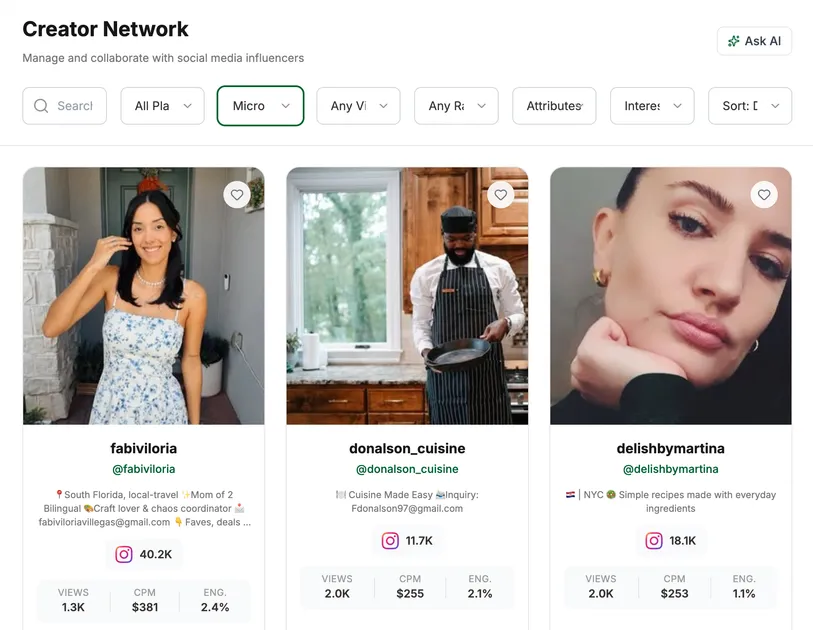
What to check specifically: does the platform filter by content interest categories relevant to food, not just broad lifestyle tags. Does it support creator attribute filtering, such as home cook, dietary lifestyle, or fitness-oriented content. Does it include any geographic or retailer proximity filtering, which matters more for a brand trying to concentrate micro creator content near specific retail markets than it does for a brand running a single national macro campaign.

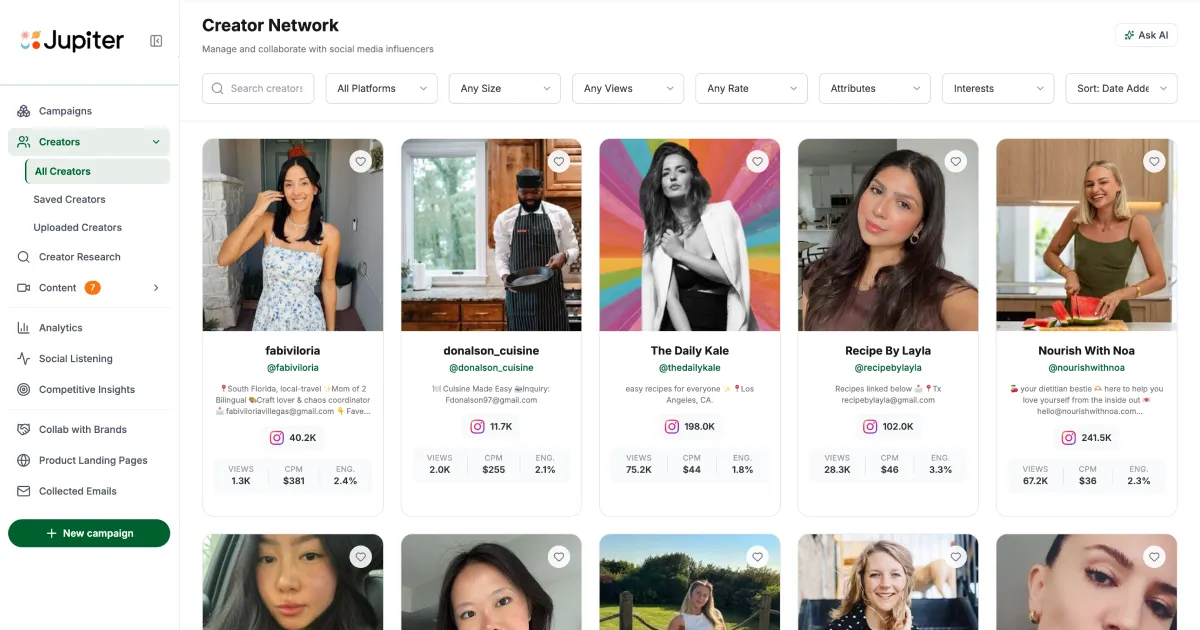
See how micro creators are filtered beyond follower count
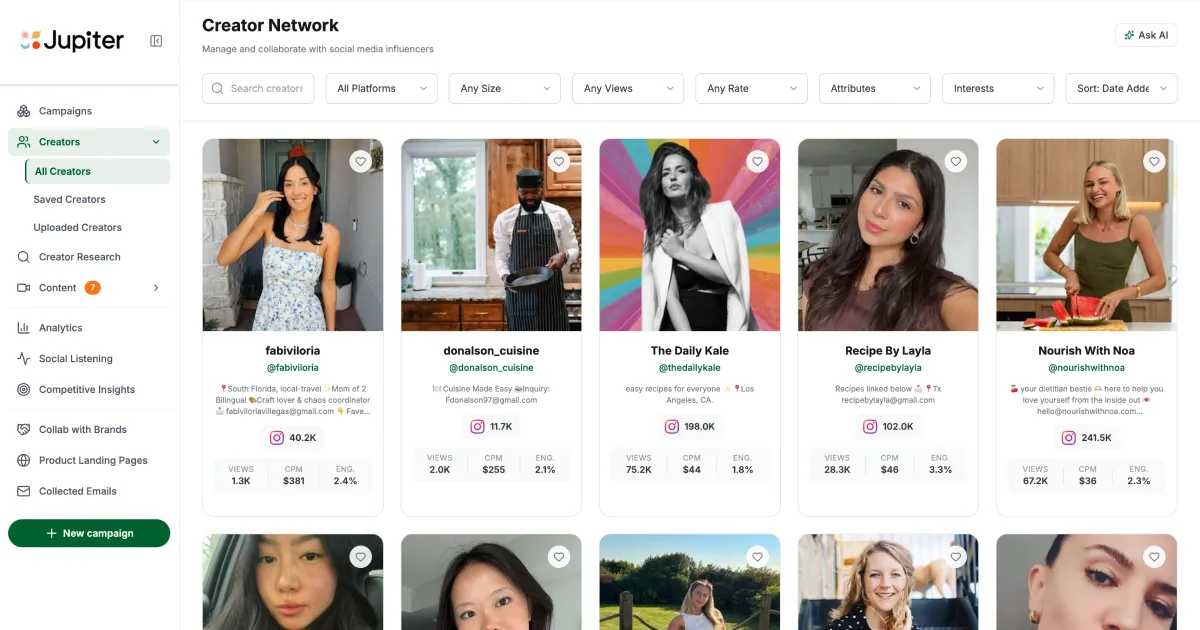
Jupiter's creator network filters on content interests, dietary and lifestyle attributes, and retailer proximity, the signals that actually predict fit for a micro-influencer program.
Pricing Transparency Matters More at This Tier
Micro-tier pricing is less standardized than macro or celebrity pricing, since a smaller creator has less external benchmark data available and more room for a rate to be negotiated ad hoc. A platform evaluation should check whether pricing is shown transparently per creator before outreach begins, or whether a brand has to negotiate blind with each individual creator to discover the actual cost.
A platform that shows estimated cost per creator up front, ideally broken out by platform since Instagram and TikTok rates for the same creator are often different, lets a brand plan a multi-creator micro campaign budget with actual numbers rather than a rough estimate that gets revised repeatedly as outreach happens. This matters disproportionately for micro programs specifically, because the whole strategy depends on running enough creators that budget predictability across the full roster is what makes the math work.
Does the Platform Actually Model the Aggregate Outcome
A single macro creator's projected performance is a relatively simple estimate. A micro-influencer program's projected performance is an aggregate calculation across many creators with different follower counts, engagement rates, and pricing, and a platform should be able to model that aggregate before a brand commits a budget.
Look for a platform that runs a budget-constrained selection process specifically, one that can take a total budget and a target creator profile and return a projected creator mix along with estimated aggregate impressions and cost per impression, rather than requiring a brand to manually add up individual creator estimates one at a time. A 12-signal optimizer that scores every eligible creator on content fit, posting recency, audience credibility, and other signals, then solves for the mix that maximizes projected impressions within budget, is built specifically for this kind of aggregate decision, and it matters more for micro programs than for any other tier because the number of individual decisions being aggregated is so much higher.
Manually adding up individual micro creator estimates in a spreadsheet?
A platform that can only estimate one creator at a time was not built for a real micro-influencer program.
Content Review at Scale Without Becoming a Bottleneck
A micro-influencer program generates a higher volume of individual content submissions than a macro program does, simply because there are more creators posting. A content review workflow that works fine for five macro creators can become a genuine operational bottleneck at thirty or forty micro creators, particularly if review has to happen manually across scattered channels rather than in a single queue.
What to check: does the platform centralize content submissions into one review queue rather than scattering them across email and direct messages. Can a reviewer filter by status, pending, approved, rejected, to work through a batch efficiently. Does rejection include a structured reason that goes back to the creator automatically, rather than requiring a separate message outside the platform. These are small workflow details individually, but at micro-program volume they compound into a real difference in how much manual coordination a brand's team has to absorb.
Reporting Has to Roll Up, Not Just List
A macro campaign report can reasonably list each of a handful of creators individually. A micro-influencer program report needs to roll a much larger creator roster up into an aggregate view a brand manager can actually act on: total impressions and cost per impression across the full roster, plus a leaderboard identifying which individual creators are over- or under-performing relative to the group.
A platform that only shows a flat, unranked list of every micro creator in a campaign is asking a brand manager to do the aggregation and ranking work manually. A platform that surfaces a creator leaderboard automatically, ranked by impressions per dollar, gives a brand the information needed to decide which micro creators to re-engage in the next cycle without a manual data pull first.
The Checklist, Condensed
Before selecting a platform for a micro-influencer program specifically, confirm it can filter creators on more than follower count and engagement rate, show transparent per-creator pricing before outreach, model an aggregate budget-constrained creator mix rather than one creator at a time, centralize content review into a single queue that scales with volume, and roll performance up into a ranked leaderboard rather than a flat list. A platform missing more than one of these was likely built for a different tier or a different category, and the gaps will show up as manual work the moment a brand tries to run a real micro program at scale.
Run a micro-influencer program built for real volume
Jupiter's optimizer models the full creator mix, budget, and projected impressions before you spend a dollar, used by 58+ leading CPG brands to run creator programs at scale.
FAQs
Quick answers to common questions.
What should a food CPG brand look for in a micro-influencer platform?▼
A food CPG brand should check whether a platform can filter creators on content interests and dietary or lifestyle attributes beyond follower count, show transparent per-creator pricing, model an aggregate budget across many creators at once, and handle a high volume of content review without becoming a bottleneck.
How is evaluating a micro-influencer platform different from evaluating a general influencer platform?▼
Micro-influencer programs typically involve more creators per campaign than macro-focused programs, so the evaluation has to weigh volume handling more heavily: batch outreach, aggregate budget modeling, and scalable content review matter more at this tier than for a program built around a small number of high-touch creator relationships.
Does micro-influencer pricing vary more than macro pricing?▼
Micro-tier pricing is generally less standardized than macro or celebrity pricing, since smaller creators have less external benchmark data and more room for ad hoc negotiation. This makes transparent, platform-shown pricing more valuable at this tier, since it removes the need to negotiate blind with each individual creator.
Can a general influencer marketplace handle a micro-influencer program well?▼
It depends on whether the platform was built to handle volume. A marketplace that can only manage a handful of creator relationships at a time, rather than filtering, briefing, and reviewing content across dozens of creators efficiently, will create manual bottlenecks once a micro program scales past a small roster.
What reporting should a micro-influencer platform provide?▼
Reporting should roll a full creator roster up into an aggregate view, including total impressions and cost per impression across the group, plus a ranked leaderboard showing which individual creators are over- or under-performing relative to the rest of the roster.
Why does content review workflow matter more for micro-influencer programs specifically?▼
A micro-influencer program generates more individual content submissions than a macro program, simply because there are more creators posting. A review workflow that is manageable for a handful of macro creators can become a genuine bottleneck at higher volume unless it centralizes submissions into a single queue built to scale.
More in Platforms & Comparisons
More from Platforms & Comparisons.