Influencer Marketing Agencies vs AI Platforms: What Food and Beverage Brands Need to Know
Food and beverage CPG brands evaluating influencer marketing agencies face a structural choice: pay for full-service creative management, or use an AI-powered platform built for the grocery retail purchase journey. Here is how to think through it.
Full-service influencer agencies typically charge $10,000 to $30,000 per month in management retainers, separate from creator costs. For a mid-market food CPG brand allocating $50,000 to $100,000 annually, a $15,000 monthly fee changes the math on the entire program. AI-powered platforms replace that overhead with a food-specific creator network, 12-signal selection, and Instacart comment-to-cart attribution.
Key takeaways
- Agency retainers run $10,000 to $30,000 per month, separate from creator costs
- Jupiter maintains a network of 1,000+ food and recipe creators; across 635 tracked campaign posts, impressions split 73.7% Instagram and 26.3% TikTok
- A plant-based pasta ambassador campaign delivered 70M+ impressions at a $1.25 CPM
- One Instagram Reel generated 6.5 million views and more than 1,000 Instacart cart adds
- Agency retainers make more sense above $300,000 annual influencer budget; under $150,000, a platform fee usually produces better cost efficiency
Trusted by leading CPG brands














On this page
▼
- What Traditional Influencer Marketing Agencies Offer
- Where Agencies Fall Short for Food and Beverage CPG
- Creator vetting at the vertical level
- Retail attribution
- Speed and iteration speed
- Cost structure relative to output
- What an AI-Powered Platform Provides Instead
- A vetted, food-specific creator network
- Algorithmic creator selection before spending
- Instacart comment-to-cart attribution
- Campaign management in one workflow
- Performance analytics with memory
- Comparing Real Campaign Benchmarks
- A Decision Framework for CPG Brand Managers
- Budget and overhead tolerance
- Attribution requirements
- Speed and iteration frequency
- Internal capability
- How Jupiter Positions Against Traditional Agencies
Influencer marketing agencies manage creator relationships, campaign execution, and performance reporting on behalf of brands. They have been doing this for over a decade, and for many industries they remain a legitimate option. For food and beverage CPG brands, the choice is more complicated.
The tension is structural. Traditional influencer agencies were built around the DTC e-commerce model: find a creator, generate a link, track clicks, measure conversions. That workflow maps cleanly onto a Shopify brand. It does not map cleanly onto a food CPG brand selling a $7.99 pasta sauce through Whole Foods, Kroger, and Instacart. The purchase journey is different, the attribution infrastructure is different, and the creator expertise required to drive grocery sales is different.
Over the past several years, AI-powered influencer marketing platforms have emerged as an alternative to the traditional agency model. They offer self-serve campaign management, algorithmic creator selection, and attribution capabilities that legacy agencies were not built to deliver. For CPG food brands specifically, the question of which approach fits is not abstract. It affects campaign performance, budget efficiency, and how defensible your influencer spend looks to leadership.
This post breaks down both sides of that decision.
What Traditional Influencer Marketing Agencies Offer
A full-service influencer agency typically provides four core services: creator sourcing and vetting, rate negotiation and contracting, campaign management and creative coordination, and post-campaign reporting.
The value proposition for an agency is straightforward. You hand off the operational complexity. A team of account managers, talent specialists, and campaign coordinators handles the workflow while your internal team focuses on brand strategy. For companies without dedicated influencer marketing headcount, this has real appeal.
Agencies also bring existing creator relationships. A well-established agency has negotiated with the same creators across many campaigns and understands informal rate norms that are not published anywhere. That institutional knowledge has value, particularly for brands entering creator marketing for the first time.
Where agencies add the most value: brands that need significant creative strategy support, companies with large enough budgets that management overhead is a small percentage of total spend, and organizations running campaigns across multiple channels simultaneously that benefit from centralized coordination.
The case for an agency is real. The question is whether the trade-offs fit your category.
Where Agencies Fall Short for Food and Beverage CPG
The gaps appear predictably in four areas.
Creator vetting at the vertical level
Most influencer agencies maintain databases that span categories: beauty, fashion, lifestyle, fitness, travel, food. Food is a subcategory, not a specialization. When a food CPG brand asks an agency for creator recommendations, the result is often a roster that mixes genuine recipe creators with lifestyle influencers who post food occasionally. The agency filters by follower count, engagement rate, and category tag. They do not filter by content interest at the level of granularity that matters: does this creator post weekly recipes? Do they have a grocery-shopping audience? Do their viewers actually cook?
That distinction is the difference between a creator who drives passive impressions and one who drives cart adds. Agencies with horizontal databases rarely surface it consistently.
Retail attribution
This is the most significant gap. A traditional influencer agency measures what happens on social: impressions, reach, engagement rate, video views, link clicks if applicable. They do not measure what happens at the shelf or in a grocery app. For a food CPG brand whose primary channel is Instacart, Whole Foods, or Kroger, campaign performance that stops at social metrics is not actually campaign performance. It is a partial view.
Closing the loop from a creator post to a grocery cart add requires infrastructure that most agencies were not built to provide. It requires Instacart affiliate mechanics, comment-triggered attribution workflows, and per-creator link tracking tied to specific posts. These are platform capabilities. They are not standard agency deliverables.
Speed and iteration speed
Agency campaigns move at the pace of account management cycles. Brief development takes days. Creator outreach takes longer. Content review happens across email chains. Reporting is delivered in a deck at the end of the campaign. For CPG brand managers who need to react quickly to retail moments, seasonal windows, or competitive activity, that timeline is a constraint.
Cost structure relative to output
Full-service influencer agencies typically charge management retainers in the range of $10,000 to $30,000 per month, separate from creator costs. For a mid-market food CPG brand allocating $50,000 to $100,000 annually to creator marketing, a $15,000 monthly management fee changes the math on the entire program. The agency overhead that makes sense for a brand spending $500,000 per year on influencer marketing does not make sense for a brand spending $75,000.
The output side matters too. Agency campaigns do not inherently produce better performance than platform-managed campaigns. CPM is CPM. If an AI-optimized platform can project and deliver a $1.50 CPM before launch, and an agency charges management fees that raise your effective CPM to $4.00 when you account for overhead, the performance case for the agency has to be compelling to justify the difference.
What an AI-Powered Platform Provides Instead
An AI-powered influencer marketing platform replaces agency overhead with software infrastructure. The brand team retains control of campaign strategy and creative direction while the platform handles creator scoring, budget optimization, content operations, and performance tracking.
For food and beverage CPG brands, the relevant capabilities are specific.
A vetted, food-specific creator network
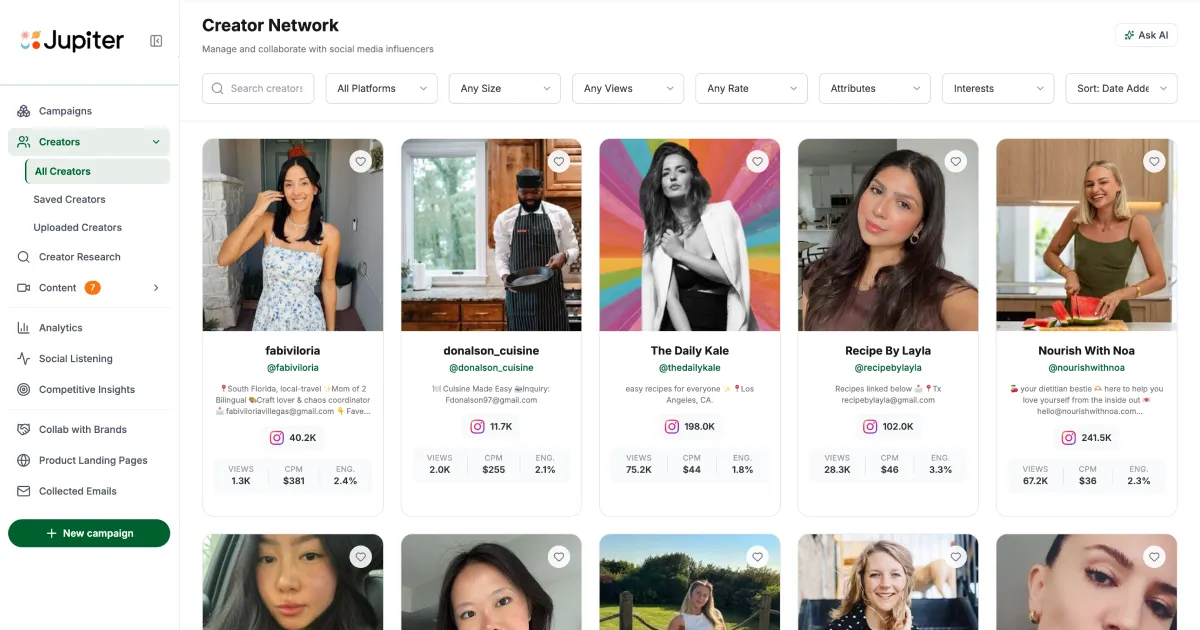
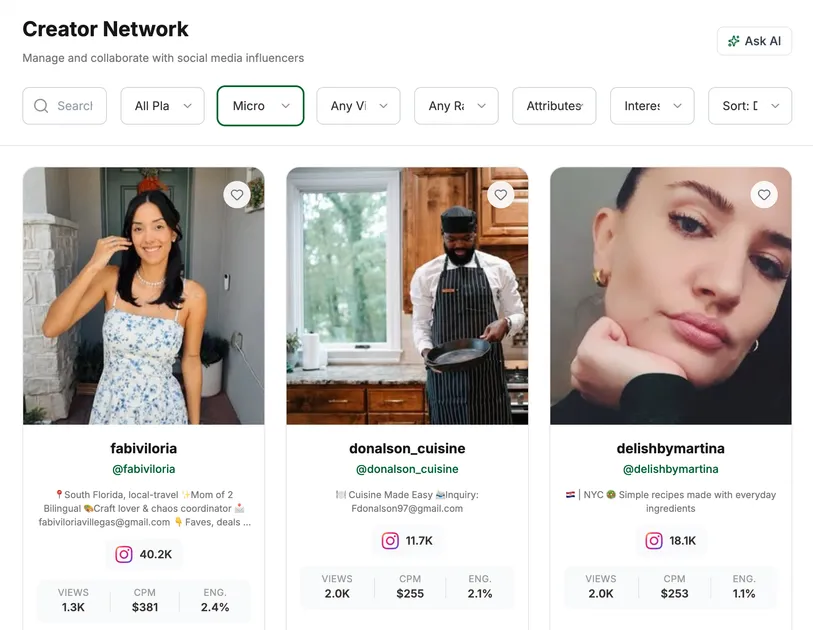
Jupiter maintains a network of 1,000+ food and recipe creators on Instagram and TikTok. These are not generalist influencers with food as an occasional category. They are creators whose primary content is recipe-focused, cooking-driven, and directed at home-cooking audiences who actively grocery shop. Every creator profile includes content interest tags, audience credibility scores showing the estimated percentage of real versus bot followers, estimated CPM based on actual campaign performance data, and retailer proximity information that enables geographic targeting by market.
Across 635 tracked campaign posts, Jupiter has delivered 229M+ total impressions, split 73.7% Instagram and 26.3% TikTok.
Algorithmic creator selection before spending
When a campaign launches on Jupiter, a 4-phase optimization pipeline runs before any budget is committed. Every eligible creator in the network is scored across 12 signals: content interest alignment, posting recency, retailer proximity, brand affinity from past collaboration history, creator attribute match, audience attribute match, geographic match, demographic alignment, engagement quality, view consistency, audience credibility, and hashtag relevance.
The result is a creator roster and an estimated metrics card showing projected impressions and CPM before launch. This is the pre-spend intelligence that agencies rarely provide. A brand can see that a proposed campaign is projected to deliver 2.4M impressions at a $1.82 CPM before committing to it, rather than receiving that information in a post-campaign report.

See projected CPM before you spend a dollar on creators.
Jupiter's 12-signal optimizer builds a creator roster and delivers estimated impressions and CPM projections before campaign launch. No agency retainer required.
Instacart comment-to-cart attribution
This is the clearest differentiation between what an AI-powered platform can do for food CPG and what a traditional agency delivers. Jupiter's attribution mechanic works at the individual post level: when a viewer comments a specific keyword on a creator's post, they automatically receive a DM with a unique shoppable Instacart link tied to that creator and that post. Cart adds attribute back to the specific creator and post, creating a direct line from content to grocery purchase.
One Jupiter campaign generated 6.5 million views from a single Instagram Reel and more than 1,000 Instacart cart adds. That is the kind of retail attribution that makes influencer spend defensible to a CFO or a CMO. Jupiter is one of Instacart's fastest-growing affiliate partners. The full mechanics are covered in the Instacart influencer marketing campaign playbook.
Campaign management in one workflow
The influencer campaign management layer handles brief creation with AI assistance through a 20-tool marketing agent, creator selection from the vetted network, content review before publishing, and posted content tracking after campaigns go live. A brand manager can launch a campaign, approve content, and monitor performance from a single platform without coordinating across email, shared drives, and agency portals.
Content review is structured: creators submit videos inside the platform before posting, the brand team approves or rejects with specific feedback, and the status pipeline is fully visible for compliance purposes.
Performance analytics with memory
The influencer marketing analytics dashboard tracks actual versus estimated impressions per campaign, cost efficiency per creator, and overall program performance across brands and SKUs. Campaign health is surfaced in real time: green when actual impressions have reached at least 80% of the pre-launch projection, yellow at 50 to 79%, red below 50%.
Critically, the platform learns. Historical creator performance feeds back into future optimizer runs, making each campaign smarter than the last. A food CPG brand in its fifth campaign on Jupiter benefits from four campaigns worth of creator performance data. A new campaign with an agency starts from the same baseline every time.
The full framework for measuring what this performance data means in terms of ROI is covered in the CPG influencer marketing ROI guide.
Comparing Real Campaign Benchmarks
Production data from Jupiter campaigns illustrates what platform-optimized creator selection can deliver.
A plant-based pasta brand running an ambassador campaign delivered 70M+ impressions at a $1.25 CPM. A bone broth brand's general awareness campaign produced 2.57M impressions at a $1.57 CPM. A frozen plant-based brand delivered 1.1M impressions at a $1.71 CPM on a $950 budget. A plant-based yogurt campaign reached 5.8M impressions at a $1.82 CPM.
These are real production numbers from Jupiter's campaign analytics, using actual delivered impressions. They reflect what the 12-signal optimizer produces when creator selection is driven by data rather than manual roster building.
No management fee is included in those CPM figures, because the platform fee structure replaces the agency retainer rather than sitting on top of it. That is the math that makes the platform model attractive for mid-market CPG brands.
Comparing an agency retainer to what a platform could deliver on the same budget?
Jupiter gives CPG teams pre-launch CPM projections, a 12-signal optimizer, and Instacart attribution for grocery retail. No account management overhead.
A Decision Framework for CPG Brand Managers
The agency versus platform decision is not universal. It depends on where your brand sits across three dimensions.
Budget and overhead tolerance
If your annual influencer budget is above $300,000 and you have limited internal bandwidth, a full-service agency may absorb operational complexity in a way that makes sense. If your annual budget is under $150,000, agency management fees change your effective CPM significantly. At that range, a platform that charges per campaign or on a subscription model almost always produces better cost efficiency.
Attribution requirements
If your primary channel is grocery retail and you need to show Instacart cart adds, retailer-proximate creator targeting, and SKU-level performance data, you need a platform that was built for that attribution infrastructure. An agency that reports on impressions and engagement rate and cannot show grocery purchase signals is not delivering what you need, regardless of the quality of creative work.
Speed and iteration frequency
If you run three to five campaigns per quarter and need to react quickly to seasonal moments or competitive activity, a platform with in-built campaign management and content review is faster than an agency workflow. If you run one or two large campaigns per year and have months to develop them, agency timelines are less of a constraint.
Internal capability
A platform requires your team to operate the tooling. That is a lower lift than it sounds, particularly with an AI-assisted campaign creation workflow, but it does require someone on your team who owns the influencer marketing function. If your team has zero influencer marketing bandwidth, an agency fills that operational gap in a way a platform cannot.
The honest answer for most mid-market food CPG brands: the combination of cost efficiency, retail attribution, food-specific creator depth, and pre-launch performance projections that a purpose-built platform provides is difficult for a traditional agency to match at comparable investment levels.
How Jupiter Positions Against Traditional Agencies
Jupiter is used by 58+ leading CPG brands including Banza, Pete & Gerry's, and Kettle & Fire. It is Y Combinator-backed and built exclusively for food and beverage CPG, which means every product decision, every data model, and every attribution mechanic was designed around the grocery retail purchase journey, not the DTC e-commerce funnel.
The platform is not a managed service. It gives brand teams the infrastructure to run campaigns in-house, with the optimizer, the creator network, the attribution layer, and the analytics dashboard all in one place. For brands that have existing creator relationships outside the Jupiter marketplace, a brand-managed roster feature allows those creators to be brought into the same campaign infrastructure and tracked with the same performance analytics.
Ambassador programs, with a 6-month minimum commitment and two posts per month per creator, give brands like La Tourangelle and Banza a structured long-term creator development model. The graduation approach, where creators from past standard campaigns are elevated into ambassador relationships based on performance data, is the kind of institutional learning that agencies cannot systematically provide.
For food and beverage brands at the stage where influencer marketing needs to become a measurable, repeatable growth channel rather than a campaign-by-campaign experiment, the case for a purpose-built platform is straightforward.
Jupiter is the influencer marketing platform built for food and beverage CPG brands.
A vetted food creator network, a 12-signal optimizer with pre-launch CPM projections, and Instacart cart attribution. Used by 58+ brands including Banza, Pete & Gerry's, and Kettle & Fire.
FAQs
Quick answers to common questions.
What is an influencer marketing agency and what do they do?▼
An influencer marketing agency manages creator sourcing, contract negotiation, campaign execution, and performance reporting on behalf of brands. They typically provide account management, talent relationships, and creative coordination. For food and beverage CPG brands, the key gaps in the standard agency model are the absence of grocery retail attribution, limited food-vertical creator specialization, and management fees that raise effective CPM relative to what a purpose-built platform can deliver.
How do influencer marketing agencies compare to platforms for CPG brands?▼
Traditional influencer agencies provide managed services and human account management. AI-powered platforms provide software infrastructure for brand teams to manage campaigns in-house, with algorithmic creator selection, pre-launch performance projections, and attribution built in. For food CPG brands specifically, platforms like Jupiter add Instacart comment-to-cart attribution and a food-specific creator network that general agencies cannot replicate. The cost structure also differs: agency retainers of $10,000 to $30,000 per month sit on top of creator costs, while platform fees typically replace the management overhead.
What should food and beverage brands look for in an influencer marketing agency or platform?▼
Five capabilities matter most for food CPG: a creator network specialized in food and recipe content with audience credibility scoring; Instacart or grocery retail attribution that closes the loop from post to purchase; pre-launch CPM projections based on algorithmic creator selection; a structured content review workflow before posting; and analytics that track actual versus estimated impressions across campaigns. Most traditional agencies provide partial coverage across these. Jupiter was built to address all five for food and beverage brands specifically.
Does Jupiter provide Instacart attribution that a traditional agency cannot?▼
Yes. Jupiter's Instacart attribution operates through a comment-triggered mechanic: when a viewer comments a specific keyword on a creator's post, they receive an automated DM with a unique shoppable Instacart link tied to that creator and post. Cart adds attribute back at the individual post level. One campaign generated 6.5 million views from a single Instagram Reel and more than 1,000 Instacart cart adds. This capability requires platform infrastructure that traditional influencer agencies do not have.
What is the typical cost of an influencer marketing agency versus a platform like Jupiter?▼
Full-service influencer agencies typically charge $10,000 to $30,000 per month in management retainer fees, separate from creator costs. For a mid-market CPG brand with an annual influencer budget of $75,000 to $150,000, that overhead significantly raises the effective cost per impression. Jupiter operates on a platform model where the fee structure replaces agency overhead rather than stacking on top of creator costs, making CPM benchmarks more transparent and total program cost easier to model before committing budget.
When does it make sense to use a traditional influencer agency instead of a platform?▼
A traditional agency makes more sense when your annual influencer budget exceeds $300,000 and you have limited internal bandwidth for campaign operations, when you need significant creative strategy support beyond what a platform's AI tools provide, or when you are running campaigns across many non-food categories simultaneously that benefit from a single coordinating partner. For most mid-market food and beverage CPG brands running five to twenty campaigns per year with a defined grocery retail channel, a purpose-built platform delivers better cost efficiency and attribution depth than a general-purpose agency.
More in Platforms & Comparisons
More from Platforms & Comparisons.