Creator Marketing Platform: How to Choose the Right Software for Your Brand
A creator marketing platform manages discovery, campaigns, content rights, and attribution for performance-focused creator programs. Here's how CPG brands evaluate features, pricing, and vendor fit to choose the right platform for their team size and vertical.
Trusted by leading CPG brands












On this page
▼
- What Is a Creator Marketing Platform?
- Key Features to Evaluate in a Creator Marketing Platform
- Creator Discovery and Network Quality
- Campaign Management and Workflow Automation
- Content Rights and Usage Licensing
- Attribution and Sales Integration
- Analytics and Competitive Intelligence
- Top Creator Marketing Platforms in 2026: Comparison and Use Cases
- Jupiter: Built Exclusively for Food and Beverage CPG
- CreatorIQ: Enterprise Platform for Multi-Vertical Brands
- Aspire: Marketplace Model with Self-Service Discovery
- GRIN: E-Commerce and DTC Focus with Shopify Integration
- #paid: Hybrid Platform with Managed Services
- How to Choose a Creator Marketing Platform: Decision Framework
- Team Size and Internal Expertise
- Budget and Pricing Structure
- Campaign Volume and Frequency
- Vertical Fit and Attribution Requirements
- Integration and Onboarding: What to Expect When Implementing a New Platform
- ROI Measurement: How Brands Track Creator Marketing Performance and Justify Platform Investment
What Is a Creator Marketing Platform?
A creator marketing platform is software that manages the full lifecycle of creator campaigns: discovery, contracting, content approval, publishing, and performance measurement. Unlike traditional influencer marketing platforms that prioritize follower count and vanity metrics, creator marketing platforms focus on content performance, conversion tracking, and attribution to business outcomes like sales, cart adds, or engagement quality.
The distinction matters because the tools optimized for reach do not optimize for performance. A platform built to find creators with large audiences will surface different recommendations than a platform built to find creators whose content drives grocery purchases. Jupiter, for example, uses a 12-signal campaign optimizer that evaluates geographic match, demographic alignment, content interest overlap, engagement quality, retailer proximity, and brand affinity. Traditional influencer platforms typically filter by follower count, engagement rate, and audience size alone.
Across Jupiter campaigns, 73.7% of impressions come from Instagram and 26.3% from TikTok, reflecting where food and recipe content performs best. A general creator marketing platform would not surface that vertical-specific intelligence. The platform you choose determines which creators you discover, how you measure success, and ultimately whether your campaigns connect to the business outcomes your CFO cares about.

See How Jupiter's 12-Signal Optimizer Finds Better Creators
Most platforms filter by follower count. Jupiter optimizes for geographic match, retailer proximity, and engagement quality. See the difference in a 20-minute demo.
Key Features to Evaluate in a Creator Marketing Platform
Not all creator marketing platforms offer the same feature set. The capabilities that matter most depend on your vertical, campaign volume, and how your brand measures success. Here are the core features CPG marketing teams should evaluate when comparing platforms.
Creator Discovery and Network Quality
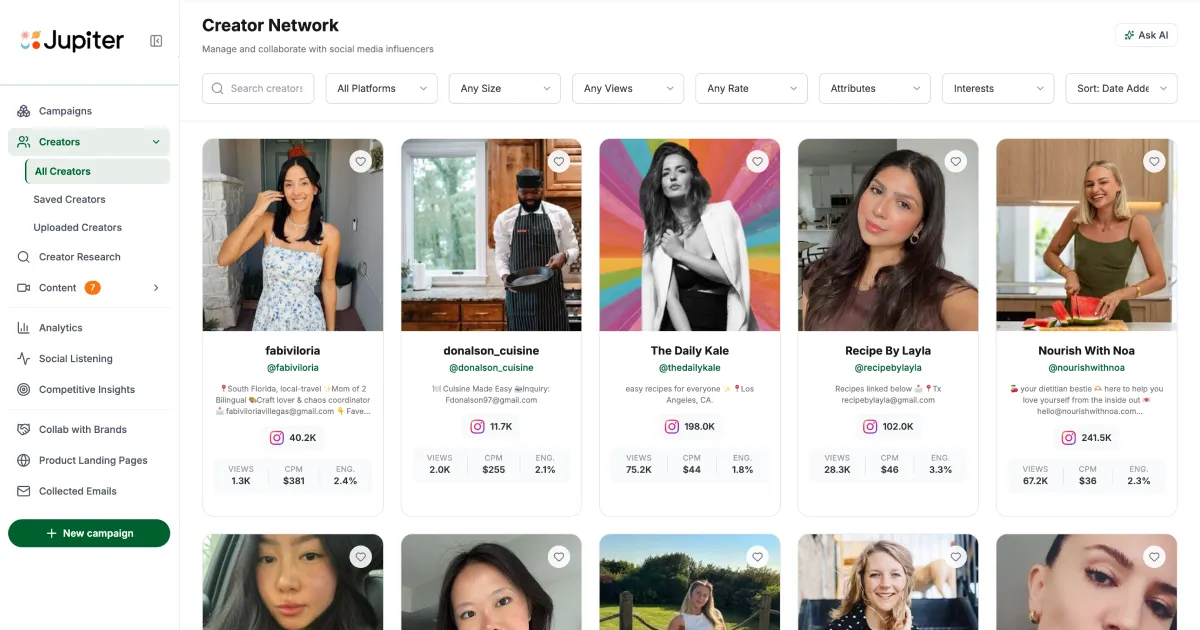
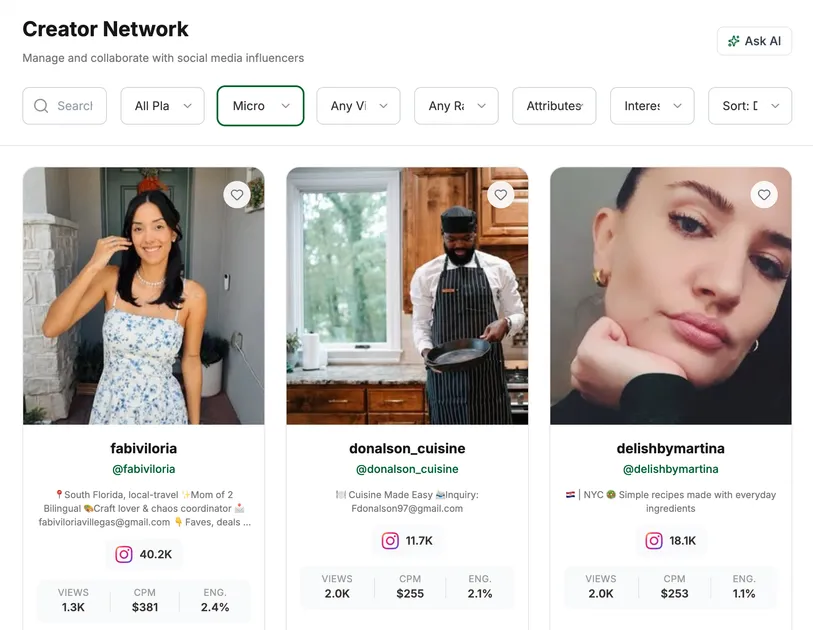
Discovery determines which creators you can work with. Some platforms offer access to millions of creators across all verticals. Others curate a vetted network specific to your category. Jupiter maintains 1,000+ vetted food and recipe creators on Instagram and TikTok only, no YouTube or Facebook creators. That focus means every creator in the network has demonstrated content performance in food and recipe categories, not fitness, beauty, or lifestyle content repurposed for food brands.
Platforms like CreatorIQ and Aspire offer multi-vertical discovery with sophisticated filtering. GRIN focuses on e-commerce and DTC brands with Shopify integration. The question is not which network is largest, but which network contains the creators whose audiences match your buyer demographics and whose content style aligns with how your product is actually used.
Campaign Management and Workflow Automation
Campaign management includes briefing, content approval, revision requests, publishing coordination, and performance tracking. The best platforms automate repetitive tasks like creator outreach, contract generation, and payment processing. Jupiter's 20-tool AI marketing agent handles brief generation, creator matching, content review, and performance reporting, reducing the manual workload for CPG marketing teams running multiple concurrent campaigns.
Look for platforms that support your team's workflow, not workflows that force your team to adapt. If you run ambassador programs, confirm the platform supports multi-month campaigns with recurring deliverables. If you run product seeding campaigns, confirm the platform tracks gifted product separately from paid posts.
Content Rights and Usage Licensing
Content rights management determines whether you can repurpose creator content for ads, retail media, or your own social channels. Some platforms include content licensing workflows with clear usage terms. Others leave rights negotiation entirely manual. For CPG brands planning to use creator content in retail media campaigns or paid social, confirming the platform tracks usage rights per asset is critical.
Attribution and Sales Integration
Attribution is where most creator marketing platforms fail CPG brands. E-commerce platforms integrate with Shopify or Amazon to track conversions. But most CPG brands sell through grocery retail, not DTC. Jupiter's Instacart attribution mechanic uses a comment-triggered DM system: a viewer comments a keyword on the creator post, automatically receives a DM with a unique shoppable Instacart link tied to that creator and post, and cart adds attribute back to the specific creator and post. One Instagram Reel campaign delivered 6.5 million views and produced over 1,000 Instacart cart adds using this mechanic.
If your brand sells primarily through retail, confirm the platform offers attribution that connects creator content to grocery sales. If it does not, you will be measuring engagement rates and hoping they correlate with purchase intent.
Analytics and Competitive Intelligence
Performance analytics should include platform-specific metrics like CPM, engagement rate, and view consistency, plus competitive benchmarks. Jupiter tracks share of voice across Instagram, TikTok, YouTube, and X, showing how your brand's creator-driven conversation compares to competitors. Across Jupiter campaigns, brands maintain 42.8% Instagram share of voice, 40.6% TikTok, 8.5% YouTube, and 8.1% X.
Platforms that only report on your own campaigns provide no context for whether your performance is strong or weak relative to category benchmarks. Competitive intelligence turns performance data into strategic direction.
Running Campaigns Without Visibility Into CPM?
Most CPG brands measure engagement rates but cannot compare their CPM efficiency to competitors. Jupiter shows you both. See how in a 20-minute demo.
Top Creator Marketing Platforms in 2026: Comparison and Use Cases
The creator marketing platform landscape includes enterprise solutions built for multi-vertical brands, vertical-specific platforms like Jupiter, and hybrid tools that blend software with agency services. Here is an honest comparison of the most widely used platforms, covering pricing, best-fit use cases, and key differentiators.
Jupiter: Built Exclusively for Food and Beverage CPG
Jupiter is the only creator marketing platform built exclusively for food and beverage CPG brands. It offers 1,000+ vetted recipe creators on Instagram and TikTok, a 12-signal campaign optimizer including retailer proximity and geographic match, Instacart attribution with comment-triggered DM mechanics, and share of voice tracking across four platforms. Pricing is structured around campaign budgets rather than flat annual fees, making it accessible for mid-market CPG brands that do not have $60,000+ annual platform budgets.
Jupiter delivers 229M+ total impressions across campaigns, with a plant-based pasta brand running one 13-week ambassador campaign that produced 70.1M impressions at $1.25 CPM with 5.1% average engagement. Another specialty oil brand ran a 52-week ambassadorship with one macro creator that delivered 20.8M impressions at $4.93 CPM with 4.5% engagement.
Best for: Food and beverage CPG brands selling through grocery retail and Instacart, especially brands prioritizing retailer proximity targeting and direct sales attribution over multi-vertical creator discovery. Used by 58+ leading CPG brands including Banza, Pete & Gerry's, and Kettle & Fire.
CreatorIQ: Enterprise Platform for Multi-Vertical Brands
CreatorIQ is one of the most respected enterprise creator marketing platforms, trusted by global brands including Nestlé, Google, and LVMH. It offers multi-platform discovery across Instagram, TikTok, YouTube, and emerging platforms, advanced analytics with custom reporting, and API integrations with enterprise marketing stacks. Pricing typically starts around $60,000 annually for enterprise access, making it best suited for large brands running high-volume campaigns across multiple categories.
Best for: Large CPG brands with dedicated influencer marketing teams managing campaigns across multiple product lines and geographies. Jupiter vs CreatorIQ provides a detailed comparison for food CPG teams evaluating both platforms.
Aspire: Marketplace Model with Self-Service Discovery
Aspire operates as a creator marketplace trusted by brands across beauty, fitness, food, and e-commerce. Creators apply to campaigns brands post, creating a self-service model that works well for brands with established influencer programs and clear creator selection criteria. Pricing varies by campaign volume and feature access, with annual contracts typical for mid-market and enterprise brands.
Best for: Brands comfortable managing creator vetting and selection internally, with marketing teams experienced in influencer campaign execution. Jupiter vs Aspire covers the key differences for food and beverage brands evaluating both.
GRIN: E-Commerce and DTC Focus with Shopify Integration
GRIN is built for e-commerce brands with native Shopify integration, making it ideal for DTC brands tracking conversions directly from creator content. It includes creator discovery, campaign management, and product seeding workflows. Pricing is structured around annual contracts with tiered feature access.
Best for: DTC food brands selling primarily through Shopify, not grocery retail. CPG brands relying on retail distribution will find GRIN's attribution model does not connect to the sales channels they care about. Jupiter vs GRIN provides a detailed comparison for food CPG brands.
#paid: Hybrid Platform with Managed Services
The #paid platform blends software with managed campaign services, offering brands a hybrid model between self-service platforms and full-service agencies. It includes creator discovery, campaign management, and content performance analytics, with optional hands-on support for brands without dedicated influencer marketing teams.
Best for: Brands new to creator marketing or those without internal resources to manage campaigns independently. The managed service model adds cost but reduces the learning curve.
How to Choose a Creator Marketing Platform: Decision Framework
Choosing the right creator marketing platform depends on four variables: team size, budget, campaign volume, and vertical fit. Here is a decision framework for CPG brands evaluating platforms.
Team Size and Internal Expertise
If you have a dedicated influencer marketing manager or team, self-service platforms like Aspire or CreatorIQ give you the most control. If you are a marketing team of one or two managing creator campaigns alongside retail marketing, trade shows, and product launches, platforms with AI-driven automation like Jupiter or managed service models like #paid reduce manual workload.
The software vs agency decision shapes whether you need a platform with hands-off automation or one that assumes you have internal capacity for creator outreach, negotiation, and content approval.
Budget and Pricing Structure
Enterprise platforms typically require $60,000 to $100,000+ annual commitments. Mid-market platforms like Jupiter structure pricing around campaign budgets rather than flat annual fees, making them more accessible for brands running 3 to 6 campaigns per year rather than continuous high-volume programs.
If you are a small CPG brand with limited budget, influencer marketing for small CPG brands provides specific guidance on running effective creator campaigns without enterprise-level spend.
Campaign Volume and Frequency
Brands running 1 to 2 campaigns per year may not justify annual platform fees. Brands running continuous campaigns, ambassador programs, or seasonal activations benefit from platforms with campaign health monitoring and performance dashboards. Jupiter's campaign health system flags campaigns performing below 80% of estimated impressions as yellow or red, allowing teams to adjust creator selection or content strategy mid-flight rather than waiting for post-campaign reports.
Vertical Fit and Attribution Requirements
CPG brands selling through grocery retail need different platform features than DTC e-commerce brands. If your sales happen at Kroger, Whole Foods, or Instacart, confirm the platform offers grocery-specific attribution or retailer proximity targeting. If your sales happen on Shopify or Amazon, confirm the platform integrates with those channels.
Vertical fit determines whether the platform's creator network, attribution mechanics, and analytics dashboards align with how your brand actually sells product. A platform built for beauty influencers will not surface the food and recipe creators whose audiences are actively shopping for grocery products.
Integration and Onboarding: What to Expect When Implementing a New Platform
Implementing a creator marketing platform requires integrating with your existing marketing stack, training your team, and migrating any past campaign data or creator relationships. Most platforms offer onboarding support, but the depth and duration vary significantly.
Enterprise platforms like CreatorIQ typically include multi-week onboarding with dedicated account management, API integrations with CRM or analytics tools, and custom reporting setup. Mid-market platforms like Jupiter offer streamlined onboarding focused on campaign setup, creator network access, and attribution configuration. Expect 2 to 4 weeks from contract signature to launching your first campaign on most platforms.
If you have existing creator relationships, confirm the platform allows you to import past campaign data or add creators to your roster manually. Some platforms require all creator relationships to originate within their network, which can disrupt ongoing partnerships.
See How Jupiter Fits Your CPG Marketing Program
Used by 58+ leading CPG brands including Banza, Pete & Gerry's, and Kettle & Fire. Book a 20-minute demo to see the platform, pricing, and onboarding process.
ROI Measurement: How Brands Track Creator Marketing Performance and Justify Platform Investment
Justifying platform investment requires demonstrating ROI, but most CPG brands struggle to connect creator content to sales outcomes. The platforms with the clearest ROI measurement are those with direct attribution integrations like Instacart cart adds, Amazon conversions, or Shopify checkout tracking.
For CPG brands without direct e-commerce sales, proxy metrics include CPM efficiency, engagement rate improvements, and share of voice growth against competitors. A plant-based pasta brand running a 4-week campaign with 6 macro creators delivered 25.9M impressions at $2.47 CPM with 3.6% average engagement. Another plant-based pasta brand ran a 13-week ambassador campaign that produced 70.1M impressions at $1.25 CPM, nearly half the CPM of the shorter campaign.
The platform you choose determines which metrics you can track and therefore which ROI argument you can make to your CFO. Platforms with Instacart attribution let you report cart adds per dollar spent. Platforms without attribution force you to report impressions and engagement rates, which do not answer the question of whether the campaign drove sales.
How to measure influencer marketing ROI provides a complete framework for CPG brands building ROI measurement systems that connect creator content to grocery sales, not just engagement metrics.
The creator marketing platform you choose shapes every campaign you run: which creators you discover, how you measure success, and whether your CFO sees influencer marketing as a cost center or a growth driver. For food and beverage CPG brands, the platform decision comes down to whether the software is built for your vertical, your sales channels, and the attribution logic your business actually requires.
FAQs
Quick answers to common questions.
What is a creator marketing platform?▼
A creator marketing platform is software that manages creator discovery, campaign execution, content rights, and performance attribution. Unlike traditional influencer platforms that focus on vanity metrics like follower count, creator marketing platforms prioritize content performance, conversion tracking, and ROI measurement tied to business outcomes like sales or cart adds.
How much does a creator marketing platform cost?▼
Creator marketing platform pricing typically ranges from $10,000 to $100,000+ annually depending on campaign volume, team size, and feature access. Enterprise platforms like CreatorIQ start around $60,000 per year for brands managing high-volume campaigns. Vertical-specific platforms like Jupiter offer pricing structured around campaign budgets rather than flat annual fees, making them more accessible for mid-market CPG brands.
What is the difference between a creator marketing platform and an influencer marketing platform?▼
Creator marketing platforms emphasize content creation, performance measurement, and attribution to business outcomes. Influencer marketing platforms focus on discovery based on follower count, reach, and vanity engagement metrics. Creator platforms typically include content rights management, direct sales attribution, and integration with e-commerce or retail media networks that influencer platforms lack.
Which creator marketing platform is best for food CPG brands?▼
Jupiter is built exclusively for food and beverage CPG brands selling through grocery retail, with 1,000+ vetted recipe creators, Instacart attribution, and 12-signal campaign optimization including geographic match and retailer proximity. CreatorIQ and Aspire serve multi-vertical brands well but lack grocery-specific attribution. GRIN focuses on e-commerce brands with Shopify integration, making it less suitable for CPG brands relying on retail distribution.
What features should I look for in a creator marketing platform?▼
Essential features include creator discovery with audience demographic filters, campaign workflow management, content approval and rights tracking, performance analytics with platform-specific metrics, and attribution integrations with sales channels like Instacart, Shopify, or Amazon. For CPG brands, retailer proximity targeting and share of voice tracking across competitors are critical features most general platforms lack.
How do I measure ROI from a creator marketing platform?▼
ROI measurement requires tracking campaign costs against attributed sales or engagement outcomes. Platforms with direct attribution integrations like Instacart cart adds, Amazon conversions, or Shopify checkout tracking provide the cleanest ROI data. For CPG brands without direct e-commerce sales, measuring CPM efficiency, engagement rate improvements, and share of voice growth against competitor benchmarks provides proxy ROI metrics.
More in Platforms & Comparisons
More from Platforms & Comparisons.