Instagram vs TikTok for Food CPG: Where Budget Goes Further
The data on where food CPG brand conversation happens and where impressions actually deliver points in opposite directions. Here is how to read both signals and build a platform mix that works.
Trusted by leading CPG brands











On this page
▼
- The Platform Gap Every CPG Brand Manager Needs to Understand
- Instagram Still Wins on Impressions Delivery for Food CPG
- Reels reach and content shelf life
- Instacart attribution depth
- Engagement rate consistency
- Audience composition for grocery buyers
- TikTok Wins on Discovery and Category Conversation Share
- TikTok as a food search engine
- Viral upside is structurally higher
- CPM arbitrage at mid-tier
- Conversation momentum
- How to Split Your Creator Budget Between Instagram and TikTok
- Your primary retail channel and attribution priority
- Your target consumer age
- Your campaign objective
- Creator Selection Differs by Platform
- How Jupiter Handles Both Platforms in One Workflow
Instagram vs TikTok for food CPG brands is a budget allocation question, not a platform loyalty question. Instagram still delivers the majority of impressions from food creator campaigns. TikTok has caught up with Instagram for food and beverage brand conversation share. The gap between where the conversation is happening and where impressions are actually delivering is the most important signal in food CPG creator marketing right now, and understanding it tells you exactly how to split your budget.
If you are a CPG marketing manager currently spending 90% of your creator budget on Instagram and wondering whether to shift, this guide gives you the numbers to make that decision with confidence rather than instinct.
The Platform Gap Every CPG Brand Manager Needs to Understand
Jupiter's share-of-voice infrastructure tracks food and beverage brand mentions across Instagram, TikTok, YouTube, and X. The 2026 numbers tell a specific story.
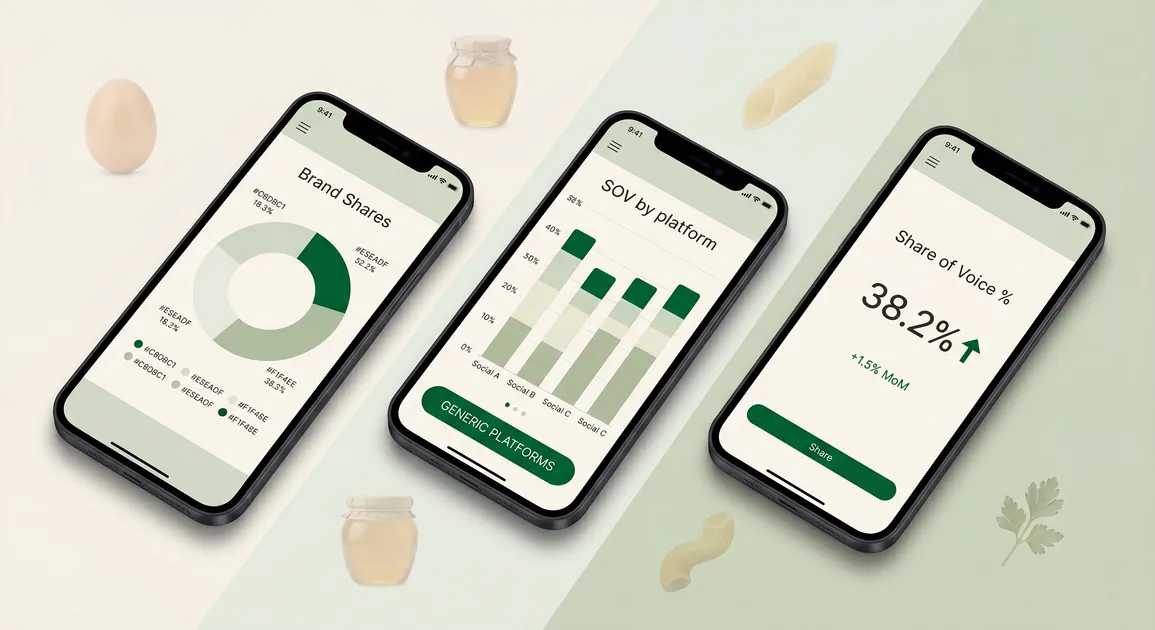
Instagram accounts for 42.8% of food and beverage brand conversation. TikTok accounts for 40.6%. The two platforms are functionally tied for where the category conversation is happening.
Now look at where impressions actually land. Across 635 creator posts tracked through Jupiter campaigns, 73.7% of delivered impressions came from Instagram and 26.3% came from TikTok.
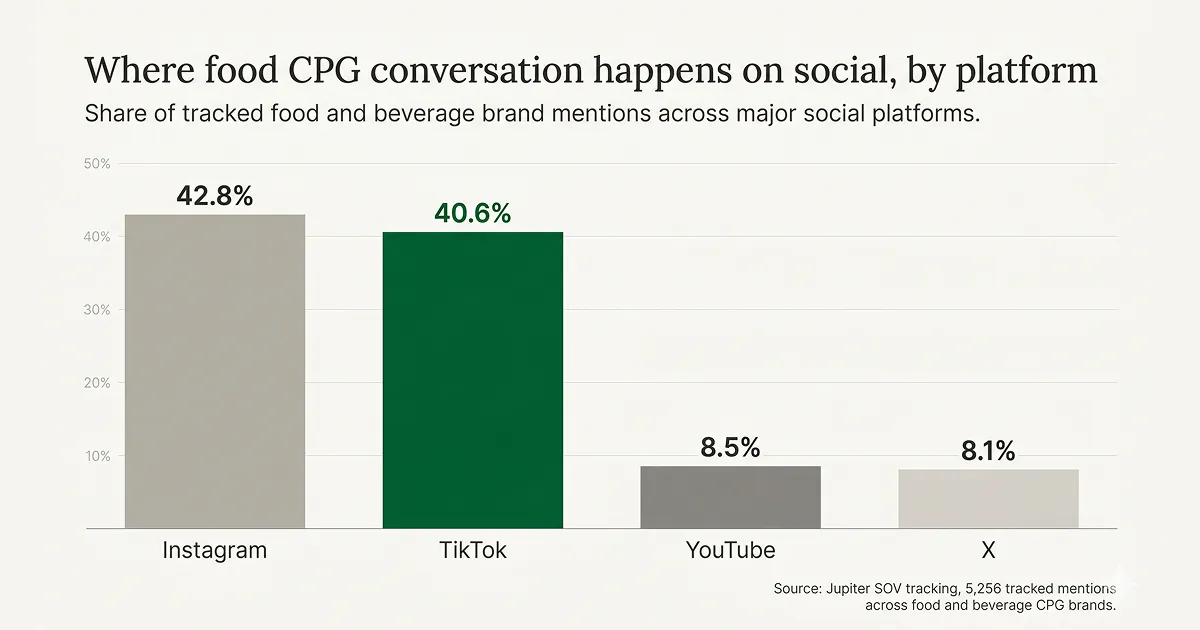
The gap between conversation share (nearly equal) and impression delivery (nearly 3:1 in favor of Instagram) tells you two things at once. Instagram is still the more efficient impression delivery channel for food CPG creator campaigns. TikTok is under-deployed relative to where the category conversation already is.
Neither number is wrong. They measure different things. Conversation share measures where your audience is talking. Impression delivery measures where you can reach them efficiently at scale with paid creator partnerships. A brand that allocates budget based solely on conversation share will over-index TikTok and miss Instagram's superior delivery efficiency. A brand that ignores conversation share will keep its entire budget on Instagram while competitors build TikTok presence in a channel growing faster than brand spend is following it.
The answer is not to pick one. The answer is to know what each platform does and allocate accordingly.
Instagram Still Wins on Impressions Delivery for Food CPG
Instagram is not losing ground to TikTok on impression delivery, and the structural reasons are not going away.
Reels reach and content shelf life
Instagram Reels have a longer algorithmic shelf life than TikTok videos for most creator tiers. A recipe Reel continues generating impressions weeks after its original post date, particularly when it surfaces in Explore. Food content performs especially well in this regard because users save recipes and return to them. Saves extend the algorithmic life of a post in ways that passive watches do not.
Instacart attribution depth
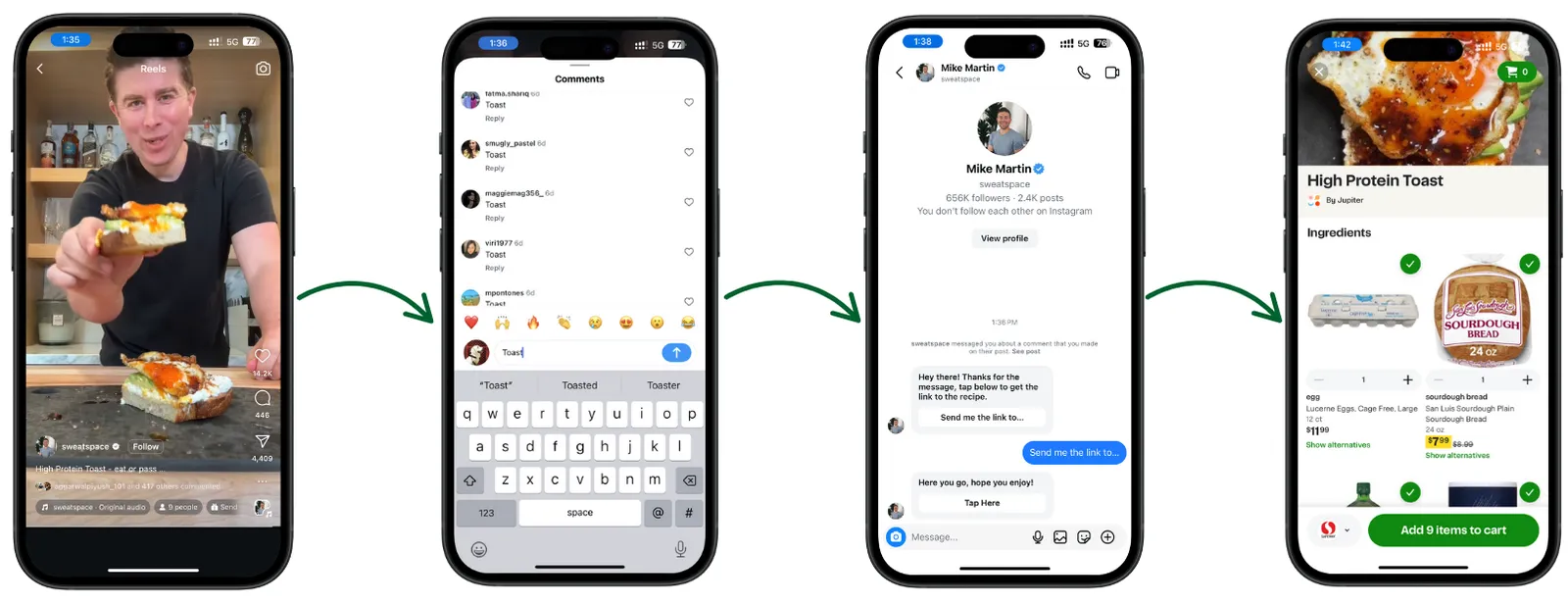
Jupiter's comment-to-cart mechanic, where a viewer comments on a creator's post with a specific keyword and receives an automatic DM with a shoppable Instacart link, is proven at significant scale on Instagram. A single Instagram Reel drove 6.5 million views and more than 1,000 Instacart cart adds. The Instagram DM infrastructure is more mature for this commerce mechanic than TikTok's equivalent, making Instagram the stronger channel for brands whose primary KPI is Instacart shopping list adds.
Engagement rate consistency
Food creators on Instagram show more consistent engagement across individual posts than their TikTok counterparts, where algorithmic distribution makes view counts variable. For brands running campaigns where CPM predictability matters for budget planning, Instagram's consistency is a structural advantage that compounds over multiple campaign cycles.
Audience composition for grocery buyers
US consumers in the 35 to 55 age range, who make the majority of household grocery decisions, skew Instagram over TikTok. If your product targets primary household grocery shoppers rather than trend-driven younger consumers, Instagram's audience composition is more commercially relevant regardless of platform growth rates.
TikTok Wins on Discovery and Category Conversation Share
The TikTok case for food CPG is not about impressions today. It is about search behavior and category conversation now, and impression dominance eventually.
TikTok as a food search engine
A growing share of US consumers under 35 use TikTok to search for food queries before Google or Pinterest. Searches like "high protein dinner ideas," "gluten-free snacks at Whole Foods," and "quick weeknight meals" route through TikTok at meaningful volume. Brand presence in those search results functions like SEO. A creator post that ranks in TikTok's food search results generates impressions continuously, not just in the first 48 hours after posting.
Viral upside is structurally higher
TikTok's algorithmic distribution means a creator with 25,000 followers can deliver 500,000 views on a single video when the content hits. This does not happen at the same rate on Instagram Reels. The floor on TikTok impression delivery is lower than Instagram, but the ceiling is significantly higher. For brands launching a new SKU that needs wide discovery, TikTok's distribution upside makes it a high-expected-value channel even at lower average impressions per campaign.
CPM arbitrage at mid-tier
Mid-tier TikTok food creators (50,000 to 250,000 followers) frequently deliver lower cost-per-thousand impressions than their Instagram counterparts, because TikTok creator pricing in this tier has not fully caught up with actual reach potential. The gap is narrowing, but brands that lock in mid-tier TikTok creator relationships now are buying that efficiency before it closes.
Conversation momentum
A 40.6% TikTok conversation share against 26.3% impression delivery means the platform is generating organic category conversation faster than brand investment is following it. Brands that increase TikTok creator spend now are entering a channel where the conversation is already happening without them.

See how Jupiter manages both Instagram and TikTok creator campaigns in one workflow
One brief, one creator selection engine, one analytics dashboard, with platform-specific CPM benchmarks and Instacart attribution across both channels.
How to Split Your Creator Budget Between Instagram and TikTok
There is no universal split that works for every brand. The right allocation depends on three brand-specific inputs.
Your primary retail channel and attribution priority
Brands with strong Instacart velocity and a priority on attributable shopping list adds should weight Instagram more heavily, because Jupiter's Instacart comment-to-cart mechanic is most proven there. Brands building category awareness for a new product launch benefit more from TikTok's discovery distribution.
Your target consumer age
For grocery buyers in the 35 to 55 range, a 70/30 Instagram/TikTok split is a reasonable starting point. For brands targeting consumers under 35, a 50/50 or even a 40/60 split better reflects where that audience spends time.
Your campaign objective
If the goal is maximum attributable impressions at predictable CPM, Instagram is the more reliable channel. If the goal is category share-of-voice growth and organic discovery, TikTok is the better investment. Most CPG brands should run both objectives simultaneously, which argues for a platform split rather than a single-channel strategy.
A practical framework for brands running three to five campaigns per year: allocate 65% of creator budget to Instagram as the primary impression delivery channel and 35% to TikTok as the conversation and discovery channel. Reassess each quarter based on CPM actuals and share-of-voice movement tracked through your analytics platform.
One thing not to do: treat TikTok as a repurposing channel for Instagram content. Posting Instagram Reels directly to TikTok underperforms consistently. TikTok requires native content creation, native caption structure, and creator voices that feel organic to the platform. If the TikTok content looks like a branded Instagram Reel, the algorithm treats it like one.
Splitting your creator budget between Instagram and TikTok without platform data? See what changes when you have it.
Jupiter surfaces platform-specific CPM projections, creator view performance, and Instacart attribution across both channels before you spend a dollar.
Creator Selection Differs by Platform
The evaluation criteria overlap but are not identical. Brands that apply the same creator selection signals across both platforms systematically pick the wrong creators on at least one of them.
On Instagram, the signals that predict campaign performance are engagement rate (above 3% is strong for food creators), Reels view consistency, audience demographics, and follower credibility score. Saves are the strongest purchase-intent signal on Instagram. They indicate the viewer plans to use the content, which for recipe posts means they plan to cook the dish and buy the ingredients.
On TikTok, average view count per post is more predictive than follower count, because TikTok's algorithm distributes content beyond a creator's followers at a rate Instagram does not match. A TikTok creator with 30,000 followers averaging 200,000 views per video reaches more people than a creator with 150,000 followers averaging 40,000 views. Selecting TikTok creators on follower count alone misses the highest performers in every tier.
Across Jupiter's TikTok food creator network, median average views per post by follower tier are: Nano creators (1,000 to 10,000 followers) at 1,062 views, Micro creators (10,000 to 50,000 followers) at 2,118 views, Mid-tier creators (50,000 to 250,000 followers) at 9,154 views, Macro creators (250,000 to 1 million followers) at 27,208 views, and Top-tier creators (1 million or more followers) at 99,037 views.
The outliers above the median in each tier are where the best CPM efficiency lives. Identifying them requires view count data surfaced at the creator level, not just follower count and category tags.
How Jupiter Handles Both Platforms in One Workflow
Jupiter is built exclusively for food and beverage CPG brands, with Instagram and TikTok creator data, pricing, and attribution unified in a single platform. The campaign management platform handles the full workflow from brief to posted content tracking across both channels simultaneously.
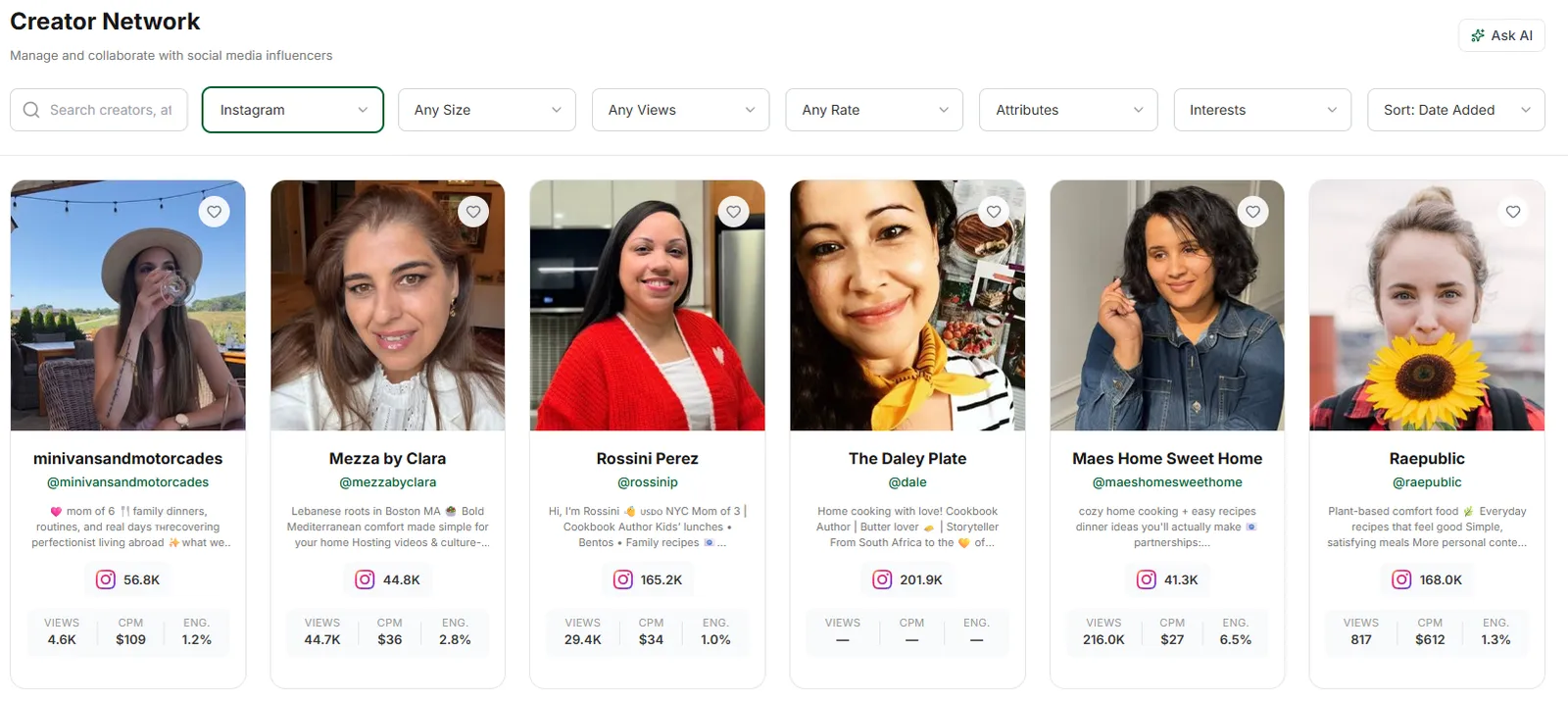
The creator network includes 1,000+ vetted recipe creators with platform-specific data: separate Instagram and TikTok pricing, per-platform engagement rates, TikTok average view counts, Instagram Reels performance data, and credibility scores for both. When you build a campaign, you select creators for Instagram, TikTok, or both, with the 12-signal optimizer projecting platform-specific CPM for each creator combination.
Jupiter's 12-signal campaign optimizer evaluates content interest alignment, posting recency, retailer proximity, brand affinity from past collaboration history, creator attribute match, audience attribute match, engagement quality, view consistency, audience credibility, audience demographics, hashtag relevance, and geographic distribution. It selects the creator combination that maximizes projected impressions within budget, with platform-specific benchmarking built in.
Instacart attribution runs across both platforms via Jupiter's comment-to-cart mechanic. A viewer comments on a creator post, receives a shoppable Instacart DM, and the resulting cart add is tracked back to the specific creator and post. Jupiter is one of Instacart's fastest-growing affiliate partners.
The Jupiter AI Marketing Agent, built with 20 specialized tools, pulls platform-specific creator recommendations, compares TikTok vs. Instagram CPM projections across creator combinations, and surfaces share-of-voice trends in plain language. Share of voice tracking runs continuously across Instagram, TikTok, YouTube, and X, so you can see whether your TikTok investment is translating into category conversation growth, not just impressions logged. The full analytics dashboard shows estimated vs. actual impressions, CPM by creator and campaign, and creator cost efficiency across both platforms in one view.
Brands including Banza, Pete & Gerry's, Kettle & Fire, and La Tourangelle use Jupiter to run campaigns across both platforms from a single workflow, with unified attribution regardless of which platform generated the view.
Your creator budget deserves a platform that understands both Instagram and TikTok for food CPG.
Jupiter is the only platform built exclusively for food and beverage brands, with 1,000+ vetted recipe creators, a 12-signal campaign optimizer, and Instacart attribution across both channels. Used by 58+ CPG brands including Banza, Pete & Gerry's, and Kettle & Fire.
FAQs
Quick answers to common questions.
Should food CPG brands use Instagram or TikTok for influencer marketing?▼
Both. Instagram delivers 73.7% of impressions from food CPG creator campaigns and has more established Instacart attribution infrastructure. TikTok holds 40.6% of food and beverage brand conversation share and offers stronger product discovery reach, particularly for US consumers under 35. A 65/35 Instagram/TikTok budget split is a practical starting point for most US grocery brands, adjusted based on target consumer age and campaign objective.
Does TikTok or Instagram deliver better CPM for food CPG brands?▼
Instagram typically delivers more predictable CPM because its algorithmic distribution is more consistent post to post. TikTok offers lower CPM potential at mid-tier creator levels (50,000 to 250,000 followers) where creator pricing has not caught up to actual reach. For brands prioritizing CPM certainty, Instagram is the more reliable channel. For brands optimizing on average view count rather than guaranteed CPM, TikTok mid-tier creators frequently outperform on cost efficiency.
How much of a food CPG creator budget should go to TikTok vs Instagram?▼
A practical starting split for US food CPG brands is 65% Instagram and 35% TikTok. Brands targeting consumers under 35 or prioritizing category share-of-voice growth should weight TikTok higher. Brands with Instacart as a primary revenue channel and an emphasis on attributable conversions should weight Instagram more. Reassess quarterly based on CPM actuals and share-of-voice data.
How do you measure TikTok influencer marketing ROI for a CPG brand?▼
Measurement runs through four layers: estimated vs. actual impressions and CPM against pre-campaign benchmarks, creator-level cost efficiency by impressions per dollar, trackable Instacart links attributing shopping list adds to specific creator posts, and share-of-voice growth across the category. Because most CPG products sell through grocery retail rather than a DTC checkout, Instacart shopping list adds are the most direct revenue-adjacent signal available.
What TikTok creator tier delivers the best value for food CPG brands?▼
Mid-tier creators (50,000 to 250,000 followers) typically deliver the best cost-per-impression for food CPG brands on TikTok. Nano creators are efficient per post but require coordinating many relationships to hit meaningful aggregate reach. Macro creators reach more people but at significantly higher CPM. Within any tier, creators whose average views exceed their tier median deliver the best efficiency and require view count data, not just follower count, to identify.
Can you run Instagram and TikTok food influencer campaigns from the same platform?▼
Yes. Jupiter manages Instagram and TikTok creator campaigns in a single workflow, with platform-specific creator data, separate pricing, per-platform CPM projections, and Instacart attribution across both channels. Brands running campaigns on both platforms build, manage, and report on them without switching between tools or rebuilding analytics in separate systems.
More in Strategy & Guides
More from Strategy & Guides.