Should a CPG Brand Hire an Agency or Run Creator Campaigns In-House?
A CPG social media agency and an in-house creator program are not the same decision at every stage of a brand's growth. Here's the framework food and beverage marketing teams use to choose, and what changes if you choose wrong.

Trusted by leading CPG brands











On this page
▼
- A CPG social media agency sells time, not creator access
- An in-house creator program trades headcount for tooling
- Four questions decide which model actually fits
- How many campaigns run per quarter
- How specialized the creator need is
- How much retail attribution matters
- How much internal bandwidth exists today
- Where agencies genuinely win
- The hybrid model most food CPG brands actually land on
- How Jupiter supports the in-house model for food CPG brands
A CPG social media agency is a retained outside team that plans, executes, and reports on a brand's social and creator marketing. An in-house creator program is the same set of functions run by the brand's own marketing team, usually with software instead of headcount. Neither is universally correct. The right answer depends on campaign volume, internal bandwidth, and how much control the brand needs over creator relationships and retail attribution.
Most food and beverage CPG brands ask this question at the wrong time; either too early, before they have enough campaign volume to justify a retainer, or too late, after a slow agency cycle has already cost them a launch window. The decision framework below is built around volume and control, not price, because price alone answers the wrong question.
A CPG social media agency sells time, not creator access
A social media agency's core product is staffing. You are paying for a strategist, an account manager, and often a coordinator to run the creator outreach, briefing, and reporting cycle on your behalf. That is valuable when a brand has no internal capacity for social or influencer work at all.
It is also where the friction starts for food and beverage brands specifically. Most social media agencies are generalists. They run campaigns across categories, from apparel to beauty to CPG, and their creator rosters reflect that breadth rather than depth in food content. Sourcing a recipe creator who can shoot, style, and edit a full cooking sequence is a different search than sourcing a fashion creator, and a generalist agency's existing relationships often don't cover it well.
Retainer structures compound this. A typical CPG social media agency retainer runs several thousand dollars a month before a single creator is paid, covering strategy and management time regardless of campaign volume. For a brand running one or two campaigns a quarter, that overhead can exceed the media spend itself.
An in-house creator program trades headcount for tooling
Running creator campaigns in-house means a member of the brand's own marketing team owns sourcing, briefing, content review, and reporting directly, typically using a platform built for the job rather than spreadsheets and Instagram DMs.
The tradeoff is time, not money saved outright. In-house teams gain direct creator relationships, faster campaign turnaround because there is no account manager relaying requests, and full visibility into what content review, budget allocation, and creator selection actually look like. What they need in exchange is a platform that replaces the coordination work an agency would otherwise do, because manual creator sourcing without agency support is where most in-house programs stall.
This is the core reason CPG-specific software exists. It is not a replacement for an agency's strategic thinking so much as a replacement for its operational plumbing: creator discovery, budget optimization, and content approval, run by the brand team directly instead of relayed through an account manager.

See what an in-house creator program looks like with the operational plumbing already built
Jupiter replaces the agency coordination layer with a 12-signal optimizer, 1,000+ vetted recipe creators, and built-in content review, run directly by your team.
Four questions decide which model actually fits
How many campaigns run per quarter
Below roughly four campaigns a quarter, an agency retainer is usually the more expensive path per campaign. Above that volume, dedicated software or a dedicated in-house hire starts to pay for itself against the retainer fee.
How specialized the creator need is
A brand running recipe-driven content, retailer-specific campaigns, or ambassador programs needs food-specific creator sourcing. A generalist agency's roster rarely goes deep here, which pushes food brands toward either a food-focused agency (rare and expensive) or an in-house program on food-specific software.
How much retail attribution matters
Brands measuring creator impact against Instacart cart adds or retailer velocity need attribution built into the campaign flow itself. Few generalist agencies offer this natively; it usually requires a separate attribution vendor layered on top of the agency relationship, which adds cost and reporting lag.
How much internal bandwidth exists today
A single marketing generalist juggling creator campaigns alongside five other responsibilities will lose time to manual sourcing and outreach regardless of budget. That is the scenario where either an agency or purpose-built software earns its cost. Doing neither is the actual failure mode, not choosing the "wrong" one of the two.
Where agencies genuinely win
Agencies earn their retainer in a few specific situations food brands should recognize rather than dismiss.
A brand with no internal marketing capacity at all, not even one person who can own creator relationships, needs staffing before it needs software. A brand entering an entirely new channel, like a first TikTok Shop push, can benefit from an agency's cross-category pattern recognition even if their food-specific roster is thin. And a brand managing a genuinely complex multi-channel calendar, where creator content is one piece of a broader paid and organic media plan, may need an agency's coordination across channels that a creator-focused platform doesn't attempt to replace.
None of these apply to every food CPG brand, and none of them require accepting a retainer that scales with headcount rather than campaign output.
Still relaying every creator brief through an account manager?
If your team already knows what a good campaign looks like, the agency layer is often just adding time, not judgment.
The hybrid model most food CPG brands actually land on
In practice, few food and beverage brands choose purely one path. The more common pattern is an in-house team running the bulk of always-on creator campaigns directly on a platform, while an outside agency or freelance strategist is brought in for a specific launch, a rebrand, or a channel the internal team hasn't run before.
This works because the split follows the volume-versus-specialization logic rather than an all-or-nothing decision. The recurring, retailer-tied campaigns that benefit from fast turnaround and direct creator relationships stay in-house. The occasional strategic push that needs outside creative thinking goes to an agency engagement scoped to that single project, not an ongoing retainer.
For brands weighing this against a full agency relationship rather than a hybrid one, see our broader comparison of software platforms versus full-service agencies for food CPG brands, which covers the decision at the platform level rather than the staffing level.
How Jupiter supports the in-house model for food CPG brands
Jupiter is built exclusively for food and beverage CPG brands, and the in-house creator program is the model it's designed around. It replaces the coordination work a social media agency would otherwise bill for, without replacing the brand team's ownership of strategy and creator relationships.
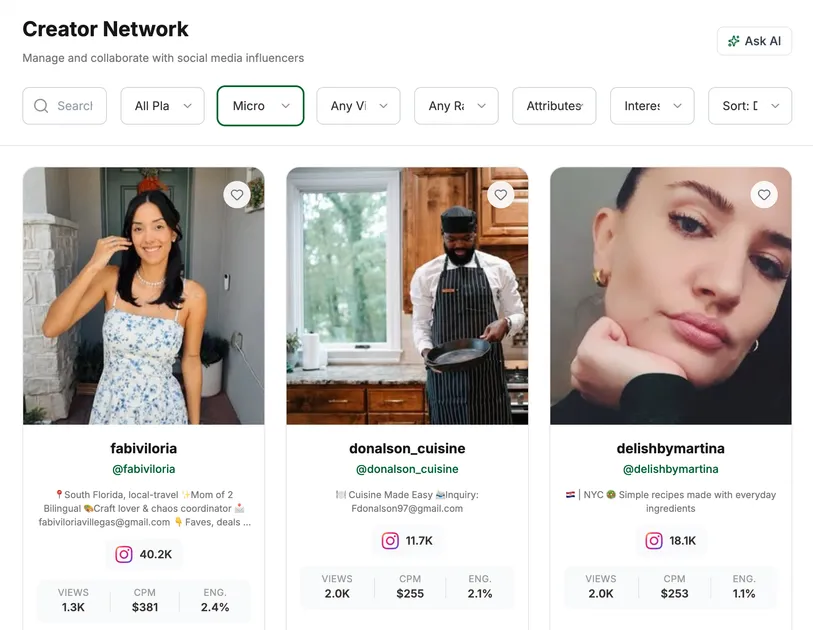
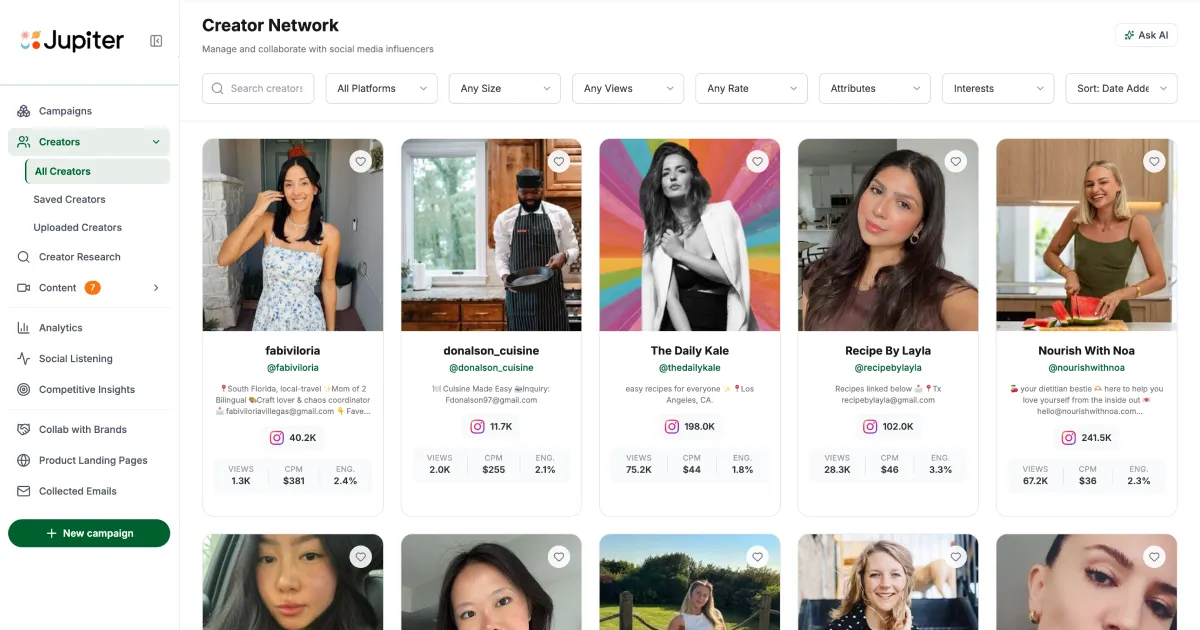
The creator network holds 1,000+ vetted recipe creators across Instagram and TikTok, filterable by platform, follower count, engagement rate, content interests, and geographic location, so sourcing does not depend on an account manager's existing relationships. The 12-signal campaign optimizer scores every eligible creator on content interest alignment, posting recency, retailer proximity, brand affinity, and audience and creator attribute match, then runs budget-constrained selection to project impressions and CPM before a dollar is spent, the same estimation work a strategist would otherwise produce manually.
Content review happens directly inside the platform: creators submit videos for approval before posting, with an approve-or-reject workflow that replaces email chains and shared drives. And Instacart attribution is native to the campaign flow, tracking a viewer's comment on a creator's post through to a shoppable Instacart link and, from there, back to a specific cart add. One Instagram Reel driving 6.5 million views produced 1,000+ Instacart cart adds through that exact mechanic. No separate attribution vendor, no reporting lag waiting on an agency's monthly deck.
Brand teams running this model still get campaign-level and cross-campaign reporting: the analytics dashboard shows estimated versus actual impressions and CPM per campaign, a creator leaderboard ranked by cost efficiency, and campaign health scored green, yellow, or red against the original projection. That is the reporting cadence an agency account manager would otherwise compile by hand.
Jupiter is used by 58+ leading CPG brands including Banza, Pete & Gerry's, and Kettle & Fire, running creator programs directly rather than through an outside agency.
Run your creator program in-house without losing the coordination an agency provides
1,000+ vetted recipe creators, a 12-signal optimizer, and built-in Instacart attribution, all run by your own team. Used by 58+ leading CPG brands including Banza, Pete & Gerry's, and Kettle & Fire.
FAQs
Quick answers to common questions.
What is the difference between a CPG social media agency and an in-house creator program?▼
A CPG social media agency is a retained outside team that handles creator sourcing, briefing, and reporting on a brand's behalf, typically for a monthly fee separate from media spend. An in-house creator program means the brand's own marketing team runs those same functions directly, usually supported by software built for creator campaign management rather than agency headcount.
Is it cheaper to run creator campaigns in-house than through an agency?▼
It depends on campaign volume. Agency retainers charge for strategist and account manager time regardless of how many campaigns run, which makes them expensive per campaign for brands running fewer than roughly four campaigns a quarter. Above that volume, the retainer cost spreads across more output and the math shifts, though in-house programs still require either a dedicated team member or software to replace the agency's coordination work.
When should a food CPG brand hire a social media agency instead of running campaigns in-house?▼
Agencies make the most sense for brands with no internal marketing capacity to own creator relationships at all, brands entering a completely new channel where outside pattern recognition helps, or brands managing a complex multi-channel calendar where creator content is one piece of a larger coordinated media plan.
Can an in-house team run creator campaigns without dedicated software?▼
Technically yes, through spreadsheets, Instagram DMs, and manual outreach, but this is where most in-house programs stall. Creator sourcing, budget allocation, and content review all take significantly longer without a system built for it, which is why in-house programs at scale are almost always paired with a purpose-built platform.
Do social media agencies handle Instacart or retail attribution for CPG brands?▼
Most generalist social media agencies do not offer retail attribution natively. Brands that need to tie creator content to Instacart cart adds or retailer velocity typically need a separate attribution vendor layered on top of the agency relationship, which adds both cost and reporting lag compared to a platform with attribution built into the campaign flow.
Can a food CPG brand use both an agency and an in-house creator program?▼
Yes, and this is the most common pattern in practice. Brands often run recurring, retailer-tied creator campaigns in-house on a dedicated platform while bringing in an outside agency or strategist for specific launches, rebrands, or new channels the internal team hasn't run before, rather than treating it as an all-or-nothing choice.
More in Platforms & Comparisons
More from Platforms & Comparisons.