How Food Brands Drive Sprouts Velocity With Creator Campaigns
Sprouts shoppers over-index on natural and better-for-you positioning. Creator selection for Sprouts campaigns has to weight dietary attribute match higher than follower count, and most brands get that backwards.
Trusted by leading CPG brands















On this page
▼
Sprouts Farmers Market is not Whole Foods, and it is not Walmart's natural aisle. It is a distinct shopper base, one that seeks out natural, organic, and better-for-you products deliberately, not incidentally. A creator campaign built for a mass grocery launch does not automatically work for a Sprouts launch, and brands that treat retailer targeting as an afterthought waste budget reaching the wrong audience.
This playbook covers how to build a creator campaign specifically for a Sprouts listing or expansion: who to cast, how to brief, when to launch, and how to measure it.
Why Sprouts is a high-value influencer channel
Sprouts shoppers self-select into the store because of what it represents, not just what it stocks. That self-selection is the entire opportunity. A shopper walking into Sprouts has already decided that ingredient quality, dietary fit, or better-for-you positioning matters to their purchase decision. A creator campaign that speaks to that decision, rather than a generic product benefit, converts better than the same content would at a retailer with a broader, less self-selected shopper base.
This is also why follower count is a weaker signal for Sprouts campaigns than it is for a mass retail launch. A creator with a smaller but tightly aligned dietary-lifestyle audience, someone whose content already centers on clean eating, gluten-free cooking, or plant-based recipes, reaches more of the actual Sprouts shopper base per post than a larger generalist food creator does. For the broader grocery context this sits inside, see the 2026 CPG grocery influencer marketing playbook.
Creator selection for Sprouts campaigns
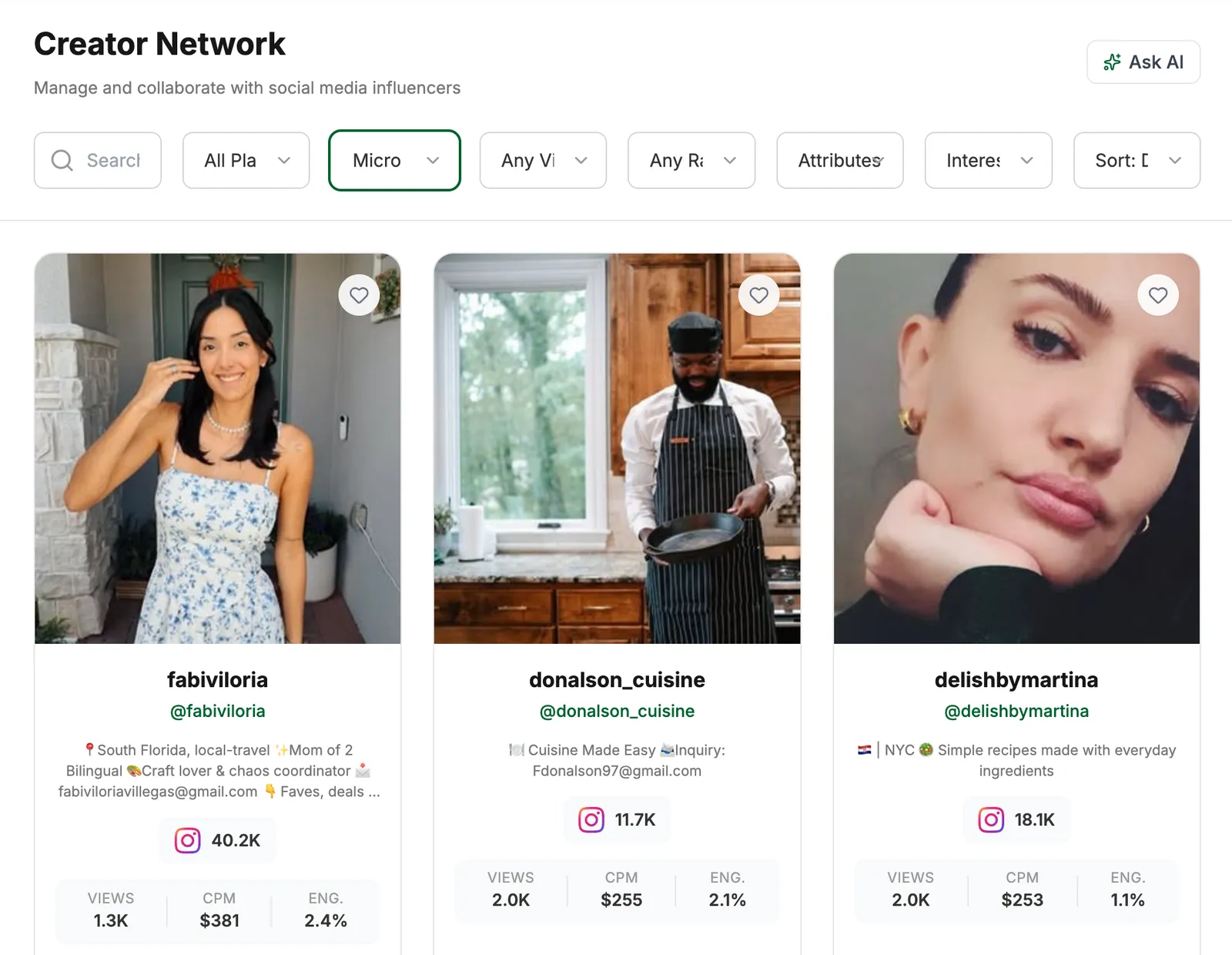
Weight dietary attribute match above follower count when building a Sprouts roster. A creator tagged for attributes like "Dairy-Free Lifestyle," "Gluten-Free," or "Home Cook, Clean Eating" is a stronger fit than a larger creator with no established dietary lens, because their existing audience already trusts their judgment on exactly the kind of product decision a Sprouts shopper is making.
Retailer proximity matters too, and matters more here than it would for a national retailer. Sprouts has a smaller store footprint than Kroger or Walmart, concentrated in specific regions. A creator whose audience is geographically distant from any Sprouts location is reaching people who cannot act on the content by walking into a store, even if they can act on it through delivery. Filtering creators by proximity to Sprouts locations, not just general US audience size, keeps the roster relevant to people who can actually shop there.
The benchmark CPM range for food CPG creator campaigns, $1.25 to $12.67 depending on category and structure, applies here as well. A Sprouts-specific campaign in a recipe-versatile category should land toward the lower end of that range with the right creator mix. Full category and platform context lives in the 2026 food CPG influencer benchmark.
Brief structure for Sprouts content
A Sprouts brief should lead with the dietary or lifestyle fit, not the product feature list. Creators briefed on generic product benefits produce generic content. Creators briefed on why this product fits a specific dietary lens, why it belongs in a Sprouts cart specifically, produce content that reads as a genuine recommendation rather than an ad.
Recipe or usage content still performs best for most food categories in this context, but the recipe itself should reflect what a Sprouts shopper is already cooking. A brand launching a specialty grain, for example, briefs differently for Sprouts than it would for a mass retailer, leaning into the ingredient story and dietary fit rather than convenience.

Retailer proximity targeting, built into the optimizer
Filter creators by dietary attribute match and distance to specific retail locations before you spend a dollar.
Timing campaigns with retail moments
Sprouts runs its own seasonal and promotional calendar, separate from mass retail resets. Launching creator content ahead of a Sprouts-specific promotional window, rather than a generic seasonal moment, increases the odds that content lands while the product actually has featured placement or a promotional price point in store.
Lead time matters. Creator content takes time to brief, produce, review, and post. A campaign timed to launch the same week as a retail moment needs to start the briefing and creator selection process well before that window opens, not once it does.
Attribution for Sprouts campaigns
Attribution for a Sprouts campaign works differently than attribution for a retailer with strong Instacart integration in every market. Sprouts markets vary in Instacart coverage, so a campaign built entirely around the comment-to-cart Instacart mechanic may reach shoppers in markets where that path isn't available.
Track a combination of the impression and engagement data available at the platform level with any retail lift signal you can access, rather than relying on a single attribution path. This is a genuinely harder measurement problem than a national retailer with full Instacart coverage, and a brand should go in expecting to triangulate rather than get one clean attribution number.
Common mistakes CPG brands make with Sprouts campaigns
The most common mistake is casting a national creator roster built for a mass retail launch and reusing it for Sprouts without adjusting for dietary attribute fit. The second is briefing generic product content instead of content that speaks to why this product belongs in a Sprouts cart specifically. The third is timing content to a generic seasonal moment instead of a Sprouts-specific promotional window. Each of these is a targeting or briefing failure, not a platform failure, and each is avoidable with the right creator selection process upfront.
Launching at a retailer without local creator coverage?
Most food brands find out their creator roster doesn't overlap with their actual store footprint after the campaign is already live.
How Jupiter handles Sprouts influencer marketing for CPG
Jupiter's campaign optimizer filters and scores creators against retailer proximity and dietary attribute match as two of its 12 signals, so a Sprouts campaign can be built around creators who are both geographically relevant and audience-aligned to a natural grocery shopper, not just creators with the largest generalist following. The creator network includes 1,000+ vetted recipe and lifestyle creators across Instagram and TikTok, filterable by the exact dietary and lifestyle attributes that matter for a Sprouts launch.
Campaign budgets for a Sprouts-specific launch can be planned against the same $1.25 to $12.67 CPM benchmark range that applies across food CPG creator campaigns generally, giving a brand a realistic cost expectation before committing spend.
Used by 58+ leading CPG brands including Banza, Pete & Gerry's, and Kettle & Fire
See how Jupiter builds a retailer-specific creator roster for your next Sprouts launch.
FAQs
Quick answers to common questions.
How do I run a Sprouts influencer campaign?▼
Start by selecting creators for dietary attribute fit and proximity to Sprouts locations, not just follower count or general food content. Brief creators on why the product fits a natural or better-for-you lifestyle specifically, and time the campaign against Sprouts' own promotional calendar rather than a generic seasonal moment.
What does a Sprouts creator campaign cost?▼
Food CPG creator campaigns in production data range from $1.25 to $12.67 CPM depending on category and campaign structure. A Sprouts-specific campaign in a recipe-friendly category with the right creator mix can land toward the lower end of that range.
How do I find creators near Sprouts store locations?▼
Retailer proximity targeting filters creators by geographic distance to specific retail locations, which matters more for Sprouts than for a retailer with national coverage, since Sprouts has a more concentrated regional footprint.
How do I time a campaign with a Sprouts reset or promotion?▼
Sprouts runs its own promotional calendar separate from mass retail. Start the briefing and creator selection process well ahead of a targeted promotional window, since content production and review take time before anything can post.
How do I measure retail lift from a Sprouts campaign?▼
Instacart coverage varies by Sprouts market, so a campaign shouldn't rely on comment-to-cart attribution alone. Combine platform-level engagement and impression data with whatever retail lift signal is available in each market.
Does Instacart attribution work for Sprouts campaigns?▼
It works in markets where Sprouts has Instacart coverage, but not universally. Brands running Sprouts campaigns should expect to triangulate attribution across multiple signals rather than rely on a single clean number.
More in Retailer & Category Playbooks
More from Retailer & Category Playbooks.