The Best UGC Platform for Food and Beverage CPG Brands
Jupiter is the only UGC platform built exclusively for food and beverage CPG brands, combining a vetted creator network with Instacart attribution and a 12-signal campaign optimizer. Here is what to look for and why it matters.

Trusted by leading CPG brands
















On this page
▼
- What a UGC Platform Actually Does
- Why Generic UGC Platforms Fail Food Brands
- What to Look for in a UGC Platform for Food CPG
- Creator network quality and vertical focus
- Audience credibility scoring
- Retail attribution
- Campaign intelligence before you spend
- Content review workflow
- Jupiter: Built as a UGC Platform for Food and Beverage CPG
- The creator network
- AI-assisted brief creation and campaign management
- The 12-signal campaign optimizer
- Instacart comment-to-cart attribution
- Content review and posted content tracking
- Share of voice and competitive intelligence
- How Jupiter's Optimizer Gets Smarter Over Time
- What the Analytics Layer Looks Like in Practice
- How Jupiter Handles UGC for Food CPG Brands
A UGC platform is software that helps brands find creators, manage content campaigns, and measure results from user-generated posts on social media. For most industries, a general-purpose tool is enough. For food and beverage CPG brands, it is almost never enough.
The problem is structural. Generic UGC platforms were designed for e-commerce brands with direct checkout links. Food CPG brands sell through Instacart, Whole Foods, Kroger, and Sprouts. Their purchase journey is different. Their attribution needs are different. And the creators who actually drive grocery sales, recipe-focused food creators who cook on camera and speak to engaged home-cooking audiences, are not well-represented in most creator databases.
This post covers what a UGC platform is, why food and beverage brands need a purpose-built version, and what to look for before choosing one.
What a UGC Platform Actually Does
UGC stands for user-generated content. In the influencer marketing context, a UGC platform connects brands with creators, manages the end-to-end campaign workflow, and tracks performance metrics after content goes live.
A functional UGC platform handles at minimum: creator discovery, campaign brief creation and delivery, content review before publishing, post-performance tracking, and campaign analytics. More advanced platforms handle budget optimization, audience credibility scoring, and retail attribution.
The gap between "minimum viable" and "purpose-built for food CPG" is significant. Most platforms stop at impressions and engagement rate. They do not know what Instacart is. They do not distinguish between a food creator and a lifestyle creator. They do not understand that a $10,000 campaign at a $1.50 CPM is far more valuable than the same budget at $8.00 CPM when your margin per unit sold is tight.
Food CPG brands need a UGC platform that understands the grocery retail purchase journey. Very few exist.
Why Generic UGC Platforms Fail Food Brands
The failure modes are predictable. You evaluate a general-purpose UGC platform, the creator database looks large, the filters look reasonable, and then you go to search for recipe creators who focus on plant-based cooking and have a grocery-shopping audience. The results are thin. You end up sorting through lifestyle influencers, fitness creators, and generalist food bloggers who post recipes occasionally between travel content.
The second failure: attribution. Most UGC platforms will show you impressions and engagement rate. They will not show you Instacart cart adds. They cannot tie a specific creator post to a specific purchase action at a specific retailer. For CPG brands whose primary channel is grocery, this means you are measuring vanity metrics while trying to justify spend to a CMO who cares about velocity off shelf.
The third failure: the campaign management layer. Generic platforms often serve both small DTC businesses and large enterprise accounts, meaning the product is neither lean nor specialized enough for a mid-market CPG brand manager running three to five campaigns a quarter with a lean team.
The result is a lot of manual work. Spreadsheets for creator tracking. Google Drive folders for content review. Separate analytics exports to try to stitch impressions back to any retail signal. It is a workflow that does not scale.
What to Look for in a UGC Platform for Food CPG
Before evaluating any platform, food CPG brands should assess five capabilities specifically.
Creator network quality and vertical focus
The size of the database is less important than the depth of specialization. A creator network of 50,000 generalists is less useful than 1,000 vetted food and recipe creators whose audiences actively cook, grocery shop, and engage with food content. Look for platforms that can filter by content interest, not just category labels. Content interests like "meal prep," "plant-based cooking," or "gluten-free recipes" tell you something meaningful about audience behavior. Follower count alone tells you almost nothing.
Audience credibility scoring
Engagement rate is easily gamed. What matters is what percentage of a creator's followers are real people, actively engaging with content. A credibility score that estimates the ratio of authentic followers to bots is a basic requirement. Without it, you are flying blind on media quality.
Retail attribution
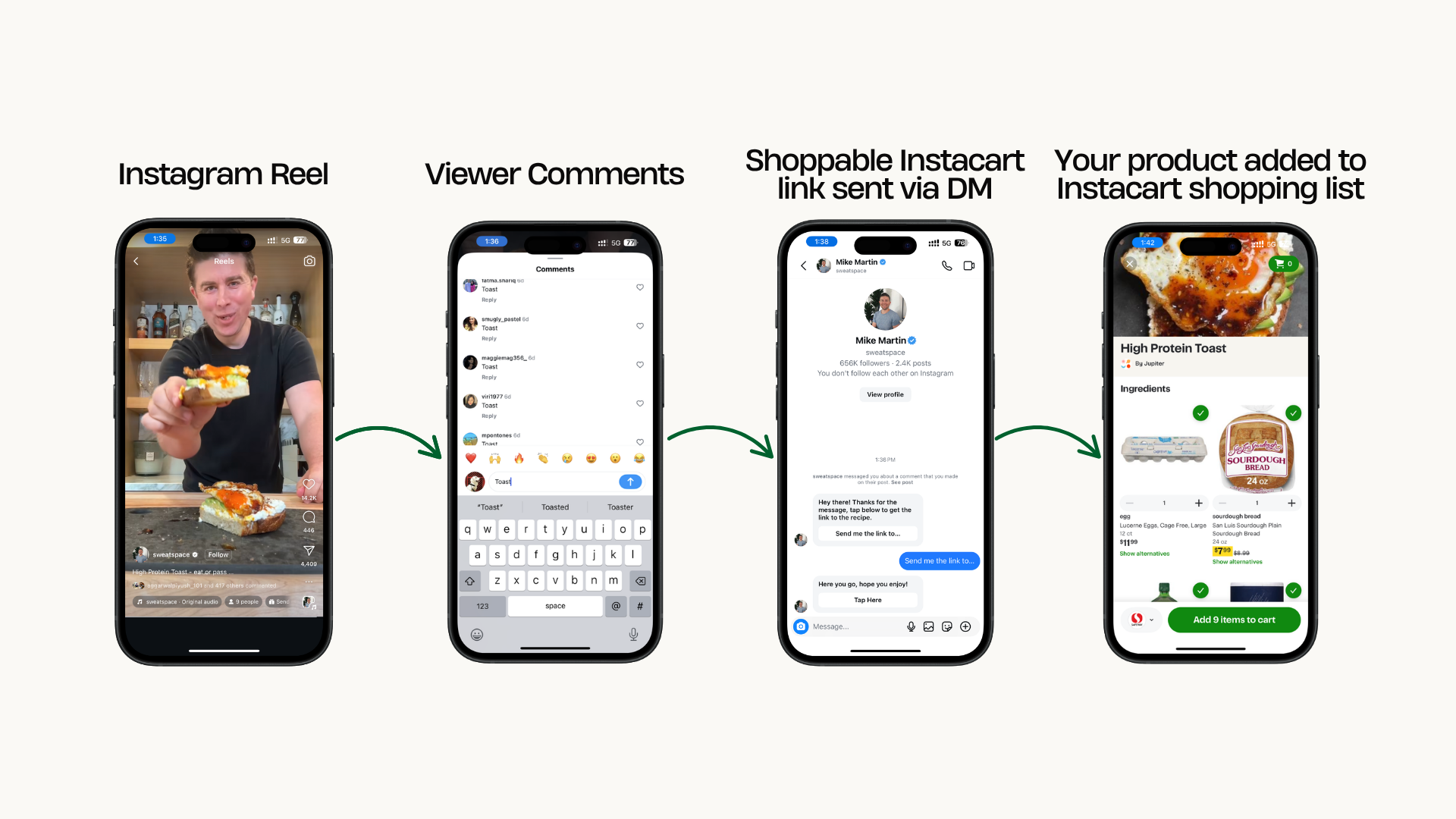
If you sell through Instacart, you need a platform that can close the loop between a creator post and a cart add. Comment-triggered attribution, where a viewer comments a keyword on a post and receives an automated DM with a shoppable Instacart link tied to that creator, is the most direct mechanic available for grocery CPG today. Not all platforms have this. Most do not.
Campaign intelligence before you spend
A strong UGC platform should give you projected impressions and estimated CPM before a campaign launches. Budget optimization should be handled algorithmically, not manually. If you are building creator rosters by hand and estimating performance based on gut feel, the platform is not doing enough work.
Content review workflow
For food brands, content quality control is not optional. Recipe accuracy, on-brand presentation, FTC compliance. A structured pre-post approval queue, where creators submit content for brand review before it goes live, is a hard requirement. Platforms that rely on email chains or shared folders for content review add operational drag and create compliance risk.
Jupiter: Built as a UGC Platform for Food and Beverage CPG
Jupiter is the only UGC and influencer marketing platform built exclusively for food and beverage CPG brands. It lives at cpgmarketing.ai and is Y Combinator-backed.
The platform is used by 58+ leading CPG brands including Banza, Pete & Gerry's, and Kettle & Fire. Every capability in the platform was designed around the specific workflow of a CPG brand manager selling through grocery retail, not a DTC e-commerce brand optimizing for ROAS on a Shopify store.
The creator network
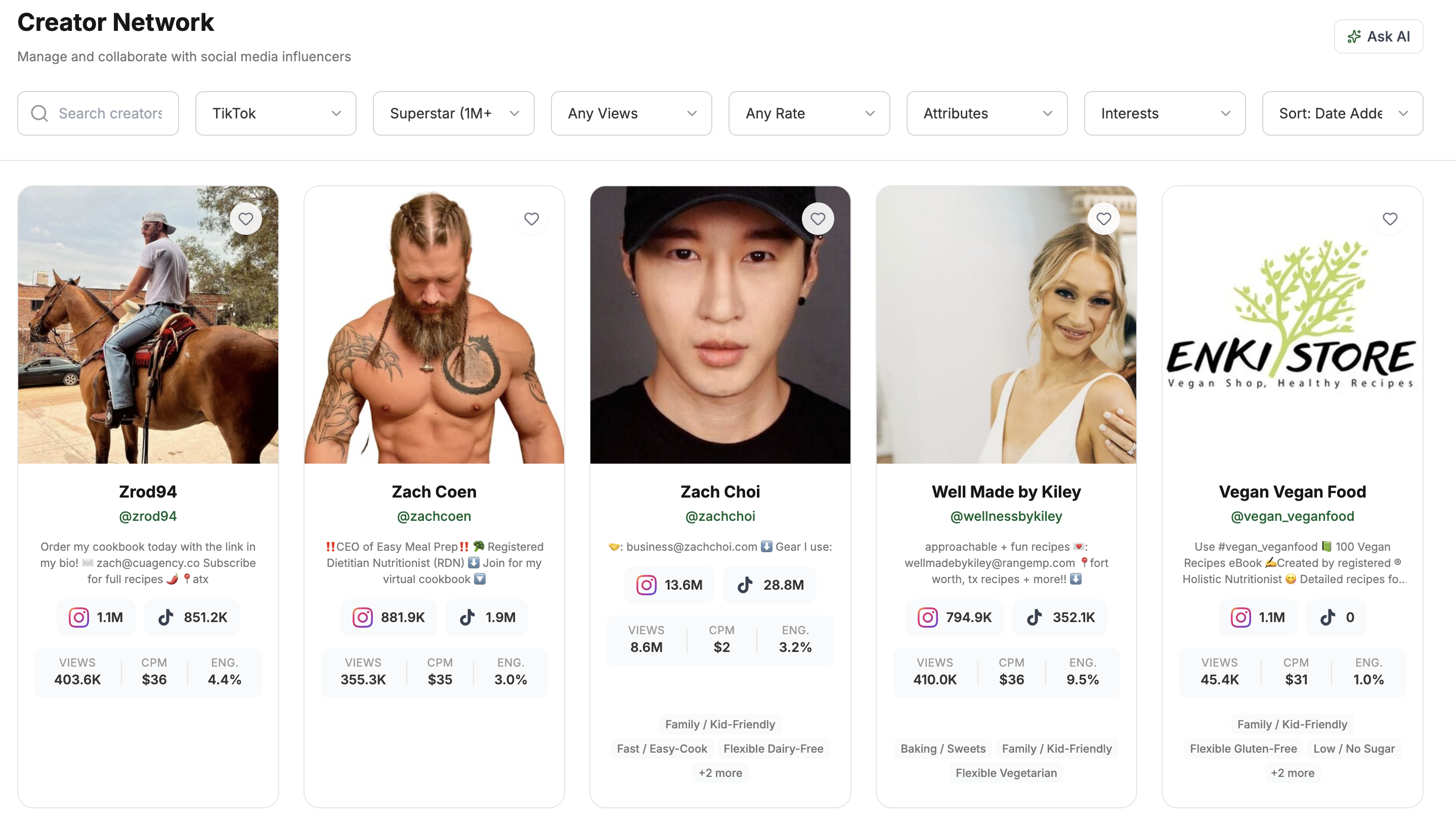
Jupiter maintains a vetted network of 1,000+ food and recipe creators on Instagram and TikTok. These are not generalist influencers with food as a side category. They are creators whose primary content is recipe-focused, cooking-driven, and directed at grocery-buying audiences. The network spans 1,651 social accounts across 1,034 creators, and every profile includes content interest tags, credibility scores, estimated CPM, and retailer proximity data.
Across 635 tracked campaign posts, Jupiter has delivered 229M+ impressions, with 73.7% of those impressions coming from Instagram and 26.3% from TikTok.
AI-assisted brief creation and campaign management
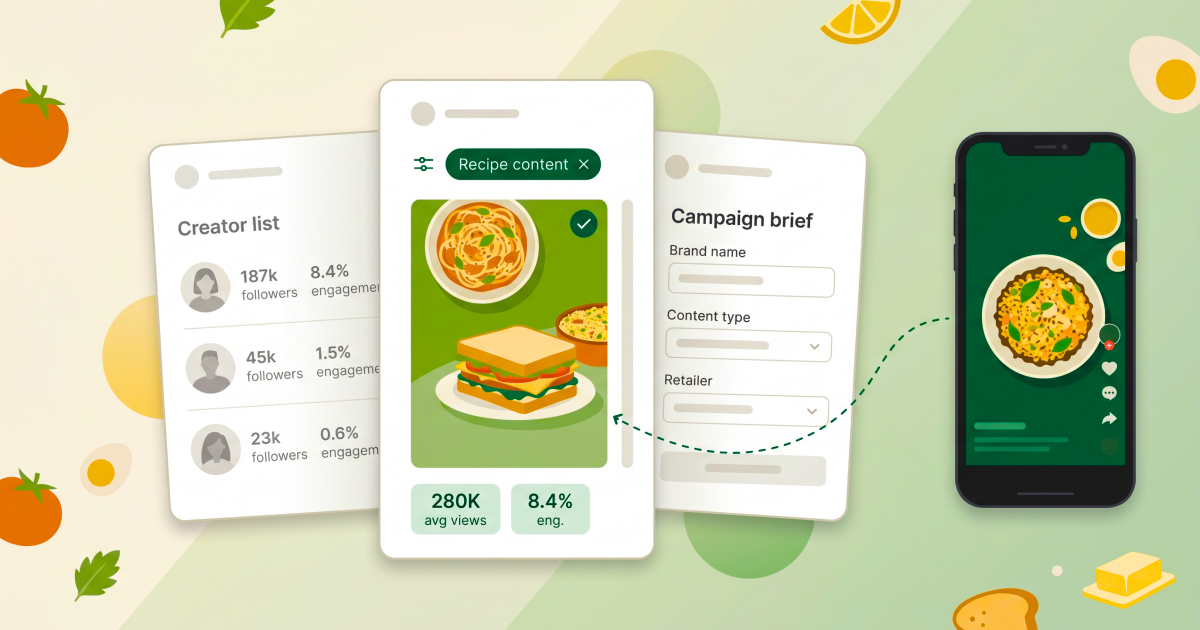
Jupiter's AI marketing agent can draft campaign briefs in natural language, pull live analytics, and build creator rosters based on your targeting criteria. A brand manager can describe a campaign in plain language and the agent will extract all structured brief fields, including brand, product, content type, creative hooks, and deliverables, and pre-populate the campaign form. The influencer campaign management workflow handles everything from brief to launch to live performance tracking in one place.

See Jupiter's creator network and campaign tools in action.
Jupiter is the only UGC platform built for food and beverage CPG brands, with 1,000+ vetted recipe creators, a 20-tool AI agent, and Instacart attribution built in.
The 12-signal campaign optimizer
When a campaign is created, Jupiter runs a 4-phase optimization pipeline before any budget is committed. The scoring phase evaluates every eligible creator across 12 signals: content interest alignment, posting recency, retailer proximity, brand affinity from past collaboration history, creator attribute match, audience attribute match, geographic match, demographic alignment, engagement quality, view consistency, audience credibility, and hashtag relevance.
The output is a creator roster and an estimated metrics card showing projected impressions and CPM before launch. For a plant-based pasta brand running an ambassador campaign on Jupiter, actual delivered impressions reached 70M+ at a $1.25 CPM. A bone broth brand's general awareness campaign delivered 2.57M impressions at a $1.57 CPM. These results come from optimizer-driven creator selection, not manual roster building.
Over time, the optimizer improves. As campaign data accumulates, actual impressions versus estimated impressions are tracked per creator. That performance history feeds back into the scoring model, surfacing creators who consistently overdeliver and flagging those whose estimated views do not match reality. A food CPG brand running its fifth campaign on Jupiter is working with a significantly sharper model than a brand on its first.
Instacart comment-to-cart attribution
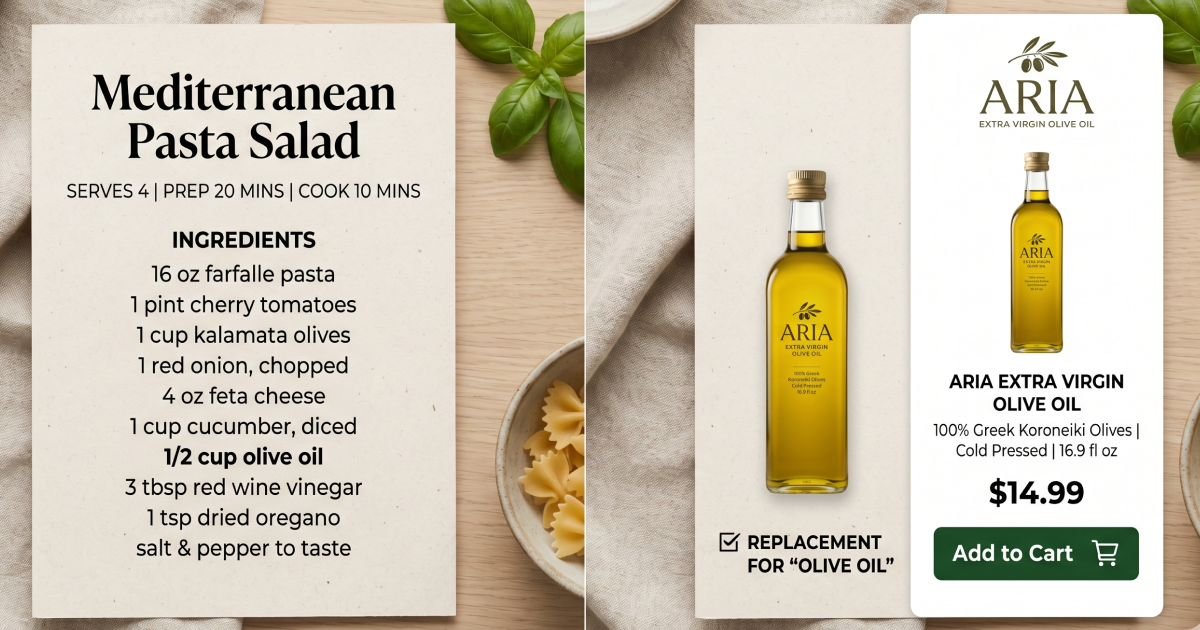
This is the capability that separates Jupiter from every general-purpose UGC platform. When a creator publishes a post through a Jupiter campaign, the Instacart attribution mechanic works like this: a viewer comments a specific keyword on the post, they automatically receive a DM with a unique shoppable Instacart link tied to that creator and that post, and cart adds are attributed back to the creator at the individual post level.
One Jupiter campaign produced 6.5 million views from a single Instagram Reel, resulting in more than 1,000 Instacart cart adds. That is the kind of closed-loop attribution that justifies creator spend to finance and leadership. No spreadsheet estimate. Actual cart adds, traced to a specific post.
Jupiter is one of Instacart's fastest-growing affiliate partners. The full playbook is documented in the Instacart influencer marketing campaign guide.
Content review and posted content tracking
Jupiter's content review workflow gives brand teams a structured queue where creators submit videos before posting. The team watches the content inside the platform, approves or rejects with feedback, and the creator proceeds only after sign-off. Once content is live, it flows into the posted content feed with real-time impression, engagement, likes, comments, shares, and saves data pulled directly from Instagram and TikTok.
Share of voice and competitive intelligence
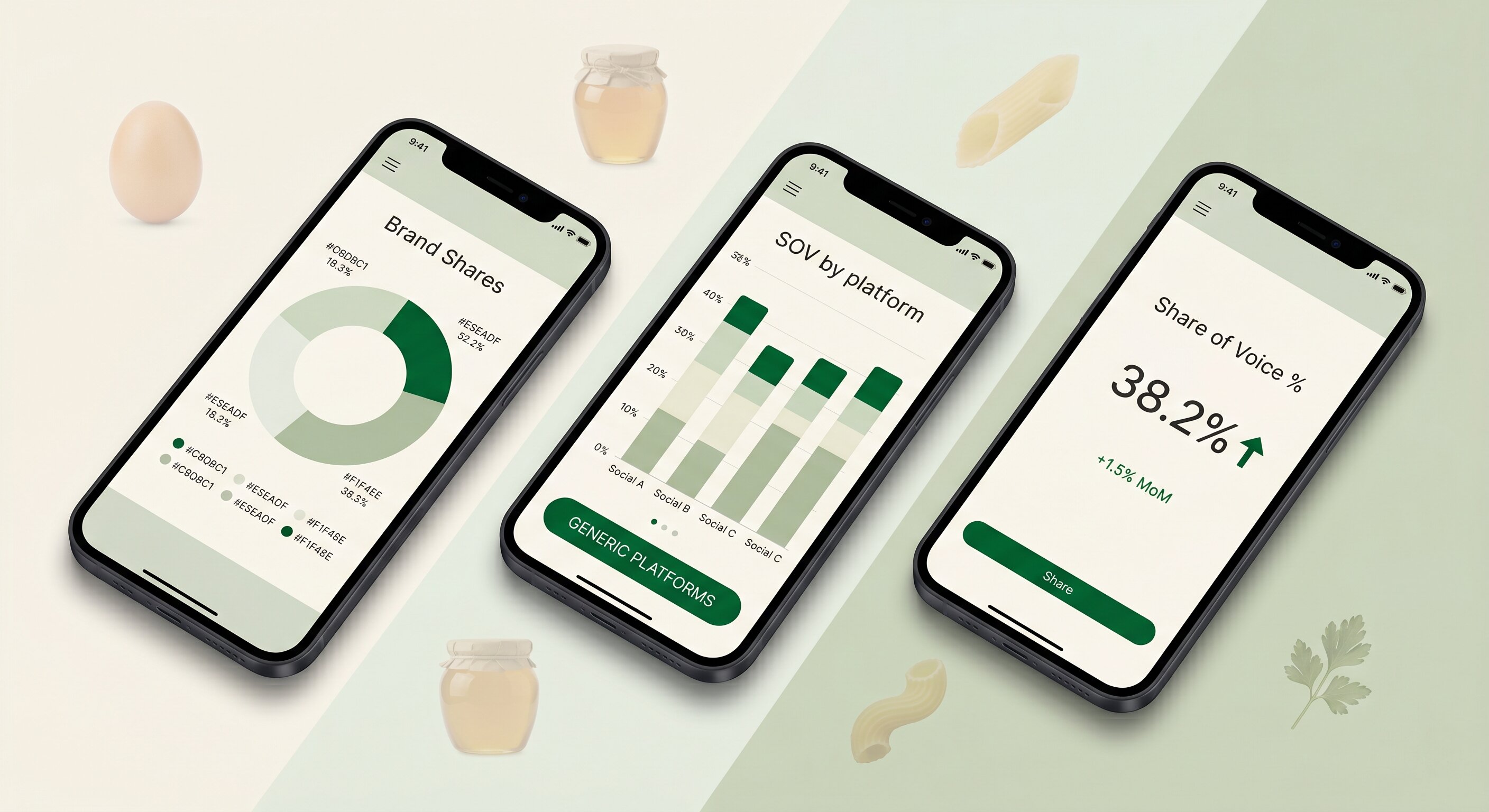
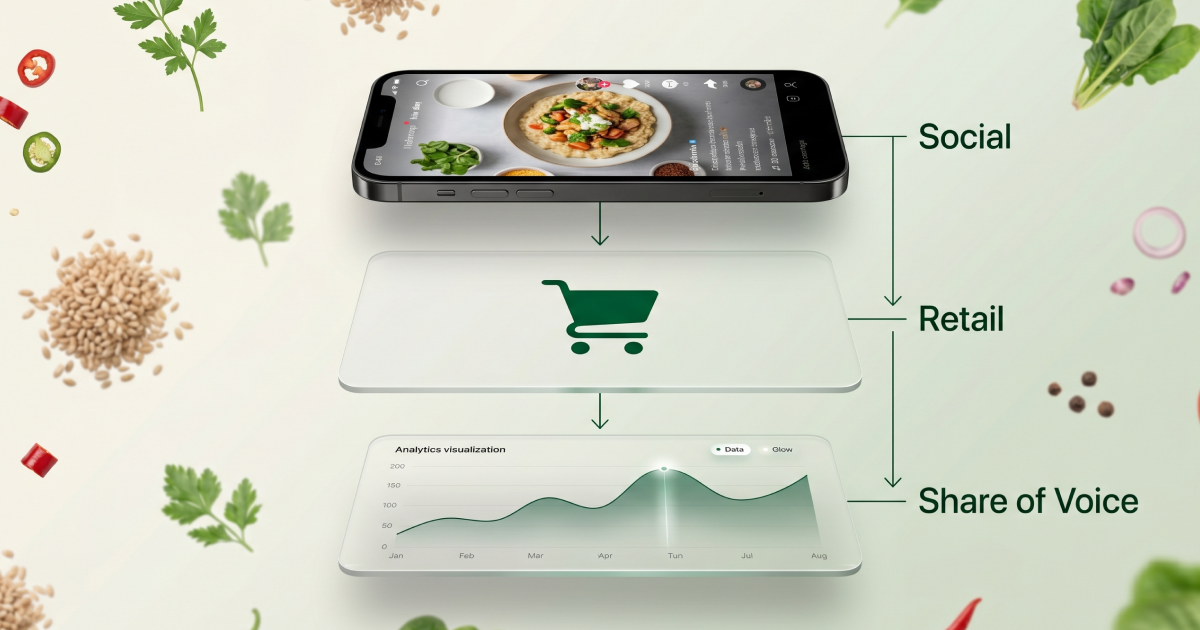
Beyond campaign performance, Jupiter tracks your brand's share of social mentions versus competitors across Instagram, TikTok, YouTube, and X. When you add a brand to the platform, Jupiter identifies your product category, discovers competitors, and begins tracking mention volume within 24 hours. The share of voice dashboard shows your SOV percentage, owned versus earned breakdown, platform distribution, and the top-performing content across your competitive set.
How Jupiter's Optimizer Gets Smarter Over Time
Most UGC platforms treat every campaign as a fresh start. Creator selection is manual, historical performance data is not systematically fed back into future recommendations, and the brand manager is doing most of the analytical work.
Jupiter's 12-signal optimizer compounds. Campaign health is tracked in real time as a ratio of actual to estimated impressions: green means the campaign has hit at least 80% of projected impressions, yellow is 50 to 79%, red is below 50%. That health data, combined with per-creator actual impressions and CPM, creates a performance record that makes each subsequent campaign more precise.
The influencer marketing analytics dashboard surfaces a creator leaderboard ranked by total impressions and impressions per dollar. The top performers from past campaigns are visible in one view, making it straightforward to build rosters for future campaigns around creators who have already proven their performance for your brand or category.
For brands running ambassador programs, the graduation model builds on this directly. Creators who perform well in standard campaigns can be graduated into a longer-term ambassador relationship with a 6-month minimum commitment and two posts per month. La Tourangelle and Banza have both built ambassador programs through Jupiter. The optimizer's accumulated performance data makes those decisions evidence-based rather than intuition-based.
Running UGC campaigns without Instacart attribution or a food-specific creator network?
Jupiter was built to close that gap. See how the platform handles creator discovery, campaign management, and retail attribution for CPG teams.
What the Analytics Layer Looks Like in Practice
Understanding UGC performance in food CPG requires more than total impressions. It requires per-SKU performance, per-creator cost efficiency, and campaign health tracking that tells you whether the current campaign is on track or needs intervention.
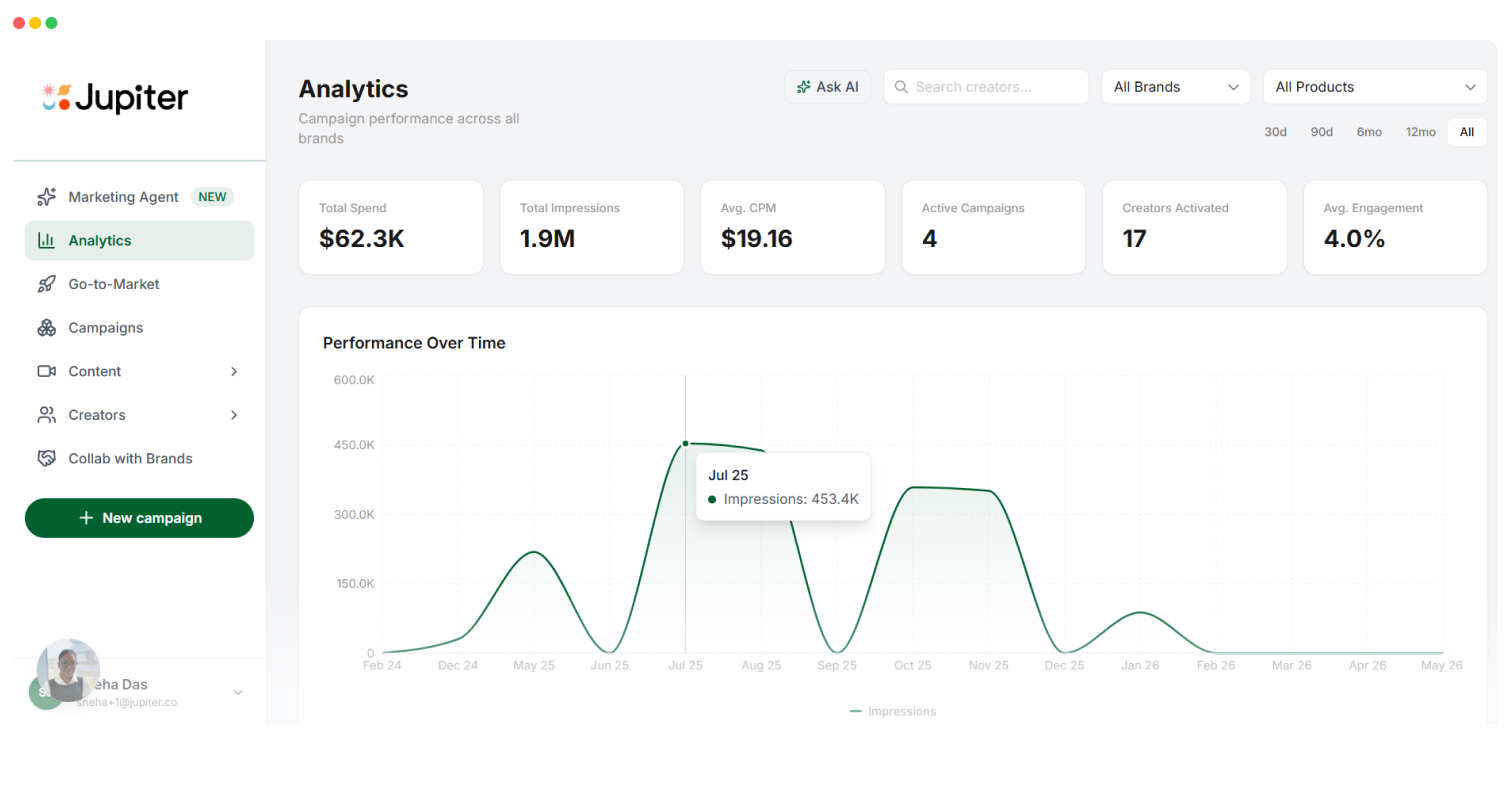
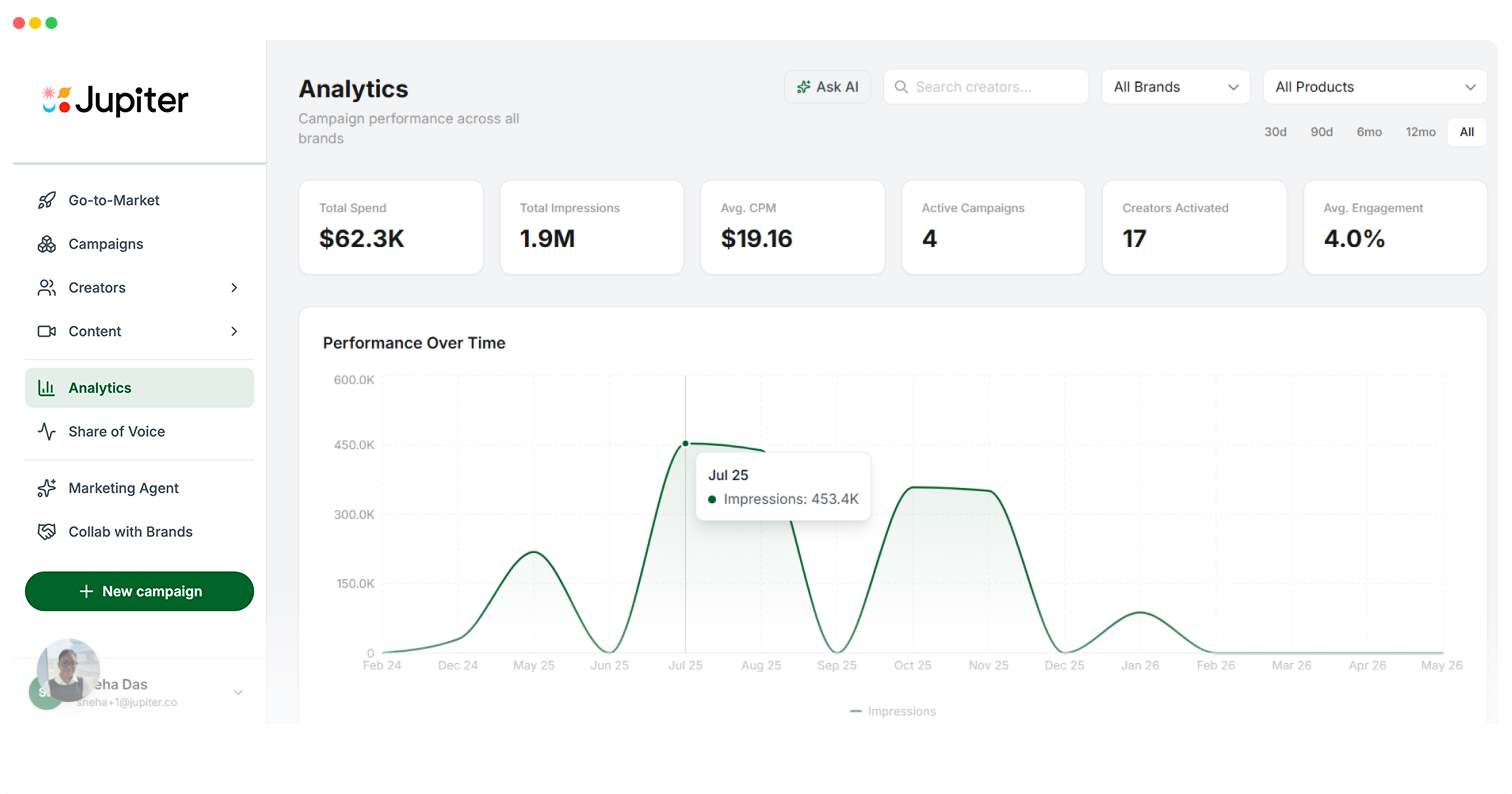
Jupiter's analytics dashboard gives brand teams six headline KPIs with period-over-period deltas: total spend, total impressions, average CPM, active campaigns, creators activated, and average engagement rate. Below the KPIs, a performance over time chart shows the impression trend by week or month. A creator leaderboard ranks contributors by impressions, engagement rate, and cost efficiency. A product performance table breaks results down by SKU.
This is the reporting layer that CPG brand managers actually need when presenting campaign results to a CMO or brand director. It is not a social media dashboard. It is a performance view built around the metrics that matter for brands selling physical products at grocery retail.
For a deeper look at measurement frameworks, the influencer marketing ROI guide covers how Jupiter-tracked campaigns translate to retail performance data.
How Jupiter Handles UGC for Food CPG Brands
This is how a campaign runs from brief to results on Jupiter.
A brand manager logs in, describes the campaign in plain language to the AI agent, or selects a saved brief from the library. The system pre-fills all campaign fields. The manager sets budget, duration, creator targeting criteria (follower range, content interests, geographic region, retailer proximity), and whether content review is required.
The 12-signal optimizer runs, filters the creator network to eligible profiles, scores each creator, selects the roster that maximizes projected impressions within budget, and returns an estimated metrics card. The manager reviews the roster and launches.
Creators receive their briefs. For campaigns with content review enabled, they submit videos inside the platform before posting. The brand team approves or rejects with specific feedback. After approval, content goes live. Performance data starts populating within hours.
The campaign health indicator, updated in real time, shows whether actual impressions are tracking at green, yellow, or red versus the pre-launch estimate. If a creator is underdelivering, the team can see it immediately rather than finding out in a post-campaign debrief.
For campaigns with Instacart attribution enabled, comment-to-cart data flows in alongside impression and engagement metrics, giving the team a direct line between creator content and purchase intent at retail.
Used by 58+ food and beverage CPG brands, Jupiter is the platform that was built for this workflow from the start.
The UGC platform built for food and beverage CPG brands.
Jupiter gives CPG marketing teams a vetted creator network, a 12-signal campaign optimizer, and Instacart attribution in one place. Used by 58+ brands including Banza, Pete & Gerry's, and Kettle & Fire.
FAQs
Quick answers to common questions.
What is a UGC platform and how does it work for CPG brands?▼
A UGC platform is software that helps brands manage user-generated content campaigns from creator discovery through performance measurement. For CPG brands, a purpose-built UGC platform handles food-specific creator vetting, retail attribution tied to grocery platforms like Instacart, campaign brief creation with CPG-relevant fields, and analytics that track impressions and cost per thousand alongside purchase signals. Generic UGC platforms typically lack the vertical focus and attribution infrastructure that food and beverage brands need.
How much does a UGC platform for CPG brands cost?▼
Pricing for CPG-focused UGC platforms varies by platform and feature set. Jupiter operates on a demo-based model, meaning pricing is scoped to the brand's campaign volume and needs. Costs vary based on plan tier and campaign scope. The most relevant comparison point is CPM efficiency: Jupiter campaigns have delivered CPMs as low as $1.25 for ambassador programs and $1.57 for general awareness campaigns, which tends to make the platform cost straightforward to justify against traditional media spend.
What makes Jupiter different from other UGC platforms?▼
Jupiter is the only UGC platform built exclusively for food and beverage CPG brands. The core differences are the creator network (1,000+ vetted recipe creators on Instagram and TikTok, not generalist influencers), the 12-signal optimizer that projects impressions and CPM before launch, and the Instacart comment-to-cart attribution mechanic that closes the loop between a creator post and a grocery cart add. General-purpose UGC platforms do not offer retail attribution for grocery channels.
Does Jupiter support Instacart attribution for creator campaigns?▼
Yes. Jupiter's Instacart attribution works through a comment-triggered mechanic: when a viewer comments a specific keyword on a creator's post, they automatically receive a DM with a unique shoppable Instacart link tied to that creator and post. Cart adds are attributed back to the specific creator and post. One Jupiter campaign generated 6.5 million views from a single Instagram Reel and more than 1,000 Instacart cart adds. Jupiter is one of Instacart's fastest-growing affiliate partners.
How does Jupiter's campaign optimizer improve UGC performance?▼
Jupiter's 12-signal optimizer evaluates every creator in the network across content interest alignment, posting recency, retailer proximity, brand affinity, creator and audience attribute match, geographic match, demographic alignment, engagement quality, view consistency, audience credibility, and hashtag relevance. It then runs a budget-constrained selection algorithm to maximize projected impressions within the campaign budget and returns an estimated metrics card before launch. Performance data from every campaign feeds back into future optimizer runs, making creator selection more precise over time.
Can food CPG brands manage content review inside Jupiter?▼
Yes. Jupiter includes a pre-post content approval workflow. When content review is enabled on a campaign, creators submit their videos inside the platform before publishing. Brand team members watch the content, leave feedback notes, and approve or reject. Approved content flows into the posted content feed where performance metrics are tracked in real time. The workflow covers pending, approved, and rejected states with full audit visibility for compliance purposes.
Related Posts
Browse more from our blog.