Managed Agency or Self-Serve Platform: What Food CPG Brands Actually Need
Linqia is a respected, enterprise-grade influencer marketing agency built for brands across every category. Jupiter is a self-serve platform built exclusively for food and beverage CPG. That's a real difference, not just a category label.
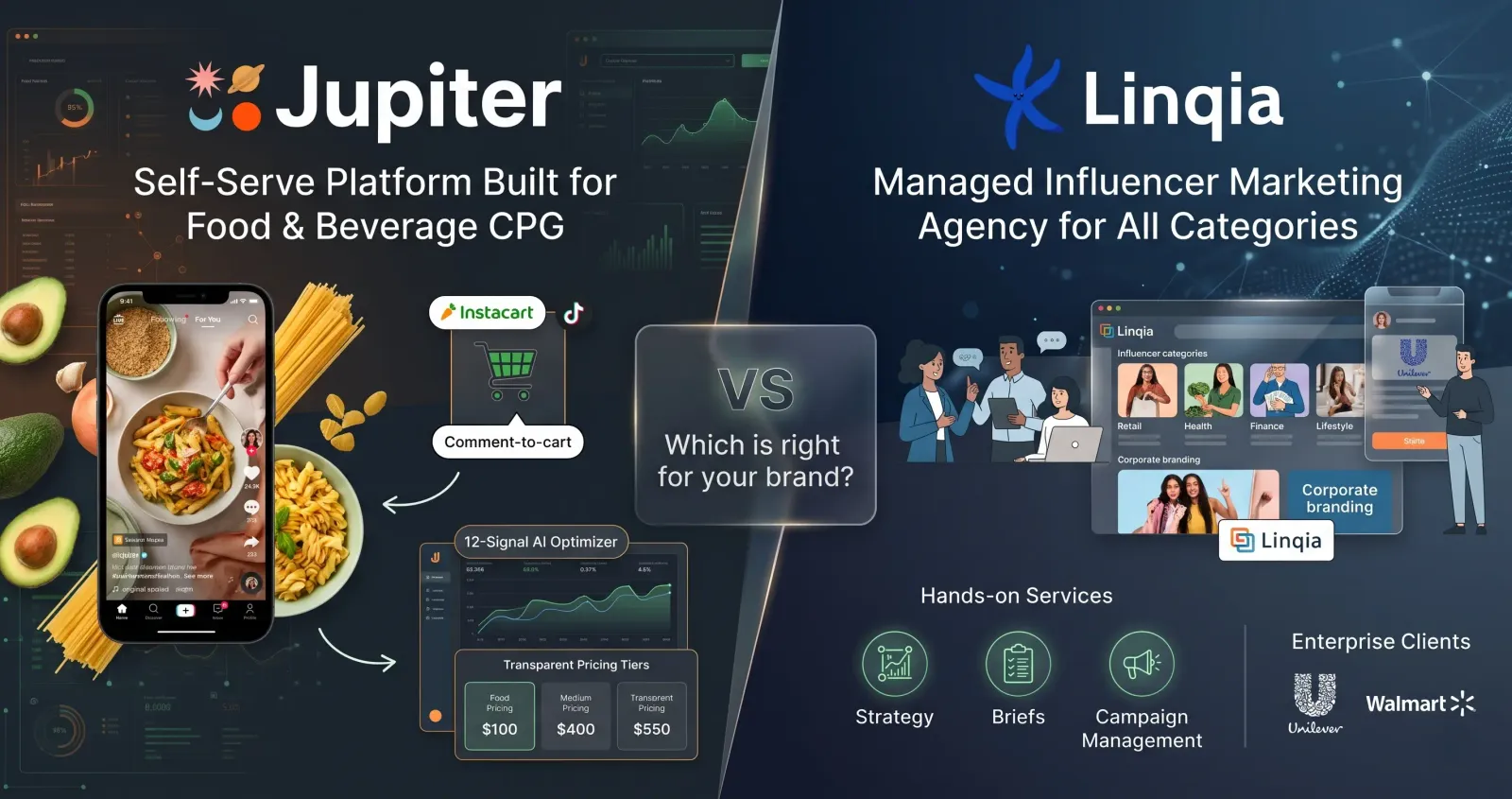
Linqia is a full-service, multi-category influencer marketing agency with custom pricing, best for enterprise brands that want to delegate execution. Jupiter is a self-serve platform built exclusively for food and beverage CPG, with transparent pricing, a 12-signal campaign optimizer, and Instacart comment-to-cart attribution, best for brands wanting direct control and grocery-specific tooling.
Key takeaways
- Different business models. Linqia is an agency-led service; Jupiter is self-serve software. How a brand wants to work matters more than any feature checklist.
- Category breadth vs depth. Linqia serves retail, CPG, healthcare, and financial services. Jupiter’s 1,000+ vetted food and recipe creators are filterable by dietary attributes, content interest, and retailer proximity.
- Pricing transparency. Jupiter publishes Free, Pro, and Business tiers. Linqia requires a custom quote through a sales process.
- Retail attribution. Jupiter’s Instacart comment-to-cart mechanic tracks the grocery purchase path directly. Linqia measures paid, owned, and earned performance like engagement and ad lift.
- Speed and control. Jupiter brands can launch same day and see projected impressions and CPM before spending. Linqia campaigns go through agency onboarding with human strategists making the calls.
- Who should pick which. Choose Linqia for enterprise, multi-category, hands-off agency management. Choose Jupiter for food and beverage CPG brands wanting control and category-specific tooling.
Trusted by leading CPG brands









Quick verdict
Jupiter | Linqia | |
|---|---|---|
Built for | Food & beverage CPG exclusively | All categories: retail, CPG, healthcare, financial services |
Model | Self-serve platform | Managed influencer marketing agency |
Pricing | Transparent subscription tiers (Free, Pro, Business) | Custom quote, not publicly listed |
Creator network | 1,000+ vetted food and recipe creators | Broad creator access via proprietary platform (Resonate) |
Campaign optimizer | 12-signal AI budget allocation and creator scoring | Agency-led strategy and creator selection |
Retail attribution | Comment-to-cart Instacart mechanic | Paid/owned/earned amplification, engagement metrics |
Speed to launch | Self-serve, launch same day | Agency onboarding and campaign build process |
Best for | Brands wanting direct control and CPG-specific tooling | Brands wanting full-service agency management at enterprise scale |
Linqia and Jupiter aren't really competing to be the same kind of company. Linqia has built a genuinely respected position as an independent influencer marketing agency working across nearly every consumer category, with an enterprise client roster that includes Danone, AB InBev, Unilever, Kimberly-Clark, and Walmart. Jupiter is a self-serve software platform built exclusively for one category: food and beverage CPG. Understanding that structural difference matters more than a feature-by-feature checklist, because it determines which one actually fits how a given brand wants to work.
Platform overview: Linqia
Linqia has operated in the influencer marketing space since 2012, and it has evolved from an early performance-guarantee platform into what it now describes as an independent influencer marketing agency. Its technology, a proprietary platform called Resonate, supports creator discovery and filtering, brief and content approval workflows, organic and paid performance tracking, and content repurposing, with an AI assistant layered in for campaign simplification.
The defining characteristic of Linqia's model is that it's agency-led, not self-serve. Pricing isn't publicly listed and requires a custom quote, which is standard for an enterprise agency relationship but means a smaller or mid-sized brand can't get a transparent sense of cost without going through a sales process. Linqia's own case study library and client list, spanning food and beverage names like Danone alongside retail, healthcare, and financial services clients, reflects a platform built to serve a wide range of industries with the same underlying agency infrastructure, rather than one built around the specific mechanics of any single category.
Platform overview: Jupiter
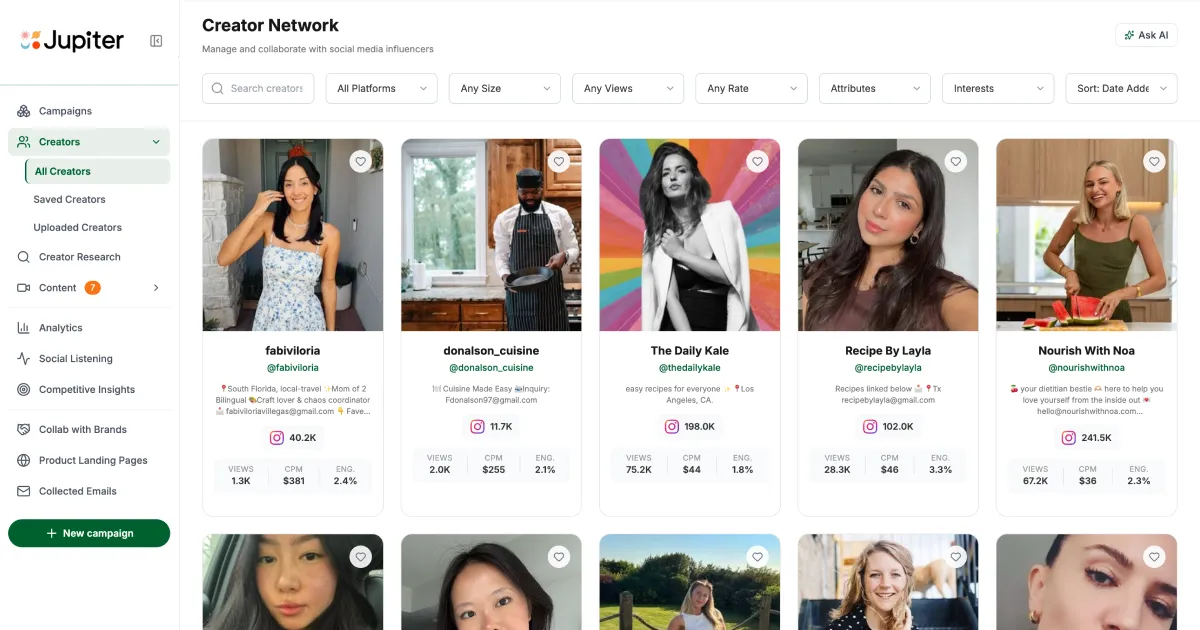
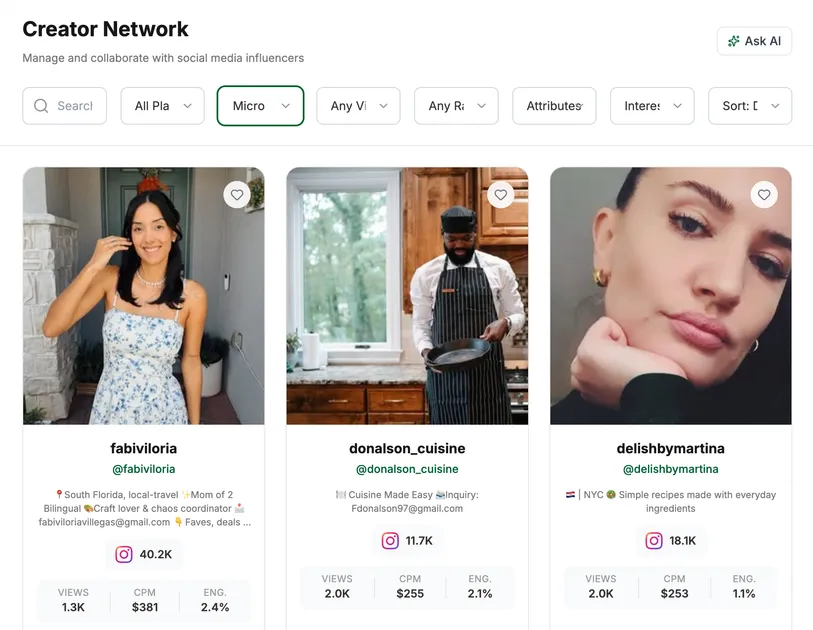
Jupiter is built exclusively for food and beverage CPG brands, and every part of the platform reflects that specificity. The creator network consists of 1,000+ vetted food and recipe creators across Instagram and TikTok, filterable by content interest, dietary attributes, and retailer proximity, rather than a general-purpose creator database serving every vertical at once. The campaign optimizer runs a 12-signal scoring and budget-allocation process automatically, factoring content interest alignment, posting recency, retailer proximity, brand affinity, and audience match to recommend a creator roster and project expected impressions and CPM before a brand commits spend.
Jupiter is self-serve. A brand can create an account, configure its brand assets and briefs, and launch a campaign directly through the platform without going through an agency onboarding or sales cycle, with subscription pricing tiers that are visible rather than requiring a custom quote. Retail attribution runs through a built-in comment-to-cart Instacart mechanic specific to grocery and CPG purchase behavior, a feature built around exactly the kind of purchase journey a general-purpose agency platform isn't structured around by default. For the broader self-serve vs agency framing, see influencer marketing software vs agency for CPG.
See the CPG-specific optimizer in action
12 signals, purpose-built for food and beverage creator selection, running automatically before you spend a dollar.
Feature-by-feature comparison
On creator discovery, Linqia's broader, cross-category creator access is an advantage for a brand running campaigns across multiple verticals or wanting a single agency relationship for all its influencer work. Jupiter's narrower, food-and-recipe-specific network is an advantage for a brand that only needs food creators and wants every filter, dietary attribute, retailer proximity, content interest, built specifically around that use case rather than adapted from a general creator database.
On campaign management, Linqia's agency model means dedicated human strategists are involved in creator selection, briefing, and optimization throughout a campaign, which suits a brand that wants hands-off execution and trusts an outside team to make judgment calls. Jupiter's self-serve model means the brand's own team drives creator selection and campaign configuration directly, with the platform's optimizer providing the data and recommendations rather than a human agency team making the final call.
On pricing transparency, Jupiter publishes its subscription tiers. Linqia requires a custom quote through a sales process. This matters most for a smaller or growing brand trying to compare options without committing time to a sales cycle first, and less for a brand already used to enterprise agency procurement processes.
On retail attribution specifically, Jupiter's Instacart comment-to-cart mechanic is purpose-built for grocery and CPG purchase behavior. Linqia's attribution approach, per its own public case studies, centers more on paid, owned, and earned media performance metrics like engagement rate and content-driven ad performance lift, which is a genuinely useful measurement approach but isn't structured around the specific retail purchase path a food CPG brand cares about most.
Two purchase journeys, two different attribution needs
Linqia's client roster and case study library, spanning CPG, retail, healthcare, and financial services, reflects a platform built around a general content-performance model: does influencer content outperform brand-created content in paid social, does it drive engagement and brand lift. That's a legitimate and valuable measurement framework, and it's genuinely well-suited to brands whose purchase journey doesn't route specifically through grocery retail or a platform like Instacart.
Jupiter was built specifically around the grocery retail and Instacart purchase journey, where a shopper sees a recipe video, comments for a link, and adds ingredients to an Instacart cart in one continuous motion. That attribution path doesn't exist in the same form for a financial services or healthcare client, which is exactly why a general-purpose platform like Linqia isn't built around it by default, and exactly why a food-CPG-exclusive platform can offer something more specific here. Production CPM context for food CPG sits in the 2026 food CPG influencer benchmark.
Running food CPG campaigns without retail-specific attribution?
Engagement metrics are useful. Knowing when a comment turned into an actual Instacart cart is more useful for a grocery brand specifically.
Who should use Linqia
Linqia is a strong fit for a brand that wants a single, full-service agency relationship covering influencer strategy, creator selection, campaign execution, and reporting, without building internal influencer marketing operations. It's particularly well suited to an enterprise brand running influencer campaigns across multiple product categories or business units, since the same agency relationship and platform can serve all of them rather than requiring a separate specialized tool per category. A brand with the budget for enterprise agency engagement and a preference for delegating day-to-day execution to an outside team will likely find Linqia's model comfortable and proven.
Who should use Jupiter
Jupiter is built for a food and beverage CPG brand that wants direct, self-serve control over its creator campaigns, transparent pricing it can evaluate without a sales process, and tooling built specifically around the mechanics of grocery retail and recipe-driven content, dietary attribute targeting, retailer proximity, Instacart attribution, rather than adapted from a general-purpose platform. It's a particularly strong fit for a brand that wants to see projected impressions and CPM before committing budget, and for a marketing team that wants to run and iterate on campaigns directly rather than relaying every decision through an agency team.
Used by 58+ leading CPG brands including Banza, Pete & Gerry's, and Kettle & Fire
See what a platform built exclusively for food and beverage CPG can do for your next campaign.
Summary
Linqia and Jupiter serve genuinely different needs, and the right choice depends less on feature checklists than on how a brand wants to work. Linqia offers a proven, enterprise-grade agency relationship that spans every category a brand might operate in. Jupiter offers direct, self-serve control and CPG-specific tooling for a brand focused exclusively on food and beverage. For a food or beverage CPG brand specifically, one built for exactly this purchase journey and this kind of content, Jupiter's category focus and retail-specific attribution are difficult for a general-purpose agency platform to fully replicate, and that specificity is the core reason to choose it over a broader, multi-category agency model.
FAQs
Quick answers to common questions.
What is the main difference between Jupiter and Linqia?▼
Jupiter is a self-serve software platform built exclusively for food and beverage CPG brands, with transparent pricing and CPG-specific tooling like retailer proximity targeting and Instacart attribution. Linqia is a managed, full-service influencer marketing agency serving brands across many categories, with custom pricing and agency-led campaign execution.
Does Linqia have transparent pricing?▼
No. Linqia's pricing is not publicly listed and requires a custom quote through a sales process, which is standard for an enterprise agency model but differs from Jupiter's published subscription tiers.
Does Linqia work with food CPG brands?▼
Yes, Linqia has worked with food and beverage clients including Danone, alongside brands in retail, healthcare, and financial services. It is not built exclusively for the food CPG category the way Jupiter is.
Which platform is better for a brand new to influencer marketing?▼
It depends on how hands-on the brand wants to be. Linqia's agency model suits a brand that wants execution handled by an outside team. Jupiter's self-serve model suits a brand that wants direct control, transparent pricing, and to see projected campaign performance before committing spend.
Does Linqia offer Instacart or retail-specific attribution for CPG brands?▼
Linqia's public case studies focus primarily on paid, owned, and earned media performance metrics like engagement rate and content-driven ad lift, rather than a built-in grocery retail attribution mechanic. Jupiter's comment-to-cart Instacart mechanic is purpose-built for that specific purchase journey.
Can a food CPG brand use both an agency like Linqia and a platform like Jupiter?▼
Some brands do use a broader agency relationship for cross-category campaigns while using a category-specific platform like Jupiter for food-focused, retail-attributed campaigns. The right combination depends on how centralized a brand wants its influencer marketing operations to be.
More in Platforms & Comparisons
More from Platforms & Comparisons.