How Magic Spoon Sold $40 Cereal Without Paying Influencers Upfront
Magic Spoon built a premium cereal brand almost entirely on nostalgia and product seeding, and its co-founder has been unusually candid about exactly why the brand doesn't pay most influencers upfront.
Magic Spoon sold $40 boxes of cereal online by pairing childhood-cereal nostalgia with a creator model that rarely paid influencers upfront. It seeded free product to creators of all sizes, converted enthusiastic ones into commission-based affiliates, and added podcast sponsorships, reaching $50 million in revenue within two years and an $85 million Series B by 2022.
Key takeaways
- Magic Spoon typically doesn't pay influencers upfront, instead sending free cereal to creators of all sizes and relying on product appeal to drive an unusually high response rate, which only works for brands with genuine, immediate product confidence.
- Magic Spoon pays creators mainly through a commission-based affiliate program rather than flat sponsorship fees, using free seeding as the first touch and formalizing relationships only with creators whose organic enthusiasm proves durable.
- Magic Spoon's flavor names, Fruity, Cocoa, and Peanut Butter, deliberately trigger childhood cereal nostalgia, so the emotional hook is built into the product and creators need almost no script to make content land.
- Magic Spoon used podcast sponsorships, from niche shows up to Joe Rogan's podcast and Pod Save America, as a parallel acquisition channel, showing that creator-style trust transfer also works in long-form audio, not just short-form video.
- Magic Spoon's free seeding model costs less than the $1.25 to $12.67 CPM range in Jupiter's paid food CPG campaign data, and its affiliate and podcast spend is performance-tied, so that range is best used as the planning reference for a paid, tiered creator program built on top of seeding.
Trusted by leading CPG brands




Selling a $40 box of cereal online, in a category built almost entirely around cheap, impulse-driven in-store purchases, sounds like a hard pitch. Magic Spoon's co-founders, Gabi Lewis and Gregory Sewitz, made it work by combining two things: a genuinely strong emotional hook, nostalgia for childhood cereal, and a creator marketing model that deliberately avoided paying most influencers upfront at all. The company raised an $85 million Series B by 2022, reported $50 million in revenue within its first two years, and eventually landed placements in Costco, Target, and Walmart, largely on the back of that specific approach.
This breakdown looks at the mechanics behind that approach, in the co-founder's own words where possible, and what's genuinely reusable for a food CPG brand.
Why Magic Spoon doesn't pay most influencers upfront
Co-founder Gabi Lewis has been unusually direct about this in interviews: Magic Spoon typically doesn't pay influencers upfront. Instead, the brand sends boxes of cereal to influencers across a range of sizes and lets the product itself do the persuading. According to Lewis, this works specifically because the product carries enough genuine appeal on its own that the brand gets an unusually high response rate from that seeding approach alone, without needing to negotiate a fee before a creator agrees to try it.
This is a meaningfully different posture from a brand that treats seeding as a fallback for creators who won't accept a flat fee. Magic Spoon built the entire model around the belief that if the product is good enough, sending it for free is a more efficient way to generate authentic content than negotiating and paying for placements upfront, reserving actual payment for creators whose content proves it's driving real results. For a parallel no-upfront seeding model, see Graza's influencer marketing breakdown.
The affiliate layer: paying for performance, not placement
Where Magic Spoon does compensate creators financially, it's generally structured as an affiliate relationship rather than a flat sponsorship fee. Creators, particularly those whose personal identity already overlaps with the brand's keto and low-carb positioning, can apply to join an affiliate program and earn commission tied to the sales they actually generate, rather than being paid a fixed amount regardless of performance.
This pairs naturally with the no-upfront-payment seeding model. A creator who receives free product and genuinely likes it has a low-friction path to also becoming an affiliate, turning an initial unpaid post into an ongoing, performance-based relationship rather than a one-time placement. The brand isn't choosing between gifting and paid partnerships, it's sequencing them: seed first, then formalize the relationship with creators whose organic enthusiasm proves durable.
Nostalgia as the actual creative brief
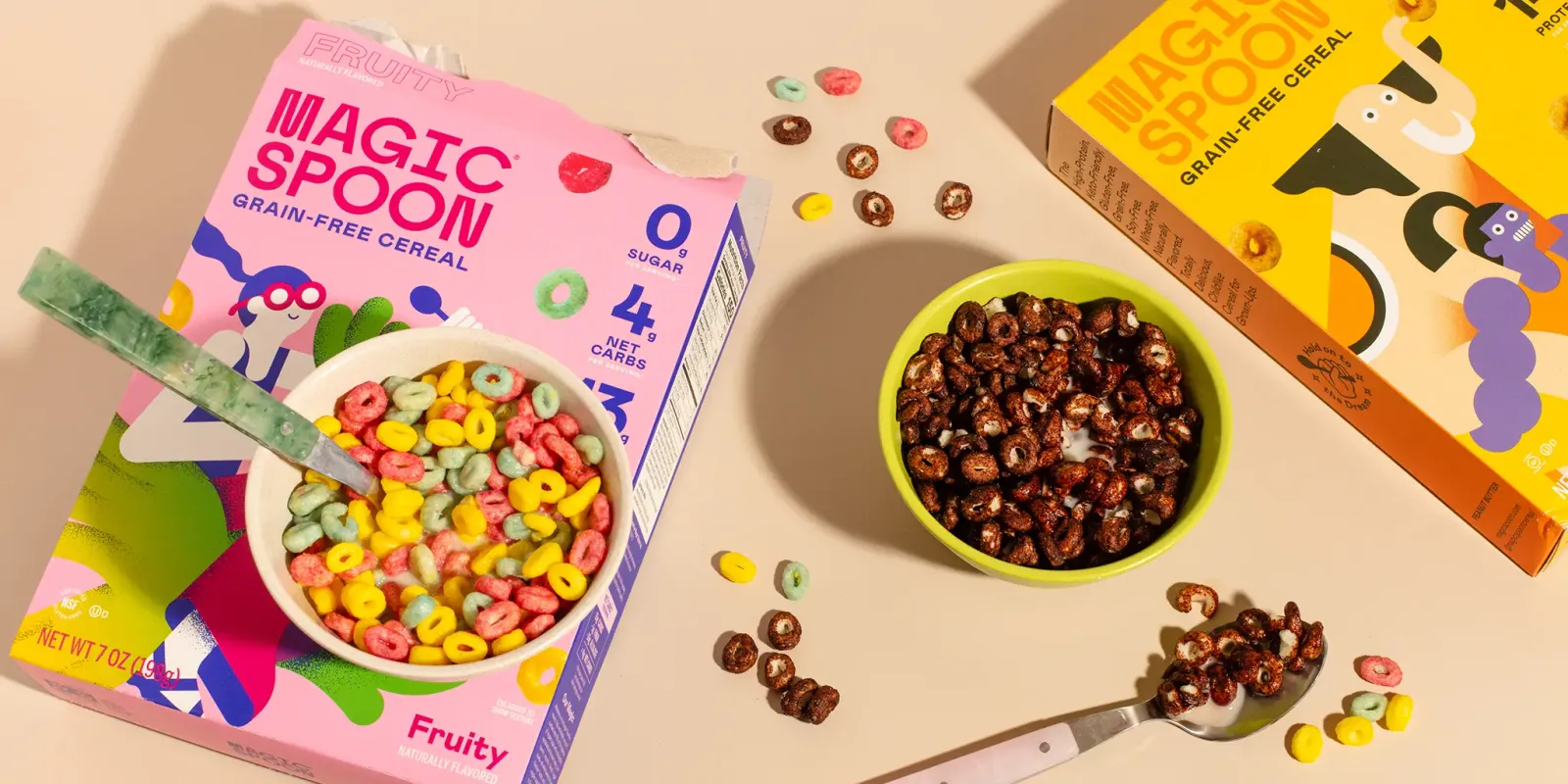
Magic Spoon's flavor names, Fruity, Cocoa, Peanut Butter, are a direct, unsubtle callback to the sugary cereals millennial and older Gen Z consumers grew up eating, deliberately designed to trigger a specific, warm memory before a single nutrition fact is mentioned. This isn't incidental to the creator strategy, it's the actual creative brief every piece of content implicitly works from. A creator doesn't need an elaborate script to make Magic Spoon content land, the flavor names and packaging already carry the emotional hook, and the creator's job is mostly to be a believable messenger for a feeling most of the audience already has some version of.
This matters because it explains why the low-friction seeding approach worked as well as it did. A product that requires a complicated pitch to make interesting needs a more directed, scripted creator brief. A product built around an emotion the audience already carries needs the creator mostly just to show up and be honest about liking it.

Creator selection built around your product's actual emotional hook
Find creators whose audience already carries the feeling your product is built to trigger.
Podcasts as a parallel acquisition channel
Alongside influencer marketing, Magic Spoon leaned heavily on podcast sponsorships as a separate but complementary acquisition channel, ranging from smaller, niche shows up to major platforms like Joe Rogan's podcast and Pod Save America. According to the brand's own co-founder, podcasts became an increasingly strong acquisition channel over time, reaching an audience that trusts a host's personal endorsement in a format similar to how a social creator's audience trusts them, but through longer-form, conversational context.
This is a useful reminder that "creator marketing" doesn't have to mean only short-form video platforms. A brand's actual audience trust relationships might live as much in long-form audio as in TikTok or Instagram, and a channel strategy built only around the most visually obvious creator platforms risks missing a genuinely effective parallel channel.
What food CPG brands can actually copy
The no-upfront-payment seeding model is directly reusable, but it depends on real product confidence. Magic Spoon's own team has been candid that this approach works because the product itself carries enough appeal to generate a high response rate without a financial incentive attached. A brand considering this model should honestly assess whether its product has that same immediate, obvious appeal before assuming free samples alone will generate meaningful creator interest.
The seed-then-formalize sequencing is a genuinely efficient structure worth building deliberately. Rather than choosing between a gifting program and a paid affiliate program, using gifting as the low-cost first touch and reserving formal, performance-based compensation for creators whose organic enthusiasm proves out is a lower-risk way to build a creator relationship pipeline.
The emotional-hook-first lesson applies well beyond nostalgia specifically. Identifying the single emotional register a product's audience already carries, nostalgia, ambition, comfort, discovery, and building the creator brief around amplifying that existing feeling rather than manufacturing a new one from scratch tends to produce content that needs far less scripting to land authentically.
The podcast channel lesson is worth real consideration for any food CPG brand that hasn't tested it. Podcast sponsorships operate on a similar trust mechanic to creator marketing, a host's personal endorsement carrying real weight with their audience, and they're worth evaluating as a parallel channel rather than treating short-form social as the only place creator-style trust transfer happens.
Confident your product can earn a response without paying upfront?
Seeding works when the product does the persuading. Get the creator fit right and let the response rate prove it.
How this compares to the food CPG benchmark
Magic Spoon's core seeding model, product cost only, no upfront creator fee, sits below the $1.25 to $12.67 CPM range documented across paid food CPG creator campaigns, similar to Graza's early approach, since it isn't a paid campaign in the traditional sense. Where Magic Spoon does spend on paid partnerships, through its affiliate program and podcast sponsorships specifically, those investments are performance-tied or reach a different audience entirely, making a direct CPM comparison less useful than treating the benchmark range as the planning reference for any brand building a more traditional, paid, tiered creator program on top of an initial seeding strategy. Full category and platform context lives in the 2026 food CPG influencer benchmark.
Used by 58+ leading CPG brands including Banza, Pete & Gerry's, and Kettle & Fire
See how Jupiter builds a seed-then-formalize creator program for your brand.
FAQs
Quick answers to common questions.
What is Magic Spoon's influencer marketing strategy?▼
Magic Spoon typically doesn't pay influencers upfront, instead sending free product to creators of various sizes and relying on the product's own appeal to generate a high organic response rate. Creators who respond well can then join a performance-based affiliate program, and the brand also invests separately in podcast sponsorships as a parallel acquisition channel.
Why doesn't Magic Spoon pay most influencers upfront?▼
According to co-founder Gabi Lewis, the brand's product carries enough genuine appeal that free samples alone generate an unusually high creator response rate, making upfront payment unnecessary for the initial seeding stage. Financial compensation is generally reserved for the affiliate program, where it's tied to actual sales performance.
How does Magic Spoon's affiliate program work?▼
Creators, particularly those whose personal identity aligns with Magic Spoon's keto and low-carb positioning, can apply to join an affiliate program and earn commission based on the sales they generate, rather than being paid a flat fee regardless of performance.
How much has Magic Spoon grown since launching?▼
Magic Spoon raised an $85 million Series B by 2022 and reported $50 million in revenue within its first two years, eventually securing placements in major retailers including Costco, Target, and Walmart.
Does Magic Spoon use podcast sponsorships in its marketing?▼
Yes. Alongside influencer marketing, Magic Spoon has invested in podcast sponsorships ranging from smaller shows to major platforms like Joe Rogan's podcast, treating podcasts as an increasingly strong acquisition channel that operates on a similar trust mechanic to creator marketing.
Can a smaller CPG brand copy Magic Spoon's no-upfront-payment model?▼
The seed-then-formalize sequencing is genuinely reusable, but it depends on the product having real, immediate appeal strong enough to generate response without financial incentive. A brand should honestly assess its own product's pull before assuming free samples alone will produce meaningful creator interest.
More in Strategy & Guides
More from Strategy & Guides.