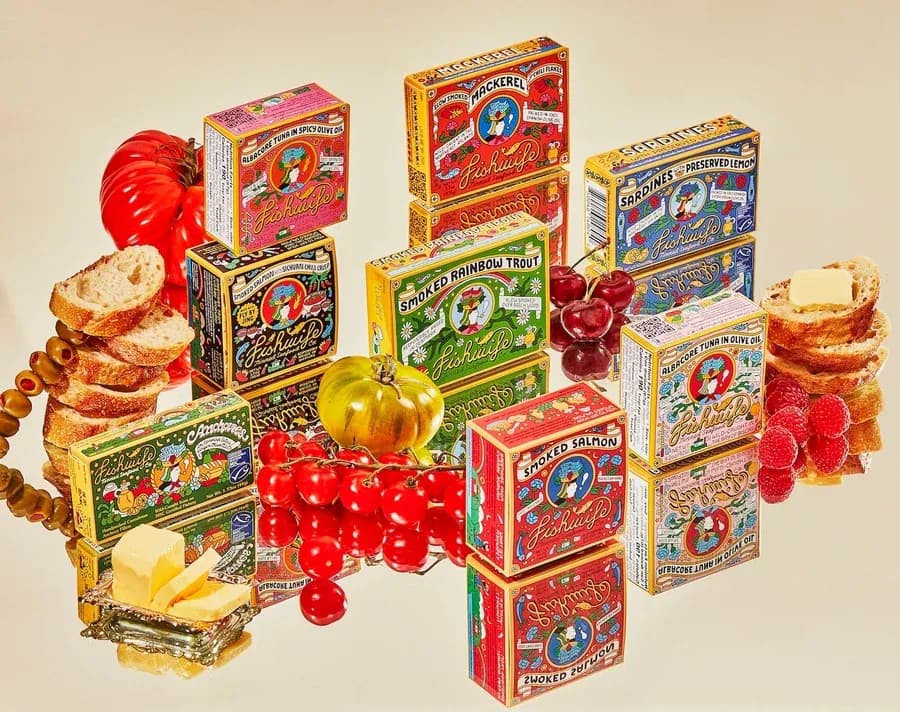
How Fishwife Made Tinned Fish Culturally Cool Without Paid Ads
Tinned fish was a stodgy, unsexy category before Fishwife existed. The brand didn't reposition it with a bigger ad budget. It spent zero dollars on paid advertising for its first two years and let culture do the work instead.
Fishwife turned premium tinned fish into a cultural moment with zero paid advertising for its first two years, relying on organic social media run personally by co-founder Becca Millstein. Wearable merch like "Hot Girls Eat Tinned Fish" shirts, the #tinnedfish hashtag with over 100 million views, and in-store sampling at retailers like Whole Foods drove adoption.
Key takeaways
- Fishwife co-founder Becca Millstein ran the brand's social media personally in its early years, building a warm, irreverent brand voice and real community before launching a broader paid creator program, so later partnerships had an established identity to plug into.
- Fishwife merchandise like "Hot Girls Eat Tinned Fish" t-shirts and totes turned paying customers into walking advertisements, giving the brand more credible social proof than most paid placements.
- Fishwife rode the #tinnedfish hashtag, which has over 100 million views, and related trends like #tinnedfishdatenight, giving creators and customers a ready-made content format that kept generating posts independent of any sponsored campaign.
- Fishwife positioned its content inside the broader protein-forward eating trend while the US tinned fish market grew roughly 9.7 percent in a single year per Euromonitor, letting the brand benefit from existing category search and discovery demand.
- Fishwife paired organic social with in-store brand ambassadors who sample product at retailers like Whole Foods, using social to build cultural relevance and in-person tasting to convert shoppers still hesitant to try tinned fish.
Trusted by leading CPG brands

















On this page
▼
- Why the founder ran social media herself
- Merch, hashtags, and turning customers into billboards
- The reclaimed name as a built-in brand story
- Working the category tailwind
- Retail-side brand ambassadors as a complementary channel
- What food CPG brands can actually copy
- How this compares to the food CPG benchmark
Tinned fish had an image problem in the American market that ran even deeper than Chomps' meat stick stigma: canned tuna and sardines were, for most shoppers, a convenient-at-best pantry backup, not something anyone felt good posting about. Fishwife co-founders Becca Millstein and Caroline Goldfarb, both coming from careers outside the food industry, started the brand during the pandemic with premium, ethically sourced tinned seafood styled after Spanish and Portuguese conservas culture. For the first two years, the brand spent zero dollars on paid advertising. Its entire growth engine was organic social media, run personally by its co-founder, and it worked well enough to help build tinned fish into a genuine cultural moment rather than a rebranded pantry staple.
This breakdown looks at the specific mechanics behind that growth and what's genuinely reusable for a food CPG brand entering a category with a real image problem.
Why the founder ran social media herself
Becca Millstein handled Fishwife's social media personally in the brand's early years, not because the company couldn't afford to hire it out, but because the direct, personal engagement was the actual strategy. She was the one replying to comments, building relationships with the brand's earliest fans, and shaping the tone that would eventually define the entire brand voice: warm, a little irreverent, funny, and genuinely community-obsessed rather than corporate.
That founder-run approach let Fishwife build real trust with its earliest audience before the brand ever needed to lean on paid influencer partnerships. By the time Fishwife did start working with a broader roster of creators, the brand already had an established voice and community for those partnerships to plug into, rather than trying to build both a brand identity and a creator program from scratch at the same time. For a parallel "unsexy category made cool" story, see Chomps' influencer marketing breakdown.
Merch, hashtags, and turning customers into billboards
Fishwife's most distinctive growth mechanic wasn't a creator campaign at all, it was merchandise designed to be worn and photographed. Products like "Hot Girls Eat Tinned Fish" t-shirts and totes turned ordinary customers into walking advertisements, spreading the brand's specific cultural positioning, tinned fish as fun, feminist, and a little bit cheeky, far beyond anyone the brand had directly paid or partnered with.
The brand also built and rode genuine hashtag culture rather than manufacturing a single campaign tag. The #tinnedfish hashtag has accumulated over 100 million views, and Fishwife leaned into related trends like #tinnedfishdatenight, content built around styling tinned fish as a trendy, shareable dinner-party moment rather than a quick meal. This gave both creators and ordinary customers a ready-made content format to participate in, one that existed independently of any single sponsored post and kept generating content long after any individual campaign would have ended.

Creator selection built to ride real category tailwinds
Position your brand's content inside the trends already driving discovery, not separately from them.
The reclaimed name as a built-in brand story
The name itself did real marketing work. "Fishwife" originally referred to the wives and daughters of fishermen who sold their husbands' catch at market, and it was later used as a gendered insult. Millstein reclaiming that term as the company name gave every piece of press, every creator conversation, and every customer interaction a built-in story hook, something genuinely interesting to talk about beyond the product's taste or sourcing. A brand name that's also a conversation starter reduces the amount of manufactured narrative a creator has to invent to make a post interesting.
Working the category tailwind
Fishwife also benefited from, and helped drive, genuine category momentum. The US tinned fish market grew roughly 9.7 percent in a single recent year according to Euromonitor data, and Fishwife's own founder has pointed to the broader protein trend as a tailwind: tinned fish offers clean, convenient protein at a moment when protein-forward eating is one of the dominant food trends across the entire industry. The brand didn't create the protein trend, but its creator content and positioning were built to sit directly inside it rather than separately from it, which meant the brand's own content benefited from search and discovery interest the category was already generating for other reasons.
Retail-side brand ambassadors as a complementary channel
Alongside its social strategy, Fishwife invested in in-store brand ambassadors, staff who work retail floors at stores like Whole Foods, talk directly with shoppers, and hand out samples. According to the brand's own founder, that direct, in-person sampling converts reliably once someone actually tastes the product. This is a useful reminder that a strong organic social strategy doesn't have to be the brand's only growth channel, it can work alongside a more traditional, high-touch retail sampling program, with each channel solving a different part of the adoption problem: social builds cultural relevance and discovery, in-store sampling closes the final gap for a shopper who's still unsure about trying tinned fish for the first time.
Fighting a category stigma with limited paid budget?
Fishwife spent zero dollars on paid ads for two years. Culture, community, and the right creator fit did the work instead.
What food CPG brands can actually copy
The founder-led early social strategy is the most broadly applicable lesson, and it doesn't require Fishwife's specific personality or category to work. Building an authentic brand voice and real community relationships before scaling into a broader paid creator program gives that later program something genuine to plug into, rather than asking hired creators to invent a brand personality from nothing.
The merch-as-content lesson is worth serious consideration for any brand fighting a category perception problem. A well-designed piece of merchandise that customers actually want to wear turns ordinary buyers into an unpaid, highly credible extension of the brand's creator strategy, since a stranger wearing a shirt they chose to buy carries more social proof than almost any paid placement.
The reclaimed or story-driven name lesson is harder to retrofit onto an existing brand, but it's worth remembering for any brand still in naming or positioning decisions: a name or story with genuine built-in narrative tension gives creators and press something authentic to talk about beyond product features.
The category tailwind lesson applies broadly: understand what larger food trend a product's story can honestly and specifically plug into, protein, sustainability, ease, and build content that sits inside that trend's existing discovery and search behavior rather than trying to manufacture interest independently.
How this compares to the food CPG benchmark
Fishwife's first two years of zero paid ad spend sit entirely outside the $1.25 to $12.67 CPM range documented across paid food CPG creator campaigns, because there was no paid media component to measure against that range at all. That result depended heavily on the specific combination of a founder with real marketing instincts, a genuinely photogenic and shareable product, and a category with real cultural tailwind, factors that don't transfer automatically to every brand. Once Fishwife scaled into a broader, structured creator program, the standard benchmark range becomes the more realistic comparison point for planning purposes. Full category and platform context lives in the 2026 food CPG influencer benchmark.
Used by 58+ leading CPG brands including Banza, Pete & Gerry's, and Kettle & Fire
See how Jupiter builds a community-first, category-tailwind-aware creator program for your brand.
FAQs
Quick answers to common questions.
What is Fishwife's influencer marketing strategy?▼
Fishwife built its early growth through founder-led social media, with co-founder Becca Millstein personally running the brand's Instagram and TikTok, combined with shareable merchandise, genuine hashtag culture like #tinnedfish, and creator partnerships that developed organically rather than through scripted campaigns.
How much did Fishwife spend on paid advertising?▼
Fishwife spent zero dollars on paid advertising for its first two years, relying entirely on organic social media, founder-led community building, and word of mouth to drive growth.
How did Fishwife's merchandise contribute to its marketing?▼
Products like "Hot Girls Eat Tinned Fish" apparel turned ordinary customers into an unpaid extension of the brand's marketing, spreading Fishwife's specific cultural positioning far beyond any single paid creator partnership or campaign.
Why did Fishwife choose a name that was historically used as an insult?▼
Co-founder Becca Millstein reclaimed "Fishwife," a term originally referring to fishermen's wives and daughters that was later used as a gendered insult, giving the brand a built-in story hook that made press coverage and creator conversations more interesting than a generic product name would have.
Is the tinned fish category actually growing?▼
Yes. The US tinned fish market grew roughly 9.7 percent in a recent year according to Euromonitor data, and Fishwife's positioning around clean, convenient protein has benefited from the broader protein-forward eating trend driving interest across the food industry.
Can a smaller CPG brand copy Fishwife's zero-paid-ads strategy?▼
The founder-led social approach and merch-as-content mechanics are genuinely replicable at small scale. The full zero-paid-spend outcome is harder to guarantee, since it depended on a specific combination of founder marketing instinct, a genuinely shareable product, and real category tailwind that won't be identical for every brand.
More in Strategy & Guides
More from Strategy & Guides.