Whole Foods Influencer Marketing: 12-Week Launch Playbook
You got the Whole Foods listing. Now the creators you hire need to live near the stores that carry you, and your measurement has to work without Instacart. Here is the 12-week plan we use after a natural or organic brand lands on shelf.
Whole Foods influencer marketing works best after the listing when creators are matched to the stores that carry your product, not bought for national reach. Plan a 12-week launch from shelf confirmation, and measure with receipt-verified purchases and store-level checks, because Whole Foods' U.S. delivery orders run through Amazon rather than Instacart.
Key takeaways
- Whole Foods influencer marketing after a listing should target the trade areas of the stores carrying the product, since a new natural brand is usually in a slice of Whole Foods' 540 U.S. stores, not all of them.
- Whole Foods' U.S. grocery delivery and pickup run through Amazon, so Instacart cart attribution cannot see Whole Foods sales and brands need receipt-verified purchases and store checks instead.
- An effective local CPM, the cost per impression that lands near a carrying store, is the number that separates a geo-targeted creator plan from a national one that wastes most of its reach.
- A 12-week Whole Foods creator launch starts only after store checks confirm the product is on shelf, then runs seeding, an in-store wave, a recipe wave and a second wave in the strongest stores.
- Whole Foods bans more than 300 ingredients, so creator recipes should call for ingredients the shopper can buy in the same Whole Foods trip.
Trusted by leading CPG brands


On this page
▼
- What should Whole Foods influencer marketing do after you're listed?
- Why can't you measure Whole Foods with Instacart attribution?
- How do you geo-target creators to your Whole Foods stores?
- Worked example: effective local CPM
- Whole Foods influencer marketing timeline: the first 12 weeks
- Which creator formats work for natural and organic products?
- What should you report to the Whole Foods category team?
- How Jupiter runs a Whole Foods creator launch
Whole Foods influencer marketing is a different job once you're on shelf. The listing is won; now you need shoppers in the specific stores that carry you, while the launch is still new. Our position: skip national creator reach, buy creators who live near your stores, and plan measurement around the fact that Whole Foods sells online through Amazon, not Instacart.
This playbook starts the day your product is confirmed on shelf. If you're still working on the listing itself, start with how to pitch a Whole Foods or regional grocery buyer.
What should Whole Foods influencer marketing do after you're listed?
It should send shoppers into the stores that stock you during your first 12 weeks. Awareness in cities where you're not on shelf is wasted spend at this stage.
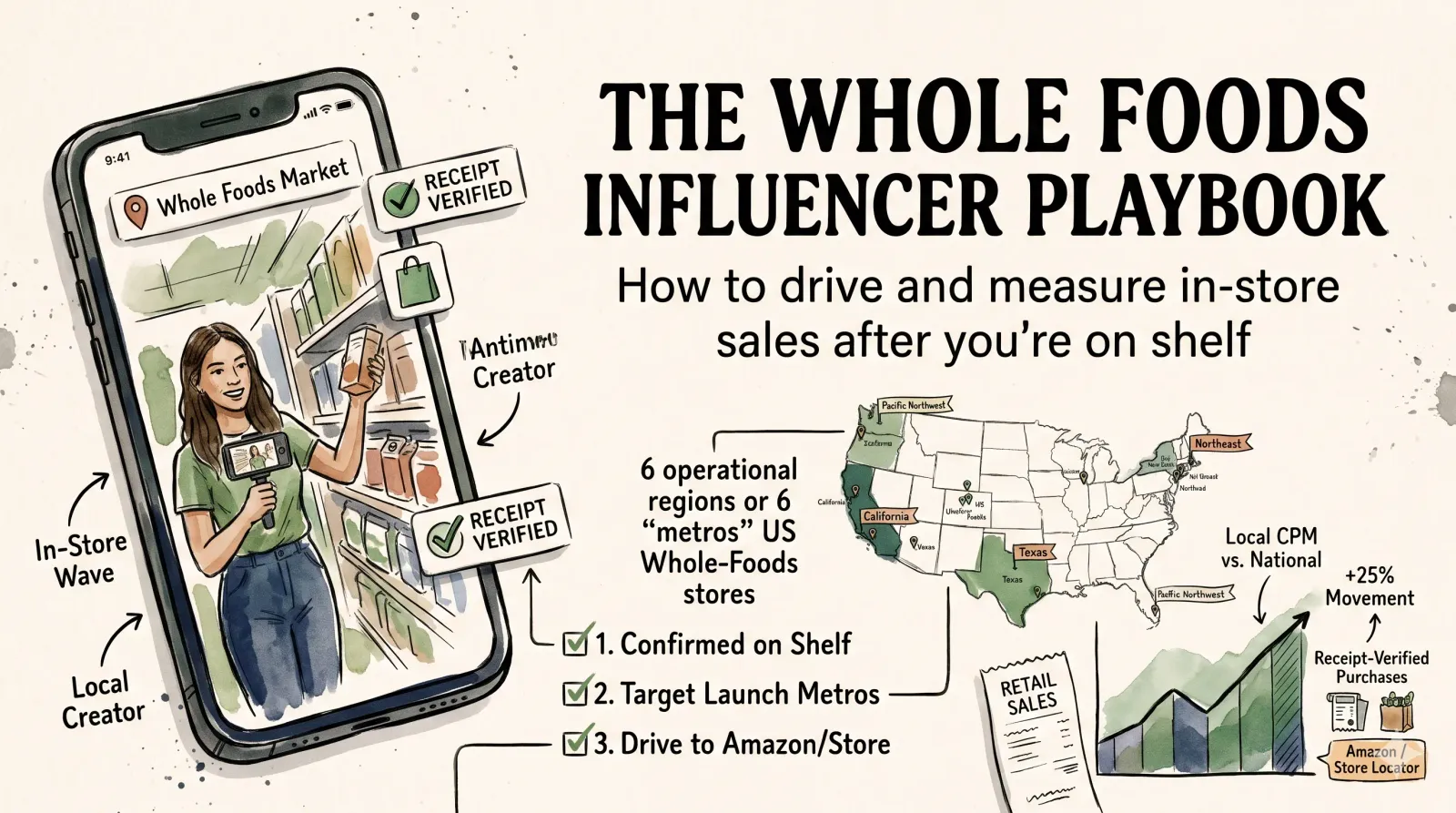
Whole Foods runs 540 U.S. stores across 6 operational areas, according to its Fast Facts page. An emerging brand rarely launches in all of them. Many first listings cover one region, or a set of stores inside one, so the useful audience is the shoppers who live near those stores.
That changes how you pick creators. A recipe creator with 400,000 followers spread across the country can deliver less local reach than a creator with 60,000 followers in the metro where you launched. Follower count stops being the deciding number.
Why can't you measure Whole Foods with Instacart attribution?
Because Whole Foods isn't on Instacart in the United States. Its online ordering page sends U.S. shoppers to Amazon.com for delivery and pickup, and lists Instacart only for Canadian delivery.
That matters if you've run creator campaigns at Kroger, Sprouts or Costco, where a shoppable recipe can route to an Instacart cart and show cart adds by creator. For Whole Foods in the U.S., that signal doesn't exist. Plan the measurement before the first post, or you'll end the launch with views and no sales story.
Signal | What it proves | Works for Whole Foods U.S.? |
|---|---|---|
Instacart cart adds | A shopper added your product to an online cart from a creator link | No. Whole Foods U.S. orders run through Amazon. |
Receipt-verified purchase | A shopper bought your product in a store, with a receipt as proof | Yes. Works in any store that sells the product. |
Store checks with photos | Your product is on shelf and in the right spot before and during the campaign | Yes. Done by your team, a broker or creators on pickup visits. |
Store-locator clicks from creator links | Shoppers looked for a store near them after a post | Yes, as an intent signal, not a sale. |
Retailer sales data from your category contact or broker | Unit movement by store or region over the launch window | Yes. Compare creator-targeted stores with the rest. |
We lean on receipt verification for Whole Foods launches because it ties a creator to a purchase in a named store. Our post on receipt-verified in-store trial campaigns covers how the method works and what it can't prove.
How do you geo-target creators to your Whole Foods stores?
Start from the store list, not the creator list. Get the exact stores carrying your SKUs, draw a trade area around each one, and only then shortlist creators whose audiences live inside those areas.
Get the store list for your launch from your Whole Foods contact or your distributor, with the date product is expected on shelf at each store.
Group the stores by metro. Each metro becomes one creator market with its own budget line.
Ask every shortlisted creator for a screenshot of the audience location view in their Instagram or TikTok insights, showing top cities.
Keep creators with a meaningful share of their audience in your metros, and drop creators whose audience is mostly in cities where you're not on shelf.
Weight budget toward metros with the most carrying stores, since each local impression has more places to turn into a purchase.
Worked example: effective local CPM
The number to compare is the effective local CPM: what you pay per thousand impressions that land near a carrying store. Here's an illustrative example for a brand with $15,000 and a launch in one Whole Foods region.
Creator plan | Assumed CPM | Impressions | Share near a carrying store | Local impressions | Effective local CPM |
|---|---|---|---|---|---|
National recipe creators | $6.00 | 2.5M | 20% | 500,000 | $30.00 |
Creators in your launch metros | $10.00 | 1.5M | 70% | 1.05M | $14.29 |
The math: $15,000 divided by the CPM, times 1,000, gives impressions. Multiply by the local share to get local impressions, then divide spend by local impressions and multiply by 1,000. The national plan looks cheaper on CPM and costs about twice as much per useful impression.
Both assumed CPMs sit inside the $1.25 to $12.67 range we've seen across food CPG campaigns on Jupiter. The local shares are examples; replace them with the location data your creators send you.
Launched at Whole Foods in one region? Point creators at those stores.
We match food creators to the trade areas of the stores carrying your product and verify in-store purchases by receipt.
Whole Foods influencer marketing timeline: the first 12 weeks
Count week 1 from the day store checks confirm product on shelf, not from the buyer's ship date. A creator post that sends shoppers to an empty shelf costs you more than a late post.
Week | Phase | What happens | Owner |
|---|---|---|---|
Before week 1 | Store checks | Confirm product is on shelf in each launch store, with photos. Fix gaps with your distributor before anyone posts. | Brand or broker |
Weeks 1 to 2 | Seeding | Ship product to local creators. Brief them with the store list and the claims they can use. | Brand and creators |
Weeks 3 to 4 | In-store wave | Creators film finding and buying the product at their own Whole Foods. Receipt-verified purchase offer goes live. | Creators |
Weeks 5 to 8 | Recipe wave | Recipe posts built around the product, with every other ingredient available at Whole Foods. | Creators |
Week 9 | Read the results | Rank stores and metros by receipt-verified purchases and retailer data. | Brand |
Weeks 10 to 11 | Second wave | Rebook the best creators in the strongest metros. Cut the weakest market. | Brand and creators |
Week 12 | Recap | Build the one-page creator recap for your Whole Foods contact. | Brand |
Twelve weeks is a planning window, not a Whole Foods rule. It's long enough for two creator waves and a read in between, and short enough to finish while the launch is still new on shelf.
Which creator formats work for natural and organic products?
Formats that show the product in the store and on the counter work best, because the shopper needs to know which Whole Foods carries it and what it's for. Content that only says the product is clean or healthy gives a Whole Foods shopper nothing new.
Format | Best for | What to require in the brief |
|---|---|---|
In-store find and buy | Weeks 3 to 4, new shelf placements | The store's city in the caption, a shelf shot, and the aisle or section |
Recipe with your product as the hero ingredient | Pantry staples, sauces, dairy, frozen | Every other ingredient available at Whole Foods, and a saved recipe page |
Label close-up | Products with short ingredient lists or a certification | The real back panel on screen, read aloud, with no extra health claims |
Stories set with a store poll | Fast reminders between full posts | A link to your store locator, not your website home page |
Trend tie-in | Products that fit a current Whole Foods trend | A recipe or use, not a trend explainer |
Two details trip brands up. First, Whole Foods' food ingredient standards ban more than 300 ingredients, including sucralose, aspartame and high-fructose corn syrup. A recipe that pairs your product with a banned ingredient sends the shopper to another store for half the basket.
Second, Whole Foods publishes a yearly trends list. Its 2026 predictions include fiber-forward products, beef tallow, restaurant-quality frozen meals and naturally sweetened treats. If your product genuinely fits one, a creator recipe built on that trend gives your category contact a reason to notice the post.
For a comparable natural-channel plan, our Sprouts influencer marketing playbook covers creator selection and briefs for a shopper base that overlaps with Whole Foods.
What should you report to the Whole Foods category team?
Report what the creators did in Whole Foods' stores, on one page. Your contact wants to know that you're spending to move product in their stores, not that a Reel went viral.
Stores and metros covered by creator content, against the full list of carrying stores.
Creators and posts per metro, with links and dates.
Receipt-verified purchases by store or metro.
Store-check photos showing shelf presence before and during the campaign.
What you're doing next: the metros getting a second wave and any you're pausing.
Keep the recap about activity and verified purchases. How category reviews judge performance is a separate conversation, covered in our guide to keeping your product on the shelf at Target, Whole Foods and Walmart.
How Jupiter runs a Whole Foods creator launch
We start with your store list. Jupiter's retailer-proximity targeting covers Whole Foods alongside Kroger, Target, Costco, H-E-B, Albertsons and Meijer, so creators are chosen by where their audience shops.
Creators run in-store and recipe content in the metros you launched in. In-store trial is verified by receipt, and for your other retailers, shoppable recipes carry Instacart attribution. Across our network, creators average 4.4% engagement and campaigns have delivered 800M+ impressions.
For the wider grocery picture beyond one retailer, see our grocery influencer marketing playbook.
Your Whole Foods launch clock is already running
Book a demo and we'll map creators to the stores carrying your product, with receipt-verified purchases by store.
FAQs
Quick answers to common questions.
How do you market a new product at Whole Foods with influencers?▼
Match creators to the stores carrying your product, start posting only after store checks confirm it's on shelf, and run two waves over about 12 weeks. Use in-store find-and-buy content first, then recipe content, and measure with receipt-verified purchases.
Is Whole Foods on Instacart?▼
Not in the United States. Whole Foods' online ordering page sends U.S. shoppers to Amazon.com for delivery and pickup, and lists Instacart only for delivery in Canada. That's why Instacart cart attribution can't measure Whole Foods sales.
How many stores does Whole Foods have?▼
Whole Foods lists 540 U.S. stores, 12 in the U.K. and 12 in Canada on its Fast Facts page, organized into 6 operational areas. Most emerging brands launch in a portion of those stores, which is why creator targeting should follow the store list.
What kind of creator content works for Whole Foods shoppers?▼
In-store content showing where the product sits, recipes that use it as the hero ingredient, and label close-ups for products with short ingredient lists. Build recipes from ingredients Whole Foods sells, since it bans more than 300 ingredients.
How long should a Whole Foods creator campaign run after launch?▼
Plan about 12 weeks from shelf confirmation. That allows a seeding phase, an in-store wave, a recipe wave, a read of the results and a second wave in the strongest metros before you recap for your Whole Foods contact.
More in Retailer & Category Playbooks
More from Retailer & Category Playbooks.