How Agencies Prove Retail Sales From Creator Campaigns
CPG clients renew on sales evidence, not impressions. How agencies with food and beverage clients report Instacart, in-store and SPINS proof, with a six-page monthly report template and a kickoff measurement agreement.
Agencies prove influencer ROI to CPG clients by reporting three levels of retail evidence: Instacart cart adds tied to specific creator posts, receipt-verified in-store purchases, and SPINS sales lift against a baseline. Add cost per result and share of voice, agree the measures at kickoff, and send the same report every month.
Key takeaways
- Agencies prove influencer ROI to CPG clients with three levels of retail evidence: Instacart cart adds by creator and post, receipt-verified in-store purchases, and SPINS sales lift against an agreed baseline.
- The IAB's 2025 creator ad spend report found 39% of US ad buyers name proving ROI as their top creator measurement challenge, and only 37% measure creator programs with internal sales data.
- A six-page monthly client report (summary, retail proof, creator leaderboard, content highlights, share of voice, next month) lets a brand manager forward pages one and two to a VP or retail buyer unedited.
- Instacart cart adds, receipts and SPINS lift overlap, so a client report should show the three side by side and never add them into one sales total.
- A one-page kickoff measurement agreement that names the primary outcome, retailers, baseline, data owner and what won't be measured prevents most reporting disputes at renewal.
Trusted by leading CPG brands














On this page
▼
- What do CPG clients take to their VP and retail buyer?
- How agencies prove influencer ROI to CPG clients: three levels of proof
- Online: Instacart comment-to-cart
- In-store: receipt-verified purchases
- Market: SPINS retail sales data
- Context that isn't sales: share of voice
- What goes in the monthly client report, page by page?
- A worked example of pages one and two
- What should agencies agree with the client at kickoff?
- How do you turn the client report into a renewal?
- How Jupiter works with CPG agencies
How agencies prove influencer ROI to CPG clients comes down to one document: the monthly report a brand manager forwards to their VP and their retail buyer. If that report opens with impressions, the renewal conversation starts on the back foot.
Our view: build the client report backwards from the retail buyer meeting. Put Instacart, in-store and SPINS evidence on page two, and move engagement metrics to the creator leaderboard.
Jupiter works with agencies. Agencies run creator programs for their food and beverage clients on Jupiter, and this guide is for the account directors and analysts who own the client report. It covers the report itself and links to the method posts for the measurement detail.
What do CPG clients take to their VP and retail buyer?
They take sales evidence tied to a retailer, a region and a time window. After your report lands, a brand manager has two audiences: a VP who sets next quarter's budget, and a category manager who decides shelf space.
The IAB 2025 Creator Economy Ad Spend & Strategy Report shows why that is hard. In its survey of 453 US ad buyers, 39% named proving ROI as their top creator measurement challenge, and 34% named attributing sales to creators.
The same report found that only 37% measure creator programs with internal sales data and 32% with retailer or partner data, while 55% rely on ad platform reporting. Most clients are being sent platform numbers when their buyers ask about sales.
Reader | What they ask | What answers it |
|---|---|---|
VP of marketing | Did the creator budget pay back against other channels? | Cost per result and sales evidence by retailer |
Retail buyer or category manager | Is this brand bringing shoppers into my category? | SPINS lift in the buyer's region, plus receipt-verified trial |
Finance | Which costs produced which outcomes? | Spend, CPM and cost per verified result, by creator |
Brand manager | What should change next month? | Creator leaderboard and a written recommendation |
The IAB report also found CPG brands and retailers named driving online sales as their top goal for creator marketing, and estimated CPG creator ad spend at $5.5B in 2025, up 24%. Clients spending at that level want answers in the units their buyers use.
Brands also keep reporting close. In Influencer Marketing Hub's in-house vs agency benchmark, only 6.9% of brands outsource reporting and analytics, against 19.44% for influencer discovery. Your report competes with numbers the client can pull itself, so it has to show something their own dashboard can't.
How agencies prove influencer ROI to CPG clients: three levels of proof
Use three levels of evidence, each answering a different question. Instacart shows purchase intent by post, receipts show that in-store purchases happened, and SPINS shows whether the market moved.
The IAB's January 2026 report on creator measurement describes verification across the industry as uneven. Stacking three independent signals is how an agency gets ahead of that doubt.
Level | What it proves | Signal to report | When it's available | Limit to state |
|---|---|---|---|---|
Online: Instacart comment-to-cart | A viewer acted on a specific post | Cart adds by creator and post | During the campaign | Covers Instacart shoppers only |
In-store: receipt-verified purchases | A real purchase happened at a real store | Verified receipts by SKU and store | As receipts come in | Proves the sale, not the cause |
Market: SPINS retail sales data | Sales moved against a baseline | Lift by geography, channel and SKU | After the next SPINS data upload | Needs a clean baseline and the client's SPINS data |
Online: Instacart comment-to-cart
Instacart attribution is the fastest proof, and it works at the post level. On Jupiter, a viewer who comments on a creator's recipe gets a shoppable Instacart link by DM, and the resulting cart add is tracked back to that creator and post.
Report cart adds per creator next to that creator's cost. That pairing decides who gets rebooked. The full method is in our guide to measuring influencer ROI with Instacart attribution.
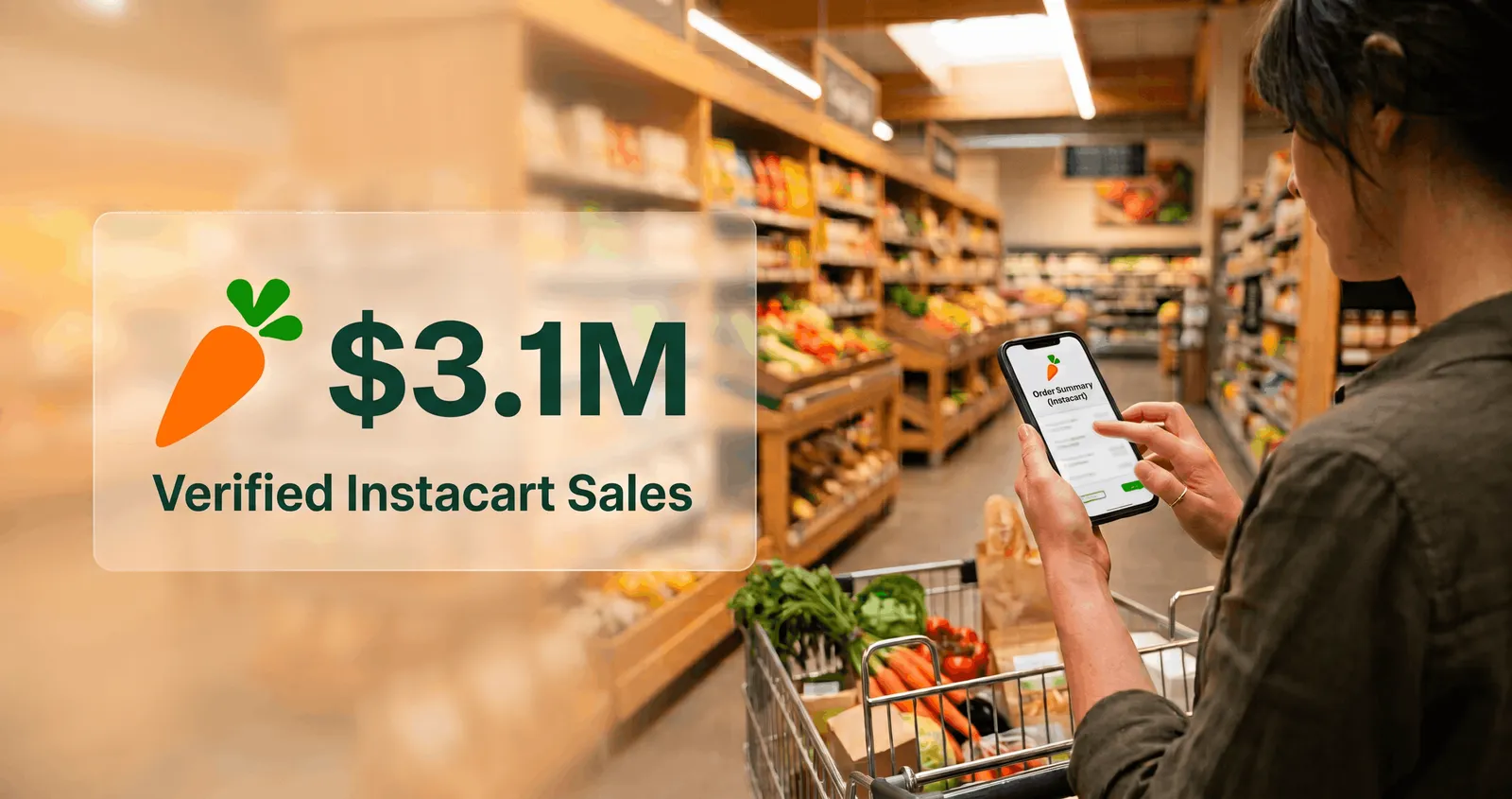
Across Jupiter's network, this tracking adds up to $3.1M in Instacart-verified grocery sales and more than 10M shop clicks a year. Those are Jupiter network totals, so don't present them as a forecast for any one client.
In-store: receipt-verified purchases
Receipts cover shoppers who buy in a physical store, where no pixel sits at the register. In Jupiter's in-store trial campaigns, each purchase is confirmed by a submitted receipt for the product.
Tell the client what a receipt does and doesn't prove. It proves the transaction happened, but on its own it doesn't prove the campaign caused it, so read trial results against a baseline. Details are in how receipt-verified in-store trial works.
Market: SPINS retail sales data
SPINS answers the retail buyer's question in a data source the buyer already uses. Jupiter's Sales Attribution dashboard maps campaigns and posts to retail sales lift using SPINS data the brand uploads, filtered by geography, channel and SKU.
Pick the baseline before launch: the pre-campaign period, the same period last year, or a seasonally adjusted expectation. A grilling sauce compared only against a quiet spring baseline will overstate its summer lift. See connecting creator content to retail sales with SPINS data.
Context that isn't sales: share of voice
Share of voice shows whether the client's category presence grew while competitors moved. Jupiter's share of voice tracking covers Instagram, TikTok, YouTube and X, and populates within 24 hours of adding a brand. It belongs in the report as context, never as the headline.
What goes in the monthly client report, page by page?
Six pages, in the same order every month. The order matters more than the design, because the client should be able to forward pages one and two without editing them.
Page | Title | What goes on it | Data source |
|---|---|---|---|
1 | Summary | Spend, the headline sales result, cost per result and one recommendation | All pages below |
2 | Retail proof | Instacart cart adds by creator, receipt-verified purchases by region, SPINS lift against the agreed baseline | Instacart attribution, receipts, SPINS upload |
3 | Creator leaderboard | Each creator's cost, impressions, CPM, engagement and cart adds, ranked by cost per result | Campaign analytics |
4 | Content highlights | The three posts that drove the most cart adds, with a line on why each worked | Post data and content review |
5 | Share of voice | Share of category mentions against named competitors, owned vs earned | Share of voice tracking |
6 | Next month | Creators to rebook, creators to drop, budget shifts and the next test | Agency recommendation |
Where a page needs a source you don't have yet, write "not measured this month" instead of dropping the page. The gap stays visible, and it becomes an agenda item for the next quarterly review.
On Jupiter, the analytics view filters to one brand and one product, and campaign health compares projected against actual impressions and CPM. That fills page three for each client from one account, and share of voice tracking fills page five. For the brand-side view of these metrics, see influencer reporting for CPG campaign performance.
A worked example of pages one and two
Every number in this table is illustrative, not a client result. It shows the math a client should be able to check.
Metric | Value (illustrative) | How it's calculated |
|---|---|---|
Creator spend | $30,000 | 12 creators over one month |
Impressions | 5,000,000 | Summed from post data |
CPM | $6.00 | $30,000 divided by 5,000 thousand impressions |
Instacart cart adds | 900 | Tracked to creator and post |
Cost per cart add | $33.33 | $30,000 divided by 900 |
Receipt-verified purchases | 150 | Receipts from the in-store trial wave |
SPINS weekly units, campaign vs baseline | 1,120 vs 1,000 | Same region, pre-campaign baseline |
Sales lift | 12% | 120 extra units divided by the 1,000 baseline |
The $6.00 CPM sits inside the $1.25 to $12.67 CPM range that food CPG campaigns on Jupiter have run at. Cost per cart add puts the whole spend against one outcome, so use it to compare creators, not channels.
Never add the three levels into one sales total. A shopper can add to an Instacart cart, buy in store and show up in SPINS, so the levels overlap. Show them side by side and let each answer its own question.

See this report built from a live campaign
Bring one client's brand, retailers and campaign dates. We'll show how Instacart, in-store and SPINS results are reported by brand in Jupiter.
What should agencies agree with the client at kickoff?
Agree what will and won't be measurable before the first creator posts. Most reporting disputes at renewal trace back to a gap nobody wrote down at kickoff.
Put it on one page and have the brand manager sign it off by email.
Item | What to agree | Example |
|---|---|---|
Primary outcome | The one sales measure the program is judged on | Instacart cart adds at a target cost per cart add |
Retailers and regions | Where proof will be read | The client's two strongest Kroger regions |
Baseline | Which comparison SPINS lift uses | Same weeks last year |
Data access | Who uploads SPINS data, and how often | Client sales team, monthly |
Not measured | Gaps stated in writing | Sales in channels the client's SPINS data doesn't cover |
Report date | When the report lands | Fifth business day of each month |
Decision owner | Who approves rebooks and budget shifts | Brand manager |
The "not measured" line does the most work. It's far easier to explain a gap on day one than to defend it at renewal.
Reporting is the last stage of a longer process. Our influencer marketing workflow for agencies covers the stages before it, from creator discovery to content approval.
How do you turn the client report into a renewal?
Use page six to sell the next quarter. A report that ends in a named recommendation gives the client a reason to sign, while one that ends in a chart invites a vendor comparison.
Rebook the top creators. Name them with their cost per cart add and propose a longer commitment with each.
Expand to the next retailer. When SPINS lift shows up in one region, propose the same plan in the next region the client sells in.
Add an in-store wave. If online proof is strong but most of the client's volume is in store, propose a receipt-verified trial.
Make share of voice a monthly line. Competitor moves give the account team a reason to reach out between reports.
For packaging these into outcome-based retainer lines, see how agencies use AI for CPG marketing and win clients.
How Jupiter works with CPG agencies
Agencies run creator programs for their food and beverage clients on Jupiter. They find vetted recipe creators, approve content, and report Instacart and in-store results by brand, with a Jupiter account manager and ops team behind every campaign.
The reporting inputs for each client sit in one place: Instacart comment-to-cart attribution, receipt-verified in-store trial, the SPINS Sales Attribution dashboard, share of voice and projected against actual impressions. See Jupiter's influencer marketing analytics for the dashboard, or read more on how Jupiter works with agencies.
Bring a client brief and see retail proof by brand
We'll walk through how Instacart, in-store and SPINS results are reported for one of your food or beverage clients.
FAQs
Quick answers to common questions.
How do you measure in-store sales from influencer campaigns?▼
Use receipt verification for the purchase and SPINS data for the market. A verified receipt confirms a shopper bought the product in a physical store, and SPINS sales lift against a baseline shows whether sales in the campaign region moved. Report both side by side, because a receipt proves the sale but not that the campaign caused it.
What should an influencer report for a CPG client include?▼
Six pages: a summary with spend, the headline sales result and one recommendation; retail proof from Instacart, receipts and SPINS; a creator leaderboard ranked by cost per result; content highlights; share of voice against named competitors; and next month's plan. Engagement metrics belong in the leaderboard, not on page one.
How often should agencies report creator results to clients?▼
Monthly, on a fixed date agreed at kickoff, with short check-ins during launch weeks. Instacart cart adds show up during the campaign, while SPINS lift depends on the next data upload, so a monthly report is the first point where all three levels of proof line up.
Can you attribute Instacart sales to a specific creator?▼
Yes, at the cart-add level. With Jupiter's comment-to-cart mechanic, a viewer who comments on a creator's post gets a shoppable Instacart link by DM, and the cart add is tracked back to that creator and post. Report these as cart adds, the strongest signal before checkout, and compare them with each creator's cost.
What's the difference between Instacart attribution and SPINS data?▼
Instacart attribution tracks individual shopper actions on Instacart back to a specific creator post, so it is fast and granular. SPINS is retail sales data that brands and retail buyers already use, so it shows whether total sales moved in a region, channel or SKU against a baseline. Instacart shows which creator worked; SPINS shows whether the market moved.
More in Attribution & Measurement
More from Attribution & Measurement.